Why We Pair CJC-1295 With Ipamorelin (No-DAC)
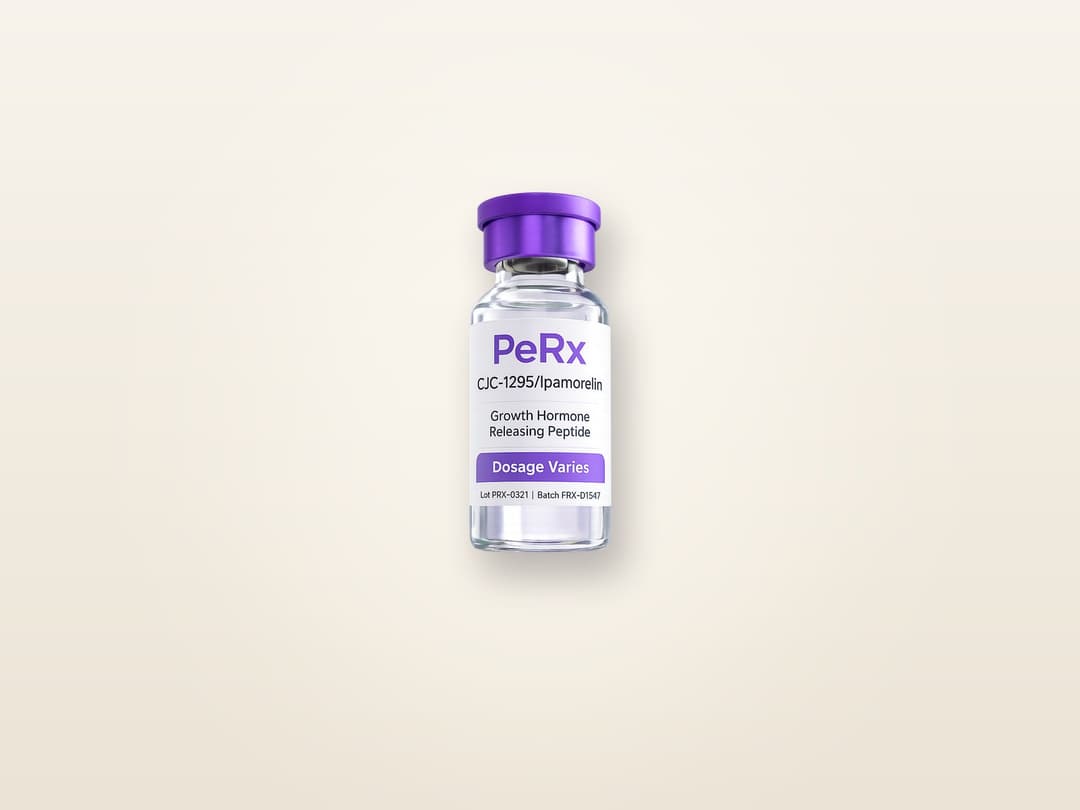
CJC-1295 and Ipamorelin act on two different receptors, so together they produce a bigger, cleaner growth-hormone pulse than either one alone. The detail most people miss: we use the no-DAC version of CJC-1295 on purpose. That choice is what keeps the release pulsatile and physiologic instead of a flat, all-day elevation. Here is the reasoning behind the pairing.
In this article
Key Takeaways
- CJC-1295 and Ipamorelin act on two different receptors (GHRH and ghrelin), so combined they produce a larger growth-hormone pulse than either peptide alone.
- CJC-1295 provides the GHRH signal that primes the pituitary; Ipamorelin triggers the actual release pulse. They are complementary, not redundant.
- We use the no-DAC version of CJC-1295 on purpose. Its ~30-minute half-life keeps release pulsatile and physiologic, unlike the long-acting DAC version that holds growth hormone elevated flatly for days.
- Pulsatile release matters: it mirrors the body’s natural overnight rhythm and reduces the chance of blunting the pituitary’s own signaling that flat, sustained elevation can cause.
- Ipamorelin is selective, triggering a growth-hormone pulse with minimal effect on cortisol, prolactin, or appetite, which is why it became the preferred partner for CJC-1295.
The Short Answer
The pairing in one paragraph
Growth hormone release depends on two signals working together: one that primes the pituitary and one that fires the pulse. CJC-1295 supplies the first, Ipamorelin supplies the second, and because they act on separate receptors the combined pulse is larger than either peptide produces alone. The part that gets overlooked is which CJC-1295 you use. We use the no-DAC version, because its short half-life keeps the release pulsatile and physiologic rather than flat and sustained. That single choice is what makes the pairing behave like your body’s own rhythm instead of overriding it.
Two Receptors, One Bigger Pulse
Your pituitary releases growth hormone in response to two upstream signals. Growth-hormone-releasing hormone (GHRH) tells the gland how much to get ready to release. A second class of signals, the ghrelin pathway, triggers the actual burst. These are genuinely separate switches, and the body uses both. When you get CJC-1295/Ipamorelin through PeRx, it is prescribed by a licensed provider and compounded in a US-based, FDA-regulated 503A pharmacy, the same regulated pathway many everyday prescriptions go through.
CJC-1295 is a GHRH analog. It binds the GHRH receptor and raises how much growth hormone the pituitary is primed to release. Ipamorelin is a selective agonist of the ghrelin receptor. It triggers the release pulse itself. Give one alone and you are working a single switch. Give both and you are priming the gland and firing it at the same time, which produces a noticeably larger pulse than either peptide on its own. This is the entire reason the two are combined rather than used separately.
Bowers CY et al., "Growth hormone (GH)-releasing peptide stimulates GH release in normal men and acts synergistically with GH-releasing hormone," Journal of Clinical Endocrinology & Metabolism, 1990. (Human evidence that combining a GHRP with GHRH produces a synergistic GH release.) View study
| CJC-1295 (no-DAC) | Ipamorelin | |
|---|---|---|
| Class | GHRH analog (Modified GRF 1-29) | Selective ghrelin-receptor agonist |
| Receptor | GHRH receptor | Ghrelin receptor (GHS-R) |
| Role in the pulse | Primes how much GH the pituitary is ready to release | Triggers the release pulse itself |
| Half-life | ~30 minutes (short, pulsatile) | Short, pulsatile |
Class
- CJC-1295 (no-DAC)
- GHRH analog (Modified GRF 1-29)
- Ipamorelin
- Selective ghrelin-receptor agonist
Receptor
- CJC-1295 (no-DAC)
- GHRH receptor
- Ipamorelin
- Ghrelin receptor (GHS-R)
Role in the pulse
- CJC-1295 (no-DAC)
- Primes how much GH the pituitary is ready to release
- Ipamorelin
- Triggers the release pulse itself
Half-life
- CJC-1295 (no-DAC)
- ~30 minutes (short, pulsatile)
- Ipamorelin
- Short, pulsatile
Why We Use the No-DAC Version
CJC-1295 comes in two forms that share a name but behave very differently. The version with a Drug Affinity Complex (DAC) binds to albumin in the blood and stretches its half-life to roughly 6 to 8 days, producing a flat elevation that lasts most of a week. The version without DAC, also called Modified GRF 1-29, has a half-life of about 30 minutes and is dosed daily. They are close to being different molecules.
We prescribe the no-DAC version, and the reason is physiology. Your body does not hold growth hormone at a constant level. It releases it in pulses, mostly during deep sleep, then lets it fall. A short-acting peptide amplifies one of those pulses and then clears, which is what the natural pattern looks like. The long-acting DAC version does the opposite: it holds growth hormone elevated flatly for days, which does not match normal physiology and is associated with a greater chance of blunting the pituitary’s own signaling over time.
Pulsatile is the point
When no-DAC CJC-1295 is paired with Ipamorelin, you get a larger pulse that still rises and falls the way a natural one does. That is the design goal: amplify the rhythm your body already has, rather than replace it with a constant signal. It is also why "CJC-1295/Ipamorelin" from a reputable provider is almost always the no-DAC version, even though the long-acting one shares the CJC-1295 name.
| CJC-1295 no-DAC (what we use) | CJC-1295 with DAC | |
|---|---|---|
| Also called | Modified GRF 1-29 | Long-acting CJC-1295 |
| Half-life | ~30 minutes | ~6 to 8 days |
| Dosing | Daily | About once weekly |
| Release pattern | Pulsatile, rises and falls | Flat, sustained for days |
| Paired with Ipamorelin | Yes, the standard combination | Rarely, the flat signal works against the pulse |
Also called
- CJC-1295 no-DAC (what we use)
- Modified GRF 1-29
- CJC-1295 with DAC
- Long-acting CJC-1295
Half-life
- CJC-1295 no-DAC (what we use)
- ~30 minutes
- CJC-1295 with DAC
- ~6 to 8 days
Dosing
- CJC-1295 no-DAC (what we use)
- Daily
- CJC-1295 with DAC
- About once weekly
Release pattern
- CJC-1295 no-DAC (what we use)
- Pulsatile, rises and falls
- CJC-1295 with DAC
- Flat, sustained for days
Paired with Ipamorelin
- CJC-1295 no-DAC (what we use)
- Yes, the standard combination
- CJC-1295 with DAC
- Rarely, the flat signal works against the pulse
Why Ipamorelin Specifically
There are several peptides that act on the ghrelin pathway. Ipamorelin earned its place as the standard partner because it is selective. Earlier growth-hormone-releasing peptides such as GHRP-6 worked, but they came with strong hunger and, in some cases, raised cortisol and prolactin. Those off-target effects are exactly what you do not want in a peptide meant to be taken consistently.
Ipamorelin triggers a clean growth-hormone pulse with minimal effect on cortisol, prolactin, or appetite. Pairing a selective trigger like Ipamorelin with a GHRH signal like no-DAC CJC-1295 gives you the amplified output without the noise. That combination of effectiveness and a quiet side-effect profile is why it became the most-used growth-hormone peptide pairing.
Raun K et al., "Ipamorelin, the first selective growth hormone secretagogue," European Journal of Endocrinology, 1998. (Characterizes ipamorelin's GH release without the cortisol and prolactin effects of earlier secretagogues.) View study
The contrast with the older options makes the point. GHRP-6 produces strong, sometimes overwhelming hunger. GHRP-2 is a potent releaser but can nudge cortisol and prolactin upward. Hexarelin is powerful but tends to desensitize the receptor with continued use. Ipamorelin was developed to keep the growth-hormone release and drop the rest, which is what makes it suitable for a peptide someone takes consistently rather than occasionally.
When and How It Is Taken
Two practical details follow directly from the physiology. The first is timing. Because the goal is to amplify your natural overnight growth-hormone surge, the combination is usually taken at night, before bed, so the pulse it triggers lines up with the one your body produces during deep sleep. A short-acting no-DAC peptide suits this well, since it does its work and clears rather than lingering into the day.
Why an empty stomach matters
Growth-hormone-releasing peptides like Ipamorelin work best on an empty stomach. Food, especially carbohydrate, raises insulin and blunts the growth-hormone pulse the peptide is trying to create. That is why many providers advise taking it fasted, away from meals, and night dosing before bed fits naturally. Your provider gives you the specific guidance for your protocol. The point is that the empty-stomach rule is not arbitrary. It follows from how the ghrelin pathway responds to blood sugar.
What to Realistically Expect
Honesty about the evidence matters here. The original CJC-1295 human research was done on the long-acting DAC version and showed it raised growth hormone and IGF-1. The no-DAC plus Ipamorelin combination that providers actually prescribe rests more on the underlying physiology and on clinical experience than on large head-to-head human trials. The mechanism is sound and well understood. The body of randomized human outcome data is thinner than the marketing usually implies.
In practice that means the reasonable expectation is gradual, not dramatic. Sleep quality is often the first thing people notice, which fits the overnight-pulse mechanism. Body-composition and recovery changes build over weeks to months. Anyone promising fast, guaranteed transformation is overselling what the evidence supports, and a good provider sets that expectation honestly. The results timeline gives a fuller picture of pacing.
Who This Pairing Fits
Ideal for
Adults addressing the age-related decline in growth hormone, with goals around body composition, recovery, and sleep quality. People who want their growth-hormone support to follow their natural overnight rhythm rather than run flat. Patients who prefer a physician-reviewed prescription over a research-chemical purchase.
Consider alternatives if
Anyone who is pregnant or breastfeeding, or who has an active or recent cancer, since the combination raises growth hormone and IGF-1. People who want the strongest visceral-fat-specific clinical evidence may discuss FDA-approved Tesamorelin with their provider instead. These are judgments your prescriber makes at intake.
The combination is a single vial given as a small subcutaneous injection, usually once daily and often at night to align with your natural growth-hormone release. PeRx ships it ready to use and refrigerated, so there is no mixing on your end. Your exact dose and schedule are set by your prescribing provider. For the full mechanism, dosing background, and timeline, see the complete CJC-1295/Ipamorelin guide, and if you are weighing peptides generally, the results timeline covers what to expect and when. Each order ships fully reconstituted and ready to use, delivered overnight in refrigerated packaging, with nothing to mix on your end.
Why We Pair CJC-1295 With Ipamorelin (No-DAC): Common Questions
Related Guides
Continue reading about peptides and protocols that pair well with this guide.
Is CJC-1295/Ipamorelin FDA Approved? (2026 Answer)
The short answer is no. CJC-1295 and Ipamorelin are not FDA-approved drugs. They are compounded medications, prescribed by licensed providers and prepared by regulated pharmacies. Here is what that actually means for you, how it compares to FDA-approved peptides, and why the distinction matters less than most people think.
CJC-1295 Peptide: What It Is, DAC vs No DAC
CJC-1295 is a lab-made version of the hormone that tells your pituitary to release growth hormone. The complication is that two different molecules are sold under that one name, one built to last a week and one built to clear quickly, and almost every published human result belongs to only one of them. This guide sorts out which is which, what the evidence covers, and why we had to pick a side.
Peptides for Gut Health: Evidence, Options and Limits
Two peptides carry almost all of the gut research: BPC-157, a fragment of a protein in human gastric juice, and KPV, a three-amino-acid piece of a melanocortin hormone. Most of what is known about either comes from rat and mouse models, not from trials in people. This guide lays out what those models measured, where the oral capsule fits, who a prescriber screens out, and what PeRx does and does not prescribe for the gut.
See if CJC-1295/Ipamorelin fits your goals
Take our 5-minute health assessment. A licensed provider reviews your intake, confirms the pairing is appropriate for you, and prescribes the no-DAC combination shipped ready to use. No labs required to start.
Medical Disclaimer
The information provided on this website, including all articles, guides, and educational content, is for informational and educational purposes only and is not intended as medical advice, diagnosis, or treatment. Nothing on this site should be construed as a substitute for professional medical advice from a qualified healthcare provider.
The majority of peptides discussed on this site are not approved by the U.S. Food and Drug Administration (FDA) for the indications described. They are classified as bulk drug substances and are available only through a licensed prescribing provider and compounding pharmacy. All treatments require a valid prescription and provider oversight.
The majority of published research on peptide therapies has been conducted in preclinical (animal) models. While early human data is encouraging, comprehensive clinical trial data remains limited for most peptide compounds. Individual results may vary significantly based on health status, injury type, and other factors. No specific outcomes are guaranteed.
Certain peptides discussed on this site are classified as prohibited substances by the World Anti-Doping Agency (WADA) and are banned by major sports organizations including the NFL, NCAA, UFC, NBA, MLB, NHL, and PGA. If you are subject to anti-doping testing, consult your governing body before considering any peptide therapy.
Statements on this website have not been evaluated by the Food and Drug Administration. Products and therapies discussed are not intended to diagnose, treat, cure, or prevent any disease.
© 2026 Wellness MD Group PC DBA PeRx. All rights reserved.