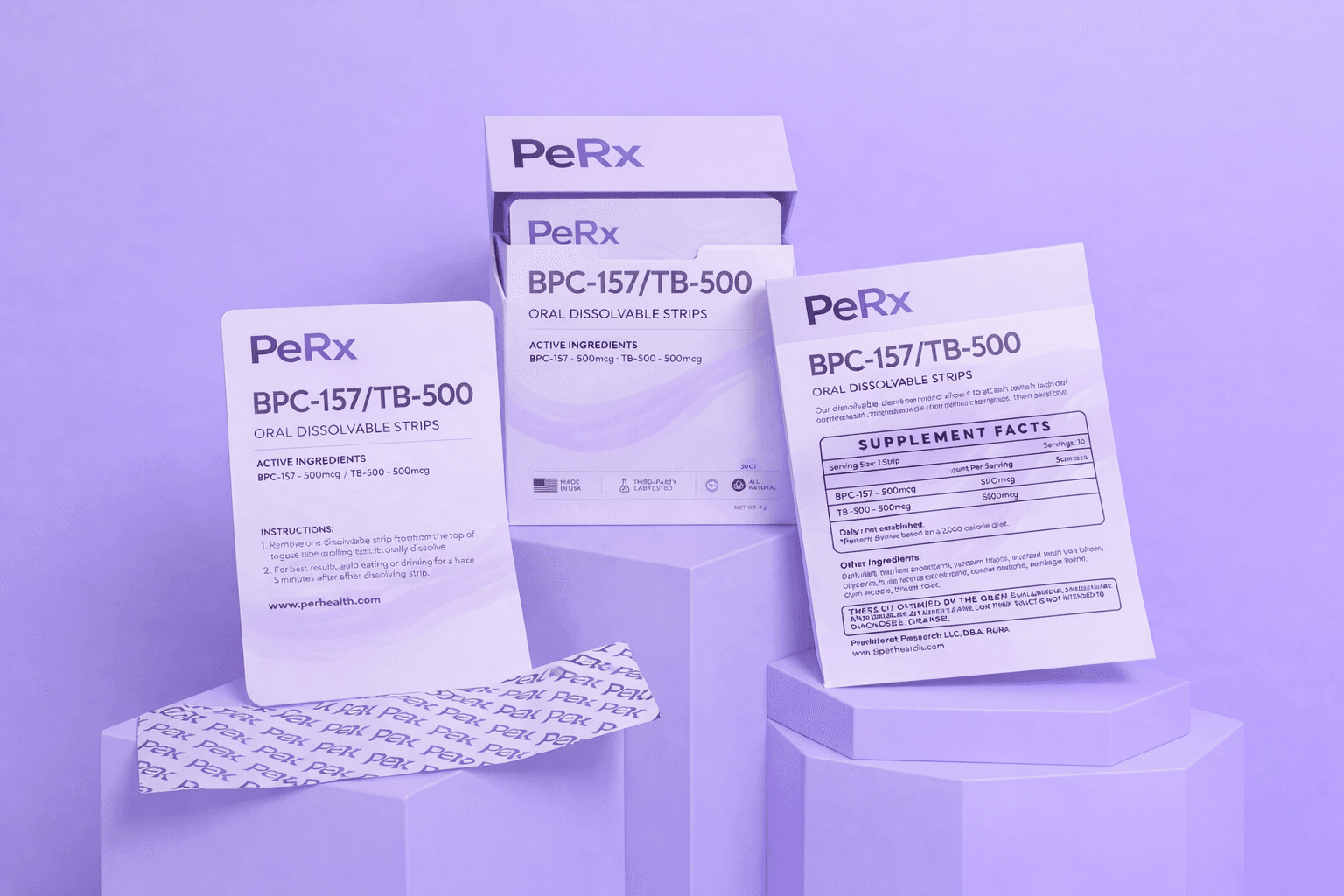
BPC-157 / TB-500
Dual-pathway resilience and recovery
A dual-peptide pairing of BPC-157 and TB-500 — two extensively researched peptides often studied together for their complementary roles in tissue integrity and recovery. BPC-157 is a gastric-derived peptide investigated for its relationship to localized tissue repair and inflammatory modulation. TB-500, a synthetic fragment of Thymosin Beta-4, has been explored in research settings for its potential influence on cellular migration and structural maintenance pathways. Delivered together in a single pre-measured oral strip.
Why the strip format
What a pre-measured dissolvable strip gives you that an injection or capsule doesn't.
Commonly explored in research involving tendon and ligament support
Referenced in studies focused on muscle repair and structural recovery
Frequently discussed in mobility and flexibility optimization routines
Studied for involvement in cellular migration and regeneration signaling
How you'll take it
One strip under the tongue, about a minute to dissolve. Here is what the dosing rhythm looks like day to day.
Both peptides absorb through the oral mucosa without passing through the gut. TB-500 has a longer half-life than BPC-157, so consistent daily dosing tends to matter more than a high single exposure.
Protocol
One pre-measured strip per day contains both peptides in a research-referenced ratio. No stacking, no two vials, no two-injection morning routine.
Timing
Morning dosing is typical. Some patients in active rehab cycles take a second strip in the post-training window, under provider guidance.
Onset
Both peptides begin uptake through the sublingual tissue within seconds of the strip contacting the mouth.
Sublingual strip vs subcutaneous injection
PeRx offers both formats for most peptides. Here is how they actually compare day to day.
Sublingual strip
- Format
- Thin pharmaceutical film
- Administration
- Place under tongue, let it dissolve
- Prep work
- None — open pouch and dose
- Needles
- None
- Storage
- Room temperature, no refrigeration
- Travel
- Pocket, wallet, carry-on — TSA friendly
- Onset
- Begins on contact with the oral mucosa
- Best fit for
- Daily routines, travel, needle-averse patients, beginners
Subcutaneous injection
- Format
- Reconstituted vial + insulin syringe
- Administration
- Draw, rotate site, inject subcutaneously
- Prep work
- Prep needle, wipe vial and injection area with an alcohol swab
- Needles
- Yes — insulin-gauge insulin syringes
- Storage
- Refrigerated after reconstitution
- Travel
- Cold pack + sharps disposal + TSA documentation
- Onset
- Systemic uptake once absorbed subcutaneously
- Best fit for
- Established protocols, higher research-referenced bioavailability
Neither format is strictly better — they are tradeoffs. Your provider will help you pick based on your goals, your comfort with needles, and how the protocol fits into the rest of your routine.
Supplement facts
What's on the label. One strip = one serving.
Supplement Facts
† Daily value not established.
*Percent daily value based on a 2,000 calorie diet.
Who explores sublingual BPC-157 / TB-500
Every sublingual protocol is reviewed by a provider before approval. This section is a general research-framing reference, not medical advice.
Commonly explored by
- Athletes in active rehab cycles for tendons, ligaments, or connective tissue
- Patients running structured four- to eight-week recovery protocols
- High-training-load individuals prioritizing structural resilience
- Patients who prefer one strip over stacking two separate injectable peptides
Consult a provider first
- Pregnant or nursing patients
- Patients with an active cancer diagnosis or history of cancer
- Anyone on immunosuppressive or anticoagulant therapy
- Anyone new to peptides without a baseline provider consult
Common questions
Why combine BPC-157 with TB-500?
The two peptides are frequently studied together because they are associated with overlapping but distinct repair pathways. BPC-157 is referenced in acute tissue protection research; TB-500 is more often discussed in the context of longer-timeline structural remodeling. Stacking them into a single strip removes the two-step ritual of dosing two separate products.
Is this appropriate if I am new to peptides?
Many first-time patients start with single-molecule BPC-157 before moving to the combination. Your provider will recommend a starting point based on your intake — there is no expectation that you pick the right product on your own.
How long is a typical course?
Recovery protocols are usually run in four- to eight-week cycles, reassessed at a provider check-in. Running indefinitely is not the default — peptides are a targeted tool, not a daily vitamin.
How is this different from running BPC-157 solo?
BPC-157 alone is studied for acute tissue protection and inflammatory modulation. Adding TB-500 brings in research around longer-timeline structural remodeling — fascia, ligament, and cellular migration. The stack is a single-strip convenience over running two protocols in parallel, and a wider research-framed coverage of the repair timeline.
When during the day should I dose it?
Morning is the standard baseline. Patients in heavy rehab cycles occasionally take a second strip in the post-training window under provider guidance, but it is not a two-dose-a-day protocol by default. Consistency tends to matter more than chasing a specific time.
Can I stack this with NAD+ or GHK-Cu?
Yes. The three target different pathways and are commonly layered in recovery-focused stacks — BPC/TB for structural repair, NAD+ for cellular energy, GHK-Cu for collagen signaling. Sequence them with your provider so they do not compete for the sublingual absorption window.
Are there side effects I should know about?
Reported tolerability for both peptides is generally favorable across the research, but side-effect reporting for sublingual delivery specifically is limited because the strip format is still new. Report anything unusual to your provider at check-in so the protocol can be adjusted early.
Explore more about BPC-157 / TB-500
Dig deeper into the injectable version, research-backed use cases, and complete clinical guide.
Injectable BPC-157 / TB-500
Our provider-prescribed subcutaneous protocol — the injectable format BPC-157 / TB-500 was originally studied in.
BPC-157 / TB-500 research & clinical guide
Long-form breakdown of the published research, dosing protocols, and what providers actually look for.
Research references
A short reading list of peer-reviewed studies and reviews on BPC-157 / TB-500. All links resolve to the primary source on PubMed.
- 1Stable Gastric Pentadecapeptide BPC 157 and Wound HealingSeiwerth et al. · Frontiers in Pharmacology · 2021 · PMID 34267654
- 2Gastric pentadecapeptide BPC 157 and its role in accelerating musculoskeletal soft tissue healingGwyer et al. · Cell and Tissue Research · 2019 · PMID 30915550
- 3Thymosin beta4 Promotes Dermal HealingKleinman et al. · Vitamins and Hormones · 2016 · PMID 27450738
- 4beta-ThymosinsHannappel E · Annals of the New York Academy of Sciences · 2007 · PMID 17468232
Links open PubMed in a new tab. Citation of a study is not an endorsement of off-label use. Always consult a licensed provider before starting any peptide protocol.
Be first in line when sublingual BPC-157 / TB-500 launches.
We'll email you the day it goes live. No spam, unsubscribe anytime.
Sublingual peptides are not yet available for purchase. PeRx does not ship this product today.