Peptides for Stunt Performers: Recovery Guide
How BPC-157, the BPC/TB-500 combo, GHK-Cu, and NAD+ map onto the wear pattern stunt work leaves behind: the hip and back from high-falls, the shoulder from ratchet pulls, the skin from fire-gags and friction, and the metabolic load of long shoot days.
In this article
Key Takeaways
- Stunt performers carry a wear pattern that maps onto specific body regions: the hip and back from repeated high-falls, the shoulder from ratchet pulls and harness drag, the skin from fire-gags and friction, and the metabolic load of 14-hour shoot days.
- Different peptides target different regions: BPC-157 for chronic hip, back, and shoulder load; BPC/TB-500 combo for deeper connective tissue (partial SLAP, labrum, patellar tendinopathy); GHK-Cu injectable for skin barrier and burn recovery; NAD+ for the metabolic side.
- None of these peptides appear on standard SAG-AFTRA production physicals or pre-employment drug panels. They are prescription medications, disclosed like any other Rx.
- Peptide therapy is not a substitute for PRP, stem cell therapy, or surgery. It is continuous low-dose signaling that supports the cumulative wear pattern. The targeted interventions still exist for acute injuries.
Take Seven
The scene
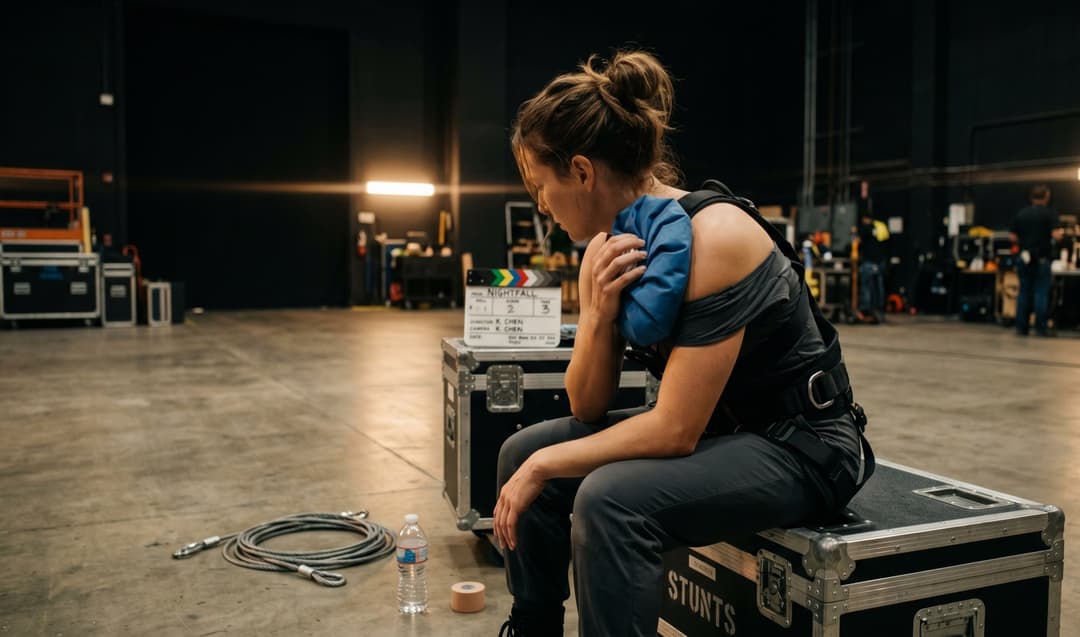
The airbag settled three inches around take four. Your hip flexor started screaming on take six. The AD just called for one more before lunch and the stunt coordinator wants the timing tighter this time. You will get the take. You always get the take. What you will not get is twelve more years like this if you keep absorbing the cumulative load the way you did at 28.
Every working stunt performer past 35 has the conversation in their head. The high-fall pad is not infinite. The ratchet-pull harness leaves a different mark on your shoulder every time. The fire-gag burn cream is a stopgap, not a recovery plan. The chair fight choreography that looked great in rehearsal puts your wrist in a position your wrist does not like. When you get a peptide through PeRx, it is prescribed by a licensed provider and compounded in a US-based, FDA-regulated 503A pharmacy, the same regulated pathway many everyday prescriptions go through.
The stunt performer is just the extreme case of skin that has to heal fast and clean. The same need applies to anyone recovering from a burn, a scrape, road rash from a bike or a board, a friction abrasion, or a surgical scar that you would rather not watch settle into a thick line. Skin is the largest organ and the slowest to forgive. Whether the damage came off a 30-foot fall or off the pavement on a Saturday ride, the repair biology underneath is the same, and the two peptides that map onto it most directly are GHK-Cu and BPC-157. The rest of this guide uses the stunt performer as the vivid worst case, then pulls the same protocol out to the everyday version.
Why Standard Recovery Does Not Scale
The standard stunt-performer recovery toolkit is built for acute injury. Ice for a flare. The chiro on Burbank Boulevard for an alignment. A Voltaren prescription for the bad days. PRP if something gets flagged on MRI. All of those tools work for what they are designed for. None of them touch the cumulative load.
Cumulative load is the problem of repeated submaximal damage across years. The hip that took ten reps of a high-fall last Tuesday and another six the Tuesday after. The rotator cuff that has absorbed three seasons of fight choreography. The skin that has been exposed to fire-gags, friction, and Arizona summer sun every shoot day for a decade. Acute tools cannot reach that pattern because there is no single acute injury to treat.
Peptide therapy operates on the cumulative side. The molecules work on continuous low-dose signaling: VEGF for new blood vessel growth into damaged tissue, fibroblast modulation for collagen deposition, mitochondrial coenzyme support for cellular energy. None of that fixes an acute tear. All of it shifts how fast the body recovers from the steady wear that defines this job. The rest of this guide walks through the wear region by region.
The Hip and Back
High-fall load goes through the SI joint and the L4-L5 disc. Body-locked takedown drills and stair-gag landings put the same forces through a smaller surface area. The downstream symptoms are familiar: hip flexor tightness, glute medius weakness on the impact side, the lumbar flare that hits on day three of a fall-heavy block.
The damage is in the connective tissue and the disc. Foam rolling and ice address the muscle-pattern symptoms, not the structural source. BPC-157 is the peptide that maps onto this layer. Researchers at the University of Zagreb have published a large body of preclinical work on BPC-157 over the last few decades, much of it on soft-tissue healing. The mechanism (VEGF upregulation, fibroblast modulation, nitric oxide pathway support) targets exactly what a repeatedly impacted disc and an inflamed SI joint actually need.
Hsieh MJ et al., "Therapeutic potential of pro-angiogenic BPC157 is associated with VEGFR2 activation and up-regulation," Journal of Molecular Medicine, 2017. View study
Realistic timeline: 2-4 weeks of daily BPC-157 before chronic flare patterns shorten. 6-8 weeks before the cumulative pattern shifts in a noticeable way. BPC-157 will not undo a herniation. What it does is take the edge off the cumulative wear enough that the next fall-heavy block does not feel like the last one.
The Shoulder
Ratchet pull is the classic. Harness drag stunts cause the same load. The forces go through the rotator cuff, the AC joint, and the long head of the biceps. Chronic shoulder impingement is a frequent complaint among performers who do harness and ratchet work, and it tends to show up in the late 30s and 40s. SLAP tears and labrum damage are the surgical endpoint when the cumulative load wins.
For deeper connective tissue work, performers typically reach for the BPC-157/TB-500 combo, which ships as a pre-mixed blend in a single vial. BPC-157 sends the repair signals; TB-500 (Thymosin Beta-4) mobilizes cells to the site of injury and supports the actin cytoskeleton dynamics that connective tissue uses to remodel. The combo is what gets used when there is a flagged partial SLAP, a labrum on MRI, or chronic patellar tendinopathy that has been sticking around.
Important boundary: this is not a substitute for surgery when surgery is indicated. A fully torn labrum is a surgical conversation. The combo accelerates the rehab arc when it is the right call to avoid the OR, or supports the post-op rehab when surgery has already happened. The combo is also available as an oral capsule, which is convenient for shoot days when on-location cooler logistics are a hassle.
The Skin
Fire-gags use Nomex underneath and protective gel, but the heat still reaches the skin. Friction from wire harnesses, drag stunts, and stair gags abrades skin daily. Outdoor shoots in Arizona summer or Vancouver winter add UV and cold damage. Barrier integrity is the difference between ready Monday and visible scarring on camera.
GHK-Cu (Glycyl-L-Histidyl-L-Lysine Copper Complex) is the peptide that targets this layer. It has been in topical skincare for decades; the injectable form is the deeper version for serious skin work. Research from Loren Pickart, who first isolated the molecule, describes GHK-Cu as a tissue-remodeling signal that influences a wide range of genes tied to skin repair, collagen synthesis, and barrier function (Pickart L, "The Human Tri-Peptide GHK and Tissue Remodeling," Journal of Biomaterials Science, 2008). The dermatology literature on copper peptides for wound and scar repair is well-developed.
Pickart L, "The human tri-peptide GHK and tissue remodeling," Journal of Biomaterials Science, Polymer Edition, 2008. View study
For stunt performers, the practical use cases are fire-gag minor burns, friction abrasion from harness work, sun and wind damage on long location shoots, and post-procedure skin recovery (cosmetic work is common in this industry). The everyday versions are the same biology: a healing minor burn, road rash from a cycling or skateboarding spill, a scrape that you want to close clean, and a surgical scar in the weeks after the stitches come out. A common cadence is GHK-Cu daily during the active healing window, tapering to 3x weekly once the skin has closed and you are working on the scar itself.
The Metabolic Load
The metabolic side is what wears down the body's ability to recover from the physical side. 14-hour days. Craft service. Location adrenaline cycles. Sleep on a trailer cot. Cortisol stays elevated for weeks at a stretch. Week three of a production feels different from week one because the metabolic baseline has shifted, not because the physical demand changed.
NAD+ is the coenzyme every cell uses to convert food into ATP. Tissue levels drop with age and with chronic stress load. Injectable NAD+ bypasses the GI conversion limits that cap how much oral NMN and NR can actually raise tissue NAD+. The mechanism is supporting the NAD+/NADH ratio that drives cellular energy production and DNA repair.
Covarrubias AJ et al., "NAD+ metabolism and its roles in cellular processes during ageing," Nature Reviews Molecular Cell Biology, 2021. View study
Practical use: 2-3x weekly during production, with a higher dose at the start of a long shoot stretch. Anecdotally, NAD+ is the compound performers report most often as feeling a difference from. It is a coenzyme rather than a peptide, though it sits alongside peptide protocols. The 4 p.m. fade on a long shoot day becomes manageable. Recovery between shoot days starts to keep up with the demand.
What This Is Not
Peptide therapy gets confused with several other things that look adjacent. Four important distinctions:
Not PRP or stem cell therapy. PRP and stem cells deliver concentrated repair signals to a single injury site in one shot, often guided by ultrasound. Peptides are continuous low-dose signaling across the body. Many performers run both: peptides for daily cumulative load, PRP for a specific injury that needs targeted intervention. They complement; they do not substitute.
Not anabolic steroids. These molecules do not increase testosterone, do not grow muscle, do not change physique. BPC-157, TB-500, GHK-Cu, and NAD+ are repair-signaling molecules. The category they sit in is closer to a dermatologist's tretinoin or a sports doctor's compounded NSAID cream than to anything from the steroid family.
Not a substitute for surgery. A fully torn labrum, a complete ACL tear, a flagged tendon rupture: these are surgical conversations. The BPC/TB-500 combo accelerates rehab. It does not reattach tissue. If imaging flags something that needs the OR, the OR is the right answer; peptides go in afterward to support recovery.
Not a painkiller. BPC-157 will not mask pain so you can push through a take that your body is telling you to skip. Do not dose it that way. The repair signaling works on weeks-to-months timescales, not on the take-seven timeline. Every batch is third-party tested for purity, and each order ships fully reconstituted and ready to use, delivered overnight in refrigerated packaging.
Questions From Working Stunt People
Related Guides
Continue reading about peptides and protocols that pair well with this guide.
Nausea & Gut Issues on GLP-1s: What Helps
GI side effects are the single biggest reason patients stop Ozempic, Wegovy, and Mounjaro. Here is why GLP-1 receptor activation hits the gut so hard, which simple changes resolve most cases, and which peptide helps when the basics have not been enough.
Peptide Therapy Palo Alto: 2026 Silicon Valley Guide
A plain guide to peptide therapy on the Peninsula: who runs it here, how a longevity stack fits together, what it costs across concierge clinics and telehealth, and how pharmaceutical-grade peptides reach any Palo Alto or Silicon Valley address without a clinic visit.
How We Approach Sleep Peptides
Sleep medications sedate you into unconsciousness. Sleep peptides do something different: they restore the architecture of sleep itself. DSIP deepens slow-wave sleep, Selank quiets the stress response that keeps you awake, and the growth-hormone peptides amplify the overnight pulse that makes sleep restorative. The trick is matching the peptide to the way your sleep is actually failing, not to "sleep" as a generic goal. Here is how a provider makes that call, and where peptides genuinely help versus where they are oversold.
Learn more about peptide therapy
Peptide therapy in the US is prescription-only and requires evaluation by a licensed provider. Browse the individual peptides to read about what each one does.
Medical Disclaimer
The information provided on this website, including all articles, guides, and educational content, is for informational and educational purposes only and is not intended as medical advice, diagnosis, or treatment. Nothing on this site should be construed as a substitute for professional medical advice from a qualified healthcare provider.
The majority of peptides discussed on this site are not approved by the U.S. Food and Drug Administration (FDA) for the indications described. They are classified as bulk drug substances and are available only through a licensed prescribing provider and compounding pharmacy. All treatments require a valid prescription and provider oversight.
The majority of published research on peptide therapies has been conducted in preclinical (animal) models. While early human data is encouraging, comprehensive clinical trial data remains limited for most peptide compounds. Individual results may vary significantly based on health status, injury type, and other factors. No specific outcomes are guaranteed.
Certain peptides discussed on this site are classified as prohibited substances by the World Anti-Doping Agency (WADA) and are banned by major sports organizations including the NFL, NCAA, UFC, NBA, MLB, NHL, and PGA. If you are subject to anti-doping testing, consult your governing body before considering any peptide therapy.
Statements on this website have not been evaluated by the Food and Drug Administration. Products and therapies discussed are not intended to diagnose, treat, cure, or prevent any disease.
© 2026 Wellness MD Group PC DBA PeRx. All rights reserved.