Why We Pair BPC-157 With TB-500
BPC-157 and TB-500 are both repair peptides, but they cover different ground. BPC-157 works fast and focal, strongest at a specific injury and in the gut. TB-500 works broad and systemic, moving repair cells across the whole body. The pairing is not automatic. Here is how a provider decides whether you need both, or whether BPC-157 on its own does the job.
In this article
Key Takeaways
- BPC-157 works fast and focal, strongest at a specific injury site and in the gut. TB-500 works broad and systemic, moving repair cells across the whole body. They cover different ground.
- The pairing is not automatic. A focal, recent injury is often handled by BPC-157 alone; TB-500 earns its place when the problem is systemic, widespread, chronic, or spread across multiple sites.
- BPC-157 is the stronger single choice for gut and digestive issues, where it has the most direct effect.
- TB-500 regulates actin and promotes cell migration, which is what gives it body-wide reach. Combined with BPC-157, you cover focal repair and systemic reach at once.
- Most evidence for both peptides is preclinical (animal and lab), and neither is FDA-approved. An honest provider says so, which is part of why this is a supervised, prescribed therapy.
The Short Answer
The pairing in one paragraph
BPC-157 and TB-500 are both repair peptides, but they are not interchangeable and they are not always used together. BPC-157 works fast and focal. TB-500 works broad and systemic. A provider reaches for BPC-157 alone when the problem is a single, recent, well-defined injury or a gut issue. The provider adds TB-500 when the problem is spread out, long-standing, or systemic, because TB-500’s strength is moving repair cells across the whole body. The combination covers both at once. This guide is about that decision, not just the synergy.
Two Different Jobs: Local vs Systemic
The reason these two peptides pair well is the same reason they are not redundant: they operate at different scales. Thinking of them as local versus systemic is the most useful way to understand when each one matters. When you get BPC/TB-500 through PeRx, it is prescribed by a licensed provider and compounded in a US-based, FDA-regulated 503A pharmacy, the same regulated pathway many everyday prescriptions go through.
BPC-157, a stable peptide originally identified in gastric tissue, acts strongest right where it is needed. It supports the growth of new blood vessels and the local signaling that drives healing in tendon, ligament, muscle, and especially the gut. Its effects show up quickly and concentrate at the injury. TB-500, a synthetic version of the active region of Thymosin Beta-4, works differently. It regulates actin, the protein scaffolding inside cells, which lets repair cells migrate to where they are needed. That gives it a broad, body-wide reach rather than a single focal point.
Cerovecki T et al., "Pentadecapeptide BPC 157 (PL 14736) improves ligament healing in the rat," Journal of Orthopaedic Research, 2010. (Preclinical rodent model of focal connective-tissue repair.) View study
Goldstein AL et al., "Thymosin beta4: actin-sequestering protein moonlights to repair injured tissues," Trends in Molecular Medicine, 2005. (Mechanistic review of Thymosin Beta-4, the parent molecule of the TB-500 region, in cell migration and tissue repair.) View study
| BPC-157 | TB-500 | |
|---|---|---|
| Reach | Focal, acts strongest at the injury site | Systemic, body-wide distribution |
| Speed | Fast, effects concentrate quickly | Slower, broader, builds over time |
| Signature strength | Gut and digestive repair; focal tendon and ligament injury | Cell migration and recovery across multiple or widespread sites |
| Best when | The problem is one recent, well-defined spot | The problem is spread out, chronic, or systemic |
Reach
- BPC-157
- Focal, acts strongest at the injury site
- TB-500
- Systemic, body-wide distribution
Speed
- BPC-157
- Fast, effects concentrate quickly
- TB-500
- Slower, broader, builds over time
Signature strength
- BPC-157
- Gut and digestive repair; focal tendon and ligament injury
- TB-500
- Cell migration and recovery across multiple or widespread sites
Best when
- BPC-157
- The problem is one recent, well-defined spot
- TB-500
- The problem is spread out, chronic, or systemic
When BPC-157 Alone Is Enough
It is worth saying plainly, because the marketing rarely does: a lot of cases do not need the combination. When the problem is a single, recent, well-localized injury, BPC-157 on its own often covers it. A specific tendon or ligament strain is the classic example. Adding a systemic peptide to a focal problem does not always add enough to justify it.
BPC-157 is also the stronger single choice for gut and digestive issues. That is where it has the most direct effect, and TB-500 does not bring the same advantage there. So if the goal is focal repair or gut support, a provider may well prescribe BPC-157 by itself. Choosing one peptide when one peptide is enough is part of good prescribing, not a downgrade. For the head-to-head detail, see BPC-157 vs TB-500.
When We Add TB-500
TB-500 earns its place when the situation is bigger than one spot. The clearest cases are multiple injury sites at once, an older or chronic injury that has stalled, widespread stiffness, or a goal centered on general recovery and flexibility rather than a single area. In those situations, BPC-157’s focal strength leaves gaps that TB-500’s systemic reach fills.
The combination covers both axes
Paired together, BPC-157 drives the local repair signaling and new blood-vessel growth at the injury, while TB-500 helps repair cells migrate to where they are needed throughout the body. You get focal intensity and systemic reach in one protocol. That dual coverage is why BPC-157/TB-500 became the most widely used combination in injury recovery, and it is also why it is worth being deliberate about when the second peptide is actually needed.
Injury by Injury: One Peptide or Two
The local-versus-systemic logic gets concrete when you map it onto real situations. None of this is a prescription, and your provider makes the actual call, but it shows how the decision tends to break down.
| Situation | Typical starting point | Why |
|---|---|---|
| Single recent tendon or ligament strain | BPC-157 alone | Focal and acute, where BPC-157 is strongest |
| Gut or digestive issues | BPC-157 alone | BPC-157 has the most direct effect in the gut |
| Older or stalled injury | BPC-157 + TB-500 | Systemic reach helps where focal repair has plateaued |
| Multiple injuries at once | BPC-157 + TB-500 | TB-500 acts body-wide rather than at one spot |
| General recovery and flexibility | BPC-157 + TB-500 | The goal is systemic, not a single site |
Single recent tendon or ligament strain
- Typical starting point
- BPC-157 alone
- Why
- Focal and acute, where BPC-157 is strongest
Gut or digestive issues
- Typical starting point
- BPC-157 alone
- Why
- BPC-157 has the most direct effect in the gut
Older or stalled injury
- Typical starting point
- BPC-157 + TB-500
- Why
- Systemic reach helps where focal repair has plateaued
Multiple injuries at once
- Typical starting point
- BPC-157 + TB-500
- Why
- TB-500 acts body-wide rather than at one spot
General recovery and flexibility
- Typical starting point
- BPC-157 + TB-500
- Why
- The goal is systemic, not a single site
Does BPC-157 Have to Be Injected Near the Injury?
This question comes up constantly, and the honest answer is that it matters less than the forums suggest. Many practitioners inject BPC-157 subcutaneously near a focal injury on the theory that a higher local concentration helps, and for a specific tendon or joint that is a reasonable approach. But BPC-157 also acts systemically once absorbed, so a standard injection site still delivers benefit. TB-500 is systemic by design, so where you inject it makes little practical difference. Your provider will advise what makes sense for your case.
The two peptides also move on different timelines, which is worth setting expectations around. BPC-157 tends to act relatively quickly, and some people notice changes within the first couple of weeks. TB-500 works more slowly and broadly, building over several weeks as it supports cell migration across tissues. In a combined protocol, the focal fast response and the systemic slower response run at the same time. The results timeline covers pacing in more detail.
An Honest Word on the Evidence
A responsible version of this article has to be straight about the research. Most of the data on both peptides is preclinical, meaning it comes from animal and laboratory studies rather than large human trials. The animal evidence for BPC-157 in tendon, ligament, muscle, and gut healing is substantial, and TB-500’s role in cell migration and tissue repair is well described. But neither peptide is FDA-approved, and the human evidence is still limited.
That is not a reason to dismiss them, and it is not a reason to treat them as proven either. It is a reason to use them under supervision. A prescribing provider weighs the evidence against your situation, screens for the reasons not to use them, and makes the call. Any source that presents these peptides as guaranteed or miraculous is overselling what the science currently supports.
Who This Pairing Fits
Ideal for
People recovering from injuries that are widespread, chronic, or spread across multiple sites, where systemic reach matters. Anyone whose goal is general recovery and flexibility rather than one specific spot. Patients who want a physician-reviewed prescription rather than a research-chemical purchase, and who understand the evidence is largely preclinical.
Consider alternatives if
If your issue is a single, recent, focal injury or a gut problem, BPC-157 alone may be the better and simpler choice. Avoid both peptides during pregnancy and breastfeeding, and discuss carefully with a provider if you have an active or recent cancer, since both promote new blood-vessel growth. Your prescriber makes these calls at intake.
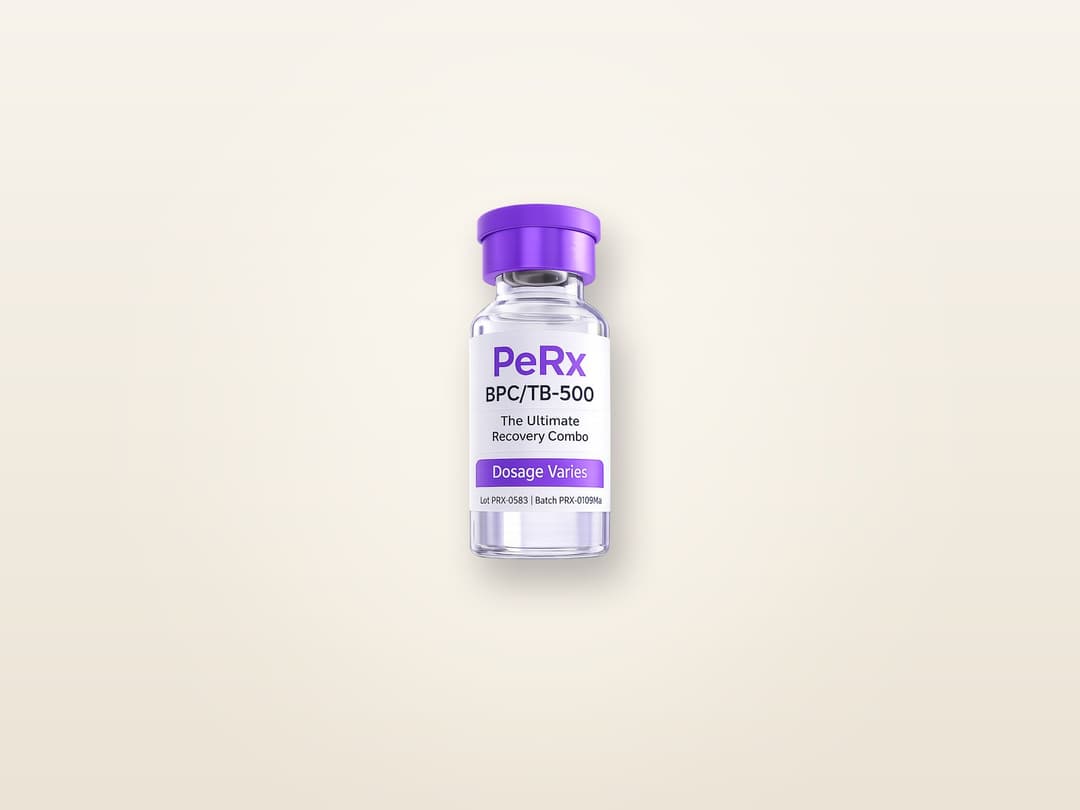
PeRx ships BPC-157/TB-500 as a single combination vial, ready to use and refrigerated, given as a small subcutaneous injection with no mixing on your end. A capsule format exists for the BPC-157 component as well. Your dose and schedule are set by your prescribing provider. For the full synergy science, dosing background, and timeline, see the complete BPC-157/TB-500 combo guide, and the results timeline for what to expect and when. Each order ships fully reconstituted and ready to use, delivered overnight in refrigerated packaging, with nothing to mix on your end.
Why We Pair BPC-157 With TB-500: Common Questions
Related Guides
Continue reading about peptides and protocols that pair well with this guide.
BPC-157/TB-500 Dosage Chart: Units, mg, Cycle
The prescribed BPC-157/TB-500 blend has one concentration and one dose, and every number on this page follows from those two facts. Draw 20 units and you get 0.6 mg of each peptide. Here is the full arithmetic: the dosage chart, units on an insulin syringe, per-day and per-week totals, how the capsules dose differently, and what a month actually costs.
Where to Inject TB-500: Sites and Rotation
TB-500 is a subcutaneous injection. One detail catches most people off guard: PeRx does not dispense TB-500 on its own. It comes pre-mixed with BPC-157 in a single ready-to-use vial, so "where to inject TB-500" is really "where to inject the BPC-157/TB-500 combo." The four standard subQ sites all work, and because this is a tissue-repair combination, there is a practical case for injecting near the injury when it makes sense. Here is the guide patients ask for after their first vial arrives.
Peptide Therapy in Fishers and the Geist District
A plain guide to peptide therapy in Fishers: what it costs across local clinics, med spas, and telehealth, and who tends to use it here. Plus how pharmaceutical-grade peptides reach any Hamilton County address without a clinic visit.
Find out if you need one peptide or both
Take our 5-minute health assessment. A licensed provider reviews your injury, history, and goals, then prescribes BPC-157 alone or the BPC-157/TB-500 combination, whichever actually fits. Shipped ready to use. No labs required to start.
Medical Disclaimer
The information provided on this website, including all articles, guides, and educational content, is for informational and educational purposes only and is not intended as medical advice, diagnosis, or treatment. Nothing on this site should be construed as a substitute for professional medical advice from a qualified healthcare provider.
The majority of peptides discussed on this site are not approved by the U.S. Food and Drug Administration (FDA) for the indications described. They are classified as bulk drug substances and are available only through a licensed prescribing provider and compounding pharmacy. All treatments require a valid prescription and provider oversight.
The majority of published research on peptide therapies has been conducted in preclinical (animal) models. While early human data is encouraging, comprehensive clinical trial data remains limited for most peptide compounds. Individual results may vary significantly based on health status, injury type, and other factors. No specific outcomes are guaranteed.
Certain peptides discussed on this site are classified as prohibited substances by the World Anti-Doping Agency (WADA) and are banned by major sports organizations including the NFL, NCAA, UFC, NBA, MLB, NHL, and PGA. If you are subject to anti-doping testing, consult your governing body before considering any peptide therapy.
Statements on this website have not been evaluated by the Food and Drug Administration. Products and therapies discussed are not intended to diagnose, treat, cure, or prevent any disease.
© 2026 Wellness MD Group PC DBA PeRx. All rights reserved.