Peptide Therapy Guide
Best Peptides for Sexual Health (2026)
Updated June 12, 2026
Sexual health runs on three systems at once: neurological signaling, hormonal balance, and vascular function. These peptides work through different mechanisms to support desire and physical response, with PT-141 carrying the most direct evidence.
Sexual desire and function depend on three systems working together. Neurological signaling matters because arousal begins in the brain, not the body. Hormonal balance matters because testosterone, estrogen, and growth hormone all play a role. Vascular health matters because physical response is ultimately a blood-flow event. When any one of these declines, whether from age, chronic stress, medications like SSRIs, or conditions like diabetes, sexual function suffers. Figuring out which system is the actual bottleneck is the whole game, because the fix is different for each.
This is where most treatments fall short. PDE5 inhibitors like Viagra and Cialis improve blood flow, but they do nothing for desire. If you have no interest in sex, a better erection does not solve the problem. Testosterone replacement addresses one hormone but carries its own risks and monitoring burden. The peptide most relevant here, PT-141 (bremelanotide), works on a different layer: it acts on melanocortin receptors in the brain to raise desire itself. It is one of the few options that targets wanting sex rather than the mechanics of having it.
PT-141 is unusual in that it has real human data in both sexes. It is FDA-approved as Vyleesi for premenopausal women with hypoactive sexual desire disorder, based on the RECONNECT phase 3 trials (Kingsberg et al., Obstetrics & Gynecology, 2019), which showed modest but statistically significant gains in desire and reductions in distress. In men, it has been studied for erectile difficulty that does not respond to PDE5 inhibitors, often as an add-on rather than a replacement. The honest read is that the effect sizes are meaningful for some people and underwhelming for others. It is not a guaranteed switch.
Timing also sets PT-141 apart from most peptides. It is taken on demand, injected roughly 45 minutes before intimacy, not dosed every day. That changes what to expect: you are looking for an effect within a window, not a slow build over weeks. It is also not the right tool for everyone. If the root cause is low testosterone, a medication side effect, relationship stress, or untreated sleep loss, addressing that directly will do more than any peptide. Growth hormone peptides like CJC-1295/Ipamorelin and tissue-supporting peptides like BPC-157 play only supporting roles here. A prescribing provider can match the approach to the specific problem rather than treating low libido as one generic complaint.
43%
of women report sexual dysfunction at some point (Laumann et al.)
52%
of men aged 40-70 report some degree of erectile difficulty
FDA-approved
PT-141 (Vyleesi) for premenopausal HSDD in women
~45 min
before intimacy is when PT-141 is dosed, not daily
How Peptides Help With Sexual Health
Melanocortin Receptor Activation
PT-141 (bremelanotide) activates melanocortin receptors, mainly MC4R, in the hypothalamus, the part of the brain that initiates sexual arousal. This is a different target from PDE5 inhibitors like Viagra, which only affect genital blood flow. Because PT-141 works upstream in the central nervous system, it can raise desire in both men and women, not just improve a physical response that depends on desire already being present.
Desire and Erection Are Two Different Problems
A common mistake is treating low libido and erectile difficulty as the same issue. They are not. Erectile difficulty is usually a vascular or blood-flow problem, which is what PDE5 inhibitors address. Low desire is a brain and hormone problem, which is where PT-141 fits. Some people have one, some have both. Getting that distinction right determines whether a peptide, a PDE5 inhibitor, hormone work, or a combination is the sensible place to start.
Hormonal and Sleep Support
Growth hormone peptides like CJC-1295/Ipamorelin do not act on sexual pathways directly. They help indirectly by improving sleep depth, energy, mood, and body composition, all of which influence libido and healthy hormone cycling. Poor sleep alone suppresses testosterone, so the overnight GH pulse these peptides amplify is part of the foundation desire sits on. This is a supporting role, not a primary libido treatment.
Vascular and Tissue Support
BPC-157 promotes angiogenesis, the formation of new blood vessels, and supports healthy circulation. Since physical sexual response is a vascular event, the general circulatory and tissue-repair benefits of BPC-157 can be supportive where blood flow or tissue health is part of the picture. As with the GH peptides, the role is supportive rather than central. PT-141 remains the peptide with the most direct sexual-health evidence.
The Honest Limits: Side Effects and Who Should Skip It
PT-141 is not side-effect free. The most common issue is nausea, which is dose-related and affects a meaningful share of users, especially early on. It also causes a transient rise in blood pressure and a brief drop in heart rate for a few hours after dosing, so it is not appropriate for people with uncontrolled hypertension or significant cardiovascular disease. Some users notice temporary skin darkening with repeated use. None of this makes it dangerous for healthy adults, but it does mean PT-141 is a real medication with real contraindications a provider should screen for.
Top Peptides for Sexual Health
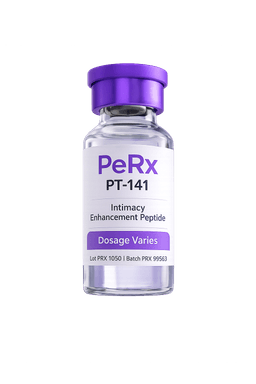
PT-141
$229/moOn-Demand Intimacy Enhancement
PT-141 (Bremelanotide) is a melanocortin receptor agonist that works through the nervous system to enhance sexual desire and arousal. Unlike other treatments that work mechanically, PT-141 addresses desire at its neurological source.
Frequently Asked Questions
What is the best peptide for sexual health?
Based on clinical research and mechanism of action, PT-141 is the top-ranked peptide for sexual health. On-Demand Intimacy Enhancement. Take our free health assessment and use the Virtual Cell to see which peptides match your biology.
How long do peptides take to work for sexual health?
Most patients notice initial improvements in sexual health within 2-4 weeks of consistent use, with more significant results over 8-12 weeks. Timelines vary based on the specific peptide, your health status, and protocol adherence.
Can I combine peptides for sexual health?
Yes. Many patients benefit from combining peptides that target sexual health through complementary mechanisms. PeRx offers pre-formulated combo products, and your provider can recommend the best combination for your goals.
Do I need a prescription for sexual health peptides?
Yes. All peptide therapies at PeRx require a valid prescription from a licensed healthcare provider. The prescription is included as part of the PeRx process — select your peptide, complete a health screening, and a provider will review and prescribe your personalized protocol.
Are sexual health peptides safe?
When prescribed by a licensed provider and sourced from an FDA-registered 503A compounding pharmacy, peptides for sexual health have a strong safety profile. Every PeRx patient undergoes a health screening before receiving a prescription.
Not sure which is right for you?
Take our free health assessment and use the Virtual Cell to discover which peptides match your biology.
Try the Virtual CellRelated Pages
Medical Disclaimer
The information provided on this page is for educational purposes only and is not intended as medical advice, diagnosis, or treatment. Peptide therapy requires a valid prescription from a licensed healthcare provider. Individual results may vary. No specific outcomes are guaranteed.
The peptides on this site are not FDA-approved. They are compounded by licensed pharmacies under provider supervision. Certain peptides are prohibited by WADA and major sports organizations. Statements on this page have not been evaluated by the FDA. These products are not intended to diagnose, treat, cure, or prevent any disease.