Best Anti-Aging Peptides 2026: Mapped by Mechanism
Aging is not one process. The hallmarks-of-aging research identified at least nine distinct mechanisms running in parallel, from telomere shortening to mitochondrial dysfunction to cellular senescence. The peptides with real evidence each target a specific mechanism, not the abstract idea of "aging." Here is the mechanism-by-mechanism map of which peptide does what, how long each takes to work, and how to choose for your specific concerns.

In this article
Key Takeaways
- There is no single best anti-aging peptide. Aging runs on at least nine parallel mechanisms, and the peptides with real evidence each target one or two of them, so the right pick depends on which mechanism is producing the symptoms you actually want to address.
- By mechanism: Epitalon for telomere maintenance, GHK-Cu for skin and connective tissue, NAD+ and MOTS-c for mitochondrial decline, Thymosin Alpha-1 for immune senescence, and BPC-157 for the regenerative slowdown that comes with age.
- GHK-Cu is the most consumer-relevant of the group. Topical versions have more than 40 years of dermatology research, and the injectable reaches deeper targets, vascular wall, hair follicles, and slow-healing tissue, that creams cannot.
- Onset varies a lot: NAD+ within one to two weeks, MOTS-c and BPC-157 within two to four weeks, GHK-Cu and Thymosin Alpha-1 within four to eight weeks, Epitalon over two to three months. Match your expectations to the peptide.
- None of these is FDA-approved as an "anti-aging" drug. They are prescribed by a licensed provider and compounded at a state-licensed 503A pharmacy. Anyone marketing an FDA-approved anti-aging peptide is misrepresenting the picture.
Anti-Aging Peptides at a Glance
Telomere Maintenance
Epitalon
Skin & Connective Tissue
GHK-Cu
Mitochondrial Decline
NAD+ and MOTS-c
Immune System Aging
Thymosin Alpha-1
Regenerative Slowdown
BPC-157
Administration
All subcutaneous injection
Why Mechanism Beats Marketing
The phrase "anti-aging peptide" is doing a lot of work. Aging is the simultaneous decline of multiple biological systems, and those systems do not decline at the same rate or in the same person. Two patients of the same age can present with completely different aging profiles: one with thin, slow-healing skin, another with mitochondrial fatigue, another with a weakened immune response. The peptide that helps each of them is different. When you get a peptide through PeRx, it is prescribed by a licensed provider and compounded in a US-based, FDA-regulated 503A pharmacy, the same regulated pathway many everyday prescriptions go through.
The 2013 paper "The Hallmarks of Aging" by Lopez-Otin and colleagues identified nine cellular and molecular mechanisms that drive aging: genomic instability, telomere attrition, epigenetic alterations, loss of proteostasis, deregulated nutrient sensing, mitochondrial dysfunction, cellular senescence, stem cell exhaustion, and altered intercellular communication. A 2023 update expanded the list. The therapeutic peptides with the strongest evidence each target one or two of these mechanisms specifically, which is exactly why a "what does this molecule actually do" framing works better than a "what supplement makes me younger" framing.
Lopez-Otin C, Blasco MA, Partridge L, Serrano M, Kroemer G. "The Hallmarks of Aging." Cell, 2013;153(6):1194-1217. View study
Lopez-Otin C, Blasco MA, Partridge L, Serrano M, Kroemer G. "Hallmarks of aging: An expanding universe." Cell, 2023;186(2):243-278. View study
So the right question for anti-aging peptide therapy is not "which peptide will make me younger" but "which mechanism is producing the symptoms I want to address, and which peptide targets that mechanism." A patient with visible skin aging needs a different protocol than a patient with declining workout recovery, even if both are 50 years old. The rest of this guide maps the peptides to the mechanisms.
Telomere Attrition
Epitalon activates telomerase and lengthens telomeres in human studies
Skin & Tissue
GHK-Cu resets age-related gene expression in skin fibroblasts
Mitochondrial Function
NAD+ and MOTS-c address the cellular energy machinery that declines with age
Immune Senescence
Thymosin Alpha-1 supports the thymus-driven immune training that fails with age
Anti-Aging Peptide Comparison
| Epitalon | GHK-Cu | NAD+ | Thymosin α-1 | MOTS-c | |
|---|---|---|---|---|---|
| Aging Mechanism | Telomere attrition | Skin & tissue aging | Mitochondrial decline | Immune senescence | Metabolic aging |
| Primary Effect | Telomerase activation | Skin gene-expression reset | NAD-dependent metabolism | T-cell function support | AMPK activation |
| What Patients Notice | Slower visible aging, sleep quality | Skin elasticity, wound healing | Energy, mental clarity | Fewer infections, faster recovery | Workout endurance, metabolism |
| Typical Onset | 8-12 weeks | 4-8 weeks | 1-2 weeks | 4-8 weeks | 2-3 weeks |
| Evidence Level | Strong (Khavinson studies) | Strong (Pickart research) | Strong (decades of use) | Strong (35+ country approval) | Growing (mitochondrial science) |
| In the PeRx catalog | Yes | Yes | Yes | Yes | Yes |
Aging Mechanism
- Epitalon
- Telomere attrition
- GHK-Cu
- Skin & tissue aging
- NAD+
- Mitochondrial decline
- Thymosin α-1
- Immune senescence
- MOTS-c
- Metabolic aging
Primary Effect
- Epitalon
- Telomerase activation
- GHK-Cu
- Skin gene-expression reset
- NAD+
- NAD-dependent metabolism
- Thymosin α-1
- T-cell function support
- MOTS-c
- AMPK activation
What Patients Notice
- Epitalon
- Slower visible aging, sleep quality
- GHK-Cu
- Skin elasticity, wound healing
- NAD+
- Energy, mental clarity
- Thymosin α-1
- Fewer infections, faster recovery
- MOTS-c
- Workout endurance, metabolism
Typical Onset
- Epitalon
- 8-12 weeks
- GHK-Cu
- 4-8 weeks
- NAD+
- 1-2 weeks
- Thymosin α-1
- 4-8 weeks
- MOTS-c
- 2-3 weeks
Evidence Level
- Epitalon
- Strong (Khavinson studies)
- GHK-Cu
- Strong (Pickart research)
- NAD+
- Strong (decades of use)
- Thymosin α-1
- Strong (35+ country approval)
- MOTS-c
- Growing (mitochondrial science)
In the PeRx catalog
- Epitalon
- Yes
- GHK-Cu
- Yes
- NAD+
- Yes
- Thymosin α-1
- Yes
- MOTS-c
- Yes
The Best Anti-Aging Peptides, By Mechanism
Each section below pairs an aging mechanism with the peptide that targets it. The framing is deliberate: the peptide is the answer to a question about which mechanism is producing your symptoms, not a generic anti-aging tool. The dedicated guides linked from each section cover the molecule itself in depth.
1. Telomere Attrition → Epitalon
Telomeres are the disposable buffer that lets cells divide without losing essential DNA. When they run out, the cell stops dividing. Most "telomere supplements" assume oral antioxidants will help, but the human telomere data does not exist for that pathway. Khavinson's research on Epitalon did produce that data, which is the reason this peptide sits in the longevity conversation rather than the wellness aisle.
The clinical signature is unusual. Epitalon does not produce a noticeable acute effect the way NAD+ does. The first thing patients usually report is sleep stabilization (the pineal-gland mechanism), and the underlying cellular changes accumulate over months. This is the long-game peptide: for the patient who wants something operating at the cellular-aging-clock level, not a daily energy boost. Read the full Epitalon guide for the discovery story and trial data, or view Epitalon.
Khavinson VK et al. (2003) "Peptide promotes overcoming of the division limit in human somatic cells." Bull Exp Biol Med 135(5):507-12.
Best For
Long-game biological aging. Sleep that has drifted with age and is not responding to lifestyle changes. The patient who wants something at the cellular-clock level, not a daily-feel peptide.
2. Skin & Extracellular Matrix → GHK-Cu
Visible aging is largely an extracellular matrix story. The collagen, elastin, and ground substance that hold skin and connective tissue together are degraded faster than they are replaced after the mid-thirties. GHK-Cu shifts the balance back by upregulating the gene-expression program that runs the matrix-building machinery. The effect is not "more collagen overall" but "the cell behaving more like a younger fibroblast." A 2018 review of the gene data put numbers on it: GHK-Cu modulates the expression of thousands of human genes, the majority in the direction of repair and regeneration.
Pickart L, Margolina A. "Regenerative and Protective Actions of the GHK-Cu Peptide in the Light of the New Gene Data." Int J Mol Sci, 2018;19(7):1987. View study
Topical GHK-Cu has been in skincare formulations for decades. The injectable approach reaches deeper systemic targets: vascular wall, hair follicles, and slower-healing tissues that topical preparations cannot reach. Patients who only want skin-texture changes are often well-served by topicals; the injectable is the right call when the goal is connective tissue and broader regeneration. Read the full GHK-Cu guide for the full gene-expression research, or see how it stacks up against NAD+ in our GHK-Cu vs. NAD+ comparison.
Best For
Visible skin and extracellular-matrix aging. Slow wound healing. Hair thinning. Patients whose primary concern is structural regeneration, not just surface texture.
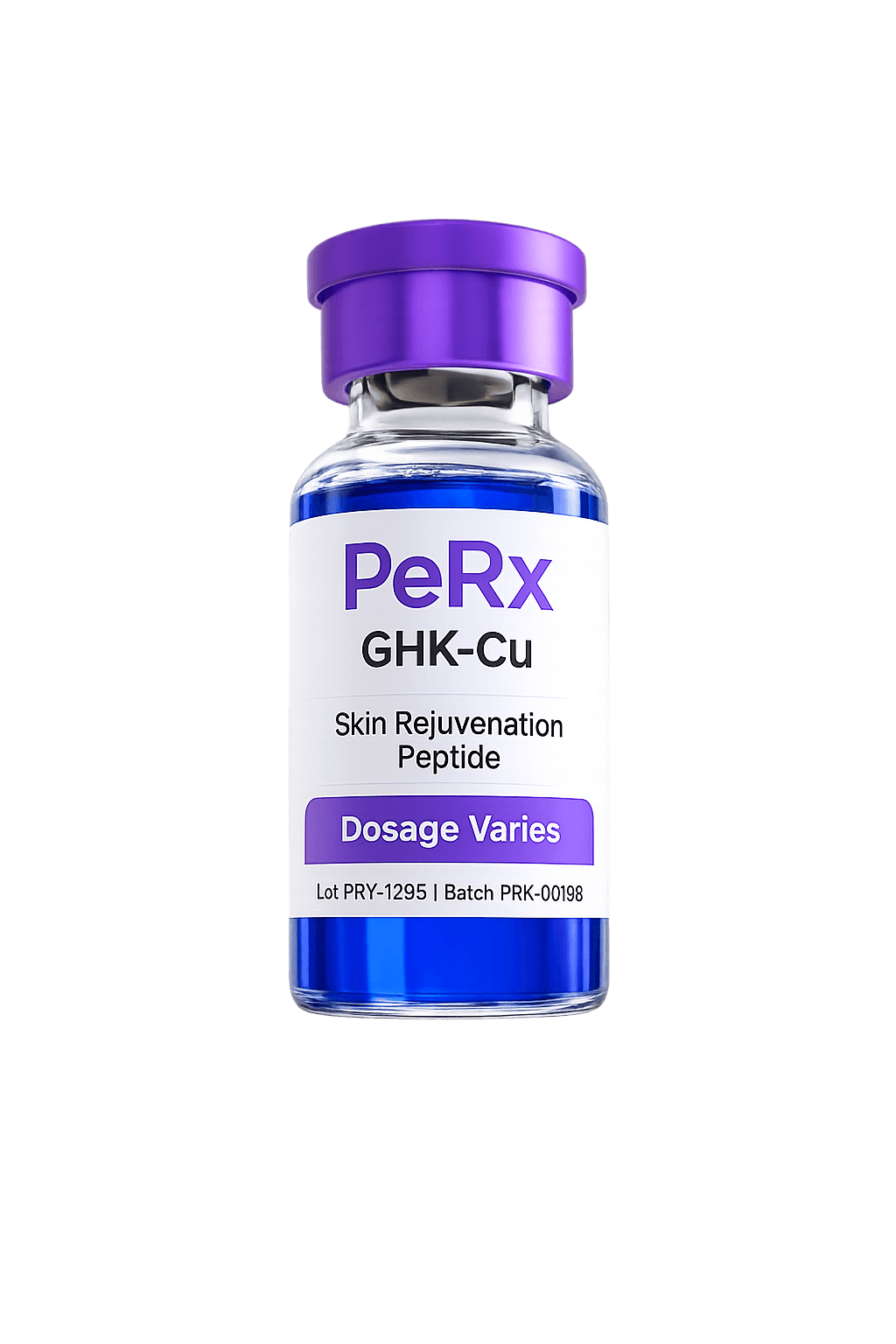
GHK-Cu
GHK-Cu is a copper-bound tripeptide (glycyl-histidyl-lysine plus copper) that occurs naturally in human plasma and declines with age. It is the most-studied peptide for skin applications specifically, with more than 40 years of dermatology research behind it. GHK-Cu upregulates collagen and elastin synthesis, increases glycosaminoglycan production (the hyaluronic-acid family that holds water in skin), and supports new blood-vessel formation in repairing tissue.
For most people whose anti-aging concern is the visible kind, skin firmness, elasticity, texture, slow wound healing, GHK-Cu is the first-line choice. PeRx ships it as a ready-to-use subcutaneous injection, prescribed by a licensed provider and compounded at a state-licensed 503A pharmacy.
3. Mitochondrial Decline → NAD+ and MOTS-c
Two peptides target this mechanism from different angles. NAD+ provides the cofactor that mitochondria need to run, and supplementation refills a pool that has dropped substantially by age sixty. MOTS-c sits one layer up: it is a signal molecule mitochondria use to coordinate with the rest of the cell. Refilling NAD without restoring the signaling produces a partial fix; restoring signaling without enough NAD to back it up does the same. The two pair naturally for that reason.
Reynolds JC et al. "MOTS-c is an exercise-induced mitochondrial-encoded regulator of age-dependent physical decline and muscle homeostasis." Nature Communications, 2021. View study
Martens CR et al. "Chronic nicotinamide riboside supplementation is well-tolerated and elevates NAD+ in healthy middle-aged and older adults." Nature Communications, 2018;9:1286. View study
Of the peptides on this list, NAD+ produces the fastest perceptible effect; most patients can identify the difference within ten days. MOTS-c is slower, more body-composition-oriented, and more felt during exercise than at rest. The right entry point depends on the symptom: cognitive fatigue and generalized brain fog point to NAD+ first; declining workout capacity and loss of metabolic flexibility point to MOTS-c first; if both pictures are present, run them in sequence rather than simultaneously so you can tell which one is doing what. See the NAD+ guide and the MOTS-c guide for the full mechanism stories, or MOTS-c vs. NAD+ for a side-by-side.
Best For
NAD+: cognitive fatigue, brain fog, generalized energy decline after 40. MOTS-c: declining workout capacity, loss of metabolic flexibility, exercise-related aging.
4. Immune Senescence → Thymosin Alpha-1
The immune system ages on its own clock, separate from skin or muscle or metabolism. The thymus, where T-cells learn to tell self from non-self, has mostly been replaced by fat by age sixty. The result is fewer naive T-cells, weaker vaccine response, slower illness recovery, and the chronic low-grade inflammation often called inflammaging. None of the other peptides on this list address that axis.
The signal that this is the right peptide is concrete: more colds in the past two years than in the prior five, infections that linger, vaccines that produce weaker reactions than they used to. These are not subjective wellness markers; they show up on T-cell counts and inflammatory panels. Thymosin Alpha-1 has the strongest international long-term safety record of any compounded peptide, part of why it sits comfortably in long-running anti-aging protocols. Read the full Thymosin Alpha-1 guide for the international clinical history, or view Thymosin Alpha-1.
Best For
A documented increase in infection frequency. Slow recovery from illness. Patients whose aging concern is concretely immune-related rather than diffuse.
5. Regenerative Slowdown → BPC-157
BPC-157 sits on this list as a deliberate anti-aging entry, not just an injury-recovery peptide. The reason is that the gap between damage and repair widens with age. A 25-year-old recovers from a minor strain in two weeks; a 55-year-old, in two months. The aging mechanism is not the injury itself, it is the slower regeneration. BPC-157 partially closes that gap by accelerating angiogenesis at the repair site.
In a long-term anti-aging protocol, BPC-157 is rarely the primary peptide. It is usually layered onto a different primary (Epitalon, GHK-Cu, NAD+) for patients whose regenerative slowdown is showing up as accumulated minor injuries that no longer fully resolve. Course-based use tied to specific recovery windows is more common than continuous indefinite dosing. Read the full BPC-157 guide for the science, or view BPC-157.
Best For
Accumulated minor injuries that no longer heal as fast as they used to. Slow joint and tendon recovery. An adjunct rather than a primary anti-aging peptide.
Topical vs. Injectable Anti-Aging Peptides
A lot of "anti-aging peptide" content blurs two very different things: peptides in a cream and peptides in a syringe. GHK-Cu and palmitoyl peptides (Matrixyl and similar) have a long history in topical skincare, and for surface-level skin texture, a well-formulated topical can do real work. But a topical only reaches the upper layers of skin. It does not reach the dermal vasculature, the hair follicle, the tendon, or any systemic target.
Injectable peptides are a different category. A subcutaneous injection puts the molecule into circulation, where it can reach the connective tissue, immune system, mitochondria, and other systems that drive whole-body aging. Epitalon, NAD+, MOTS-c, Thymosin Alpha-1, and BPC-157 are essentially injectable-only in any meaningful dose; GHK-Cu works both ways, and the choice comes down to whether your concern is "the surface of my face" (topical can be enough) or "my skin, my hair, and my connective tissue" (injectable). All of the peptides covered in this guide are prescribed and dispensed as ready-to-use subcutaneous injections.
Are Anti-Aging Peptides FDA Approved?
No peptide is FDA-approved as an "anti-aging" treatment, and you should be skeptical of anyone who says otherwise. Aging is not a recognized disease indication, so there is nothing to approve a drug for. What actually happens is more mundane: a licensed provider evaluates you, decides a peptide is appropriate, writes a prescription, and the medication is compounded for you at a state-licensed 503A pharmacy, the same pathway used for many other personalized prescriptions.
A few of the peptides discussed here have other regulatory footprints. Thymosin Alpha-1 is approved as a prescription medicine in more than 35 countries (for hepatitis and immune indications, not aging). Bremelanotide, the molecule in PT-141, is FDA-approved in the United States, but for hypoactive sexual desire disorder, not longevity. NAD+ has decades of clinical and supplemental use. Epitalon, MOTS-c, and the rest are studied compounds without an FDA approval. We cover the specifics in our FDA-status explainers, including is MOTS-c FDA approved?, and the bottom line is the same across the board: prescribed by a provider, compounded at a pharmacy, not an over-the-counter "anti-aging" product.
How Long Anti-Aging Peptides Take to Work
Onset is one of the most common sources of disappointment, almost always because someone expected an Epitalon timeline to feel like an NAD+ timeline. Roughly: NAD+ within one to two weeks (energy, mental clarity). MOTS-c within two to three weeks (workout endurance, metabolic feel). BPC-157 within two to four weeks (recovery from a specific injury). GHK-Cu and Thymosin Alpha-1 within four to eight weeks, with skin and connective-tissue changes building over three to four months and immune markers shifting over a similar window. Epitalon is the slowest; subjective changes (often sleep) tend to show up around eight to twelve weeks, with the cellular markers it targets measurable over months. If you are choosing for visible skin results before an event, GHK-Cu started three to four months ahead is the realistic plan; if you want something you can feel in two weeks, NAD+ is the one.
Which Peptide for Your Aging Concern?
Match the peptide to the specific aging mechanism producing the symptoms that matter to you. A general "anti-aging" goal is too vague to choose well; a specific concern, skin aging, energy decline, immune weakening, or recovery loss, points to a specific peptide.
Ideal for
Visible skin aging, slow wound healing → GHK-Cu Age-related energy decline, brain fog → NAD+ (often with MOTS-c) Frequent infections, immune decline → Thymosin Alpha-1 Declining workout capacity, metabolic slowdown → MOTS-c General longevity, telomere maintenance → Epitalon Slow-healing injuries, joint and tendon issues → BPC-157
Consider alternatives if
Active cancer or recent cancer history → Some peptides require careful consideration in patients with a history of malignancy. Discuss with your provider before starting. Pregnancy or breastfeeding → Most peptide protocols are contraindicated. Wait until after. Looking for one peptide that "does everything" → That peptide does not exist. Pick the mechanism that matches your primary concern, and add a second only if a second mechanism is clearly in play.
Common combinations with rationale: NAD+ plus MOTS-c (cellular metabolism plus mitochondrial signaling), Epitalon plus GHK-Cu (telomere maintenance plus skin aging), Thymosin Alpha-1 plus BPC-157 (immune support plus tissue repair). Stacking three or more anti-aging peptides simultaneously rarely produces proportional benefit and makes attribution impossible. If you do run a stack, the peptide cycling guide covers how on/off schedules differ by peptide class. Each order ships fully reconstituted and ready to use, delivered overnight in refrigerated packaging, with nothing to mix on your end.
Anti Aging Peptides: Common Questions
Related Guides
Continue reading about peptides and protocols that pair well with this guide.
Is Epitalon FDA Approved? 2026 Legal Status
No. Epitalon has never been tested in Western clinical trials. Its entire evidence base comes from four decades of research at one Russian institute by one scientist: Vladimir Khavinson. That research reported telomerase activation in cultured human cells, a result that has never been independently replicated. Here is why Epitalon never entered the FDA drug-approval pipeline, where it sits in the July 2026 compounding review, and what the Russian data actually shows.
Epitalon vs Pinealon: Pineal Peptides Compared
They sound like twins and share a lineage in the same Russian bioregulator research, but Epitalon and Pinealon were designed to do different jobs. Epitalon is a longevity-focused tetrapeptide studied for telomere maintenance and sleep. Pinealon is a short neuropeptide bioregulator studied for cognition and neuroprotection. Here is how they actually differ, what the evidence supports, and how to think about choosing.
Ann Arbor Peptide Therapy: 2026 Costs
A plain guide to peptide therapy in Ann Arbor: what it costs across local clinics, med spas, and telehealth, and who tends to use it here. Plus how pharmaceutical-grade peptides reach any Washtenaw County address without a clinic visit.
Find your anti-aging protocol
Browse the peptides above in the PeRx catalog, or take the health assessment and a licensed provider will recommend a protocol matched to your specific concerns, history, and goals.
Medical Disclaimer
The information provided on this website, including all articles, guides, and educational content, is for informational and educational purposes only and is not intended as medical advice, diagnosis, or treatment. Nothing on this site should be construed as a substitute for professional medical advice from a qualified healthcare provider.
The majority of peptides discussed on this site are not approved by the U.S. Food and Drug Administration (FDA) for the indications described. They are classified as bulk drug substances and are available only through a licensed prescribing provider and compounding pharmacy. All treatments require a valid prescription and provider oversight.
The majority of published research on peptide therapies has been conducted in preclinical (animal) models. While early human data is encouraging, comprehensive clinical trial data remains limited for most peptide compounds. Individual results may vary significantly based on health status, injury type, and other factors. No specific outcomes are guaranteed.
Certain peptides discussed on this site are classified as prohibited substances by the World Anti-Doping Agency (WADA) and are banned by major sports organizations including the NFL, NCAA, UFC, NBA, MLB, NHL, and PGA. If you are subject to anti-doping testing, consult your governing body before considering any peptide therapy.
Statements on this website have not been evaluated by the Food and Drug Administration. Products and therapies discussed are not intended to diagnose, treat, cure, or prevent any disease.
© 2026 Wellness MD Group PC DBA PeRx. All rights reserved.