Peptides for Gamers: Focus and Wrist Repair
Competitive gaming is three problems wearing one jersey: the wrist that gives out, the focus that fades in hour seven, and the fatigue that no energy drink touches. This guide treats the esports athlete like the performance athlete they are, and maps each of those three problems to where BPC-157, Semax, and NAD+ might actually fit. Honest about the evidence, and about what stays an ergonomics problem.
In this article
Key Takeaways
- Competitive gaming creates three distinct problems, not one: wrist and hand repetitive strain (including gamer's thumb and carpal tunnel), the focus fade across long sessions, and systemic fatigue. This guide is organized around those three tracks.
- Each track maps to a different peptide: BPC-157 for the tendon side of wrist RSI, Semax for the focus and cognition angle, and NAD+ for the energy and fatigue side. They address different problems and are not interchangeable.
- Whether these are allowed depends on your league. BPC-157 and TB-500 are on the WADA Prohibited List, and tournament circuits increasingly align with WADA, so tested competitors should treat them as off-limits in season.
- The evidence is plausible mechanism plus limited human data, with nothing specific to esports. Ergonomics, rest, sleep, and training are the parts that carry the strongest evidence. Peptides, if a provider prescribes them, are a support layer on top.
Quick Facts
Persona
Adult competitive gamers, streamers, and esports athletes
Three problems
Wrist and hand RSI, focus fade, systemic fatigue
Peptides in scope
BPC-157 (wrists), Semax (focus), NAD+ (fatigue)
Most common injury
Gamer's thumb (De Quervain's) and wrist tendinopathy
Doping status
BPC-157 and TB-500 are WADA-prohibited; check your league
What carries the evidence
Ergonomics, rest, and sleep first; peptides as a support layer
Hour Seven
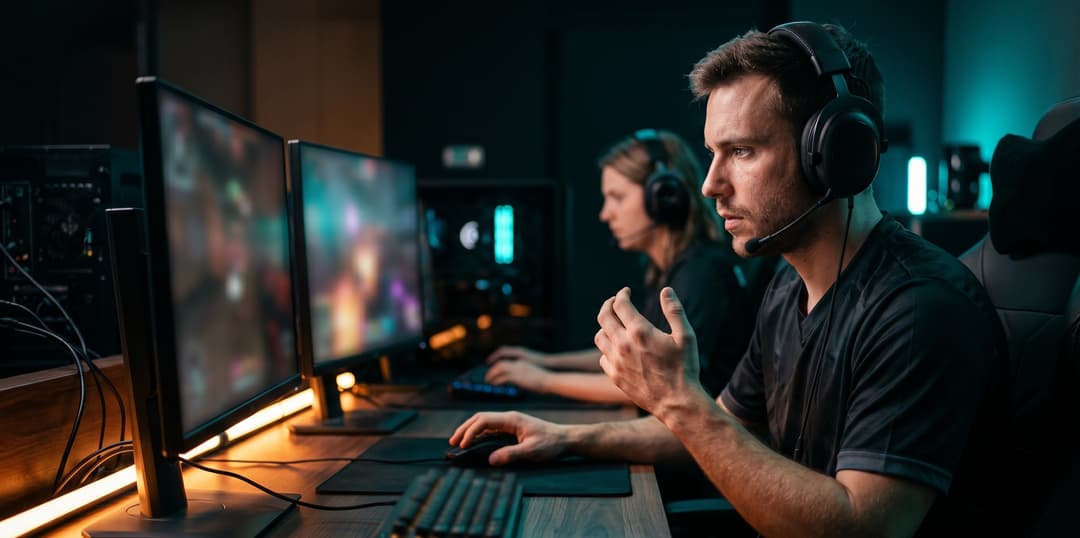
It is the seventh hour of a scrim block. Your mechanics are still there, but the read is gone. You are a half-second late on rotations, your wrist has that hot, tight ache on the thumb side that started two weeks ago and has not left, and the fourth energy drink did nothing except make your hands shake. The team wants one more game. You will play it, and you will play it worse than the first one, and tomorrow the wrist will be stiffer. Anyone who has competed seriously in a game knows this exact state. It is three separate things failing at once, and treating it like one thing is why most fixes do not work. When you get BPC-157 through PeRx, it is prescribed by a licensed provider and compounded in a US-based, FDA-regulated 503A pharmacy, the same regulated pathway many everyday prescriptions go through.
First, the Doping Question
Before anything else, because it is the question every competitor actually has: will this get me banned. The honest answer is that it depends entirely on your league, and you have to check yours specifically. Most esports organizations have historically tested for recreational and stimulant drugs, the Adderall conversation, rather than the full anti-doping panel that governs Olympic sport. But the bigger tournament circuits increasingly reference World Anti-Doping Agency standards, and both BPC-157 and TB-500 are on the WADA Prohibited List.
Check before you consider anything
If you compete in a tested, WADA-aligned circuit, treat BPC-157 and TB-500 as prohibited and do not use them in season. If you are a streamer, a ranked grinder, or in a league that does not test for these compounds, that specific rule does not apply to you, but they are still prescription-only and FDA-unapproved. NAD+ and the focus peptide Semax are a separate question from the tissue-repair peptides, but the rule is the same: read your league's actual policy, do not take a forum's word for it.
Three Problems, Not One
The reason the energy drink and the wrist brace and the gaming glasses all feel like half-measures is that each one addresses a third of the problem. Competitive gaming taxes the body in three distinct ways, on three different systems, and the smart way to think about recovery is to treat them as three tracks rather than one vague notion of "gamer health." The rest of this guide walks each track and where a peptide might fit it, because matching the tool to the specific failure is the entire point.
A note before the tracks: the esports-supplement world stops at caffeine, L-theanine, and the occasional collagen pitch, and the esports-injury world stops at braces, stretches, and ergonomic mice. Neither connects the gamer to an actual internal-recovery approach, because neither treats the gamer as a performance athlete with a body worth investing in. That gap is the reason this guide exists. The peptides below are prescription-only, given as subcutaneous injections, and require a licensed provider.
Track One: The Wrists
The wrist and hand take the most concentrated repetitive load in gaming, and they are where the injuries get names. Gamer's thumb is usually De Quervain's tenosynovitis, an irritation of the tendons running along the thumb side of the wrist, from the constant clicking, button-mashing, and controller grip. Carpal tunnel is compression of the median nerve as it passes through the wrist, producing the numbness and tingling that creeps into the fingers during long sessions. Both are overuse injuries: too much of the same motion, not enough recovery, accumulated over years of ranked grind.
BPC-157 enters here on the tendon side. Its animal-model record for tendon and soft-tissue healing, through angiogenesis and growth-factor signaling, is the same mechanism that makes it interesting for a surfer's rotator cuff or a climber's finger, applied to the thumb and wrist tendons a gamer overloads. Two honest limits. It does not decompress the pinched nerve in true carpal tunnel, which is a mechanical problem. And it does not replace the ergonomic fixes, the wrist position, the mouse, the breaks, that reduce the load causing the irritation in the first place. It is a support layer for the tendon side, used alongside the changes that actually lower the strain.
Track Two: The Focus
The focus fade is the one that costs games. Early in a session the reads are sharp and the reactions are clean, and somewhere in hour five or six the cognitive edge dulls, the decision-making slows, and tilt creeps in. Caffeine props it up for a while and then takes its cut in jitters and a crash. This is the track Semax is reached for, the same focus-peptide that comes up for traders and other long-session cognitive athletes.
Semax is a peptide developed and used clinically in Russia, with research interest in attention, mental clarity, and a proposed effect on BDNF, a brain-derived growth factor involved in cognition. The appeal for a gamer is that it is not a stimulant, so the proposed clarity does not come with the heart-rate spike or the crash. The caveat is real and worth stating twice: most of the human research is Russian and the Western trial base is thin, so the confident claims online outrun the evidence. Interested and clear-eyed is the right posture. It is also worth knowing Semax has a cousin, Selank, weighted more toward anxiety and calm than pure focus, which is a provider conversation if tilt and nerves are more your problem than attention.
Volkova A et al., "Selank Administration Affects the Expression of Some Genes Involved in GABAergic Neurotransmission," Frontiers in Pharmacology, 2016; 7:31. View study
Track Three: The Fatigue
The third track is the deep systemic fatigue that focus tools cannot fix because it is not a focus problem. A tournament weekend, a bootcamp, or a stretch of back-to-back ranked days is a genuine physical drain: compressed sleep, long hours of sustained concentration, and no real recovery between blocks. This is the NAD+ track, and it is a different mechanism than the focus peptide.
NAD+ is a coenzyme in every cell, central to the reactions that turn fuel into usable energy, and its levels fall with age and stress. The rationale for NAD+ therapy is restoring that substrate to support cellular energy and recovery across a demanding block, rather than delivering an acute jolt before a single match. For a gamer, that maps onto the multi-day grind better than the single-game moment. The honest caveat is the same one that runs through the guide: the human evidence is mechanistic and emerging, and NAD+ does not buy back the sleep that an all-night queue sacrifices. It is support for the recovery you are already trying to get, not a license to skip it.
The Three Peptides, Mapped
| The Wrists | The Focus | The Fatigue | |
|---|---|---|---|
| Peptide | BPC-157 | Semax | NAD+ |
| Targets | Thumb and wrist tendon irritation (RSI, gamer's thumb) | Attention, mental clarity, the hour-seven fade | Systemic energy and recovery across long blocks |
| Proposed mechanism | Angiogenesis and growth-factor tendon healing | Non-stimulant cognitive effect, proposed BDNF link | Restores a coenzyme central to cellular energy |
| Evidence strength | Deep animal data, limited human | Mostly Russian human data, thin in the West | Mechanistic and emerging |
| What it will not do | Decompress a pinched nerve or replace ergonomics | Act like a guaranteed stimulant boost | Replace the sleep you skipped |
Peptide
- The Wrists
- BPC-157
- The Focus
- Semax
- The Fatigue
- NAD+
Targets
- The Wrists
- Thumb and wrist tendon irritation (RSI, gamer's thumb)
- The Focus
- Attention, mental clarity, the hour-seven fade
- The Fatigue
- Systemic energy and recovery across long blocks
Proposed mechanism
- The Wrists
- Angiogenesis and growth-factor tendon healing
- The Focus
- Non-stimulant cognitive effect, proposed BDNF link
- The Fatigue
- Restores a coenzyme central to cellular energy
Evidence strength
- The Wrists
- Deep animal data, limited human
- The Focus
- Mostly Russian human data, thin in the West
- The Fatigue
- Mechanistic and emerging
What it will not do
- The Wrists
- Decompress a pinched nerve or replace ergonomics
- The Focus
- Act like a guaranteed stimulant boost
- The Fatigue
- Replace the sleep you skipped
A Tournament-Weekend Routine
The thing to understand about dosing is that the peptides do not work on a match-by-match timescale, so you do not inject between games like chugging an energy drink. They work over days and weeks, which means the routine is about consistency across a block, paired with the ergonomic and recovery habits that do the heavy lifting. Here is how the pieces actually fit a heavy weekend.
How the pieces fit a heavy block
Daily, consistent timing
If a provider has prescribed them, the peptides are dosed daily at a consistent time, not timed to matches. BPC-157 runs through the active healing window of a wrist flare; Semax and NAD+ are used across the demanding block. Consistency matters more than timing.
Every session: the ergonomics
Wrist-neutral position, a mouse and chair that fit, and actual breaks. This is the part with the strongest evidence for the wrist track, and no peptide substitutes for it. Set a timer, stand up, stretch the forearms.
Between blocks: the recovery
Sleep is the highest-leverage recovery tool you have, and the one a tournament schedule attacks first. NAD+ supports recovery; it does not replace the sleep. Protect the hours you can.
Around the wrist flare: load management
A genuinely painful wrist needs reduced load to settle, the same way a tendon anywhere does. Pushing through a De Quervain's flare at full grind volume keeps it lit no matter what you add to the protocol.
Where the Ergonomics Still Win
It would be easy to read this guide as "inject three peptides and grind harder," and that reading would be wrong. The interventions with the strongest evidence for a gamer's body are unglamorous: wrist-neutral ergonomics and breaks for the hands, real sleep for the fatigue, and trained focus and tilt control for the mind. The peptides are a possible support layer on top of those, with plausible mechanisms and limited human data, and nothing studied in esports specifically. Every batch is third-party tested for purity, and BPC-157 ships fully reconstituted and ready to use, delivered overnight in refrigerated packaging.
The evidence, stated plainly
BPC-157's tendon data is mostly from animal models. Semax's focus research is real but largely Russian and thin in the West. NAD+ is mechanistic and emerging. None of the three has trials in competitive gaming. The reasonable position is cautious interest in a support role, full respect for the ergonomics, sleep, and training that carry the actual evidence, and no illusion that a peptide is a rank-up button. Treat your body like a pro athlete's and the boring habits come first.
Questions Gamers Ask
Related Guides
Continue reading about peptides and protocols that pair well with this guide.
BPC-157 vs a Cortisone Shot for Injury Recovery
A cortisone shot can quiet an angry joint or tendon in days. BPC-157 works the other way around: a slower, regenerative approach taken as a daily injection over weeks. They are not competing versions of the same idea. They are different tools for different jobs, and the honest answer to which one you need depends on what you are actually trying to fix.
BPC-157 Capsules vs Injection: Which Route Wins
BPC-157 is the rare peptide with a real oral story, but that does not mean capsule and injection are interchangeable. A physician-reviewed breakdown of gut-local vs systemic delivery, what survives digestion, and how providers choose the route.
Nootropic Peptides for Brain Health (2026)
Nootropic is a broad word that covers everything from a cup of coffee to a prescription molecule. This guide narrows it to the peptides people actually ask about for cognition, calm, and sleep. What the research supports, what it does not yet support, and how Semax, Selank, Pinealon, and DSIP differ from one another.
Ready to get started?
Peptide therapy in the US is prescription-only and requires evaluation by a licensed provider. Browse the peptides most often discussed for recovery, focus, and energy, or read the BPC-157 guide for the full picture on the tissue-repair side.
Medical Disclaimer
The information provided on this website, including all articles, guides, and educational content, is for informational and educational purposes only and is not intended as medical advice, diagnosis, or treatment. Nothing on this site should be construed as a substitute for professional medical advice from a qualified healthcare provider.
The majority of peptides discussed on this site are not approved by the U.S. Food and Drug Administration (FDA) for the indications described. They are classified as bulk drug substances and are available only through a licensed prescribing provider and compounding pharmacy. All treatments require a valid prescription and provider oversight.
The majority of published research on peptide therapies has been conducted in preclinical (animal) models. While early human data is encouraging, comprehensive clinical trial data remains limited for most peptide compounds. Individual results may vary significantly based on health status, injury type, and other factors. No specific outcomes are guaranteed.
Certain peptides discussed on this site are classified as prohibited substances by the World Anti-Doping Agency (WADA) and are banned by major sports organizations including the NFL, NCAA, UFC, NBA, MLB, NHL, and PGA. If you are subject to anti-doping testing, consult your governing body before considering any peptide therapy.
Statements on this website have not been evaluated by the Food and Drug Administration. Products and therapies discussed are not intended to diagnose, treat, cure, or prevent any disease.
© 2026 Wellness MD Group PC DBA PeRx. All rights reserved.