Peptides for Climbers: A2 Pulley and Chalk Skin
How BPC-157, the BPC/TB-500 combo, and GHK-Cu fit into the two injuries every hard climber knows: the A2 pulley that pops on a crimp, and the chalk-dried, splitting skin that never quite heals. Built around the grade-by-grade pulley timeline and what the research actually supports.
In this article
Key Takeaways
- Hard climbing produces two signature injuries that share a root cause in connective tissue: the A2 finger pulley that strains or ruptures on a hard crimp, and the chalk-dried skin that splits and never fully heals.
- Three peptides come up here: BPC-157 for the local healing response, the BPC/TB-500 combo for broader tendon and pulley remodeling, and GHK-Cu for the skin barrier. GHK-Cu has the strongest human evidence; the tendon claims rest mostly on animal models.
- Pulley recovery is graded: grade I roughly 2 to 6 weeks, grade II roughly 6 to 12 weeks, grade III up to 3 to 6 months. Peptides are a support layer; load management, H-taping during return, and progressive loading do the structural work.
- BPC-157 and TB-500 are FDA-unapproved and on the WADA Prohibited List, so they are not an option for tested competition. The evidence for pulley healing specifically is preclinical, not proven in humans.
Quick Facts
Persona
Adult boulderers and sport climbers with finger and skin injuries
Primary injuries
A2 pulley strain or rupture; chronic chalk-dried, split skin
Peptides in scope
BPC-157, BPC/TB-500 combo, GHK-Cu
Pulley load
A full crimp can load the A2 pulley at 3 to 4 times fingertip force
Recovery by grade
I: 2-6 weeks, II: 6-12 weeks, III: 3-6 months
Competition status
BPC-157 and TB-500 are WADA-prohibited, not for tested climbers
The Pop on the Crimp
The moment
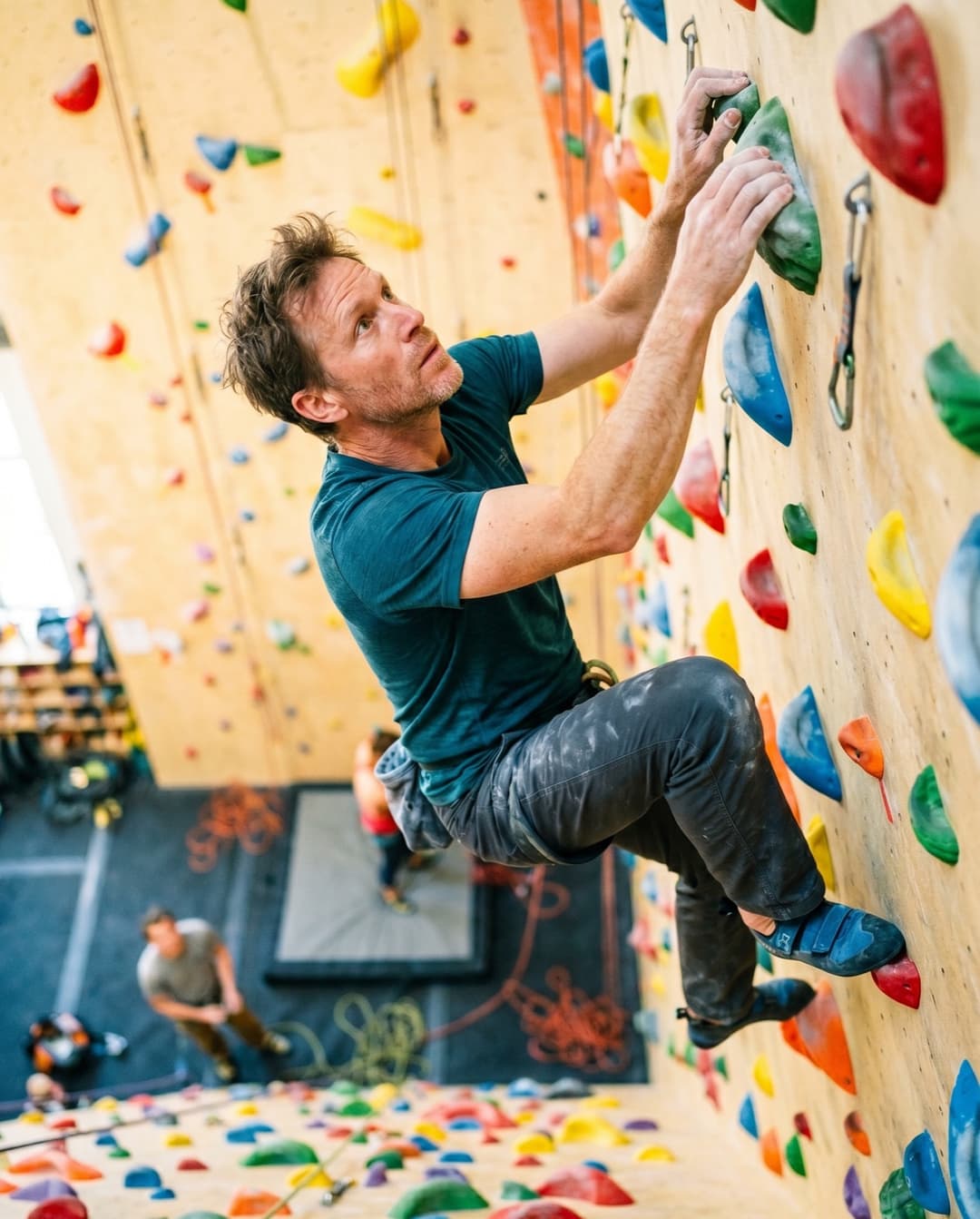
You are deep on a hard boulder, weight stacked over a small crimp, and you load the hand to pull through. There is a pop, sharp and specific, somewhere in the middle finger. You let go. The hold did not break and you did not fall, but you already know. The six weeks of trying not to make it worse start now: the careful door handles, the avoiding handshakes, the watching everyone else send while you ice a finger and read about pulley grades at midnight.
Every climber who pushes grade eventually meets the A2 pulley. And every climber who chalks up day after day eventually meets the other injury nobody writes training plans for: skin that dries, cracks, and splits at the tips until it limits sessions as hard as any tendon does. Both problems are connective-tissue problems at root, and both are slow to heal for the same reason. This guide is about where peptide therapy might support each of them, organized the way climbers actually experience the injuries, and honest about where the science is real and where it is hopeful. When you get BPC-157 through PeRx, it is prescribed by a licensed provider and compounded in a US-based, FDA-regulated 503A pharmacy, the same regulated pathway many everyday prescriptions go through.
What the A2 Pulley Actually Is
The finger pulleys are bands of fibrous tissue that hold the flexor tendons close to the bone as the finger curls. Without them, the tendons would bowstring away from the finger when you make a fist. The A2 pulley, at the base of the finger, takes the most load of any of them, and the crimp grip that climbing depends on is uniquely brutal on it. In a full crimp, the forces on the A2 can reach three to four times the force at the fingertip. No other common activity loads this small structure the way hard climbing does.
Pulley injuries are graded. A grade I is a strain or microtearing. Grade II is a partial tear. Grade III is a complete rupture of a single pulley, and grade IV is multiple pulleys torn, often with visible bowstringing of the tendon. The reason any of this heals slowly is structural: the pulley is dense, fibrous, and poorly vascularized. Tissue with a poor blood supply does not get the rapid delivery of healing factors that well-perfused tissue does, which is exactly the bottleneck that an angiogenesis-promoting approach is theorized to address.
Why Rest-and-Collagen Falls Short
The standard advice is rest, then load progressively, and maybe take collagen. The rest-and-load part is correct and non-negotiable: the climbing-medicine literature, from the rehab protocols climbers actually follow, is built on progressive loading once the acute phase passes. The weak link is the collagen part, which gets oversold. Oral collagen supplies amino acids, generic raw material the body can use anywhere. It does not deliver a targeted signal to a specific poorly vascularized pulley telling it to heal faster.
It also does nothing for the second half of the climber problem, the skin. The standard skin advice (sand the calluses, use a salve, file the splits) manages symptoms on the surface. None of it addresses the barrier repair underneath. So the climber ends up with two slow connective-tissue problems and a toolkit of generic, surface-level interventions. That gap is where the targeted-peptide conversation belongs, with appropriate caution about what is proven.
The Three Peptides in Scope
The peptides that come up for climbers are BPC-157, the BPC/TB-500 combo, and GHK-Cu. All three are prescription-only in the US and subcutaneous injections, and all require evaluation by a licensed provider.
| BPC-157 | BPC/TB-500 combo | GHK-Cu | |
|---|---|---|---|
| Targets | The injured pulley and finger tendons | The tendon-pulley complex plus surrounding tissue | Chalk-dried, splitting fingertip and hand skin |
| Proposed mechanism | Angiogenesis, growth-factor and fibroblast modulation | Adds TB-500 cell migration and remodeling across a wider area | Collagen organization and skin barrier repair |
| Evidence strength | Deep preclinical, limited human | Preclinical, limited human | Strongest human data of the three |
| When climbers reach for it | A simple pulley strain | A pulley injury involving the tendon, the Wolverine pairing | Skin that is limiting sessions |
Targets
- BPC-157
- The injured pulley and finger tendons
- BPC/TB-500 combo
- The tendon-pulley complex plus surrounding tissue
- GHK-Cu
- Chalk-dried, splitting fingertip and hand skin
Proposed mechanism
- BPC-157
- Angiogenesis, growth-factor and fibroblast modulation
- BPC/TB-500 combo
- Adds TB-500 cell migration and remodeling across a wider area
- GHK-Cu
- Collagen organization and skin barrier repair
Evidence strength
- BPC-157
- Deep preclinical, limited human
- BPC/TB-500 combo
- Preclinical, limited human
- GHK-Cu
- Strongest human data of the three
When climbers reach for it
- BPC-157
- A simple pulley strain
- BPC/TB-500 combo
- A pulley injury involving the tendon, the Wolverine pairing
- GHK-Cu
- Skin that is limiting sessions
Two details worth pulling out of the table. One study reported BPC-157 increasing growth-hormone receptor expression in tendon fibroblasts, a plausible piece of the repair picture for a slow-healing structure. And the GHK-Cu caveat: it can be drying initially for some people, so it works best alongside a ceramide or hyaluronic-acid moisturizer rather than on its own.
Vasireddi N et al., "Emerging Use of BPC-157 in Orthopaedic Sports Medicine: A Systematic Review," 2025. View study
The Pulley: Grade by Grade
The realistic way to think about peptide timing is around the grade of the injury and the rehab phase, not as a fixed protocol. The structural healing follows the same inflammatory, proliferative, and remodeling arc as any connective-tissue injury, the same arc that governs a skier rebuilding an ACL graft, and the proposed peptide mechanisms line up most closely with the proliferative and remodeling phases, when new tissue is being built and organized.
Grade I (2-6 weeks)
Strain or microtearing
Relative rest from crimping, then early protected loading. The shortest arc. A provider may include BPC-157 or the combo through the healing window as connective-tissue support while you stay off the aggravating grip and let the strain settle.
Grade II (6-12 weeks)
Partial tear
The phase where most climbers actually use a tissue-support approach. Daily BPC-157 or the BPC/TB-500 combo through the proliferative and early-remodeling window, paired with the staged loading protocol your physical therapist or a climbing-medicine source prescribes. H-taping comes in during the return-to-climbing part of this phase.
Grade III-IV (3-6 months+)
Complete or multi-pulley rupture
The serious end, sometimes warranting surgical consultation, especially with visible bowstringing. The recovery is long and the peptide role is support across a much longer remodeling arc. Do not self-manage a suspected full rupture; this is a see-a-hand-specialist injury.
Feeling better is not healed
A pulley that has stopped hurting is not the same as a pulley that has remodeled enough to take a full crimp again. The most common re-injury pattern is the climber who feels fine at week four of a grade II, goes back to projecting hard, and re-tears the partially healed tissue. No peptide changes the biology of how long fibrous tissue takes to organize. Return to crimp load on the timeline, not on how the finger feels.
Taping and the Return to Crimping
During the return-to-climbing phase, H-taping is the mechanical complement to whatever tissue support you are using. Placed correctly, close to the joint in the figure-eight or H pattern, taping has biomechanical evidence behind it: systematic-review data suggests it can reduce pulley bowstringing on the order of 15 to 22 percent. That is meaningful protection for a healing pulley taking its first real loads again.
The mental model worth holding is division of labor. The tape manages the mechanical load on the healing structure. The progressive loading protocol provides the stimulus that tells the tissue how to organize. The peptides, if your provider has prescribed them, are the background tissue-support layer underneath both. None of the three replaces the others, and the tape and the loading protocol are the parts with the strongest evidence.
The Skin Nobody Talks About
Skin is the injury climbing training plans ignore and climbing sessions revolve around. Chalk pulls moisture out of the skin, friction on rock and plastic abrades it, and the result for high-volume climbers is fingertips that dry, glass over, and split. A split tip can shut down a session as hard as a tweaked tendon, and the standard fixes (sanding, salves, filing) are surface-level symptom management. They do not rebuild the barrier.
This is the one place in the guide where the human evidence is actually strong. GHK-Cu has a real research record in skin barrier repair and collagen organization. Reframed from its usual face-and-anti-aging marketing toward the climber problem, it is a barrier-repair tool for chronically chalk-stressed hands. The honest caveat bears repeating: copper peptides can be drying initially for some people, so the sensible use is alongside a ceramide or hyaluronic-acid moisturizer as part of a skin routine, not as a standalone miracle for split tips. Used that way, it addresses the underlying barrier rather than just buffing the surface.
Real-World Logistics
All three peptides are subcutaneous injections, the standard shallow insulin-needle technique used across peptide therapy, taking about thirty seconds. PeRx ships them fully reconstituted and ready to use, stored refrigerated at 36 to 46 degrees Fahrenheit. For climbers who travel to crags and comps, the vials are prescription medications in labeled packaging and hold their temperature window for 24 to 48 hours in a soft cooler with frozen gel packs, which covers a road trip to the desert or a weekend at a bouldering destination.
On sequencing: the tissue-support peptides are typically dosed daily through the active healing window of a pulley injury, at a consistent time of day, rather than timed around climbing sessions. The mechanisms work on a days-to-weeks timescale, so there is no benefit to injecting right before you climb. For the skin side, GHK-Cu fits into a normal daily routine. The thing to actually time around your sessions is the load: the rehab and the return-to-crimp progression, not the injection.
What Peptides Will Not Do for a Pulley
Four honest distinctions, because finger injuries make climbers desperate and desperation is where the overselling lives.
It will not let you climb through a pulley injury. Nothing does. The tissue needs reduced load to heal, and the single biggest determinant of recovery is whether you actually back off the aggravating grip. A peptide is not a permission slip to keep projecting on a torn pulley.
It will not beat rehab and taping on evidence. The progressive loading protocol and H-taping are the parts of this with the strongest support. The peptides are an adjunct layer, and for the tendon side the evidence is preclinical, not proven in humans.
It will not fix a full rupture on its own. A grade III or IV pulley injury, especially with bowstringing, may need a hand specialist and sometimes surgery. That is a medical evaluation, not a peptide decision.
It is not an option for tested competition. BPC-157 and TB-500 are on the WADA Prohibited List and are FDA-unapproved. If you compete in IFSC or any tested event, they are off the table during your season. They are prescribed for recreational adult climbers who are not subject to anti-doping testing. Every batch is third-party tested for purity, and BPC-157 ships fully reconstituted and ready to use, delivered overnight in refrigerated packaging.
The evidence, stated plainly
For the pulley and tendon claims, most of the data is from animal models, and the human trials on finger injuries specifically do not exist. For the skin, GHK-Cu has genuine human research behind it. The reasonable position is cautious optimism about a support role for the finger, real confidence about the barrier-repair role for the skin, and a healthy skepticism toward anyone promising a torn pulley will heal faster than its grade allows.
Questions Climbers Ask
Related Guides
Continue reading about peptides and protocols that pair well with this guide.
How Long Does BPC-157 Take to Work?
The honest answer is that it depends on what you are treating. No human randomized trial has pinned down a precise onset for BPC-157, so the ranges below come from preclinical research and clinical-practice observation. This guide breaks the timeline down by use type, explains what speeds it up or slows it down, and covers when to check back in with your provider.
Where to Inject BPC-157: Sites & Technique
BPC-157 is a subcutaneous injection. The four standard sites all work, but the questions patients actually ask are whether to inject near the injury, how to rotate, and how to do it without a stinging welt. Here is the practical guide people want after the first vial arrives.
DSIP vs Melatonin: Different Sleep, Different Fix
Melatonin tells your body it is dark. DSIP restructures how deep you sleep. One regulates timing, the other regulates quality. They target completely different sleep systems, which is why most people who take melatonin still wake up unrefreshed. Here is the comparison.
Ready to get started?
Peptide therapy in the US is prescription-only and requires evaluation by a licensed provider. Browse the peptides most often discussed for connective-tissue and skin recovery, or read the BPC-157 guide for the full picture.
Medical Disclaimer
The information provided on this website, including all articles, guides, and educational content, is for informational and educational purposes only and is not intended as medical advice, diagnosis, or treatment. Nothing on this site should be construed as a substitute for professional medical advice from a qualified healthcare provider.
The majority of peptides discussed on this site are not approved by the U.S. Food and Drug Administration (FDA) for the indications described. They are classified as bulk drug substances and are available only through a licensed prescribing provider and compounding pharmacy. All treatments require a valid prescription and provider oversight.
The majority of published research on peptide therapies has been conducted in preclinical (animal) models. While early human data is encouraging, comprehensive clinical trial data remains limited for most peptide compounds. Individual results may vary significantly based on health status, injury type, and other factors. No specific outcomes are guaranteed.
Certain peptides discussed on this site are classified as prohibited substances by the World Anti-Doping Agency (WADA) and are banned by major sports organizations including the NFL, NCAA, UFC, NBA, MLB, NHL, and PGA. If you are subject to anti-doping testing, consult your governing body before considering any peptide therapy.
Statements on this website have not been evaluated by the Food and Drug Administration. Products and therapies discussed are not intended to diagnose, treat, cure, or prevent any disease.
© 2026 Wellness MD Group PC DBA PeRx. All rights reserved.