Peptides for Welders: Neck, Shoulder and Elbow
For welders, mechanics, construction crews, and tradespeople who load the same joints every shift. How peptide therapy is used for the connective-tissue wear that physical work leaves in the neck, shoulder, and elbow.
In this article
Key Takeaways
- Welding does not wear the body down evenly. It concentrates on three places the trade loads every shift: the neck from holding the head bent under the hood, the shoulder from overhead torch work, and the elbow from grinding and grip. Each one has a name.
- BPC-157 is the core tool here, used for the tendon and soft-tissue side of all three, with the BPC-157/TB-500 combo as the more aggressive option for stubborn or multi-site wear. Both come as oral capsules and as injection.
- GHK-Cu supports the collagen and connective-tissue remodeling underneath, while Selank and NAD+ address the stress and end-of-shift fatigue that ride along with a physical trade.
- The honest part: these are prescription-only, not FDA-approved for injury recovery, and not a painkiller you use to push through real damage. The upside for welders is that the panels a shop actually runs do not screen for peptides, so the doping caveat that limits every athlete-facing guide does not apply here.
The Neck That Locks After the Shift
The scene
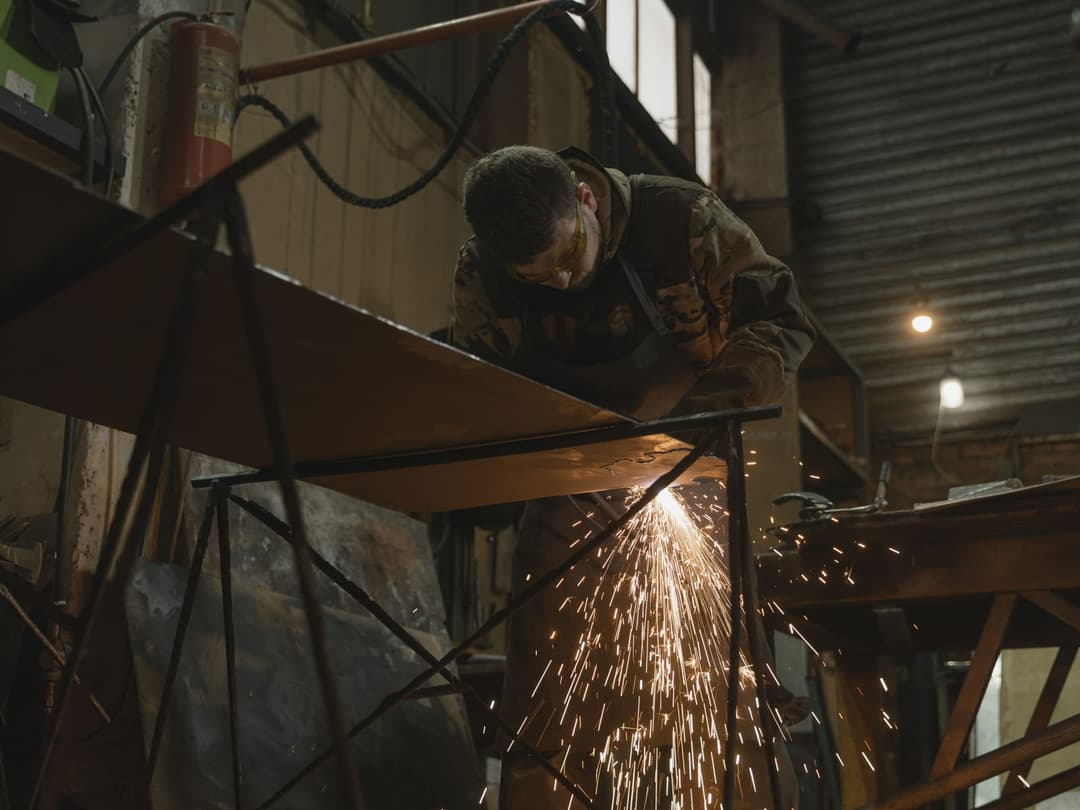
You spend the day under the hood, chin tucked toward your chest, holding the weld where you can see it. By the truck the back of your neck has gone from tight to genuinely locked, and turning your head to check the mirror is a full-shoulder maneuver. The shoulder you have been pressing overhead all week joins in. It is not a one-bad-day thing anymore. It is the trade, settling into the same three spots it always finds.
Most welders have a version of this. The stiff neck that never fully resets. The shoulder that catches on the first overhead pass of the morning. The elbow that started barking somewhere in the middle of a long grinding job and has not stopped. The wear of the work does not show up as general soreness. It shows up as a specific structure, in a specific spot, that has taken the same load one too many times. When you get a peptide through PeRx, it is prescribed by a licensed provider and compounded in a US-based, FDA-regulated 503A pharmacy, the same regulated pathway many everyday prescriptions go through.
The welder is one face of a much larger pattern. Mechanics holding tools overhead under a lift, framers and concrete crews swinging and gripping all day, machinists and assemblers running the same motion thousands of times, anyone whose living comes out of their hands and shoulders ends up in the same place. Peptide therapy has become one of the ways some of these tradespeople manage that wear. The problem is that almost every guide about it online is written for athletes and bodybuilders, not for someone who does physical work for a living. This one is built for manual labor: what repetitive load actually does to the neck, shoulder, and elbow, and the peptides used for that connective-tissue repair. It is not about training harder. It is about keeping those joints working over a long career.
Where the Trade Actually Lands
No peptide retailer has bothered to map this for manual labor, so here it is. Using welding as the worked example, the injuries are predictable from the postures, and the same logic applies to any physical trade. Naming the tissue is the first step to targeting it. Occupational-medicine literature has long linked sustained awkward postures and repetitive overhead work to neck and shoulder complaints, which is exactly what these jobs demand shift after shift.
Ramadan MA et al., "Evaluation of ergonomic posture risk and its relationship with workers' propensity for musculoskeletal disorders in metal fabrication workshops," International Journal of Occupational Safety and Ergonomics, 2026. (Metal fabrication, the trade family that includes welding.) View study
| What the job demands | What gives out first | The named injury |
|---|---|---|
| Bent under the hood, sustained neck flexion past 20 degrees | Back of the neck and upper back | Trapezius and levator scapulae strain, chronic cervical tension |
| Overhead and out-of-position torch work | Shoulder | Supraspinatus and rotator cuff tendinopathy, shoulder impingement |
| Grinding, repetitive grip, holding tools steady | Elbow and forearm | Lateral epicondylitis (tennis elbow), forearm tendinopathy |
Bent under the hood, sustained neck flexion past 20 degrees
- What gives out first
- Back of the neck and upper back
- The named injury
- Trapezius and levator scapulae strain, chronic cervical tension
Overhead and out-of-position torch work
- What gives out first
- Shoulder
- The named injury
- Supraspinatus and rotator cuff tendinopathy, shoulder impingement
Grinding, repetitive grip, holding tools steady
- What gives out first
- Elbow and forearm
- The named injury
- Lateral epicondylitis (tennis elbow), forearm tendinopathy
The common thread down the right-hand column is that these are tendinopathies and connective-tissue strains, not muscle tears. That is the category BPC-157 is used for, and it is why a single peptide covers so much of the welder injury map.
Why Rest and Anti-Inflammatories Stall Out
Here is what separates trade injury from a pulled muscle at the gym. Muscle is highly vascular, it heals fast, and a strained muscle is usually back in weeks. The structures that actually nag for months are the ones with poor blood supply: tendons and the dense connective tissue around the neck, shoulder, and elbow. They heal slowly precisely because so little blood reaches them, and that is why rest, ice, and over-the-counter anti-inflammatories so often leave you in a holding pattern where the pain backs off on the weekend and returns by Tuesday.
This matters for peptide selection because the peptide most used here, BPC-157, has a mechanism that speaks directly to that problem: it promotes angiogenesis, the growth of new blood vessels into healing tissue. For tissue that is starved of blood flow to begin with, improving the blood supply is the lever the standard recovery toolkit does not pull.
The Core Tool: BPC-157
BPC-157 is a synthetic peptide based on a sequence found in human gastric juice, and it is the one most associated with tendon and soft-tissue recovery. The human research is still limited, but the preclinical body of work is large and consistent: across many animal models it accelerates the healing of tendon, ligament, and muscle, with the angiogenesis mechanism above as a central part of the story.
Chang CH et al., "The promoting effect of pentadecapeptide BPC 157 on tendon healing involves tendon outgrowth, cell survival, and cell migration," Journal of Applied Physiology, 2011. (Rodent and tendon-fibroblast model.) View study
For welders, the appeal is that one tool targets all three problem zones, because all three are the slow-healing connective-tissue kind. The trapezius and neck tension from the hood posture, the rotator cuff from overhead work, the elbow from grinding. The usual pattern is a focused daily block while easing load on the worst area, which is the part that matters most.
Two cautions that matter on the job
First, BPC-157 is not a painkiller. It does not numb a shoulder so you can keep running overhead passes, and using it to push through a real injury is how a tendinopathy becomes a tear. Ease the load on the injured area while it heals. Second, a specific, named injury responds better than "everything aches." If the whole body is wrecked, that is a workload and recovery problem, and time off your feet will do more than a vial.
BPC-157 is available both as an oral capsule and as a subcutaneous injection. A provider sets the form and the protocol, and PeRx ships it ready to use so there is nothing to mix.
When It Is Worse: The BPC-157/TB-500 Combo
For stubborn or multi-site wear, the BPC-157/TB-500 combo is the more aggressive option. TB-500 is a synthetic fragment related to thymosin beta-4, a protein involved in cell migration, actin regulation, and tissue repair. Its mechanism is complementary to BPC-157 rather than redundant, which is the rationale for combining them. Where BPC-157 leans on angiogenesis, TB-500 supports the cell-migration side of healing. The reasoning behind pairing them is laid out in why we pair BPC-157 and TB-500.
Kleinman HK & Kulik V, "Thymosin β4 and the anti-fibrotic switch," International Immunopharmacology, 2023. (Review of thymosin beta-4, the protein TB-500 is derived from, in tissue repair.) View study
Single versus combo
The single peptide is the common starting point and handles most welder tendinopathies. The combo tends to come up when more than one zone is involved at once, or when a single area, a rotator cuff that has nagged for a couple of months, has not budged. The gray-market world markets a "Wolverine stack" with aggressive self-dosing; the legitimate version is a prescribed, pharmacy-sourced combination set by a provider.
The Connective Tissue Underneath: GHK-Cu
GHK-Cu is a copper-binding peptide best known for skin and cosmetic use, but its underlying job is collagen and connective-tissue remodeling, and that is the angle that matters for a trade built on repetitive load. Where BPC-157 drives the active repair of an injured tendon, GHK-Cu is used in support of the slower remodeling of the collagen matrix those tendons and the surrounding tissue are made of.
Maquart FX et al., "Stimulation of collagen synthesis in fibroblast cultures by the tripeptide-copper complex glycyl-L-histidyl-L-lysine-Cu2+," FEBS Letters, 1988. (In-vitro work on GHK-Cu and collagen synthesis.) View study
It is a supporting player here rather than the headline, and the evidence for the connective-tissue role is earlier and thinner than the skin research. Think of it as part of the longer-arc maintenance of tissue that takes the same load every shift, not a fix for an acute flare.
Shift Fatigue and Tension: NAD+ and Selank
A physical trade is not only a connective-tissue problem. There is the end-of-shift fatigue that builds across a long week, and the low-grade stress and muscular tension that ride along with hard, focused work. Two peptides come up for that side of it.
NAD+ is used for cellular energy and the fatigue that comes with demanding work and short recovery windows. Selank is an anxiolytic peptide used for stress resilience and the kind of wound-up tension that keeps the neck and shoulders clenched long after the torch is off. Neither is the core of an injury protocol; they address the fatigue and tension layer that sits on top of it. A provider decides whether either belongs in the plan.
The Drug-Test Question, Answered Straight
Welders ask this more than almost any other group, usually because a job site or a new employer runs panels. The honest answer is reassuring, and it does not require any games.
The straight answer
Standard workplace drug screens, the 5-panel and 10-panel, look for recreational and controlled substances. They do not test for therapeutic peptides like BPC-157, TB-500, or GHK-Cu, and these do not register as any of the substances those panels detect. Separately, BPC-157 is on the WADA Prohibited List under category S0, but WADA testing applies to drug-tested athletes, not to a welding job. If you also compete in a tested sport, that is the one place it matters.
What is true regardless: every peptide here is prescription-only in the US, none are FDA-approved for injury recovery, and the legal path runs through a licensed provider and a real pharmacy. The point of this section is not to help anyone beat a test. It is that a welder using a prescribed peptide for a bad shoulder has nothing to hide on a standard panel in the first place. Every batch is third-party tested for purity, and each order ships fully reconstituted and ready to use, delivered overnight in refrigerated packaging.
Peptides for Welders: Common Questions
Related Guides
Continue reading about peptides and protocols that pair well with this guide.
Peptides for Sonographers: Repetitive Strain
The wrist that aches after a day at the mouse, the shoulder that will not reset, the neck that locks at the screen. Sonographers get the most extreme version of it, but coders, desk workers, and anyone doing repetitive work at a keyboard share the same connective-tissue wear. How peptide therapy is used for it.
Peptides for Padel: Elbow, Shoulder and Wrist
The outside of the elbow that flares on every backhand. The shoulder that catches on the overhead. How peptide therapy is used for the tendon wear of the fastest-growing sport in the world.
Peptides for Dancers: Achilles and Ankle Repair
How BPC-157, the BPC/TB-500 combo, and NAD+ fit the injuries that define a dancing life: the Achilles that aches before opening night, the foot and ankle overuse that never fully quiets, and the tech-week fatigue that no amount of sleep covers. Organized around the way dancers actually experience the body, and honest about where the science is solid and where it is hopeful.
Learn more about peptide therapy
Peptide therapy in the US is prescription-only and requires evaluation by a licensed provider. Browse the individual peptides to read about what each one does, or start with the primer.
Medical Disclaimer
The information provided on this website, including all articles, guides, and educational content, is for informational and educational purposes only and is not intended as medical advice, diagnosis, or treatment. Nothing on this site should be construed as a substitute for professional medical advice from a qualified healthcare provider.
The majority of peptides discussed on this site are not approved by the U.S. Food and Drug Administration (FDA) for the indications described. They are classified as bulk drug substances and are available only through a licensed prescribing provider and compounding pharmacy. All treatments require a valid prescription and provider oversight.
The majority of published research on peptide therapies has been conducted in preclinical (animal) models. While early human data is encouraging, comprehensive clinical trial data remains limited for most peptide compounds. Individual results may vary significantly based on health status, injury type, and other factors. No specific outcomes are guaranteed.
Certain peptides discussed on this site are classified as prohibited substances by the World Anti-Doping Agency (WADA) and are banned by major sports organizations including the NFL, NCAA, UFC, NBA, MLB, NHL, and PGA. If you are subject to anti-doping testing, consult your governing body before considering any peptide therapy.
Statements on this website have not been evaluated by the Food and Drug Administration. Products and therapies discussed are not intended to diagnose, treat, cure, or prevent any disease.
© 2026 Wellness MD Group PC DBA PeRx. All rights reserved.