DSIP Dosage Chart: Units, Timing, Cycle Length
Most DSIP dosage charts assume a powder and a calculator. PeRx ships DSIP in a ready-to-use vial at one fixed concentration, so the entire chart collapses into a single line of arithmetic. This page converts micrograms to insulin-syringe units at 1 mg/mL, explains the 20-unit bedtime dose, puts the 100 to 250 mcg range you see online next to what the human trials actually infused, and covers cycle length and the July 2026 FDA committee vote, as of September 8, 2026.

In this article
Key Takeaways
- PeRx DSIP comes in a 5 mL vial at 1 mg/mL, ready to use with no reconstitution needed. At that concentration one unit on a U-100 insulin syringe holds exactly 10 mcg, so the whole chart is units equals micrograms divided by 10.
- The PeRx prescribed dose is 20 units (0.2 mL, 200 mcg) subcutaneously at bedtime, Monday through Friday. One vial holds 25 doses, five weeks of injections.
- The 100 to 250 mcg range circulating online is clinical convention, not trial output. The human studies infused DSIP intravenously at weight-based doses roughly ten times larger, and no study has established a dose-response curve.
- The DSIP evidence is honestly mixed. One sleep-lab study reported normalized sleep in chronic insomniacs, a double-blind trial called its own significant effects weak, and a 2006 review noted the peptide’s gene and receptor have never been found.
- In July 2026 an FDA advisory committee voted 6-7 against recommending DSIP for the compounding bulks list. That is a declined recommendation, not a ban, and DSIP remains available through a licensed provider and 503A pharmacy while rulemaking, which takes a year or more, plays out.
- Whatever chart you read, the dose you inject is the one on your prescription label. At PeRx that is 20 units, and it does not change based on anything on this page.
DSIP Dosing at a Glance
Vial
5 mL at 1 mg/mL (5 mg total), ready to use
Prescribed dose
20 units on a U-100 insulin syringe = 0.2 mL = 200 mcg
When
At bedtime, right before you get into bed
Schedule
Monday through Friday
Doses per vial
25, about five weeks
Cost
$229 per vial at PeRx; one vial per prescription month
The DSIP Dosage Chart
Nearly every DSIP dosage chart on the internet was built for a different product: a dry powder the buyer dissolves at home, where the final concentration depends on how much liquid went into the vial that day. Those charts need three inputs and a calculator. This one needs none of that. PeRx DSIP ships fully reconstituted and ready to use at a fixed 1 mg per mL, so the concentration never varies from vial to vial and the conversion is the same every night.
Here is the arithmetic once, so the table below makes sense. A U-100 insulin syringe holds 100 units per mL, which makes each unit 0.01 mL. At 1 mg per mL, a full mL carries 1,000 mcg, so each unit carries 10 mcg. Units equals micrograms divided by 10. DSIP happens to have the friendliest math in the catalog, because every common dose lands on a round number of units.
| Dose (mcg) | Units on U-100 syringe | Volume (mL) | Doses per 5 mL vial |
|---|---|---|---|
| 100 mcg | 10 units | 0.1 mL | 50 |
| 150 mcg | 15 units | 0.15 mL | ~33 |
| 200 mcg (PeRx prescribed) | 20 units | 0.2 mL | 25 |
| 250 mcg | 25 units | 0.25 mL | 20 |
100 mcg
- Units on U-100 syringe
- 10 units
- Volume (mL)
- 0.1 mL
- Doses per 5 mL vial
- 50
150 mcg
- Units on U-100 syringe
- 15 units
- Volume (mL)
- 0.15 mL
- Doses per 5 mL vial
- ~33
200 mcg (PeRx prescribed)
- Units on U-100 syringe
- 20 units
- Volume (mL)
- 0.2 mL
- Doses per 5 mL vial
- 25
250 mcg
- Units on U-100 syringe
- 25 units
- Volume (mL)
- 0.25 mL
- Doses per 5 mL vial
- 20
What the chart is for
The rows above and below 200 mcg are there for translation, so a dose quoted on a forum or another clinic’s protocol means something in our units. They are not a menu. The number you draw is the number printed on your prescription label, and at PeRx that is 20 units. This conversion also only holds at 1 mg/mL; ten units from a home-mixed vial could be almost any dose.
DSIP
Every number on this page assumes the standardized PeRx vial: 5 mL at 1 mg/mL, 5 mg of DSIP total, shipped cold overnight with insulin syringes in the box. There is no powder and nothing to mix.
DSIP is prescribed by a licensed provider after a health screening and compounded at a US-based 503A pharmacy with testing on every batch. A vial is $229 and covers a month on the Monday through Friday schedule.
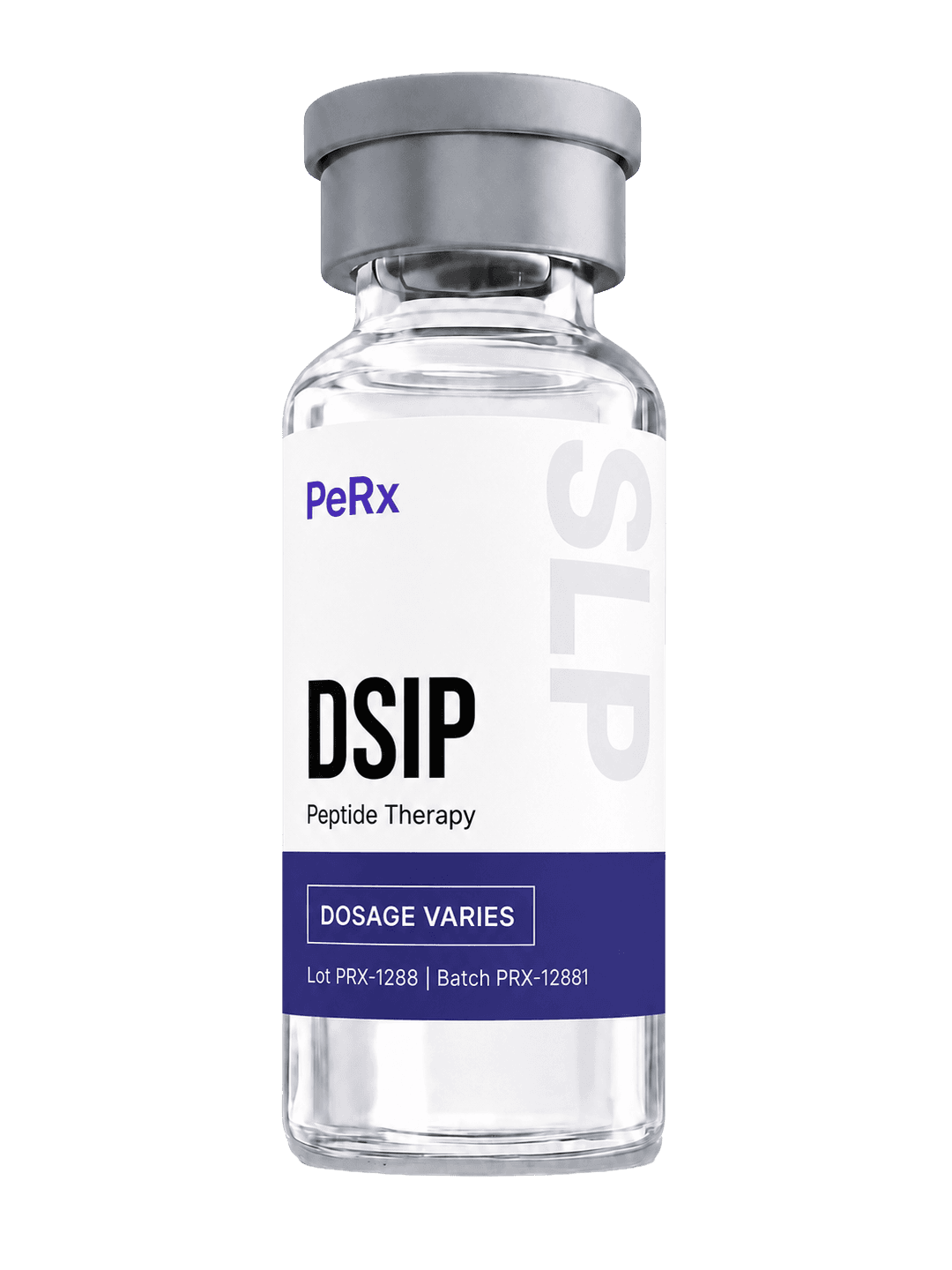
What PeRx Prescribes for DSIP
PeRx DSIP Protocol
Concentration
1 mg/mL, 5 mL vial
Dose
20 units (0.2 mL, 200 mcg)
Route
Subcutaneous, 29 to 31 gauge insulin syringe
Timing
At bedtime, right before you lie down
Days
Monday through Friday
Vial lasts
25 doses, about five weeks
Storage
Refrigerate 36 to 46°F. Do not freeze.
That box is the whole label, and this page stays on the numbers inside it. Site selection is a separate question with a short answer, abdomen or thigh, and a longer one about rotation and low-light technique covered in where to inject DSIP. If you have never given yourself a subcutaneous injection of anything, how to inject peptides walks through the mechanics from the first alcohol swab. And for what DSIP actually is, a nonapeptide pulled from the cerebral blood of sleeping rabbits in the 1970s with one of the strangest research histories in the field, start with the DSIP pillar guide.
What the DSIP Trials Actually Dosed
A DSIP dosage page owes you some honesty before it hands you a number. DSIP was characterized in 1977 by Schoenenberger and Monnier in Basel, and the bulk of its human literature dates from the decade that followed, small European and Soviet-era studies with methods that vary from paper to paper. That literature is where every modern protocol ultimately borrows its credibility, so it is worth knowing what it actually says about dose.
Schoenenberger GA, Monnier M. "Characterization of a delta-electroencephalogram (-sleep)-inducing peptide." Proceedings of the National Academy of Sciences. 1977;74(3):1282-1286. View study
The most encouraging human data comes from Schneider-Helmert, who gave 18 chronic insomniacs six intravenous doses of 30 nmol per kilogram across a single week in a sleep laboratory. Sleep normalized in the middle-aged group by the end of the dosing week and in the older group by the end of a follow-up week, and the whole sample showed normal sleep patterns when the study closed. A small study without the machinery of a modern trial, but a real polysomnography result.
Schneider-Helmert D. "Efficacy of DSIP to normalize sleep in middle-aged and elderly chronic insomniacs." European Neurology. 1986;25(6):448-453. View study
The most rigorous study is less flattering. Bes and colleagues ran a double-blind, placebo-controlled trial in 16 chronic insomniacs at 25 nmol per kilogram intravenously and found higher sleep efficiency and shorter sleep latency with DSIP, then noted in their own discussion that the significant effects were weak and concluded short-term DSIP was unlikely to be of major therapeutic benefit. A 2006 review by Kovalzon and Strekalova went further, pointing out that no gene, precursor, or receptor for DSIP has ever been identified and calling the sleep-factor hypothesis poorly documented.
Bes F, Hofman W, Schuur J, Van Boxtel C. "Effects of delta sleep-inducing peptide on sleep of chronic insomniac patients. A double-blind study." Neuropsychobiology. 1992;26(4):193-197. View study
Kovalzon VM, Strekalova TV. "Delta sleep-inducing peptide (DSIP): a still unresolved riddle." Journal of Neurochemistry. 2006;97(2):303-309. View study
Now notice what those trial doses were. At DSIP’s molecular weight, 25 to 30 nmol per kilogram works out to roughly 1.5 to 1.8 mg for a 70 kg adult, given intravenously. The subcutaneous doses prescribed today are about a tenth of that, by a different route, and no study has ever mapped one onto the other or established a dose-response curve at any dose. That is the honest foundation under every DSIP chart, including this one: the conversion table is exact, and the biology behind the chosen dose is not. It is also why the label, not the literature, governs what you inject.
Why DSIP Is Dosed at Bedtime
DSIP degrades fast, with a half-life around 15 minutes in vitro, and whatever it does to sleep architecture it does around the transition into sleep. The protocol is built for that window: the injection goes in right before you lie down, so the peptide’s brief active period overlaps the moment your brain is deciding whether to descend into slow-wave sleep. Taking it at lunch is not a small scheduling change. It is a different protocol, and not the prescribed one.
Unlike the growth hormone peptides, DSIP carries no fasting rule; dinner does not blunt it as far as anyone has shown. The cautions that do matter are about what DSIP is: a compound taken for sleep. The PeRx instructions say not to drive or operate machinery until you know how it affects you, and to be careful stacking it with alcohol or sedating medications the provider has not signed off on. Where the sleep peptides sit relative to each other, and why depth and timing are different problems, is mapped in the best peptides for sleep.
The practical version
Lights low, lamp on. Draw to the 20-unit mark reading the barrel at eye level, inject in the abdomen or thigh, cap the sharp into the container, lie down. The whole routine takes about ninety seconds and belongs at the very end of your evening, not the middle.
The 100 to 250 mcg DSIP Range
Search for DSIP dosing and the range you will meet everywhere is 100 to 250 mcg before bed. That range is clinical convention, the band most prescribers and compounding protocols have settled into, and it is worth being clear that convention is what it is: the trials above did not test it, and there is no published curve showing 250 mcg outperforms 100 mcg. At the PeRx concentration the endpoints are simply 10 and 25 units on the syringe, and the PeRx prescription sits at 200 mcg, inside the band and on a round 20-unit draw that is easy to read at eleven at night.
The absence of a dose-response curve cuts one way in practice: more is not better, it is just more. If the effect you notice at 200 mcg is nothing, doubling the draw has no evidence behind it and grogginess against it. The PeRx instructions are blunt on that last point: waking up groggy means the dose was too high for you, and the printed guidance is to halve the next one. Raise anything beyond that with your provider at the renewal check-in, and if a dose change is warranted it will arrive as a new instruction on the label, which always outranks a table on a blog.
DSIP Cycle Length: How Long to Run It
Tolerance and dependence have not been documented in the DSIP literature, and the practical consequence shows up in how it is scheduled. DSIP is one of the few peptides that can be run continuously without a mandated off period; typical courses run three to six months with a re-evaluation at each renewal, and some patients use it only on nights when sleep has been poor, which is functional rather than scheduled cycling. Both patterns and the reasoning behind them are laid out in the peptide cycling guide.
The vial math is tidy either way. Twenty units, Monday through Friday, empties a 5 mL vial in 25 doses, five weeks of school-night sleep on a one-vial-per-month prescription at $229. Two off nights a week also give you a built-in read on progress: if Saturday sleep without an injection starts resembling Wednesday sleep with one, that is worth mentioning at the renewal. And whatever the syringe is doing, the boring fundamentals still carry most of the load. DSIP layers onto consistent sleep and wake times, a dark cool room, and restrained caffeine; it does not replace them, and it is not a sedative, a distinction unpacked in DSIP vs melatonin.
DSIP and the July 2026 FDA Vote
One regulatory note belongs on a 2026 dosing page. On July 24, 2026, the FDA’s Pharmacy Compounding Advisory Committee finished a two-day review of seven peptides proposed for the 503A bulks list and recommended six of them. The one it declined was Emideltide, the compounding name for DSIP, in a narrow 6-7 vote. That is a declined recommendation, not a ban and not a scheduling action. DSIP came off the FDA’s restricted Category 2 list in April 2026 and sits in the same gray zone today as it did the week before the meeting: prescribed by a licensed provider, compounded by a licensed 503A pharmacy. Advisory votes feed a formal rulemaking process that takes a year or more, and nothing about the vote changes the dose, the schedule, or the label. The full tally and what it does and does not mean is in the FDA panel article, and the longer regulatory history lives in is DSIP FDA approved.
DSIP Dosage: Common Questions
Related Guides
Continue reading about peptides and protocols that pair well with this guide.
Where to Inject DSIP: Sites and Bedtime Timing
DSIP is a subcutaneous injection, and the honest answer is that the clock matters more than the map. The dose goes in at bedtime, Monday through Friday. Here is the site rundown, the technique that fits a nighttime routine, and the safety rules that actually change how you take it.
DSIP Peptide: Delta Sleep-Inducing Peptide Guide
Discovered in 1974. Found in your brain, your gut, and your breast milk. Over 500 studies published. And yet: no one has ever found its gene. DSIP does not sedate you. It restores the deep, restorative sleep architecture your body has been losing since childhood. Here is everything science knows about the delta sleep-inducing peptide, everything it does not, and why that mystery might be the most interesting part.
KPV Peptide Benefits: What It Is & How It Works
KPV is three amino acids long, which makes it one of the smallest molecules anyone calls a peptide. Search interest in KPV peptide benefits has grown far faster than the evidence has, and almost none of the literature behind those benefit claims involves humans. Here is what is actually known, what the research supports and does not, why PeRx only supplies KPV inside a four-peptide blend, and what the July 2026 FDA panel vote did and did not do.
Ready to get started?
Pharmaceutical-grade DSIP, prescribed by a licensed provider and shipped to your door ready to use with no reconstitution needed.
Medical Disclaimer
The information provided on this website, including all articles, guides, and educational content, is for informational and educational purposes only and is not intended as medical advice, diagnosis, or treatment. Nothing on this site should be construed as a substitute for professional medical advice from a qualified healthcare provider.
The majority of peptides discussed on this site are not approved by the U.S. Food and Drug Administration (FDA) for the indications described. They are classified as bulk drug substances and are available only through a licensed prescribing provider and compounding pharmacy. All treatments require a valid prescription and provider oversight.
The majority of published research on peptide therapies has been conducted in preclinical (animal) models. While early human data is encouraging, comprehensive clinical trial data remains limited for most peptide compounds. Individual results may vary significantly based on health status, injury type, and other factors. No specific outcomes are guaranteed.
Certain peptides discussed on this site are classified as prohibited substances by the World Anti-Doping Agency (WADA) and are banned by major sports organizations including the NFL, NCAA, UFC, NBA, MLB, NHL, and PGA. If you are subject to anti-doping testing, consult your governing body before considering any peptide therapy.
Statements on this website have not been evaluated by the Food and Drug Administration. Products and therapies discussed are not intended to diagnose, treat, cure, or prevent any disease.
© 2026 Wellness MD Group PC DBA PeRx. All rights reserved.