Growth Hormone Peptides
PeRx prescribes growth hormone peptides through licensed US providers, compounded at state-licensed 503A pharmacies and shipped ready to use to all 50 states. None of the four options here is growth hormone itself. They are secretagogues: peptides for growth hormone release that signal your own pituitary to produce it on the pulsed schedule the body already uses. Sermorelin and Tesamorelin work on the GHRH receptor alone; CJC-1295/Ipamorelin and Tesamorelin/Ipamorelin add a second pathway. Every protocol is provider-led. You complete an assessment, a provider reviews your history, and a vial ships only after they write the prescription.

Growth Hormone Peptides Available at PeRx
Showing 4 peptides in Growth Hormone
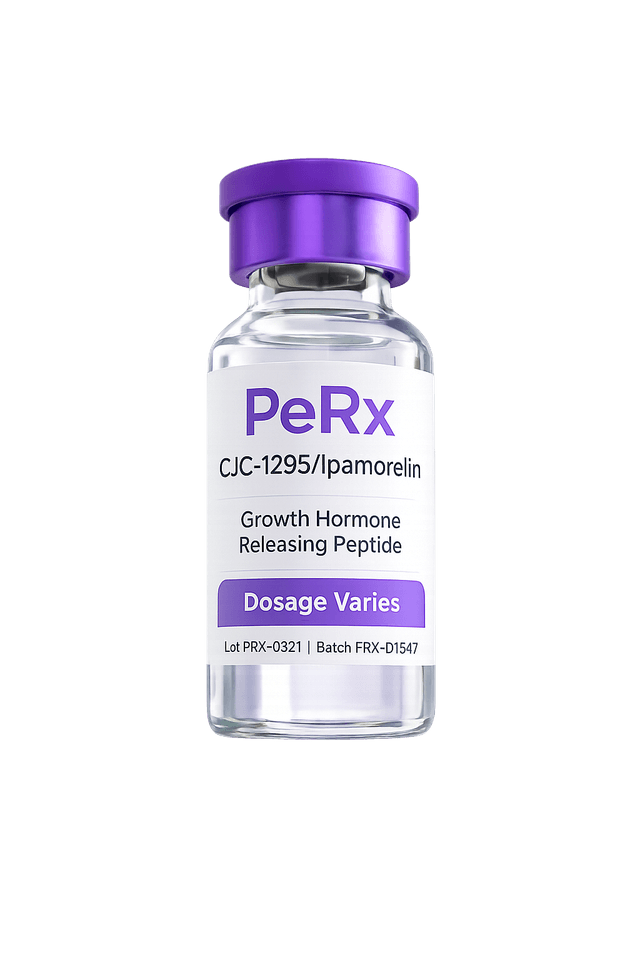
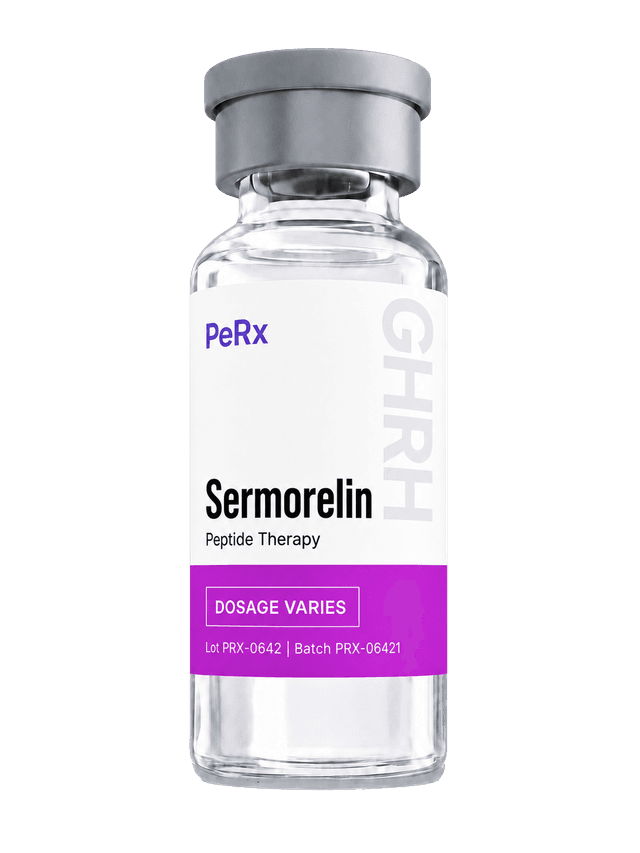
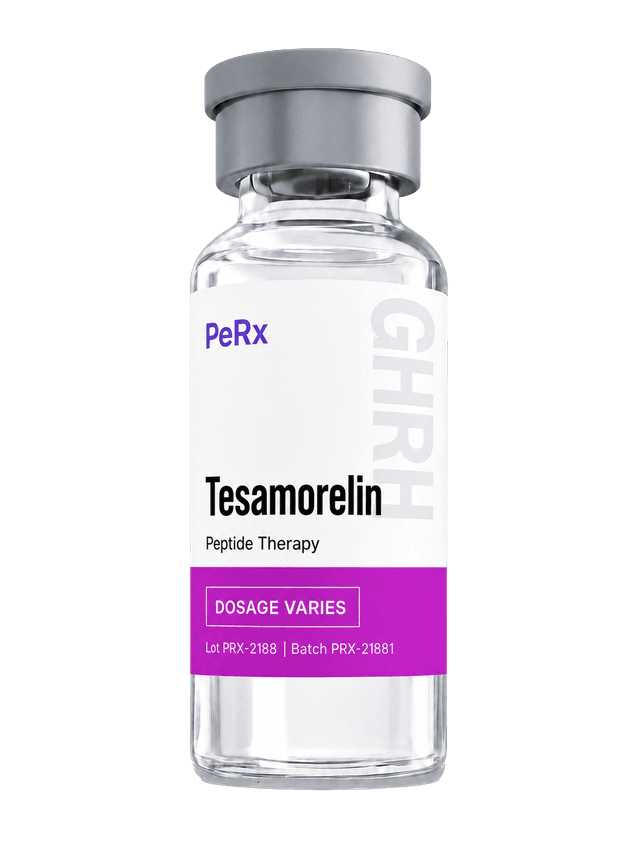
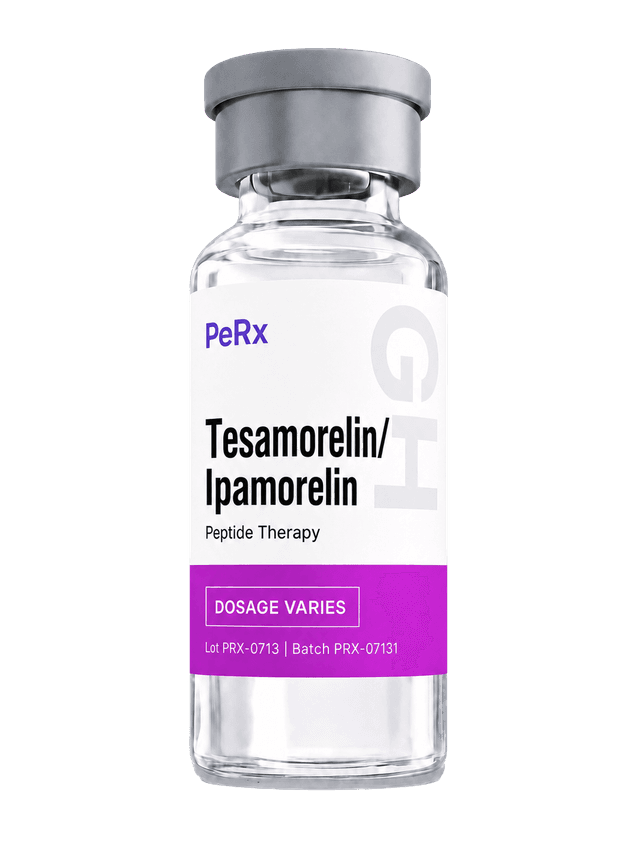
Not sure which peptide is right for you?
Take our 60-second assessment. A licensed US provider reviews and recommends a protocol if appropriate.
How GH Secretagogues Signal Your Pituitary
Growth hormone is not released in a steady stream. The pituitary puts it out in pulses, the largest of them in the first hours of deep sleep, and the size of those pulses shrinks through adulthood. Injected human growth hormone (HGH) replaces the hormone from outside and flattens that rhythm. Growth hormone peptides take the other route: they act upstream, on the signals that tell the pituitary when to release its own supply.
Two signals matter. The hypothalamus sends GHRH, growth hormone-releasing hormone, which is the on switch. A second pathway runs through the ghrelin receptor, and the growth hormone releasing peptides (GHRPs) that bind it amplify the pulse GHRH started. Sermorelin and Tesamorelin are GHRH analogs, built to bind the same receptor the natural hormone does. Ipamorelin is a GHRP, chosen because it triggers a growth hormone pulse without also raising cortisol or prolactin the way older GHRPs did.
Because the peptide only asks the pituitary to release what it can make, the body’s feedback loop stays intact. When growth hormone rises, IGF-1 rises with it, and that IGF-1 signal turns the pituitary back down. That is the mechanistic argument for a secretagogue over HGH: output moves within a physiological range instead of past it. A provider can also see the effect on a lab, since IGF-1 is the standard marker for whether the pituitary is responding. Peptides vs HGH goes through the comparison in detail.
Single-Agent vs Dual-Peptide Stacks: Choosing Your Protocol
Most services that prescribe these compounds offer one GHRH analog and stop there. PeRx offers the single agents and the stacks, and the difference is worth understanding before a provider recommends one.
A single GHRH analog is the foundational choice. A sermorelin growth hormone peptide protocol is the one with the longest clinical record: Sermorelin was approved as Geref in 1997 for pediatric growth hormone deficiency and discontinued in 2008 for commercial reasons, not safety, which the FDA confirmed in a 2013 determination. It is where many providers start, especially when sleep is the main complaint. Tesamorelin is the other single agent, a longer GHRH analog with a specific record on visceral fat.
A dual-peptide stack pairs a GHRH analog with a GHRP so both pathways fire at once. CJC-1295/Ipamorelin uses the no-DAC form of CJC-1295, which acts on the GHRH receptor for roughly thirty minutes and then clears, so the release stays pulsatile rather than continuous. Ipamorelin adds the ghrelin-receptor signal in the same window. The two together produce a larger pulse than either alone, which is the reason the stack exists. Why We Pair CJC-1295 With Ipamorelin explains the no-DAC decision.
Tesamorelin/Ipamorelin applies the same logic with Tesamorelin as the GHRH half, for people whose goal is visceral fat and lean mass together. Neither stack is a human growth hormone peptide in the sense of replacing the hormone; both are still secretagogues, and a provider decides which pairing, if any, fits your history.
What Growth Hormone Peptides Are Used For
People ask about growth hormone peptides for four reasons, and the honest framing for each is “may support,” because the compounded versions have not been studied in the trials the branded products were.
Fat metabolism, especially visceral fat. Growth hormone drives lipolysis, and Tesamorelin has the clearest record here: in trials of the branded product in HIV-associated lipodystrophy, it reduced visceral fat measured by CT. Providers extrapolate from that when a patient’s concern is deep abdominal fat, while being clear that the compounded product is not the one studied. Tesamorelin after GLP-1 covers the common case of using it once the scale has already moved.
Recovery and lean-mass support. Growth hormone and IGF-1 are anabolic signals for muscle and connective tissue. The practical effect people describe is recovering faster between training sessions and holding muscle during a calorie deficit, which is why CJC-1295/Ipamorelin also appears on the Muscle Growth and Weight Loss pages.
Sleep quality. Because the largest natural growth hormone pulse happens in slow-wave sleep, and these peptides are dosed at bedtime to ride it, deeper sleep is usually the first change patients report, often within the first few weeks.
Skin and hair. Slower and less certain. Growth hormone supports collagen turnover, and some patients notice skin texture change over months. Peptides for growth hormone release are not a skin treatment in the way GHK-Cu is, and a provider will say so if that is the main goal.
Eligibility, Contraindications & What to Expect
A growth hormone peptide is a prescription medication, and eligibility is decided by a licensed provider rather than at checkout. PeRx prescribes to adults 21 and older who complete the health assessment. It generally suits adults noticing the slow decline in sleep, recovery and body composition that comes with falling growth hormone output.
Some histories rule it out. Active or recent cancer is a hard stop, because growth hormone and IGF-1 are growth signals. So are pregnancy and breastfeeding. Diabetes or insulin resistance needs a careful conversation, since growth hormone raises blood glucose. Pituitary disease or surgery means a growth hormone-releasing peptide has nothing functional to act on. Screening covers each of these before a provider sees your file.
What to expect once approved: injection site redness is the most common side effect and usually settles on its own. Water retention, tingling in the hands and a temporary rise in appetite can happen in the first weeks and tend to ease. Nothing about a growth hormone peptide protocol produces overnight change; sleep tends to shift first, energy and recovery over four to eight weeks, body composition over three to six months.
Compounded medications require a valid prescription, and a compounded growth hormone peptide is not FDA-approved. Tesamorelin has an FDA-approved indication as Egrifta for HIV-associated lipodystrophy; that approval does not extend to the compounded product or to fat-loss, anti-aging or athletic use, and PeRx does not claim that it does. Results vary.
Start Your Growth Hormone Peptide Protocol
Starting a peptide growth hormone protocol at PeRx takes three steps and no office visit.
First, take the 60-second assessment. It covers your goals, your health history and the screening questions above. Then choose your peptide and save a card. You are not charged at that point.
Second, a licensed US provider reviews your file. If they approve, they write the prescription, set your dose and timing, usually at bedtime and away from food, and only then is your card charged. If they do not approve, you are not charged at all. If your labs matter to the decision, they will ask for them before prescribing rather than after.
Third, the pharmacy ships one vial, ready to use, in cold-chain packaging with syringes, alcohol swabs and instructions. Nothing ships before a prescription is approved. Growth hormone peptides are prescribed per cycle, so a refill goes back through a provider who checks how you responded rather than renewing on its own.
If you are not sure whether a single agent or a stack fits, take the assessment and let a provider make the call. If you would rather ask first, talk to us.
Compare Growth Hormone Peptides
The four growth hormone peptides at PeRx split by pathway: two single GHRH analogs and two GHRH-plus-GHRP stacks. The mechanism column is what a provider reasons from; the right-hand column is what patients usually describe when they ask, and a provider may still choose differently based on your history.
| Product | Mechanism | Best for |
|---|---|---|
| CJC-1295/Ipamorelin | Dual GHRH + GHRP secretagogue combo | Strong pulsatile GH release, muscle and recovery |
| Sermorelin | GHRH analog (single agent) | Foundational GH support, sleep, established option |
| Tesamorelin | GHRH analog | Visceral fat reduction |
| Tesamorelin/Ipamorelin | Dual GHRH + GHRP combo | Visceral fat and lean muscle together |
Frequently Asked Questions
What are growth hormone peptides and how do they work?
They are secretagogues: short peptides that signal the pituitary to release its own growth hormone in pulses, unlike a human growth hormone peptide injection that replaces it from outside. GHRH analogs such as Sermorelin start the pulse; growth hormone releasing peptides such as Ipamorelin amplify it. The feedback loop stays intact.
What's the difference between a single peptide and a combo stack like CJC-1295/Ipamorelin?
A single agent works one pathway, the GHRH receptor. A stack adds a GHRP on the ghrelin receptor so both fire together, producing a larger pulse. Single agents are the foundational, longest-studied option; stacks are for when a provider wants a stronger release. Either way these are peptides, growth hormones are what your pituitary makes.
Do growth hormone peptides require a prescription?
Yes. Growth hormone peptides are prescription-only compounded medications in the United States, Sermorelin, Tesamorelin, CJC-1295 and Ipamorelin included, and compounded medications require a valid prescription. At PeRx a licensed provider writes it after reviewing your assessment, before any charge is made.
Is Tesamorelin FDA-approved?
Tesamorelin is FDA-approved as Egrifta for one indication: excess abdominal fat in HIV-associated lipodystrophy. Compounded tesamorelin at PeRx is not that product, and the approval does not extend to fat-loss, anti-aging or athletic use. It is prescribed off-label by a licensed provider.
How long until I notice results from GH peptide therapy?
On a sermorelin growth hormone peptide protocol, sleep is usually first, often within a few weeks of bedtime dosing. Energy and recovery tend to build over four to eight weeks. Body composition and skin changes are slowest, developing over three to six months. Response varies with age, baseline levels, timing and consistency.