DSIP Peptide Benefits: Which Claims Hold Up
DSIP is named after an effect that was proposed in the 1970s and never firmly established. The clinic pages listing its benefits rarely mention that two research teams tried to reproduce the sleep findings and could not, that every human study used an intravenous drip rather than the injection people are actually prescribed, or that an FDA advisory committee looked at all of it in July 2026 and declined to recommend the peptide. Here is each claimed benefit, graded by what was measured and in whom.

In this article
Key Takeaways
- DSIP was named for an effect that has never been firmly established. It was isolated in the 1970s and proposed as a delta-wave sleep factor, and a 1986 review of the field concluded there was insufficient evidence that it reliably induced or maintained sleep. Forty years later that has not changed much.
- The widely quoted "59 percent increase in total sleep time" describes something narrower than it sounds. It came from six healthy volunteers given an intravenous infusion at nine in the morning, and it measured sleep during the 130 minutes right after the drip, not a night of sleep.
- Two independent teams tried to reproduce the sleep benefit in people with chronic insomnia and could not. The one study with a genuine separate placebo group concluded short-term treatment was "not likely to be of major therapeutic benefit."
- One of those teams measured sleep stages directly and found that slow-wave sleep, the delta sleep the peptide is named for, was not modified at all. The increase it did find was in stage 2, a lighter stage.
- Every human study used an intravenous drip. FDA reviewers searching the literature in 2026 found no study of effectiveness and no safety data for subcutaneous injection, which is the only form a US clinic can prescribe, including ours.
- The cortisol claim has been tested in people and did not hold. A 1995 study in healthy men found DSIP did not affect ACTH or cortisol release, and the authors wrote that their data do not support an inhibitory role in man.
- On July 24, 2026 an FDA advisory committee declined to recommend DSIP for the compounding list by 6 to 7 with one abstention. Of the seven peptides reviewed over those two days, it was the only one the committee voted against.
DSIP Benefits at a Glance
What It Is
A nine-amino-acid peptide first isolated from rabbit brain material in the 1970s
Named For
Delta-wave sleep, a proposed function that was never firmly established
Best Human Evidence
Small intravenous studies in chronic insomnia, with conflicting results
Failed to Replicate
Two teams found weak or no benefit against placebo
Tested by Injection?
No. FDA found no effectiveness or safety data for the subcutaneous route
How PeRx Supplies It
Subcutaneous 1 mg/mL vial, prescribed after screening, $229
What Are the Benefits of DSIP?
DSIP has been studied for deeper sleep, sleep quality in chronic insomnia, pain, and symptoms of opioid and alcohol withdrawal. None of those uses is settled. The human record is a handful of small studies run between 1981 and 1992, mostly by one research group, and when two other groups ran similar experiments they did not find the same thing. The peptide is interesting. The marketing around it is considerably more confident than the evidence underneath it.
What the FDA reviewers actually concluded
Preparing for the July 2026 advisory meeting, FDA staff searched PubMed, Embase, the Cochrane database, ClinicalTrials.gov and the adverse event reporting system. They concluded there is "insufficient information concerning effectiveness" for chronic insomnia, narcolepsy and opioid withdrawal, and that the insomnia studies "appear to be inconclusive and at best preliminary." They also noted that authors did not reach the same conclusions as each other, and that the studies reporting a positive response had "poor study methodologies."
How to Read the Evidence Grades
A benefits list that puts a rabbit experiment next to a human trial makes both look equally solid. The grades below rank findings by how much weight they can carry. For DSIP the interesting thing is where the evidence clusters, and it is not near the top.
| Tier | What it means | What DSIP has here |
|---|---|---|
| Tier 1: Controlled trial | A separate group got placebo and outcomes were compared between groups | One study, in 16 people. It found weak effects and no meaningful benefit |
| Tier 2: Study without a placebo arm | People got the peptide, and results were compared to their own baseline or to outside controls | Most of the positive findings, all from one research group |
| Tier 3: Open-label series | Everyone knew what they were getting and there was no control | The source of the durable "months of normal sleep" claim, in seven patients |
| Tier 4: Animal and laboratory | Rodents, tissue, or cells | The bulk of the literature, including the longevity and tumor findings |
Tier 1: Controlled trial
- What it means
- A separate group got placebo and outcomes were compared between groups
- What DSIP has here
- One study, in 16 people. It found weak effects and no meaningful benefit
Tier 2: Study without a placebo arm
- What it means
- People got the peptide, and results were compared to their own baseline or to outside controls
- What DSIP has here
- Most of the positive findings, all from one research group
Tier 3: Open-label series
- What it means
- Everyone knew what they were getting and there was no control
- What DSIP has here
- The source of the durable "months of normal sleep" claim, in seven patients
Tier 4: Animal and laboratory
- What it means
- Rodents, tissue, or cells
- What DSIP has here
- The bulk of the literature, including the longevity and tumor findings
DSIP Benefits, Graded
Deeper delta-wave sleep
This is the namesake claim, and it is the one with the most complicated history. The number that circulates everywhere is a 59 percent increase in total sleep time. It is real, it is published, and it describes something much narrower than a better night of sleep. Six healthy middle-aged volunteers received an intravenous infusion at nine in the morning. Researchers then measured how much they slept during the 130 minutes that followed, and the median sleep time in that window was 59 percent higher than after placebo. It was a daytime nap window in six people who did not have a sleep problem, and the authors noted the compound produced no sedation in the ordinary pharmacological sense.
Schneider-Helmert D, Gnirss F, Monnier M, Schenker J, Schoenenberger GA. "Acute and delayed effects of DSIP (delta sleep-inducing peptide) on human sleep behavior." International Journal of Clinical Pharmacology, Therapy and Toxicology. 1981;19(8):341-345. PMID 6895513. View study
The stronger test of a delta-sleep claim is whether delta sleep itself moves, and one team measured exactly that. In six people with severe chronic insomnia given intravenous DSIP across four nights, total sleep time and non-REM sleep did rise, but the researchers traced the increase to stage 2, a lighter stage. Slow-wave sleep, meaning stages 3 and 4, the delta sleep the peptide is named after, was not modified. Neither was REM. Their conclusion was that the sleep improvement was of little clinical significance.
Monti JM, Debellis J, Alterwain P, Pellejero T, Monti D. "Study of delta sleep-inducing peptide efficacy in improving sleep on short-term administration to chronic insomniacs." International Journal of Clinical Pharmacology Research. 1987;7(2):105-110. PMID 3583493. View study
Sleep quality in chronic insomnia
Here the literature splits along a line worth understanding, because it is the difference between a study that can show an effect and one that cannot. The encouraging results come from a single group. In a 1987 study, 14 middle-aged people with chronic insomnia received intravenous DSIP for seven consecutive nights, and sleep efficiency and daytime alertness reportedly reached the levels of a healthy comparison group. FDA reviewers reading the same paper pointed out that although the authors described it as placebo-controlled, there was no placebo arm in it. Participants got placebo on an initial baseline night and one night afterward, and were otherwise compared against outside controls.
Schneider-Helmert D. "Effects of delta-sleep-inducing peptide on 24-hour sleep-wake behaviour in severe chronic insomnia." European Neurology. 1987;27(2):120-129. PMID 3622582. View study
The study that did have a real placebo arm found much less. Sixteen people with chronic insomnia were split into two groups, half receiving intravenous DSIP before three consecutive nights and half receiving a glucose solution, with independent raters scoring the sleep recordings. Sleep efficiency and sleep latency came out better on DSIP, but the authors judged the statistically significant effects "weak" and noted they could partly reflect an incidental change in the placebo group. Subjective sleep quality did not move at all. Their conclusion: short-term treatment of chronic insomnia with DSIP "is not likely to be of major therapeutic benefit."
Bes F, Hofman W, Schuur J, Van Boxtel C. "Effects of delta sleep-inducing peptide on sleep of chronic insomniac patients. A double-blind study." Neuropsychobiology. 1992;26(4):193-197. PMID 1299794. View study
The claim that benefits persist for months after stopping traces to a 1984 report of seven patients with severe insomnia given a series of ten injections. Sleep was described as normalized in all but one of them across follow-up periods of three to seven months. That is a striking observation and it is worth taking seriously as a reason to study the peptide properly. It is also an open study: no control group, no blinding, seven people, and the author noted that a long-standing habit of drug dependence in this population may be a complicating factor. It is a starting point for research, not a result you can plan around.
Kaeser HE. "A clinical trial with DSIP." European Neurology. 1984;23(5):386-388. PMID 6391926. View study
Lower cortisol and stress
This one is common on clinic pages and it has been tested directly in people. Researchers infused DSIP into healthy young men and measured the hormone response, first against a corticotropin-releasing hormone challenge and then against the ordinary midday rise that follows a meal. Responses of ACTH and cortisol were almost identical whether the men received DSIP or placebo, and the meal-related surge was unaffected. The authors wrote that their data do not support an inhibitory role of DSIP on ACTH and cortisol secretion in man. Anyone telling you the peptide lowers your cortisol is not describing this study.
Späth-Schwalbe E, Schäfer A, Uthgenannt D, Born J, Fehm HL. "Delta-sleep-inducing peptide does not affect CRH and meal-induced ACTH and cortisol secretion." Psychoneuroendocrinology. 1995;20(3):231-237. PMID 7777652. View study
Pain, withdrawal, recovery and longevity
These sit at the thin end. The withdrawal work is the largest body of human exposure DSIP has and also the least controlled: case reports and unblinded series, which FDA characterised as limited by design, small numbers and widely varying doses. PeRx does not prescribe DSIP for withdrawal or for pain, and withdrawal belongs under direct medical supervision regardless. Recovery and growth hormone claims rest mainly on rodent work plus the assumption that deeper sleep follows, which is the claim still in question. The longevity and tumor findings quoted online come from mice given Deltaran, a preparation combining DSIP with glycine, and FDA noted that glycine has itself been reported to have antimutagenic properties, so those results cannot be read as belonging to DSIP alone.
Graf MV, Kastin AJ. "Delta-sleep-inducing peptide (DSIP): an update." Peptides. 1986;7(6):1165-1187. PMID 3550726. View study
The Route Nobody Has Studied
Every human study described above used an intravenous drip, usually 25 nmol per kilogram infused over a few minutes. That detail gets dropped from almost every benefits page online, and it matters more here than it would for most peptides. FDA reviewers put it plainly: they found no study evaluating effectiveness for the subcutaneous route, and no clinical safety data for it either. What they found was limited pharmacokinetic information for the intravenous route and nothing for the route actually being nominated.
Why route is not a technicality for this molecule
DSIP has a plasma half-life of roughly 8 minutes and is broken down in blood by aminopeptidases. One group found the infusion speed changed the result: the same total dose given over 2.5 minutes, 7.5 minutes, or 1 minute produced different effects on sleep, and infused over a single minute it was completely ineffective. When how fast a drug enters the bloodstream changes whether it works at all, results from a controlled intravenous drip do not transfer automatically to an injection under the skin that absorbs over a different timescale.
This is a real gap and we would rather name it than write around it. PeRx prescribes DSIP by subcutaneous injection because that is the form a 503A pharmacy can compound into a sterile vial at a fixed concentration, not because it is the form the published research used. Dose, timing and units are in the DSIP dosage chart, and where to inject DSIP covers the practical side.
Why the FDA Committee Said No
On July 24, 2026, the FDA Pharmacy Compounding Advisory Committee finished a two-day review of seven peptides proposed for the 503A bulks list. It recommended six of them, in each case against the position of FDA staff, who had opposed all seven. DSIP, nominated under the name emideltide, was the one it declined, by 6 in favour to 7 against with one abstention. Official minutes for the meeting have not been published as of late September 2026, so that tally comes from press coverage rather than from FDA itself. The committee is advisory, its votes do not bind the agency, and a change in either direction requires formal rulemaking that runs well into 2027. Our FDA panel write-up has the full two days.
The reasoning behind the staff position is public, and it is more useful than the vote. FDA concluded the substance is not well characterized: naming conventions in the literature are inconsistent, and tests for impurities, aggregates and endotoxins were missing from what the nominators supplied. Reviewers raised the potential for an immune response to an injected peptide of this length, a risk they considered particularly relevant for injectable routes. They also noted that because DSIP dissolves poorly in water, it was unclear to them how it could be formulated for injection at 1,000 micrograms per millilitre without a co-solvent, which is the concentration that was nominated. And they pointed out that insomnia and narcolepsy are serious conditions with approved treatments that have established efficacy.
The addiction question nobody has answered
FDA reviewers described DSIP's sleep-inducing effect as conserved across species and mediated through opioid-dependent mechanisms. It does not appear to bind opioid receptors directly, but it can stimulate calcium-dependent release of the body's own endorphins, which is also the likely explanation for the pain findings. The reviewers then made the point that follows from it: stimulating the opioid system that way could in principle lead to dependence, and they identified no study, in animals or people, designed to find out. Marketing copy that advertises "no dependence documented" is describing an absence of research, not a finding of safety.
What People Report Versus What Was Measured
Patients on DSIP commonly describe falling asleep more easily in the first few nights, more vivid dreams early on, and mornings that feel less heavy than they do on a sedative. Some describe nothing at all. That is clinic experience and patient report, and it belongs in its own category: nobody has run a trial designed to confirm any of it, sleep is unusually responsive to expectation, and the one controlled study that asked people to rate their own sleep quality found no difference from placebo.
Nights 1 to 3
Whether anything happens at all
The common report is easier sleep onset and more vivid dreaming. This window is also where expectation does the most work, so treat it as information about you rather than about the peptide.
Weeks 1 to 2
A fair read
If sleep is going to feel different, this is usually when people say it does. Tracking sleep the same way each night before and during gives you something better than memory to judge by.
Weeks 3 to 5
The honest checkpoint
One vial at the standard dose runs about five weeks. If nothing has changed by the time it is empty, nothing in the published evidence suggests that continuing will change that.
Who It Fits, and Who It Does Not
Ideal for
Adults with generally healthy sleep who want to try improving its quality, who have read the evidence above and understand they are trying something unsettled rather than taking a treatment. People who have already addressed the boring foundations, meaning a consistent schedule, light exposure, caffeine and alcohol timing, since those outperform anything in this catalog. People who prefer something that has not been shown to cause next-day impairment over a sedative that has.
Consider alternatives if
Anyone whose main problem is a racing mind at bedtime rather than sleep depth, where the Pinealon/PE-22-28/Selank blend is the more sensible starting point. Anyone with a diagnosed sleep disorder, including suspected sleep apnea or narcolepsy, which needs a workup rather than a peptide. Anyone with a history of opioid dependence, given the mechanism described above. Anyone who is pregnant or breastfeeding. And anyone who wants a predictable result, because this is not the molecule for that.
If the goal is simply "sleep better," it is worth reading best peptides for sleep before settling on this one, and DSIP vs melatonin if you have not yet tried the cheapest option. Cognitive behavioural therapy for insomnia is what sleep medicine guidelines recommend first for chronic insomnia, and FDA reviewers noted that those guidelines do not mention this peptide at all.
How DSIP Is Prescribed
DSIP
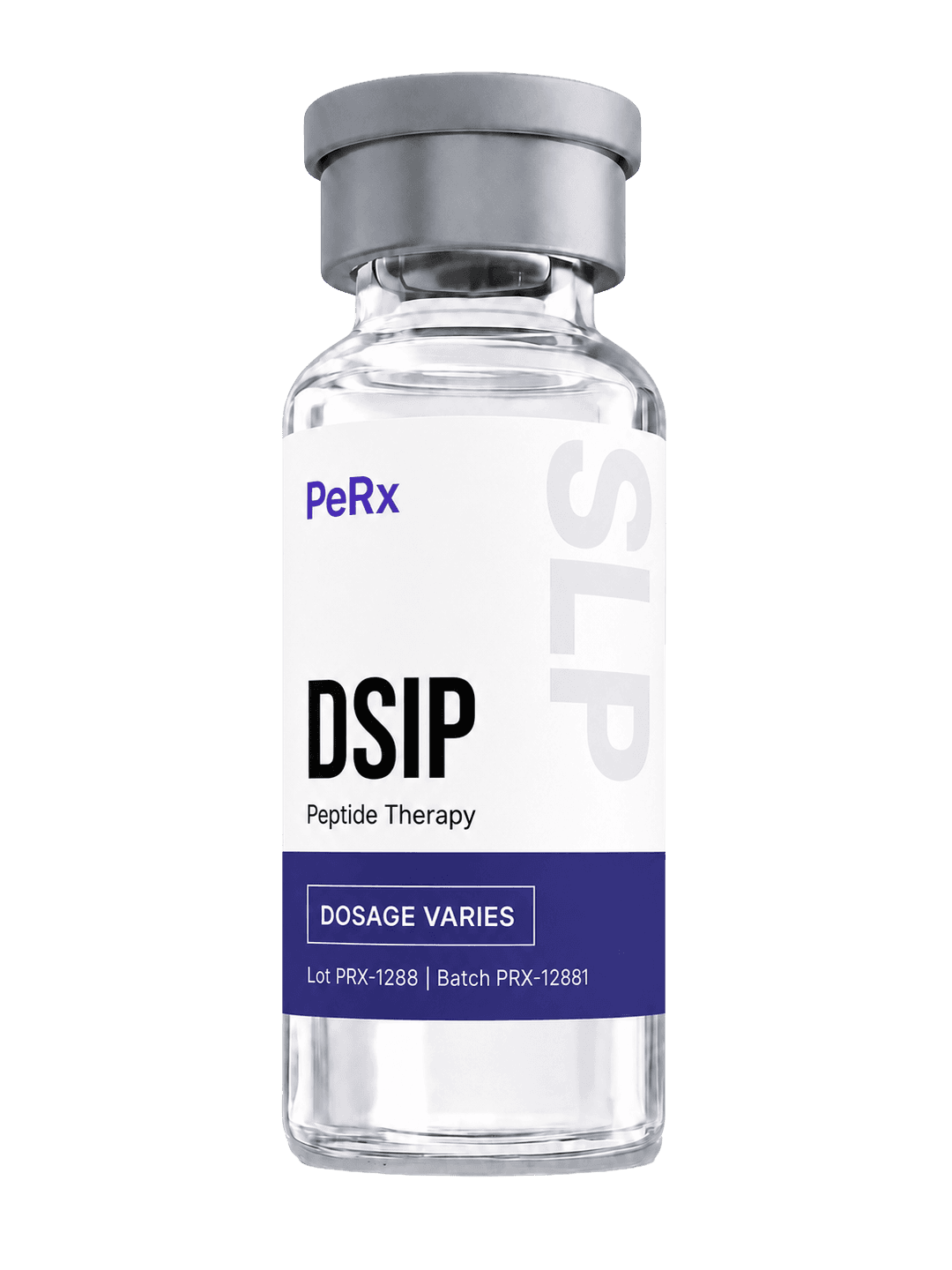
A nine-amino-acid peptide in a 5 mL vial at 1 mg/mL, compounded by a licensed US 503A pharmacy and given as a small subcutaneous injection at bedtime. It arrives fully reconstituted and ready to use, shipped cold, with insulin syringes and alcohol swabs included.
From $229 for a one-month supply. Your card is stored at checkout and only charged once a licensed provider has reviewed your intake and approved the prescription.
Screening exists partly because of the uncertainties on this page. An intake that mentions a diagnosed sleep disorder, a history of opioid dependence, pregnancy or breastfeeding is a reason for a provider to decline or ask more questions rather than to write a prescription. What providers review before prescribing covers how that decision is made, and the background on the molecule itself is in the DSIP pillar guide.
DSIP Benefits: Common Questions
Related Guides
Continue reading about peptides and protocols that pair well with this guide.
DSIP Peptide: Delta Sleep-Inducing Peptide Guide
Discovered in 1974. Found in your brain, your gut, and your breast milk. Over 500 studies published. And yet: no one has ever found its gene. DSIP does not sedate you. It restores the deep, restorative sleep architecture your body has been losing since childhood. Here is everything science knows about the delta sleep-inducing peptide, everything it does not, and why that mystery might be the most interesting part.
DSIP vs Melatonin: Different Sleep, Different Fix
Melatonin tells your body it is dark. DSIP restructures how deep you sleep. One regulates timing, the other regulates quality. They target completely different sleep systems, which is why most people who take melatonin still wake up unrefreshed. Here is the comparison.
How to Read a Peptide COA
A Certificate of Analysis is the lab report behind a peptide vial. Learn to read one line by line: identity, purity, net peptide content, sterility, and endotoxin. Then learn the red flags that separate a real prescription COA from the screenshot a gray-market vendor pastes into a product page.
Ready to get started?
Physician-prescribed DSIP from a licensed US compounding pharmacy, shipped cold with everything you need to start.
Medical Disclaimer
The information provided on this website, including all articles, guides, and educational content, is for informational and educational purposes only and is not intended as medical advice, diagnosis, or treatment. Nothing on this site should be construed as a substitute for professional medical advice from a qualified healthcare provider.
The majority of peptides discussed on this site are not approved by the U.S. Food and Drug Administration (FDA) for the indications described. They are classified as bulk drug substances and are available only through a licensed prescribing provider and compounding pharmacy. All treatments require a valid prescription and provider oversight.
The majority of published research on peptide therapies has been conducted in preclinical (animal) models. While early human data is encouraging, comprehensive clinical trial data remains limited for most peptide compounds. Individual results may vary significantly based on health status, injury type, and other factors. No specific outcomes are guaranteed.
Certain peptides discussed on this site are classified as prohibited substances by the World Anti-Doping Agency (WADA) and are banned by major sports organizations including the NFL, NCAA, UFC, NBA, MLB, NHL, and PGA. If you are subject to anti-doping testing, consult your governing body before considering any peptide therapy.
Statements on this website have not been evaluated by the Food and Drug Administration. Products and therapies discussed are not intended to diagnose, treat, cure, or prevent any disease.
© 2026 Wellness MD Group PC DBA PeRx. All rights reserved.