Peptides for Disc Golf: Tennis and Golfer's Elbow
The hot point on the inside or outside of the elbow that flares with every swing, throw, or hard grip. How peptide therapy is used for lateral and medial epicondylitis in tennis, golf, pickleball, climbing, disc golf, and any gripping work.
In this article
Key Takeaways
- Tennis elbow (lateral epicondylitis) and golfer's elbow (medial epicondylitis) are the same underlying problem: elbow tendinopathy, the slow-healing wear of a loaded tendon. It shows up across racquet, throwing, climbing, and gripping sports, with the shoulder and wrist often along for the ride on the same chain.
- BPC-157 is the core tool here, used for the tendon and soft-tissue side of all three problem spots, with the BPC-157/TB-500 combo as the more aggressive option for stubborn, multi-site overuse.
- GHK-Cu supports the collagen remodeling underneath, and CJC-1295/Ipamorelin or Tesamorelin is the systemic recovery and deep-sleep layer for a body that throws hundreds of times a round.
- The honest part: these are prescription-only, not FDA-approved for injury recovery, and not a painkiller to throw through real damage. The upside for disc golfers is that the PDGA does not drug-test in the US, so the doping caveat that limits every athlete-facing guide does not apply to the recreational player.
The Forehand That Stopped Being Free
The scene
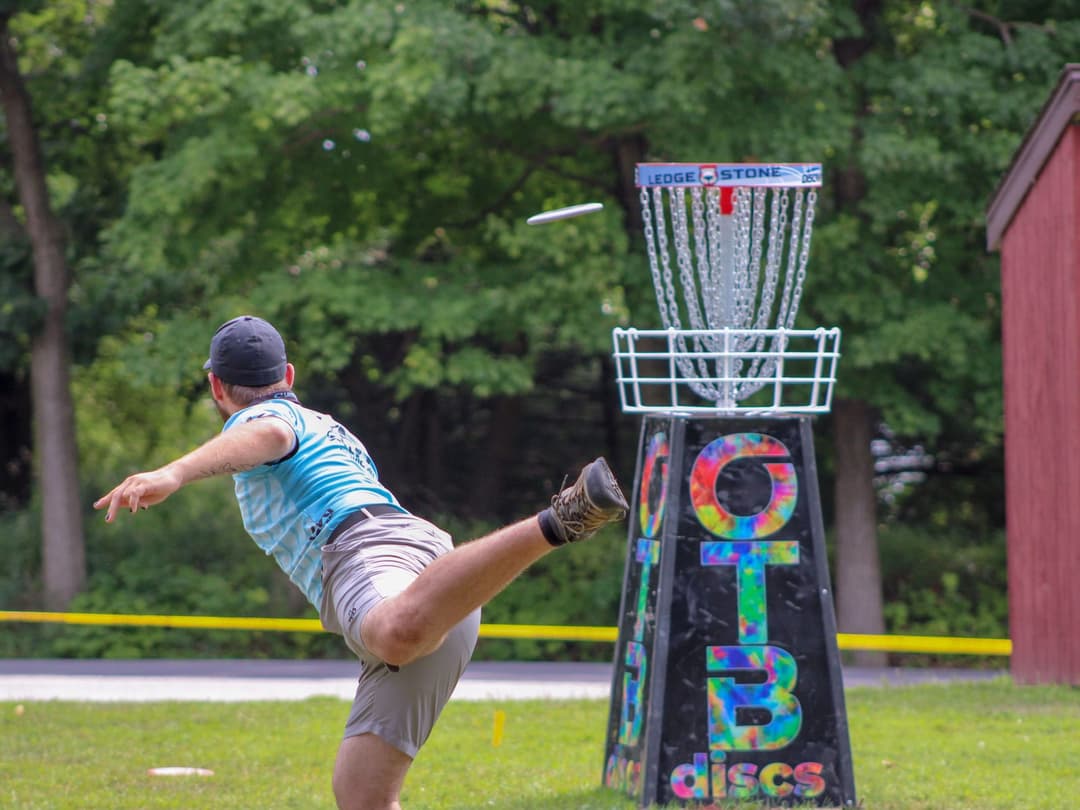
You used to rip a forehand without a second thought. Now there is a hot point on the inside of your elbow that shows up on the first big flick of the round and gets louder from there. By the back nine the throwing shoulder has joined in, that deep ache behind the cap, and you find yourself favoring the backhand and throwing soft. It has been weeks. Rest helps until you play again, and then you are right back where you started.
Disc golf is just one version of a much wider problem. The same hot point on the elbow shows up for the tennis player who lives on a one-handed backhand, the golfer who fat-hits off a mat, the pickleball convert grinding three nights a week, the climber crimping at their limit, and anyone whose work is a full day of gripping, twisting, and squeezing. The names differ. Tennis elbow on the outside is lateral epicondylitis. Golfer's elbow on the inside is medial epicondylitis. Both are elbow tendinopathy, the slow-healing wear of a tendon that has taken one too many loaded reps. The torque just has to land somewhere, and for these athletes and workers it lands on the same few tendons at the elbow, plus the wrist and shoulder along the same chain. When you get a peptide through PeRx, it is prescribed by a licensed provider and compounded in a US-based, FDA-regulated 503A pharmacy, the same regulated pathway many everyday prescriptions go through.
Search for help and you get two things that do not connect. There is a wall of disc golf injury content, all of it ergonomics: flexbar reps, braces, thoracic rotation drills, rest. And there is generic peptide content written for ball golfers and bodybuilders that never says the words "disc golf," "forehand," or "throwing shoulder." This guide bridges the two. It is built for the disc golfer: what the throw actually injures, and the peptides used for that connective-tissue repair.
Where the Torque Actually Lands
Few peptide guides bother to map this for the throwing or gripping athlete, so here it is. The injuries are predictable from the motion, and naming the tissue is the first step to targeting it. The pattern is consistent across racquet, throwing, and grip-heavy sports: the elbow tends to be the loudest complaint, with the shoulder and wrist close behind, and the side that flares depends on whether the load comes through a pulling, snapping forehand-style motion or a gripping, twisting one.
| What the throw demands | What gives out first | The named injury |
|---|---|---|
| Forehand (flick), wrist snap and elbow pronation | Inside of the elbow | Medial epicondylitis ("disc golf elbow"), forearm flexor tendinopathy |
| Backhand and grip-heavy throws | Outside of the elbow and forearm | Lateral epicondylitis (tennis elbow), wrist extensor overuse |
| Max-effort throwing motion, repeated all round | Shoulder | Rotator cuff tendinopathy, supraspinatus strain, impingement |
| Snap and release at high speed | Wrist | Wrist and forearm tendinopathy, TFCC-side wrist strain |
Forehand (flick), wrist snap and elbow pronation
- What gives out first
- Inside of the elbow
- The named injury
- Medial epicondylitis ("disc golf elbow"), forearm flexor tendinopathy
Backhand and grip-heavy throws
- What gives out first
- Outside of the elbow and forearm
- The named injury
- Lateral epicondylitis (tennis elbow), wrist extensor overuse
Max-effort throwing motion, repeated all round
- What gives out first
- Shoulder
- The named injury
- Rotator cuff tendinopathy, supraspinatus strain, impingement
Snap and release at high speed
- What gives out first
- Wrist
- The named injury
- Wrist and forearm tendinopathy, TFCC-side wrist strain
The common thread down the right-hand column is that these are tendinopathies and connective-tissue injuries, not muscle tears. That is the category BPC-157 is used for, and it is why a single peptide covers so much of the disc golf injury map.
Why Rest Alone Keeps Failing
Here is what makes throwing-arm injury so frustrating. A strained muscle has a rich blood supply and heals fast. The structures that nag for months are the slow-healing ones: the tendons at the elbow, the rotator cuff, the wrist tendons, all of which have poor blood flow. They heal slowly precisely because so little blood reaches them, which is why rest, ice, and a flexbar back the pain off without ever finishing the job, and the first hard round brings it all back.
This is why the peptide most used here, BPC-157, is relevant: it promotes angiogenesis, the growth of new blood vessels into healing tissue. For a tendon that heals slowly because it is blood-starved to begin with, improving that supply is the lever the ergonomics toolkit does not pull. The two work together. Fixing your form and easing the load stops the re-injury; the peptide supports the repair underneath.
The Core Tool: BPC-157
BPC-157 is a synthetic peptide based on a sequence found in human gastric juice, and it is the one most associated with tendon and soft-tissue recovery. The human research is still limited, but the preclinical body of work is large and consistent: across many animal models it accelerates the healing of tendon, ligament, and muscle, with the angiogenesis mechanism above as a central part of the story. One frequently cited animal study looked specifically at rotator cuff tendon-to-bone healing, which is exactly the throwing-shoulder problem disc golfers get.
Krivic A et al., "Achilles detachment in rat and stable gastric pentadecapeptide BPC 157: Promoted tendon-to-bone healing and opposed corticosteroid aggravation," Journal of Orthopaedic Research, 2006. View study
For a disc golfer, the appeal is that one tool targets the whole throwing arm, because the elbow, shoulder, and wrist injuries are all the slow-healing connective-tissue kind. The usual pattern is a focused daily block while easing the throwing volume, which is the part that matters most.
Two cautions that matter for throwers
First, BPC-157 is not a painkiller. It does not numb an elbow so you can keep ripping forehands, and using it to throw through a real injury is how a tendinopathy becomes a tear. Ease the throwing load while it heals. Second, it works best on a specific, named injury, not "my whole arm hurts." If everything is wrecked, that is a volume problem, and a few weeks of easy rounds will do more than a vial.
BPC-157 comes as both an oral capsule and a subcutaneous injection. A provider sets the form and protocol, and PeRx ships it ready to use, so there is nothing to mix.
When It Is Multi-Site: The BPC-157/TB-500 Combo
When the throwing arm has more than one thing going at once, the elbow and the shoulder and maybe the wrist, the BPC-157/TB-500 combo is the more aggressive option. TB-500 is a synthetic fragment related to thymosin beta-4, involved in cell migration and tissue repair, and its mechanism is complementary to BPC-157 rather than redundant. Where BPC-157 leans on angiogenesis, TB-500 supports the cell-migration side of healing, which is the rationale for pairing them.
Philp D et al., "The actin binding site on thymosin beta4 promotes angiogenesis," FASEB Journal, 2003. View study
Single versus combo
The single peptide is the common starting point and handles most disc golf tendinopathies. The combo tends to come up for the stubborn, multi-site version a heavy throwing schedule produces over a season. The gray-market world markets a self-dosed "Wolverine stack"; the legitimate version is a prescribed, pharmacy-sourced combination set by a provider.
The Collagen Underneath: GHK-Cu
GHK-Cu is a copper-binding peptide best known for skin, but its underlying role is collagen and connective-tissue remodeling, and that is the angle that matters for a throwing arm under repetitive load. Where BPC-157 drives the active repair of an injured tendon, GHK-Cu is used in support of the slower remodeling of the collagen those tendons are built from. It is a supporting player here rather than the headline, and the connective-tissue evidence is earlier and thinner than the skin research. Think maintenance of tissue under chronic load, not a fix for an acute flare.
Recovery and Sleep: CJC-1295/Ipamorelin and Tesamorelin
CJC-1295/Ipamorelin is a growth-hormone-axis combination used to support systemic recovery and deeper sleep, which matters because collagen turnover and tissue repair happen largely during deep sleep. For the older or higher-volume player, Tesamorelin is a related growth-hormone-releasing-hormone tool that supports the collagen turnover and recovery capacity that decline with age. Both are longer-arc, systemic supports rather than targeted fixes for a single tendon, and a provider decides whether either belongs in the plan.
Friedman SD et al., "Growth hormone-releasing hormone effects on brain gamma-aminobutyric acid levels in mild cognitive impairment and healthy aging," JAMA Neurology, 2013. View study
Is Disc Golf Drug Tested? The Straight Answer
Disc golfers ask this a lot, and the answer is unusually clean compared to most sports.
The straight answer
The PDGA does not run drug testing at sanctioned events in the US, so for recreational and amateur disc golf there is no anti-doping program to worry about. Standard workplace drug panels do not detect therapeutic peptides like BPC-157 either. The one real exception is international competition held under a national anti-doping body, such as a World Championships, where WADA rules apply and BPC-157 is prohibited under category S0. If that is you, this matters; if you are a weekend or league player, it does not.
What is true regardless: every peptide here is prescription-only in the US, none are FDA-approved for injury recovery, and the legal path runs through a licensed provider and a real pharmacy. The point is not to help anyone beat a test. It is that the typical disc golfer is not being tested in the first place, and the rare touring player bound by WADA should know exactly where the line is. Every batch is third-party tested for purity, and each order ships fully reconstituted and ready to use, delivered overnight in refrigerated packaging.
Peptides for Disc Golf: Common Questions
Related Guides
Continue reading about peptides and protocols that pair well with this guide.
Peptides for Welders: Neck, Shoulder and Elbow
For welders, mechanics, construction crews, and tradespeople who load the same joints every shift. How peptide therapy is used for the connective-tissue wear that physical work leaves in the neck, shoulder, and elbow.
Peptides for Padel: Elbow, Shoulder and Wrist
The outside of the elbow that flares on every backhand. The shoulder that catches on the overhead. How peptide therapy is used for the tendon wear of the fastest-growing sport in the world.
BPC-157 Capsules vs Injection: Which Route Wins
BPC-157 is the rare peptide with a real oral story, but that does not mean capsule and injection are interchangeable. A physician-reviewed breakdown of gut-local vs systemic delivery, what survives digestion, and how providers choose the route.
Learn more about peptide therapy
Peptide therapy in the US is prescription-only and requires evaluation by a licensed provider. Browse the individual peptides to read about what each one does, or start with the primer.
Medical Disclaimer
The information provided on this website, including all articles, guides, and educational content, is for informational and educational purposes only and is not intended as medical advice, diagnosis, or treatment. Nothing on this site should be construed as a substitute for professional medical advice from a qualified healthcare provider.
The majority of peptides discussed on this site are not approved by the U.S. Food and Drug Administration (FDA) for the indications described. They are classified as bulk drug substances and are available only through a licensed prescribing provider and compounding pharmacy. All treatments require a valid prescription and provider oversight.
The majority of published research on peptide therapies has been conducted in preclinical (animal) models. While early human data is encouraging, comprehensive clinical trial data remains limited for most peptide compounds. Individual results may vary significantly based on health status, injury type, and other factors. No specific outcomes are guaranteed.
Certain peptides discussed on this site are classified as prohibited substances by the World Anti-Doping Agency (WADA) and are banned by major sports organizations including the NFL, NCAA, UFC, NBA, MLB, NHL, and PGA. If you are subject to anti-doping testing, consult your governing body before considering any peptide therapy.
Statements on this website have not been evaluated by the Food and Drug Administration. Products and therapies discussed are not intended to diagnose, treat, cure, or prevent any disease.
© 2026 Wellness MD Group PC DBA PeRx. All rights reserved.