Thymosin Alpha-1 Benefits: What the Evidence Shows
Thymosin alpha-1 is sold online as an immune booster for cold and flu season. The human evidence is narrower and more interesting than that: a better flu-vaccine response in people on dialysis, a run of sepsis trials that ended with a large negative one, and no trial at all of colds or flu in healthy adults. This page grades every claimed benefit by the study behind it.

In this article
Key Takeaways
- Thymosin alpha-1 is an immune-modulating peptide, not an immune booster. The best human evidence is a better antibody response to a flu vaccine in people on hemodialysis, plus sepsis trials in intensive care. Almost all of it comes from people who were already ill.
- No trial has tested thymosin alpha-1 to prevent or treat the common cold or seasonal flu in healthy adults. The only cold study measured the body's own thymosin levels during an experimental rhinovirus infection and gave nobody the peptide.
- The sepsis story is mixed. A 2013 multicenter trial and a 2025 meta-analysis pointed toward lower mortality, and a 2025 placebo-controlled trial of over a thousand adults found no difference. Both results are on this page.
- Thymosin alpha-1 is approved as Zadaxin in more than 35 countries for hepatitis B and other uses. It is not FDA approved in the United States, and compounded thymosin alpha-1 is not an FDA-approved drug either.
- At PeRx it is prescribed by a licensed provider after an eligibility check and filled by a state-licensed 503A pharmacy. Whether it has any role for you, including timing around a flu shot, is a provider conversation.
Thymosin Alpha-1 Benefits: Quick Facts
What it is
A 28-amino-acid peptide first isolated from the thymus. The synthetic form is called thymalfasin, sold abroad as Zadaxin.
Strongest human evidence
Better antibody response to a pandemic flu vaccine in people on hemodialysis, in a small open-label pilot.
Sepsis trials
Lower 28-day mortality in a 2013 trial of 361 patients; no difference in a 2025 placebo-controlled trial of 1,106.
Colds and seasonal flu
No trial in healthy adults. "Immune support" does not mean fewer colds.
Side effects in trials
Usually well tolerated. Injection-site irritation is the most common report.
Regulatory status
Not FDA approved. Approved in 35+ countries as Zadaxin. Compounded by prescription in the US.
Here is the short version of thymosin alpha 1 benefits. It is an immune-modulating peptide, and the best human evidence is a better flu-vaccine response in people with weakened immune systems, plus data in severe infections. There is no trial showing it prevents or treats the common cold in healthy adults, and it is not FDA approved in the US. Everything else on this page is detail, and every claim carries a label that says where it came from.
This is a companion page, not a replacement for the complete thymosin alpha-1 guide, which covers the peptide's history, mechanism and international approvals in depth. The job here is narrower: to take the benefits people search for in cold and flu season and hold each one up against the studies that exist. PeRx prescribes thymosin alpha-1, which is exactly why this page is strict about the difference between what has been shown and what has been assumed.
How to read the evidence labels on this page
Human trial means a controlled or randomized study in people. Pilot or observational means a small, open-label or retrospective human study. Review means a published summary of other studies. Laboratory means cell or animal work. The label matters more than the headline: a laboratory finding describes a mechanism, not a result you can expect.
Thymosin Alpha-1 Benefits at a Glance: What the Evidence Supports
The table below lists the benefits most often attached to the Ta1 peptide and, for each one, the best human evidence that exists, who was studied, and the main reason for caution. Where a row says "no trial," that is the finding. An absence of evidence is worth knowing before anyone spends money on a protocol.
| Claimed benefit | Best human evidence | Population studied | Evidence level | Main caution |
|---|---|---|---|---|
| Flu-vaccine response | Higher antibody titers and more seroconversion at day 21 when given with a pandemic H1N1 vaccine (Carraro 2012), supported by a 2011 review | People on hemodialysis; older and immunocompromised adults in earlier studies | Pilot or observational | Open-label, 94 analyzed, pandemic vaccine; not tested for seasonal shots in healthy adults |
| Severe sepsis | Lower 28-day mortality in a 2013 multicenter trial of 361 patients; no difference in a 2025 placebo-controlled trial of 1,106 | Critically ill adults in Chinese intensive care units | Human trial | The largest and best-designed trial was negative; the earlier trial was single-blind |
| Chronic hepatitis B and C | Older randomized trials, the basis of the Zadaxin approvals abroad | Adults with chronic viral hepatitis | Human trial | Largely replaced by direct-acting antivirals; not an FDA-approved use |
| T-cell counts in severe COVID-19 | Higher T-cell counts and lower mortality in a retrospective series of 76 severe patients; no T-cell benefit in a later retrospective study of 275 | Hospitalized patients with severe COVID-19 in China | Pilot or observational | Retrospective, unmatched, conflicting results |
| HIV as an add-on | Small older studies alongside antiviral therapy | Adults with HIV in the 1990s | Pilot or observational | Predates modern antiretroviral therapy; no current role |
| Preventing or treating colds in healthy adults | No trial. One 1989 study measured natural thymosin levels during an experimental cold and gave nobody the peptide | Healthy volunteers | Laboratory | The most-marketed benefit has the least evidence |
| Seasonal prevention | Not established | None | No evidence | No study has followed healthy people through a winter on thymosin alpha-1 |
Flu-vaccine response
- Best human evidence
- Higher antibody titers and more seroconversion at day 21 when given with a pandemic H1N1 vaccine (Carraro 2012), supported by a 2011 review
- Population studied
- People on hemodialysis; older and immunocompromised adults in earlier studies
- Evidence level
- Pilot or observational
- Main caution
- Open-label, 94 analyzed, pandemic vaccine; not tested for seasonal shots in healthy adults
Severe sepsis
- Best human evidence
- Lower 28-day mortality in a 2013 multicenter trial of 361 patients; no difference in a 2025 placebo-controlled trial of 1,106
- Population studied
- Critically ill adults in Chinese intensive care units
- Evidence level
- Human trial
- Main caution
- The largest and best-designed trial was negative; the earlier trial was single-blind
Chronic hepatitis B and C
- Best human evidence
- Older randomized trials, the basis of the Zadaxin approvals abroad
- Population studied
- Adults with chronic viral hepatitis
- Evidence level
- Human trial
- Main caution
- Largely replaced by direct-acting antivirals; not an FDA-approved use
T-cell counts in severe COVID-19
- Best human evidence
- Higher T-cell counts and lower mortality in a retrospective series of 76 severe patients; no T-cell benefit in a later retrospective study of 275
- Population studied
- Hospitalized patients with severe COVID-19 in China
- Evidence level
- Pilot or observational
- Main caution
- Retrospective, unmatched, conflicting results
HIV as an add-on
- Best human evidence
- Small older studies alongside antiviral therapy
- Population studied
- Adults with HIV in the 1990s
- Evidence level
- Pilot or observational
- Main caution
- Predates modern antiretroviral therapy; no current role
Preventing or treating colds in healthy adults
- Best human evidence
- No trial. One 1989 study measured natural thymosin levels during an experimental cold and gave nobody the peptide
- Population studied
- Healthy volunteers
- Evidence level
- Laboratory
- Main caution
- The most-marketed benefit has the least evidence
Seasonal prevention
- Best human evidence
- Not established
- Population studied
- None
- Evidence level
- No evidence
- Main caution
- No study has followed healthy people through a winter on thymosin alpha-1
Two things stand out when the table is read as a whole. Almost all of the evidence comes from people who were already ill or immune-compromised, which is the population researchers had reason to study. And the benefit people most often buy it for, fewer winter infections in a healthy adult, is the one with no trial behind it. Regulatory status is covered in is thymosin alpha-1 FDA approved.
Thymosin Alpha-1
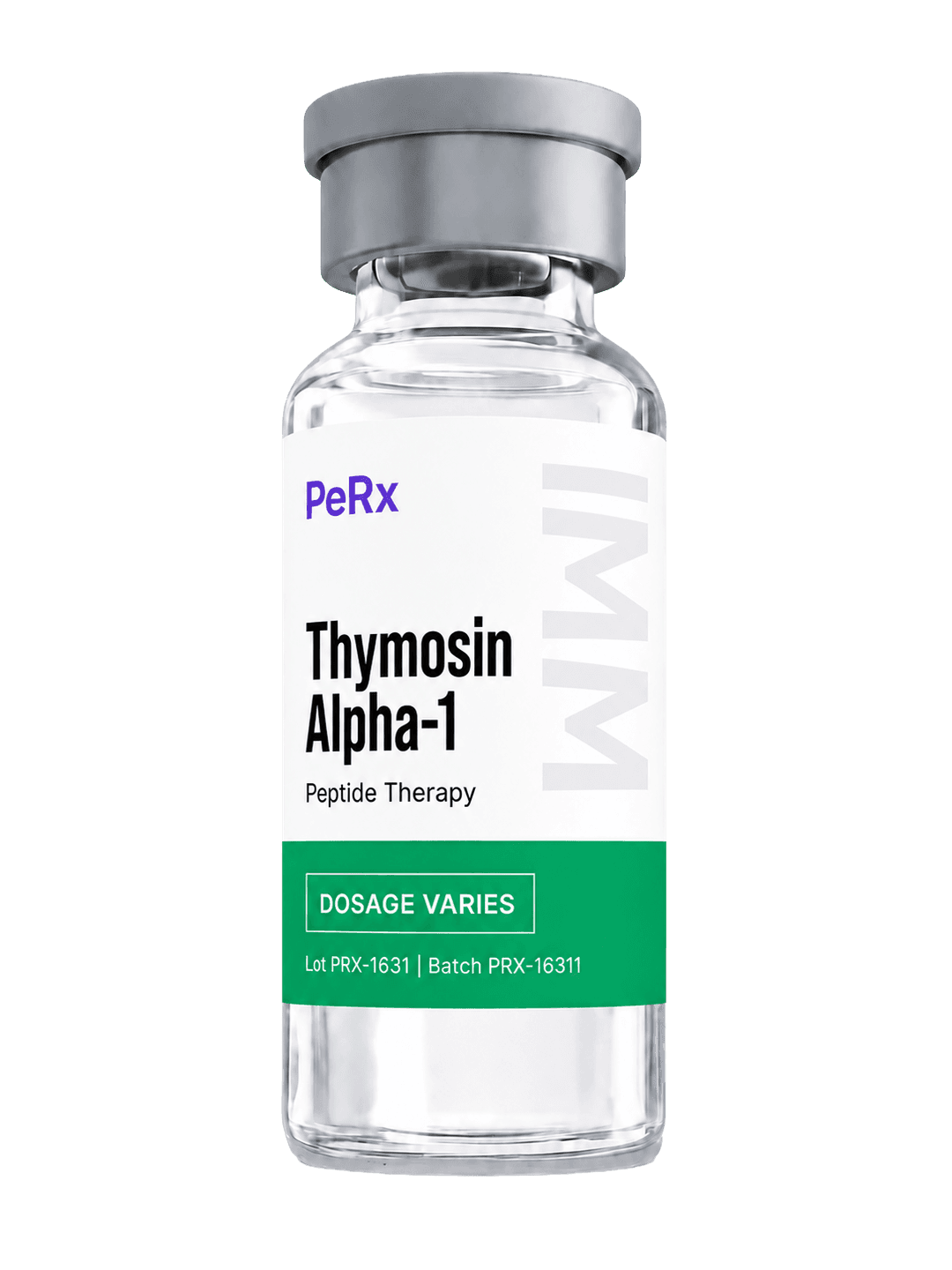
One vial, ready to use. Thymosin Alpha-1 at PeRx is an immune-modulating peptide prescribed by a licensed provider after an eligibility check and compounded at a state-licensed 503A pharmacy, with every lot independently tested for potency, sterility, endotoxins and pH before it ships.
It is prescribed for immune modulation, not to prevent or treat any infection. Compounded thymosin alpha-1 is not an FDA-approved drug, and whether it fits your situation is a decision the provider makes with your history in front of them.
How Thymosin Alpha-1 Supports the Immune System
Everything in this section is mechanism, and mechanism is laboratory work. It explains why researchers thought the thymosin alpha 1 peptide was worth testing in people. It does not show that a person taking it will get fewer infections.
T Cells and Thymic Output
Thymosin alpha-1 is a 28-amino-acid peptide that was first isolated from the thymus, the gland behind the breastbone where T cells mature. The synthetic version, thymalfasin, is the form used in every trial on this page. The proposed effect is simple to state: it appears to help T cells mature and can raise T-cell counts when they are low, which is why the COVID-19 studies measured exactly that. Thymic output falls steadily with age, and that decline is the reason older adults keep appearing as a study population. None of this means the peptide reverses aging. It means the thymus is the organ it was named for, and the organ that shrinks first.
Toll-Like Receptors and Inflammation Balance
In cell and mouse studies, thymosin alpha-1 acts on dendritic cells through toll-like receptors 2 and 9, the sensors that tell the immune system a microbe is present. Through that route it can raise signals such as interleukin-2 and interferon and activate natural killer cells. The same Italian group showed that it also pushes dendritic cells toward a regulatory, tolerance-promoting state, which is the basis for calling it a modulator rather than a stimulant. These are laboratory findings in cells and animals. They describe a plausible mechanism, and a plausible mechanism is where a benefit claim starts, not where it ends. For how this peptide differs from the thymosin beta family, see thymosin alpha-1 vs TB-500.
Thymosin Alpha-1 and Flu Vaccine Response
This is the strongest human evidence for immune support, and it deserves to be described exactly rather than summarized into a slogan.
What the Hemodialysis Pilot Showed
In 2012, Carraro and colleagues published a pilot trial in people on hemodialysis, a group that responds poorly to vaccines because kidney failure blunts the immune system. Participants were split into three groups: an adjuvanted pandemic H1N1 vaccine alone, or the same vaccine plus Zadaxin at one of two doses. Antibody levels were measured on set days out to day 168. In the intention-to-treat analysis of 94 patients, both vaccine-plus-peptide groups had higher antibody titers and a larger share reaching seroconversion at day 21 than the vaccine-only group, and the European regulatory criteria for vaccine immunogenicity were fully met only in the peptide groups. No adverse event was linked to the peptide. One detail that commercial pages leave out: by day 42 the antibody titers were already falling, and they fell faster in the peptide groups. A 2011 review by Panatto and colleagues had reached a similar conclusion from earlier studies in elderly and at-risk adults, which is why the pilot was run.
What It Does Not Show
It was a small, open-label, exploratory pilot in a vulnerable population, using a pandemic vaccine with an adjuvant. That design answers one question: does the peptide improve the antibody response to this vaccine in these patients. It does not show a benefit for seasonal flu vaccines, for healthy adults, or for actually getting sick less often, because none of those were measured. Nothing in it says how long any effect lasts beyond the study window, and the day-42 decline argues against assuming it lasts the season. The honest reading of thymosin alpha 1 benefits here is a real but narrow finding. The vaccine itself is the proven step; whether any peptide has a role around vaccination is a decision for a provider who knows your history, and no dosing schedule for that purpose is published on this site.
Does Thymosin Alpha-1 Help With Colds, Flu and Other Viral Infections?
Colds and Flu in Healthy Adults
No trial has tested thymosin alpha-1 to prevent or treat common colds or seasonal flu in healthy adults. That sentence is the whole finding, and it is worth sitting with before reading any winter marketing. The only cold-related study in the literature is from 1989, when Hsia and colleagues infected healthy volunteers with a rhinovirus and measured their own thymosin alpha-1 and thymosin beta-4 levels, which rose on day five of the cold alongside a rise in T cells. Nobody in that study received the peptide. It tells us the body makes more thymosin during a cold. It does not tell us that giving more helps. "Immune support" is a description of a mechanism, and it does not equal fewer colds.
Severe Infections: Sepsis and COVID-19
The infection evidence that does exist comes from hospitals, not from winter wellness. In 2013, a multicenter, single-blind randomized trial in six Chinese teaching hospitals gave thymosin alpha-1 or usual care to 361 adults with severe sepsis. Twenty-eight-day mortality was 26.0 percent with the peptide and 35.0 percent without, a difference that was borderline for statistical significance, and the peptide group recovered a marker of monocyte function faster. A 2016 systematic review and a 2025 meta-analysis of eleven randomized trials pooled toward lower mortality, but the 2025 analysis found the benefit disappeared when it looked only at high-quality or multicenter trials, and said the total sample was still too small to settle the question.
Then the question was settled, at least for now. In January 2025 the same Guangzhou group published TESTS in the BMJ: a multicenter, double-blind, placebo-controlled phase 3 trial in 1,106 adults with sepsis. Twenty-eight-day mortality was 23.4 percent on thymosin alpha-1 and 24.1 percent on placebo, with no difference on any secondary or safety outcome. Subgroup signals in older adults and in people with diabetes were reported as hypotheses, not findings. For COVID-19, a retrospective review of 76 severe cases in Wuhan in 2020 reported lower mortality and restored T-cell counts in treated patients, while a 2021 retrospective study of 275 patients in Shanghai found no effect on T-cell counts at all. In China the peptide is used in hospital for patients with very low lymphocyte counts. These are critically ill people under specialist care, which is not a model for self-treatment, and the data disagree with each other. The peptide is approved in more than 35 countries for other uses and is not FDA approved in the US; the full thymosin alpha-1 guide covers the hepatitis approvals that earned those licenses.
Who Might Discuss Thymosin Alpha-1 With a Provider, and Who Should Avoid It
The people in whom thymosin alpha-1 has been studied, those with weakened immune systems, older adults and critically ill patients, are also the people who most need specialist supervision. So any use is a provider conversation, including the timing of a course around a flu shot. The groups below should avoid it or ask a clinician first, and a provider reviews history and medications before prescribing; the list is not exhaustive. The what providers review before prescribing guide explains the screening in detail.
| Group | Why | What to do |
|---|---|---|
| Known hypersensitivity to thymosin alpha-1 | The one listed contraindication in the product literature | Do not use |
| Immunosuppressed people, including transplant recipients | The 2020 review lists this as a contraindication unless benefits clearly outweigh risks | Specialist decision only |
| Autoimmune conditions | Modulation cuts both ways; the evidence is limited and condition-specific | Read peptides for autoimmune conditions, then talk to your specialist |
| Pregnant or breastfeeding | No safety data | Avoid |
| Children and adolescents | Not studied for this purpose | Avoid |
| Current fever or active infection | An infection needs diagnosis, not a peptide | See a clinician first |
Known hypersensitivity to thymosin alpha-1
- Why
- The one listed contraindication in the product literature
- What to do
- Do not use
Immunosuppressed people, including transplant recipients
- Why
- The 2020 review lists this as a contraindication unless benefits clearly outweigh risks
- What to do
- Specialist decision only
Autoimmune conditions
- Why
- Modulation cuts both ways; the evidence is limited and condition-specific
- What to do
- Read peptides for autoimmune conditions, then talk to your specialist
Pregnant or breastfeeding
- Why
- No safety data
- What to do
- Avoid
Children and adolescents
- Why
- Not studied for this purpose
- What to do
- Avoid
Current fever or active infection
- Why
- An infection needs diagnosis, not a peptide
- What to do
- See a clinician first
Thymosin Alpha-1 Side Effects and Safety
Thymosin alpha 1 side effects in trials are mild and uncommon, which is part of why the peptide has been studied so widely. Injection-site irritation, redness or discomfort is the most frequent report. Fever, fatigue, muscle aches, nausea and low white-cell counts appeared rarely, almost always in hepatitis trials where the peptide was combined with interferon, a drug that causes all of those on its own. The sepsis trials, including the large placebo-controlled one, recorded no serious drug-related adverse events. So is thymosin alpha 1 safe? In the populations studied, over the study periods, yes by the usual measures. Long-term safety in healthy adults taking it for general immune support has not been established, because that study has not been done, and a product from an unregulated source can be impure or mislabeled regardless of how the molecule itself behaves.
When to call a provider
Hives, facial swelling or trouble breathing after an injection; spreading redness, warmth or fever at an injection site; or an unexplained fever or fatigue that does not settle. Stop the course and contact your provider the same day. The peptide side effects guide covers normal versus red-flag reactions, and the important safety information page applies to every PeRx product. For how each lot is tested before it ships, see how PeRx tests its peptides.
Getting Thymosin Alpha-1 Through a Prescription
The path is the same as for every peptide PeRx prescribes: an eligibility check, a licensed provider's review of your health history, a prescription filled by a state-licensed 503A pharmacy, and a check-in before each renewal. The vial ships fully reconstituted and ready to use, with the dose set by the provider and printed on the paperwork that arrives with it. Compounded thymosin alpha-1 is not FDA approved. Browse the longevity and immune peptides category, read where to inject thymosin alpha-1 once you have a prescription, or start with how to get peptides prescribed online.
Want to know if thymosin alpha-1 fits your situation?
New to PeRx: the eligibility check takes about a minute, and a licensed provider reviews every order before it ships. Already a patient: message your care team with questions about timing, side effects or your next course.
Thymosin Alpha-1 Benefits FAQs
Related Guides
Continue reading about peptides and protocols that pair well with this guide.
Thymosin Alpha-1 2026: The Vanishing Immune Hormone
Your immune system has a master gland. It trained every T-cell you've ever had. And it started disappearing the day you hit puberty. Shrinking, replaced by fat, producing less of the hormone that keeps your defenses sharp. In 1974, a dying five-year-old became the first human to receive that hormone. Her life was saved. Today, the synthetic version is approved in 35+ countries, has been given to patients ages 13 months to 101 years, and has the strongest safety profile of any peptide in clinical use. Here's everything you need to know about Thymosin Alpha-1.
Peptides for Autoimmune Patients: Cautions
Autoimmune disease makes every immune-active therapy a shared decision. A physician-reviewed guide to Thymosin Alpha-1 as an immunomodulator (not a booster), what to tell your rheumatologist, and where caution is non-negotiable.
Peptides vs SARMs: The Difference and Why It Matters
They get lumped together in the same forum threads, but peptides and SARMs are not the same category. One is a class of signaling molecules. The other is a class of synthetic androgen-receptor drugs the FDA has flagged for serious harm. The more useful line, though, is not peptide vs SARM. It is prescribed and tested vs unregulated. Here is the honest comparison.
References and Review
Every evidence label on this page can be checked against the studies below, which were verified against PubMed before publication. Regulatory statements follow the FDA status page. Content current as of November 2026; the sepsis and COVID-19 literature is active and this page will be updated when a new trial changes the picture.
Dominari A, Hathaway Iii D, Pandav K, et al. Thymosin alpha 1: A comprehensive review of the literature. World J Virol. 2020;9(5):67-78. View study
Carraro G, Naso A, Montomoli E, et al. Thymosin-alpha 1 (Zadaxin) enhances the immunogenicity of an adjuvated pandemic H1N1v influenza vaccine (Focetria) in hemodialyzed patients: a pilot study. Vaccine. 2012;30(6):1170-1180. View study
Panatto D, Amicizia D, Lai PL, et al. Utility of thymosin alpha-1 (Zadaxin) as a co-adjuvant in influenza vaccines: a review. J Prev Med Hyg. 2011;52(3):111-115. View study
Wu J, Zhou L, Liu J, et al. The efficacy of thymosin alpha 1 for severe sepsis (ETASS): a multicenter, single-blind, randomized and controlled trial. Crit Care. 2013;17(1):R8. View study
Liu F, Wang HM, Wang T, et al. The efficacy of thymosin α1 as immunomodulatory treatment for sepsis: a systematic review of randomized controlled trials. BMC Infect Dis. 2016;16:488. View study
Gu B, Zhou Y, Nie Y, et al. Efficacy of thymosin α1 for sepsis: a systematic review and meta-analysis of randomized controlled trials. Front Cell Infect Microbiol. 2025;15:1673959. View study
Wu J, Pei F, Zhou L, et al. The efficacy and safety of thymosin α1 for sepsis (TESTS): multicentre, double blinded, randomised, placebo controlled, phase 3 trial. BMJ. 2025;388:e082583. View study
Liu Y, Pan Y, Hu Z, et al. Thymosin alpha 1 reduces the mortality of severe coronavirus disease 2019 by restoration of lymphocytopenia and reversion of exhausted T cells. Clin Infect Dis. 2020;71(16):2150-2157. View study
Wang Z, Chen J, Zhu C, et al. Thymosin alpha-1 has no beneficial effect on restoring CD4+ and CD8+ T lymphocyte counts in COVID-19 patients. Front Immunol. 2021;12:568789. View study
Hsia J, Sztein MB, Naylor PH, et al. Modulation of thymosin alpha 1 and thymosin beta 4 levels and peripheral blood mononuclear cell subsets during experimental rhinovirus colds. Lymphokine Res. 1989;8(4):383-391. View study
Romani L, Bistoni F, Perruccio K, et al. Thymosin alpha1 activates dendritic cell tryptophan catabolism and establishes a regulatory environment for balance of inflammation and tolerance. Blood. 2006;108(7):2265-2274. View study
Bozza S, Gaziano R, Bonifazi P, et al. Thymosin alpha1 activates the TLR9/MyD88/IRF7-dependent murine cytomegalovirus sensing for induction of anti-viral responses in vivo. Int Immunol. 2007;19(11):1261-1270. View study
Medical Disclaimer
The information provided on this website, including all articles, guides, and educational content, is for informational and educational purposes only and is not intended as medical advice, diagnosis, or treatment. Nothing on this site should be construed as a substitute for professional medical advice from a qualified healthcare provider.
The majority of peptides discussed on this site are not approved by the U.S. Food and Drug Administration (FDA) for the indications described. They are classified as bulk drug substances and are available only through a licensed prescribing provider and compounding pharmacy. All treatments require a valid prescription and provider oversight.
The majority of published research on peptide therapies has been conducted in preclinical (animal) models. While early human data is encouraging, comprehensive clinical trial data remains limited for most peptide compounds. Individual results may vary significantly based on health status, injury type, and other factors. No specific outcomes are guaranteed.
Certain peptides discussed on this site are classified as prohibited substances by the World Anti-Doping Agency (WADA) and are banned by major sports organizations including the NFL, NCAA, UFC, NBA, MLB, NHL, and PGA. If you are subject to anti-doping testing, consult your governing body before considering any peptide therapy.
Statements on this website have not been evaluated by the Food and Drug Administration. Products and therapies discussed are not intended to diagnose, treat, cure, or prevent any disease.
© 2026 Wellness MD Group PC DBA PeRx. All rights reserved.