Thymosin Alpha-1 Dosage: Chart, Units, Schedule
Thymosin alpha-1 is unusual among compounded peptides in that its dose was not invented on a forum. There is an approved pharmaceutical version abroad, Zadaxin, with a labeled regimen of 1.6 mg under the skin twice a week, and three decades of trials built around numbers close to it. This page uses that reference point to anchor the chart, converts milligrams to insulin-syringe units at the PeRx concentration of 5 mg/mL, and covers schedule, cycle length, missed doses, and monthly cost, as of August 31, 2026.
In this article
Key Takeaways
- Thymosin alpha-1 has a real pharmaceutical reference dose. Zadaxin (thymalfasin), the approved product in 35+ countries, is labeled at 1.6 mg subcutaneously twice weekly, and most clinical trials used that number or something near it.
- The PeRx prescribed protocol is 20 units on a U-100 insulin syringe (0.2 mL, 1 mg) once daily, Monday through Friday. At the fixed 5 mg/mL concentration, a 5 mL vial holds 25 doses, five working weeks.
- The units math is one line: at 5 mg/mL, each syringe unit holds 50 mcg, so units equals milligrams times 20. The 1.6 mg Zadaxin dose is 32 units; the 1 mg PeRx dose is 20 units.
- Timing is about consistency, not physiology. Unlike growth hormone peptides, thymosin alpha-1 is not coupled to meals or sleep, so any repeatable time of day works.
- There is no cycling. Thymosin alpha-1 is prescribed for continuous use with no washout period, which makes it one of the simplest schedules in the catalog to keep.
- Thymosin alpha-1 is $229 per vial at PeRx, one vial per prescription month, which works out to just over $9 per dose. The dose you inject is always the one on your prescription label.
Thymosin Alpha-1 Dosing at a Glance
Vial
5 mL at 5 mg/mL (25 mg total), ready to use
Prescribed dose
20 units on a U-100 insulin syringe = 0.2 mL = 1 mg
Schedule
Once daily, Monday through Friday
Reference dose
Zadaxin label: 1.6 mg subcutaneously twice weekly
Cycling
None. Continuous use as prescribed.
Cost
$229 at PeRx; a single vial covers the prescription month
Thymosin Alpha-1 Dosage Chart
Most thymosin alpha-1 dosage questions collapse into one conversion problem: the literature talks in milligrams, your syringe is marked in units, and the answer depends entirely on the concentration in the vial. PeRx thymosin alpha-1 ships fully reconstituted and ready to use at a fixed 5 mg per mL, so the conversion never changes. A U-100 insulin syringe holds 100 units per mL, each unit is 0.01 mL, and at 5 mg/mL each unit carries 50 mcg of peptide. Multiply milligrams by 20 to get units.
| Dose (mg) | Units on U-100 syringe | Volume (mL) | Doses per 5 mL vial |
|---|---|---|---|
| 0.5 mg | 10 units | 0.1 mL | 50 |
| 0.75 mg | 15 units | 0.15 mL | ~33 |
| 1 mg (PeRx prescribed) | 20 units | 0.2 mL | 25 |
| 1.5 mg | 30 units | 0.3 mL | ~16 |
| 1.6 mg (Zadaxin label) | 32 units | 0.32 mL | ~15 |
| 2 mg | 40 units | 0.4 mL | 12 |
0.5 mg
- Units on U-100 syringe
- 10 units
- Volume (mL)
- 0.1 mL
- Doses per 5 mL vial
- 50
0.75 mg
- Units on U-100 syringe
- 15 units
- Volume (mL)
- 0.15 mL
- Doses per 5 mL vial
- ~33
1 mg (PeRx prescribed)
- Units on U-100 syringe
- 20 units
- Volume (mL)
- 0.2 mL
- Doses per 5 mL vial
- 25
1.5 mg
- Units on U-100 syringe
- 30 units
- Volume (mL)
- 0.3 mL
- Doses per 5 mL vial
- ~16
1.6 mg (Zadaxin label)
- Units on U-100 syringe
- 32 units
- Volume (mL)
- 0.32 mL
- Doses per 5 mL vial
- ~15
2 mg
- Units on U-100 syringe
- 40 units
- Volume (mL)
- 0.4 mL
- Doses per 5 mL vial
- 12
How to read this chart
The rows above and below the highlighted line exist so you can translate doses quoted in papers and on other sites into syringe units, not so you can choose your own number. Your provider prescribes your protocol, and the dose you draw is the one on your prescription label. At PeRx that is 20 units, a round mark on the barrel that is hard to misread.
One chart, one molecule
A dosing chart labeled "thymosin" is not automatically a thymosin alpha-1 chart. TB-500 comes from a different branch of the same protein family, is used for entirely different reasons, and follows entirely different protocols, and plenty of pages blur the two. Thymosin Alpha-1 is the only standalone thymosin product PeRx carries; TB-500 appears only inside combination blends. The thymus peptides explained guide untangles the family tree if the names look interchangeable.
The Zadaxin Reference Dose
Here is what separates thymosin alpha-1 from nearly every other compounded peptide: its headline dose comes off a drug label. Zadaxin, the pharmaceutical form of thymosin alpha-1 (generic name thymalfasin), is an approved medicine in more than 35 countries, and its labeled regimen is 1.6 mg injected under the skin twice a week. That number was not reverse-engineered from anecdotes. It was carried through formal clinical development in the 1990s and has been the workhorse dose in trials ever since.
Camerini R, Garaci E. "Historical review of thymosin alpha 1 in infectious diseases." Expert Opinion on Biological Therapy. 2015;15 Suppl 1:S117-S127. View study
The US phase III chronic hepatitis B study is a good example of the regimen in action, and of why this page keeps its evidence claims modest. Mutchnick and colleagues randomized 97 patients to 1.6 mg twice weekly or placebo for six months. The dose was well tolerated across the full year of observation, but the efficacy results did not reach statistical significance and did not confirm the stronger findings of earlier, smaller studies. Honest reading: the 1.6 mg twice-weekly regimen has a long tolerability record, and the clinical results across indications are mixed rather than uniform.
Mutchnick MG, Lindsay KL, Schiff ER, et al. "Thymosin alpha1 treatment of chronic hepatitis B: results of a phase III multicentre, randomized, double-blind and placebo-controlled study." Journal of Viral Hepatology. 1999;6(5):397-403. View study
The same 1.6 mg figure shows up in acute-care research. The ETASS trial gave thymosin alpha-1 to patients with severe sepsis across six Chinese hospitals: 28-day mortality was 26.0 percent in the treated group against 35.0 percent in controls, a difference that hovered at the edge of statistical significance, with no serious drug-related adverse events recorded in 361 patients. None of that is a promise about what the peptide will do for a healthy adult using it for immune support. It is context for the dose itself, which has been given to seriously ill people at meaningful scale without a safety signal.
Wu J, Zhou L, Liu J, et al. "The efficacy of thymosin alpha 1 for severe sepsis (ETASS): a multicenter, single-blind, randomized and controlled trial." Critical Care. 2013;17(1):R8. View study
One distinction matters before the math section. Zadaxin the branded drug is approved abroad and is not sold in the United States, and thymosin alpha-1 is not an FDA-approved drug here. What a US patient receives is compounded thymosin alpha-1: the same 28-amino-acid peptide, prepared per prescription by a licensed 503A pharmacy after a licensed provider signs off. The regulatory story, including the orphan drug designation and why the manufacturer never pursued a US approval, is covered in is thymosin alpha-1 FDA approved. For the biology and the full clinical history, start with the thymosin alpha-1 guide. This page stays on the numbers.
How Many Units on an Insulin Syringe?
The arithmetic, worked once. PeRx thymosin alpha-1 is 5 mg per mL. One mL is 100 units on a U-100 insulin syringe, so one unit is 0.01 mL and holds 50 mcg. The prescribed 1 mg dose is therefore 20 units, which is 0.2 mL of solution. If you are translating the Zadaxin label instead, 1.6 mg at this concentration is 32 units. The conversion only holds at 5 mg/mL; a chart written for a different concentration gives different unit counts for the same milligram dose, which is exactly how people end up confused.
PeRx Thymosin Alpha-1 Protocol
Concentration
5 mg/mL, 5 mL vial (25 mg total)
Dose
20 units (0.2 mL, 1 mg)
Route
Subcutaneous, 29 to 31 gauge insulin syringe
Schedule
Once daily, Monday through Friday
Timing
Any consistent time of day; no fasting requirement
Cycle
Continuous. No cycling or washout period.
Storage
Refrigerate 36 to 46°F. Do not freeze.
Draw to the 20 mark, check it at eye level, and inject into subcutaneous fat. At this small volume a misread of a few units is a meaningful fraction of the dose, so read the barrel rather than eyeballing against the vial. Site selection, the five-day rotation map, and the technique details live in where to inject thymosin alpha-1, and if this is your first subcutaneous injection of anything, how to inject peptides walks through the mechanics from hand washing to sharps disposal.
Thymosin Alpha-1
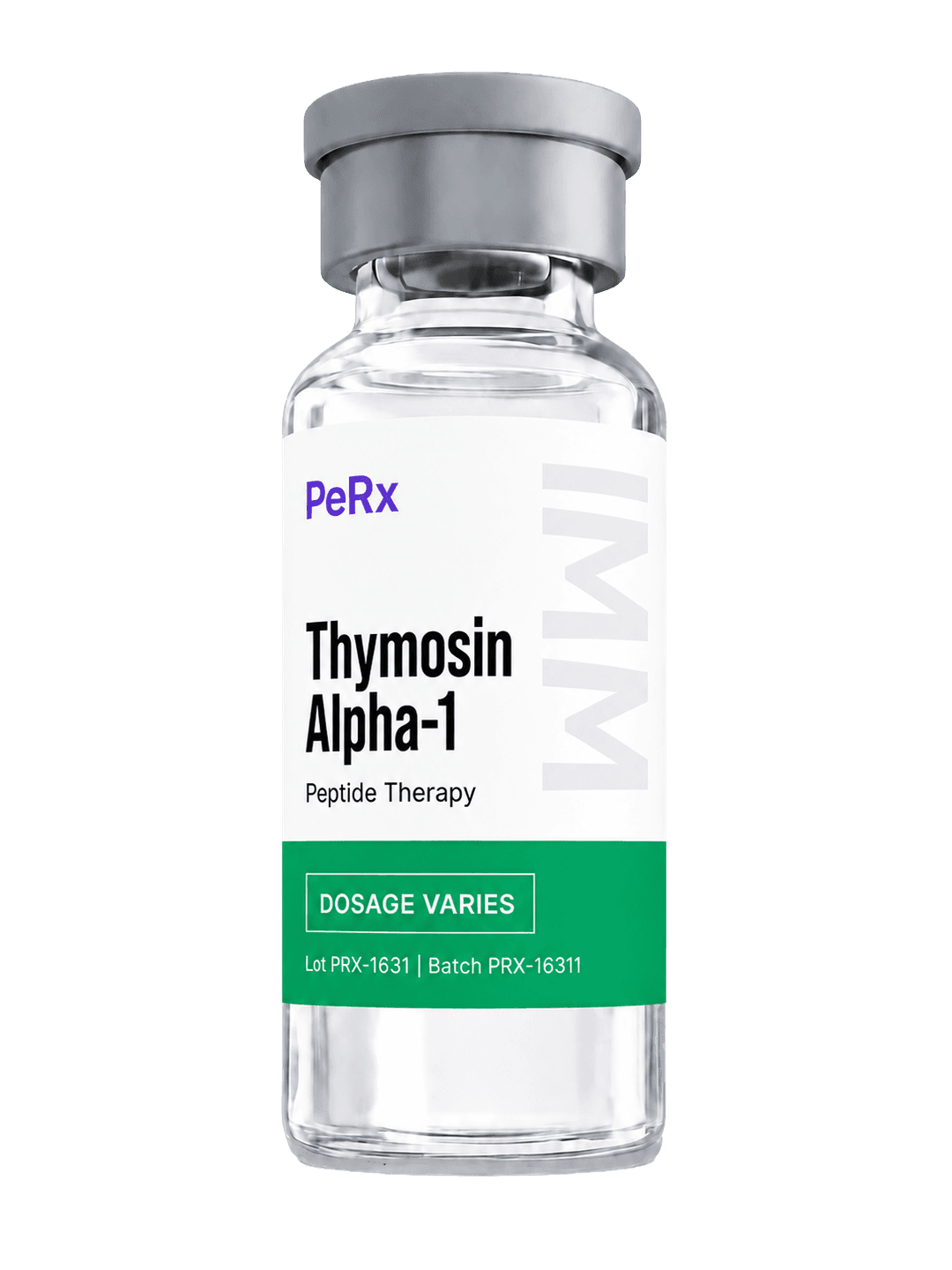
The units math above assumes the PeRx vial: thymosin alpha-1 at 5 mg/mL, prescribed by a licensed provider and compounded at a US-based 503A pharmacy with third-party testing. It ships fully reconstituted and ready to use, with insulin syringes included.
One vial covers the prescription month at $229. Your prescription label carries the exact draw your provider chose, and the Zadaxin reference regimen above stays exactly that: a reference.
Timing and Frequency
Readers coming from our growth hormone peptide pages expect timing rules: bedtime, empty stomach, two hours after dinner. Thymosin alpha-1 has none of them. It does not work by riding a sleep-linked hormone pulse and its activity is not blunted by a meal, so there is no physiological window to hit. The peptide clears from the blood quickly, with pharmacology reviews describing a serum half-life of roughly two hours, and its effect comes from the downstream immune signaling each dose sets in motion rather than from keeping blood levels constant. What matters is taking the dose on the days it is prescribed.
Ancell CD, Phipps J, Young L. "Thymosin alpha-1." American Journal of Health-System Pharmacy. 2001;58(10):879-885. View study
That leaves consistency as the whole game, and it is why the practical advice is boring: pick a time you will not skip. For most people that is the morning, alongside coffee or teeth brushing, because a weekday-daily schedule lives or dies on habit. Evening works just as well if that is when you are reliably home and near the refrigerator.
On frequency, two legitimate patterns exist. The pharmaceutical label abroad is twice weekly at 1.6 mg, about 3.2 mg per week. The PeRx protocol is 1 mg every weekday, 5 mg per week, smaller individual doses given more often. Twice-weekly dosing is what most of the trial literature used, including the influenza vaccine studies in older adults, where Gravenstein and colleagues showed thymosin alpha-1 injections augmented antibody response to the flu shot in elderly men in a double-blind, placebo-controlled study. Daily low-dose schedules are common in US wellness practice because they pair naturally with a fixed-concentration vial and a simple weekday habit. No head-to-head trial has compared the two patterns, so this is a prescriber judgment, and the schedule on your label is the one to follow.
Gravenstein S, Duthie EH, Miller BA, et al. "Augmentation of influenza antibody response in elderly men by thymosin alpha one. A double-blind placebo-controlled clinical study." Journal of the American Geriatrics Society. 1989;37(1):1-8. View study
Cycle Length
Thymosin alpha-1 does not cycle. There is no three-months-on, one-month-off structure, no washout week, and no planned stopping point built into the protocol. That is unusual in this catalog, where most peptides carry a cycle to protect a feedback loop, and the reason is mechanistic: thymosin alpha-1 is an immune modulator acting through dendritic and T-cell signaling rather than a secretagogue pushing on a hormonal axis, so there is no axis to give a rest. The international clinical record reflects this, with labeled courses abroad running six to twelve months of continuous twice-weekly injections.
In practice, how long you run it is a question about goals rather than safety ceilings. Some patients use a vial or two around a demanding season and stop. Others treat it as a long-term component of an immune support routine and refill month over month. Both fit inside a protocol with no mandated off period. What changes over weeks, from measurable immune markers to how the peptide is actually experienced, is covered in the thymosin alpha-1 guide, and nothing about the dose accelerates that timeline. A bigger number on the syringe does not buy a faster result; it just empties the vial sooner.
What a Month Costs
Thymosin alpha-1 at PeRx is $229 per vial, one vial per prescription month. The price includes the provider review, the compounding, overnight refrigerated shipping, insulin syringes, and alcohol swabs, with no membership fee and no charge until a licensed provider approves the prescription. The arithmetic on the vial is friendly: 25 mg at 1 mg per dose is 25 doses, which covers five working weeks on the Monday-through-Friday schedule, a little over $9 per injection. Pricing is visible on the product page once you have an account.
For scale, the branded pharmaceutical version is not a realistic comparison shop for a US patient. Zadaxin is not distributed in the United States, and where it is sold, per-vial pricing for the 1.6 mg single-dose format has historically placed a twice-weekly month well above compounded pricing. The more useful comparison is inside the catalog: thymosin alpha-1 sits in the same $229 tier as most PeRx injectables, and unlike the growth hormone peptides there is no off month to budget around.
If You Miss a Dose
The rule is simple because the protocol is continuous. If you remember the same day, take the dose when you remember. If the day has passed, skip it and resume on the next scheduled weekday. Do not inject two doses to make up ground. Thymosin alpha-1 is a modulator working through repeated signals over weeks, so one missed signal in a long series changes essentially nothing, while doubling a dose does nothing except spend the vial faster.
A missed weekend does not count as missed doses; Saturday and Sunday off are already part of the schedule. If travel or a stretch of chaos costs you several weekdays in a row, restart the normal pattern on the next weekday and keep going. There is no loading phase to repeat and no reset penalty. The only version of a missed dose worth a message to the care team is a pattern, because a schedule you are missing more than you are keeping is a schedule worth discussing at your renewal.
Thymosin Alpha-1 Dosage: Common Questions
Related Guides
Continue reading about peptides and protocols that pair well with this guide.
Peptides for Autoimmune Patients: Cautions
Autoimmune disease makes every immune-active therapy a shared decision. A physician-reviewed guide to Thymosin Alpha-1 as an immunomodulator (not a booster), what to tell your rheumatologist, and where caution is non-negotiable.
Where to Inject Thymosin Alpha-1: Site Map
Thymosin Alpha-1 goes under the skin, 20 units at a time, five weekdays out of seven. That daily cadence changes how you should think about site selection and rotation. Here is the practical version: the four sites, the syringe math, the weekly map, and the one confusion worth clearing up before your first dose.
What Is Compounded Semaglutide? Is It Safe?
Compounded semaglutide is the same active molecule as Ozempic and Wegovy, prepared by a licensed pharmacy for one named patient instead of manufactured under an FDA approval. That one sentence carries a lot of legal weight. This page unpacks it: what compounding is, how the compounded product differs from the brands, what changed between 2022 and 2026, and what a legitimate prescription looks like from inside a clinic that writes them.
Ready to get started?
Pharmaceutical-grade thymosin alpha-1, prescribed by a licensed provider and shipped to your door ready to use, with syringes and instructions in the box.
Medical Disclaimer
The information provided on this website, including all articles, guides, and educational content, is for informational and educational purposes only and is not intended as medical advice, diagnosis, or treatment. Nothing on this site should be construed as a substitute for professional medical advice from a qualified healthcare provider.
The majority of peptides discussed on this site are not approved by the U.S. Food and Drug Administration (FDA) for the indications described. They are classified as bulk drug substances and are available only through a licensed prescribing provider and compounding pharmacy. All treatments require a valid prescription and provider oversight.
The majority of published research on peptide therapies has been conducted in preclinical (animal) models. While early human data is encouraging, comprehensive clinical trial data remains limited for most peptide compounds. Individual results may vary significantly based on health status, injury type, and other factors. No specific outcomes are guaranteed.
Certain peptides discussed on this site are classified as prohibited substances by the World Anti-Doping Agency (WADA) and are banned by major sports organizations including the NFL, NCAA, UFC, NBA, MLB, NHL, and PGA. If you are subject to anti-doping testing, consult your governing body before considering any peptide therapy.
Statements on this website have not been evaluated by the Food and Drug Administration. Products and therapies discussed are not intended to diagnose, treat, cure, or prevent any disease.
© 2026 Wellness MD Group PC DBA PeRx. All rights reserved.