One injection a week
Not a daily medication. Same day each week, with or without food, at whatever time fits.
The engineered half-life is roughly seven days, which is what makes weekly dosing possible at all.
Once-Weekly GLP-1 for Weight Management
Weight Loss
A once-weekly GLP-1 injection for weight management, compounded with B12 and titrated by your provider.
About
Semaglutide is a GLP-1 receptor agonist. GLP-1 is an incretin — a hormone your small intestine releases after you eat, which tells the pancreas to release insulin, tells the stomach to empty more slowly, and tells the brain you have had enough. The molecule is a modified version of that hormone, engineered to survive in the body for about a week rather than a few minutes.
That week-long half-life is the whole reason it is a once-weekly injection. It is also why the dose has to be raised gradually: your gut adapts to the slowed emptying over time, and moving up faster than that adaptation is what produces the nausea the medication is known for. The titration schedule is not caution for its own sake — it is the difference between a medication people stay on and one they quit in month two.
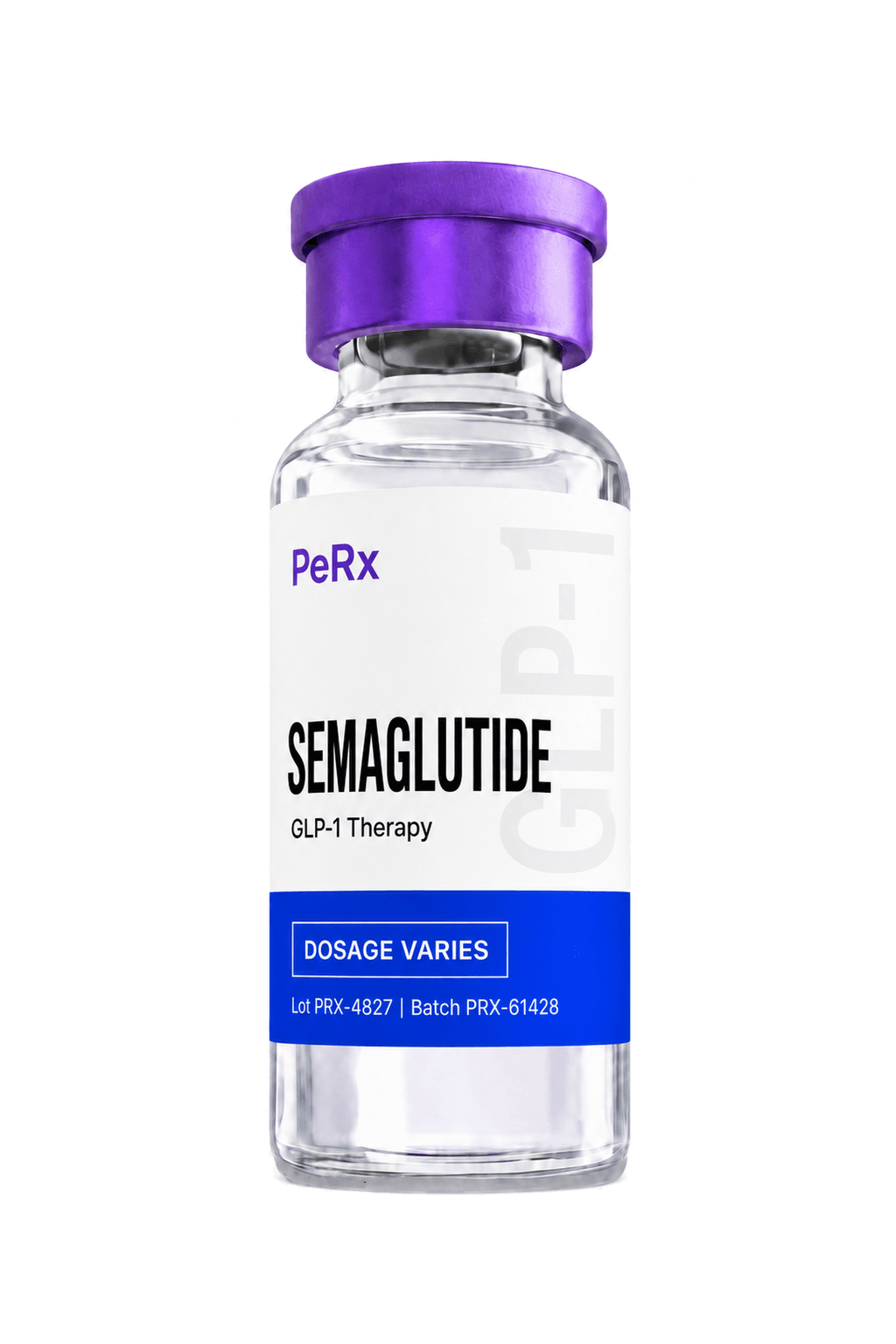
PeRx compounds semaglutide with vitamin B12 in a single vial. Your provider sets the concentration, reviews how you are doing before every refill, and raises it when you are ready rather than on a fixed calendar. If a step is difficult, they can hold you there or step back down.
This is a compounded preparation, not one of the FDA-approved branded products. It is prescribed for you specifically by a licensed provider and compounded by an FDA-registered 503A pharmacy. Syringes, alcohol swabs, and a step-by-step injection guide arrive in the box.
Why people explore Semaglutide
Not a daily medication. Same day each week, with or without food, at whatever time fits.
The engineered half-life is roughly seven days, which is what makes weekly dosing possible at all.
Every refill goes back to a provider who sees how you are doing before deciding whether to move you up.
You cannot buy a higher strength yourself. The dose changes when a clinician decides it should.
The mechanism acts on appetite signalling rather than willpower — most people describe food taking up less mental space.
GLP-1 receptors sit in the hypothalamus and brainstem, which is why the effect feels like reduced interest rather than suppressed craving.
Compounded with vitamin B12, so it is one injection rather than two.
Glycine is available as an alternative base if B12 does not suit you.
What it helps with
Ideal for
Adults pursuing medically supervised weight management · People who want a once-weekly option rather than a daily medication · Anyone who wants a provider reviewing their dose before each refill

The science
Semaglutide binds the GLP-1 receptor, mimicking the incretin hormone the small intestine releases in response to food. That signal acts on appetite centres in the hypothalamus to reduce hunger and food preoccupation, slows gastric emptying so meals stay satisfying for longer, and increases glucose-dependent insulin release. Because it is glucose-dependent, the insulin effect scales with blood sugar rather than acting continuously.
Semaglutide is delivered by subcutaneous injection, once weekly, entering circulation and reaching the tissues where it acts.
Semaglutide binds the GLP-1 receptor, mimicking the incretin hormone the small intestine releases in response to food. That signal acts on appetite centres in the hypothalamus to reduce hunger and food preoccupation, slows gastric emptying so meals stay satisfying for longer, and increases glucose-dependent insulin release. Because it is glucose-dependent, the insulin effect scales with blood sugar rather than acting continuously.
Over the following weeks, most people report gradual change in the areas Semaglutide targets: medically supervised weight management.
What the research shows
Our medication is delivered from a state-licensed pharmacy in our network, right to your door when you need it.

Our pharmacies perform third-party testing through FDA and DEA registered labs to run quality control checks for every compounded lot. They test four key characteristics associated with quality and safety.
Performed on every batch to confirm the active ingredient is present at the labeled concentration. Your vial contains exactly what it should.
Tests for the presence of bacteria, fungi, and other microorganisms. Every batch is tested and must meet the requirements of USP 797.1.
Screens for bacterial endotoxins that can cause fever or adverse reactions. Every batch is tested and must not exceed the threshold limits defined in USP 85.
Assesses the acid/base balance to ensure minimal irritation upon injection and confirm the solution is within the correct range for subcutaneous administration.
What to expect
Week 1–4
What you may notice: Appetite changes are often noticeable within the first week or two. Mild nausea, fullness arriving sooner than expected, and constipation are the common early effects.
What’s happening: You start at the lowest concentration. This step is about tolerance, not results — it exists so your gut adapts to slowed gastric emptying before the dose goes up.
Month 2–4
What you may notice: Each increase can bring a few days of the early side effects back. They typically settle within the week.
What’s happening: Your provider raises the concentration one step at a time, checking your check-in answers before each move. Some people stay at a middle step; there is no requirement to reach the top.
Month 5 onward
What you may notice: Most people settle at a dose that balances effect against how they feel day to day.
What’s happening: The dose stops climbing and refills continue at whatever concentration you and your provider settled on. Check-ins keep happening every cycle.
What’s included
From the moment you finish your assessment to your first dose, every step is handled by licensed providers and U.S. pharmacies.
New to self-injection? See the step-by-step guideFAQ
Patient reviews
Post-menopause weight gain had been stubborn despite walking and watching what I ate. Started the injections and noticed smaller portions felt satisfying much sooner. Steady loss over a few months, better sleep, and less afternoon fatigue. Still had to put in the work with food choices, but the medication removed a lot of the constant mental battle.
Used semaglutide while focusing on strength training and protein intake. The reduced appetite made it simpler to stay in a calorie deficit without obsessing over every meal. Strength held up better than in past cuts, and the scale moved consistently. No major energy crashes. Practical support that let me stick to the plan longer than I usually manage.
Turning 56 this year, I felt like I hit a wall with diet and exercise alone. Added the weekly injections. Appetite dropped noticeably within the first couple of weeks, and the cravings that used to derail evenings are mostly gone. Lost weight at a sustainable pace and my clothes fit better without extreme restriction.
This is not medical advice. Every patient's experience differs and not everyone qualifies for peptide therapy. All reviews are from verified PeRx patients and are published as submitted. Peptide therapy requires a valid prescription from a licensed provider.
Your safety, first
All prescriptions are issued by a licensed US provider after reviewing your intake.
Side effects, contraindications, and what to discuss with your provider before starting.
Read safety informationSupporting research
A selection of peer-reviewed work on Semaglutide. Browse the full literature on PubMed and Google Scholar for ongoing research.
The incretin system and GLP-1 physiology
Drucker DJ. Cell Metab. 2018;27(4):740–756.Gastric emptying and the GLP-1 receptor agonist class
Nauck MA, Meier JJ. Diabetes Obes Metab. 2019;21(S1):5–21.Dose escalation strategies to limit gastrointestinal effects
Wharton S et al. Diabetes Obes Metab. 2022;24(1):94–105.The statements on this page have not been evaluated by the Food and Drug Administration. This product is not intended to diagnose, treat, cure, or prevent any disease. The FDA does not review or approve compounded medications for safety or effectiveness. Off-label use must be prescribed and supervised by a licensed provider.
Keep exploring
Last updated April 2026
Medical disclaimer
The information provided on this page is for educational purposes only and is not intended as medical advice, diagnosis, or treatment. Peptide therapy requires a valid prescription from a licensed healthcare provider. Individual results may vary. No specific outcomes are guaranteed.
The peptides on this site are not FDA-approved. They are compounded by licensed pharmacies under provider supervision. Certain peptides are prohibited by WADA and major sports organizations. Statements on this page have not been evaluated by the FDA. These products are not intended to diagnose, treat, cure, or prevent any disease.
Take our 2-minute assessment. A licensed US provider reviews and, if appropriate, prescribes a protocol shipped to your door.
Create a free account to view pricing
Supply Duration