Where to Inject Semaglutide and Tirzepatide
Both are once-weekly subcutaneous injections, and the three standard sites are the same for each. The part that trips people up is not the site. It is that a compounded vial is not a prefilled pen, so you are drawing your own dose and reading it in syringe units. Here is the practical version.
In this article
Key Takeaways
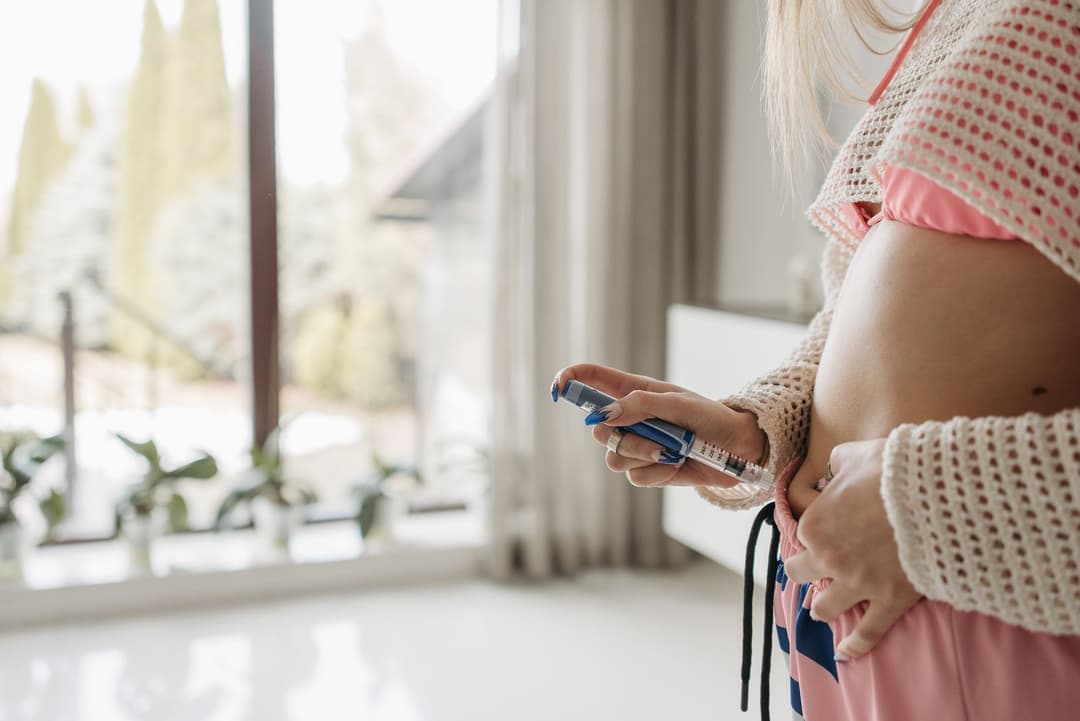
- Both semaglutide and tirzepatide are subcutaneous injections, not intramuscular. The needle goes into the fat layer just under the skin, and the three approved sites are the abdomen, the front or outer thigh, and the back of the upper arm.
- Site choice does not meaningfully change how the medication works. Absorption from all three sites is close enough that the labeling for the approved products lets patients switch between them without a dose change. Pick the site you can reach comfortably and reliably.
- Rotate anyway. Repeatedly injecting the same square inch causes lipohypertrophy, a firm fatty lump that absorbs erratically. Rotation is about protecting the tissue, not about chasing a better effect.
- The real difference between a compounded vial and a brand-name pen is measurement. A pen dials a fixed dose. A vial means you draw the dose yourself and read it in syringe units, which is where the reported dosing errors come from.
- Never convert your own dose. The number of units you draw depends on the concentration of your specific vial, so it comes from your prescription label, not from a chart you found online.
- These are prescription medications compounded by a licensed pharmacy for an individual patient. They are not the FDA-approved products, and they have not been through the FDA approval process themselves.
If you are already on a GLP-1, the technique below applies to any pen or vial. If you are looking for a prescribed source, PeRx offers compounded semaglutide ($249 per 28 days) and compounded tirzepatide ($399 per 28 days), each with a licensed provider review, compounded by a US 503A pharmacy and shipped ready to inject with syringes included.
The Three Sites
Semaglutide and tirzepatide are both given as a subcutaneous injection once a week. Subcutaneous means the medication goes into the layer of fat between the skin and the muscle, not into the muscle itself. That layer is shallow, which is why the needles are short and thin and why most people find the injection far less dramatic than they expected.
There are three standard sites, and they are the same for both medications:
| Site | Where exactly | Practical notes |
|---|---|---|
| Abdomen | Anywhere across the belly, staying at least two inches away from the navel | The most used site. Easy to see, easy to reach, usually the most generous fat layer. Avoid the waistband line if your clothes press there all day. |
| Thigh | The front or outer thigh, roughly the middle third between hip and knee | Easy to reach sitting down. Skip the inner thigh, where the tissue is thinner and more sensitive. |
| Upper arm | The back of the upper arm, over the triceps | Works well but is awkward to do on yourself. Most people who use this site have someone else do it. |
Abdomen
- Where exactly
- Anywhere across the belly, staying at least two inches away from the navel
- Practical notes
- The most used site. Easy to see, easy to reach, usually the most generous fat layer. Avoid the waistband line if your clothes press there all day.
Thigh
- Where exactly
- The front or outer thigh, roughly the middle third between hip and knee
- Practical notes
- Easy to reach sitting down. Skip the inner thigh, where the tissue is thinner and more sensitive.
Upper arm
- Where exactly
- The back of the upper arm, over the triceps
- Practical notes
- Works well but is awkward to do on yourself. Most people who use this site have someone else do it.
One rule that covers all three
Inject into soft tissue you can pinch. Skip anywhere that is bruised, tender, red, hard, scarred, or tattooed over raised ink, and stay clear of the navel. If a spot feels lumpy compared to the skin around it, use somewhere else and mention it at your next visit.
Does the Site Actually Matter?
Less than people expect. The instructions for use on the FDA-approved semaglutide and tirzepatide products list the abdomen, thigh, and upper arm as interchangeable, and they do not ask patients to change the dose when switching between them. Absorption differs slightly between sites in the way it does for most subcutaneous drugs, but not by enough to build a strategy around.
This matters because the internet is full of confident claims that one site produces better results, fewer side effects, or faster onset. There is no good evidence for that with these medications. The site that works best is the one you can reach without contorting, see clearly, and use consistently week after week. Consistency beats optimization here, because the failure mode that actually costs people progress is a missed or badly measured dose, not a suboptimal square inch of skin.
Rotation and Why It Matters
Rotating sites is not about improving absorption. It is about not wearing out one patch of tissue. Injecting the same spot repeatedly can cause lipohypertrophy, a firm rubbery thickening of the fat under the skin. It is the same problem people who inject insulin have known about for decades. Once it forms, that tissue absorbs unpredictably, which means the dose you measured is not necessarily the dose you get.
With a weekly injection you have a lot of room to work with. A simple approach that people actually stick to: pick one site for the month and move about an inch each week within it, then switch sites the next month. Or rotate quadrants of the abdomen, one per week. Either works. The only thing that does not work is using the same spot every Sunday for a year.
A trick that removes the guesswork
Write the date and the spot on the same note where you log the dose. Most people cannot remember on Sunday where they injected the previous Sunday, and a two-word log ends the problem permanently. If you would rather not keep notes, tie the site to something fixed: left side on even weeks, right side on odd.
The Vial Is Not a Pen
This is the part most guides skip, and it is the part that matters most if you are moving from a brand-name product to a compounded one.
The FDA-approved products, Ozempic and Wegovy for semaglutide and Mounjaro and Zepbound for tirzepatide, are supplied as prefilled pens or single-dose devices. The dose is set by the device. You do not measure anything. A compounded product is different: it is a vial, and you draw your dose out of it with a syringe. Nothing about the medication is harder to inject, but the measurement step is now yours, and that is a genuinely new task if a pen is all you have used.
Why this deserves real attention
The FDA has received reports of dosing errors involving compounded GLP-1 medications, including cases where patients drew far more than intended because they confused the units on the syringe with the milligrams on the prescription. This is not a reason to avoid a vial. It is a reason to read your own label carefully the first time and to ask rather than guess.
Units, and the Mistake to Avoid
Your prescription is written in milligrams. Your syringe is marked in units. Those are not the same thing, and the number that connects them depends on how concentrated your particular vial is. Two vials of the same medication at different concentrations require completely different volumes for the identical dose.
So the safe rule is short: the number of units you draw comes from your prescription label and your prescriber, not from a conversion chart online. A chart written for someone else’s concentration will give you the wrong answer with total confidence. If your label and your understanding disagree, stop and ask before you draw.
What to check before the first dose
Confirm three things on the label: the concentration of the vial, the dose you are prescribed, and the number of units that corresponds to. If any of the three is unclear, that is a question for the pharmacy or your provider, and it is a completely ordinary thing to ask about. Nobody expects a patient to do pharmacy math.
One more reason to re-read the label rather than working from memory: these medications are titrated. Prescribing usually starts low and steps up over months, so the strength your provider sets is a clinical decision made fresh each cycle rather than a number that stays fixed. At PeRx, semaglutide and tirzepatide ship one vial per 28-day cycle, which is exactly four weekly doses, and the provider re-sets the strength at each renewal rather than the patient choosing it at checkout. The practical consequence is simple. When a new vial arrives, check the label again. The units you drew last cycle are not automatically the units you draw this one.
The Injection Itself
The mechanics are the same as any subcutaneous injection, and they are genuinely simple once you have done one.
Wash your hands. Wipe the vial stopper and the skin with an alcohol swab and let both dry, because injecting through wet alcohol stings. Draw your dose. Pinch a fold of skin, insert the needle at somewhere between 45 and 90 degrees depending on how much tissue you have, push the plunger steadily, and pull straight out. Dispose of the syringe in a sharps container, not a household bin.
You do not need to aspirate, which is the step where you pull back on the plunger to check for blood. That is an intramuscular practice and it is not part of subcutaneous technique. If a small bead of blood appears afterward, press it with a clean cotton pad rather than rubbing, and carry on.
Making It Hurt Less
Most of the discomfort people report has a fixable cause. Cold medication straight from the refrigerator stings more than medication that has sat out for a few minutes, so letting the drawn syringe come toward room temperature usually helps. Wet alcohol stings, so let the swab dry. A dull needle stings, so use a new one every time rather than re-capping and reusing.
Going slowly on the plunger reduces the pressure sensation, and relaxing the muscle underneath matters more than people expect. Injecting into a tensed thigh is noticeably worse than injecting into a relaxed one. If a particular site is consistently uncomfortable no matter what you do, that is useful information: use a different one.
Timing and the Weekly Rhythm
Both medications are dosed once weekly, and neither depends on food. You can inject at any time of day, with or without a meal. What matters is picking a day and staying with it, because the weekly rhythm is what keeps levels steady.
A practical consideration people figure out the hard way: if side effects show up for you, they tend to be most noticeable in the first day or two after a dose. Some people therefore prefer to inject on a day when the following morning is quiet rather than the morning of something demanding. That is a scheduling preference, not a medical rule, and your provider sets the actual protocol.
PeRx ships compounded medications fully reconstituted and ready to use, stored refrigerated at 36 to 46 degrees Fahrenheit. There is nothing to mix. The same storage logic that applies to the rest of the catalog applies here, and the traveling with peptides guide covers keeping a vial cold on the road.
When Something Looks Wrong
A small amount of redness, a little swelling, or mild itching at the injection site is common and usually settles within a day. Persistent hardness under the skin, a lump that does not resolve, spreading redness, warmth, or anything that looks like an infection is a reason to contact a clinician rather than to keep injecting the same area. If lumps, bruising, or lingering soreness are the recurring problem rather than a one-off, injection site irritation on a GLP-1 covers why the tissue reacts and what actually helps.
Inspect the vial every time
The solution should be clear and colorless, or the expected color for your specific formulation, and free of particles. If it looks cloudy, has visible specks, or has changed appearance from when it arrived, do not use it. Contact the pharmacy. Do not use a vial that has been frozen, and do not use one past the beyond-use date on the label.
Common Questions
Related Guides
Continue reading about peptides and protocols that pair well with this guide.
Can You Mix Peptides in the Same Syringe?
Search this question and nearly every answer comes from a research-chemical vendor teaching people to combine powders at home. That advice starts from the wrong premise. In a prescription model, the combining that makes clinical sense already happened at the pharmacy, in one vial, before the box shipped. Everything else stays in its own syringe. This page covers the why, and then the part that actually takes effort: running a weekly GLP-1, a daily peptide, and a three-times-a-week peptide on one calendar without mixing anything up.
Semaglutide vs Tirzepatide: Which One Fits You
PeRx prescribes two compounded GLP-1 medications, one at $249 a month and one at $399. This is the decision guide we wish existed: what each molecule does, how the approved brands differ on their FDA labels, what the head-to-head research on those brands actually shows, and the questions a prescriber weighs before picking one for a specific patient.
Peptide Therapy in Fishers and the Geist District
A plain guide to peptide therapy in Fishers: what it costs across local clinics, med spas, and telehealth, and who tends to use it here. Plus how pharmaceutical-grade peptides reach any Hamilton County address without a clinic visit.
Ready to get started?
Pharmaceutical-grade peptides, prescribed by a licensed provider and shipped fully reconstituted and ready to use. Browse the catalog to read about what each one does, or start with the primer on what peptide therapy is.
Medical Disclaimer
The information provided on this website, including all articles, guides, and educational content, is for informational and educational purposes only and is not intended as medical advice, diagnosis, or treatment. Nothing on this site should be construed as a substitute for professional medical advice from a qualified healthcare provider.
The majority of peptides discussed on this site are not approved by the U.S. Food and Drug Administration (FDA) for the indications described. They are classified as bulk drug substances and are available only through a licensed prescribing provider and compounding pharmacy. All treatments require a valid prescription and provider oversight.
The majority of published research on peptide therapies has been conducted in preclinical (animal) models. While early human data is encouraging, comprehensive clinical trial data remains limited for most peptide compounds. Individual results may vary significantly based on health status, injury type, and other factors. No specific outcomes are guaranteed.
Certain peptides discussed on this site are classified as prohibited substances by the World Anti-Doping Agency (WADA) and are banned by major sports organizations including the NFL, NCAA, UFC, NBA, MLB, NHL, and PGA. If you are subject to anti-doping testing, consult your governing body before considering any peptide therapy.
Statements on this website have not been evaluated by the Food and Drug Administration. Products and therapies discussed are not intended to diagnose, treat, cure, or prevent any disease.
© 2026 Wellness MD Group PC DBA PeRx. All rights reserved.