CJC-1295/Ipamorelin Dosage Chart: Units & Timing
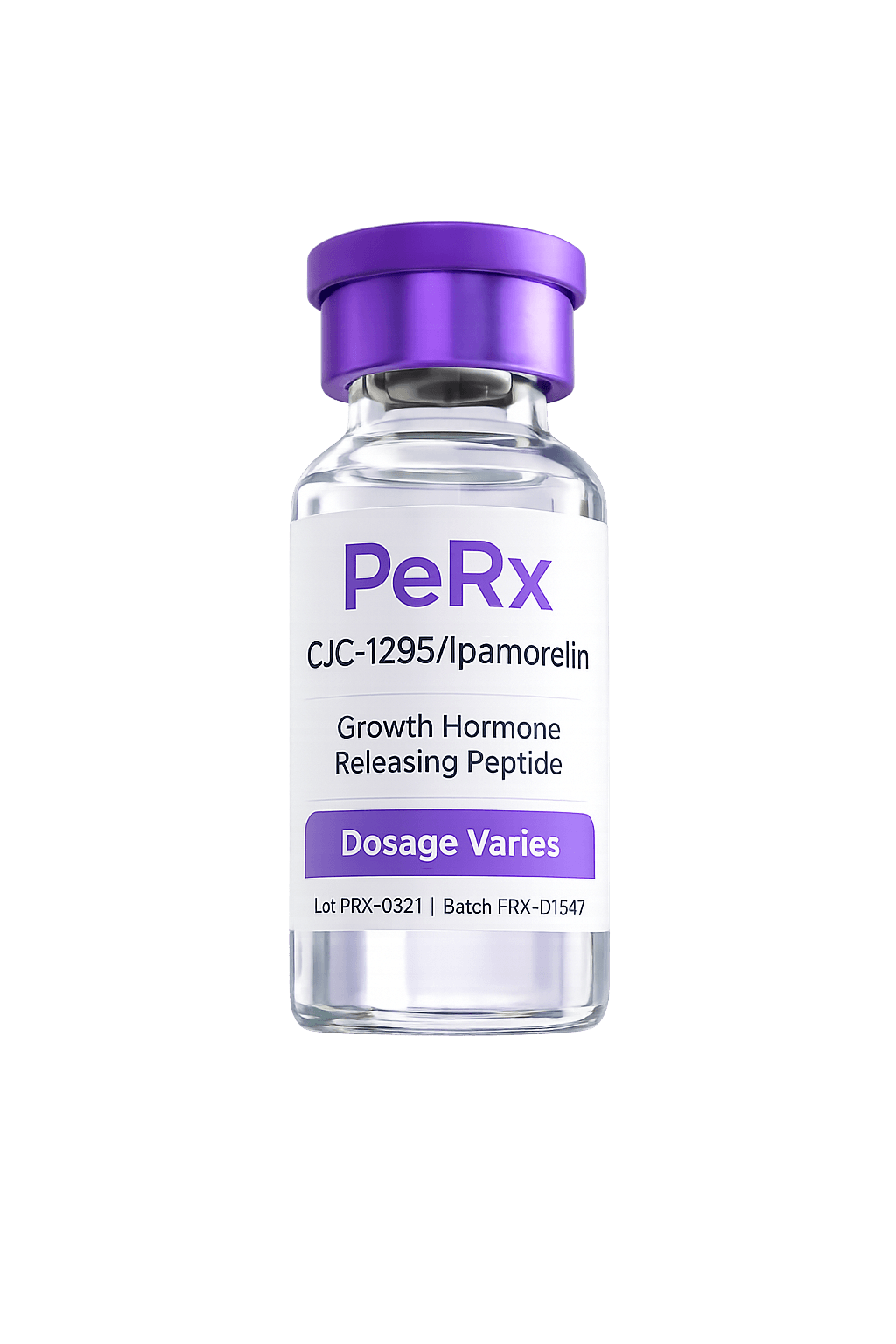
Most CJC-1295 ipamorelin dosage advice online is written in milligrams for a different molecule, or assumes you are juggling two separate vials. PeRx ships one combined vial at a fixed concentration, ready to use. This page converts insulin-syringe units into micrograms of each peptide at that concentration, explains the bedtime and empty-stomach rules, walks through 5-on-2-off and 3-months-on cycling, and prices out a month, as of August 31, 2026.
In this article
Key Takeaways
- PeRx CJC-1295/Ipamorelin is one combined 5 mL vial at 1.2 mg/mL of CJC-1295 (no-DAC) and 2 mg/mL of ipamorelin, ready to use with no reconstitution needed. Each unit on a U-100 insulin syringe holds 12 mcg of CJC-1295 and 20 mcg of ipamorelin.
- Because both peptides share one solution, a single draw sets both doses at once. Ten units delivers 120 mcg of CJC-1295 plus 200 mcg of ipamorelin, inside the ranges most published clinic protocols quote for the no-DAC combination.
- Your provider prescribes your protocol, and the number of units on your prescription label is the number you draw. The chart on this page translates units into micrograms. It does not replace the label.
- Timing is physiology: inject in the evening, 1 to 2 hours after your last meal and shortly before bed, so the peptide-driven pulse lands on the large growth hormone release that arrives with early deep sleep.
- Doses quoted in whole milligrams belong to CJC-1295 with DAC, the long-acting version Teichman and colleagues studied in 2006. The nightly combo vial uses the no-DAC form, which acts for roughly 30 minutes and is dosed in micrograms.
- A vial is $299 at PeRx, one vial per prescription month. The common cycling patterns are 3 months on with 1 month off, or 5 days on and 2 days off each week.
CJC-1295/Ipamorelin Dosing at a Glance
Vial
5 mL combo vial: 1.2 mg/mL CJC-1295 (no-DAC) + 2 mg/mL ipamorelin, ready to use
One unit holds
12 mcg CJC-1295 + 20 mcg ipamorelin (U-100 insulin syringe)
Dose
The units on your prescription label; published protocols cluster around 10 to 15 units
When
Evening, 1 to 2 hours after your last meal, shortly before bed
Schedule
Once nightly; 3 months on, 1 month off (or 5 on, 2 off weekly)
Cost
$299 per vial at PeRx; one vial per prescription month
CJC-1295/Ipamorelin Dosage Chart
Search for cjc-1295 ipamorelin dosage and the results disagree with each other by a factor of a thousand. One page says 100 micrograms. Another says 2 milligrams. Both numbers are real. They just describe different molecules, and mixing them up is the single most common dosing confusion with this stack. There is a second problem too: most charts assume you bought two separate products and have to work out each peptide on its own. The PeRx product is one combined vial that ships fully reconstituted and ready to use, with CJC-1295 (no-DAC) at 1.2 mg per mL and ipamorelin at 2 mg per mL in the same solution. That changes the math, mostly by deleting it.
Here is the whole conversion. A U-100 insulin syringe holds 100 units per mL, so one unit is 0.01 mL. At 1.2 mg per mL, that 0.01 mL carries 12 mcg of CJC-1295. At 2 mg per mL, the same 0.01 mL carries 20 mcg of ipamorelin. One number on the syringe sets two doses at once, always in the same 12 to 20 ratio, and the ratio cannot drift because both peptides live in one vial.
| Units on U-100 syringe | Volume (mL) | CJC-1295 (mcg) | Ipamorelin (mcg) | Doses per 5 mL vial |
|---|---|---|---|---|
| 5 units | 0.05 mL | 60 mcg | 100 mcg | 100 |
| 8 units | 0.08 mL | 96 mcg | 160 mcg | ~62 |
| 10 units | 0.10 mL | 120 mcg | 200 mcg | 50 |
| 15 units | 0.15 mL | 180 mcg | 300 mcg | ~33 |
| 20 units | 0.20 mL | 240 mcg | 400 mcg | 25 |
| 25 units | 0.25 mL | 300 mcg | 500 mcg | 20 |
5 units
- Volume (mL)
- 0.05 mL
- CJC-1295 (mcg)
- 60 mcg
- Ipamorelin (mcg)
- 100 mcg
- Doses per 5 mL vial
- 100
8 units
- Volume (mL)
- 0.08 mL
- CJC-1295 (mcg)
- 96 mcg
- Ipamorelin (mcg)
- 160 mcg
- Doses per 5 mL vial
- ~62
10 units
- Volume (mL)
- 0.10 mL
- CJC-1295 (mcg)
- 120 mcg
- Ipamorelin (mcg)
- 200 mcg
- Doses per 5 mL vial
- 50
15 units
- Volume (mL)
- 0.15 mL
- CJC-1295 (mcg)
- 180 mcg
- Ipamorelin (mcg)
- 300 mcg
- Doses per 5 mL vial
- ~33
20 units
- Volume (mL)
- 0.20 mL
- CJC-1295 (mcg)
- 240 mcg
- Ipamorelin (mcg)
- 400 mcg
- Doses per 5 mL vial
- 25
25 units
- Volume (mL)
- 0.25 mL
- CJC-1295 (mcg)
- 300 mcg
- Ipamorelin (mcg)
- 500 mcg
- Doses per 5 mL vial
- 20
How to read this chart
The chart is a translator, not a menu. It exists so you can take a dose quoted anywhere, in units or in micrograms of either peptide, and see what it means at this concentration. The dose you actually inject is the one your provider prescribed, printed on your vial. Published clinic protocols for the no-DAC combination tend to land between 100 and 300 mcg of ipamorelin per night, which is 5 to 15 units here, and 10 units is the row where both peptides sit comfortably inside their commonly quoted ranges.
This page deliberately stays on arithmetic, timing, and cost. For what the two peptides are, how the GHRH and ghrelin pathways reinforce each other, and what the human data shows, the full CJC-1295/Ipamorelin guide covers mechanism and evidence in depth so this one does not have to.
How Many Units Is That on an Insulin Syringe?
Prescriptions and protocols quote this combination three different ways: units, micrograms of ipamorelin, or micrograms of CJC-1295. All three describe the same draw. To go from ipamorelin micrograms to units, divide by 20. To go from CJC-1295 micrograms to units, divide by 12. To go the other way, multiply. Those conversions hold at this vial concentration and no other, which is why a chart from a different pharmacy, or a forum post about someone else’s product, does not transfer.
A worked example
Say a protocol calls for 200 mcg of ipamorelin. Divide by 20 and you get 10 units. Draw the plunger to the 10 mark on a U-100 insulin syringe and that volume automatically carries 120 mcg of CJC-1295 with it, because the two peptides are premixed at a fixed ratio. There is no second calculation and no second injection.
Now the milligram confusion, because it matters. CJC-1295 exists in two forms that share a name. The version with DAC binds albumin in the blood and keeps working for about a week, which is why studies and clinics that use it quote doses of 1 to 2 mg injected weekly. Teichman and colleagues showed in 2006 that single injections of that long-acting form raised growth hormone concentrations 2 to 10 fold for up to 6 days, with IGF-1 staying elevated for as long as 28 days after repeated dosing. The nightly combo vial contains the other form, CJC-1295 without DAC, which acts for roughly half an hour and is dosed in micrograms every evening. If you plug a 2 mg DAC dose into a no-DAC nightly schedule you are off by more than a factor of ten. When a number you find online is written in whole milligrams, it is not describing this product.
Teichman SL, Neale A, Lawrence B, et al. "Prolonged stimulation of growth hormone (GH) and insulin-like growth factor I secretion by CJC-1295, a long-acting analog of GH-releasing hormone, in healthy adults." Journal of Clinical Endocrinology and Metabolism. 2006;91(3):799-805. View study
One practical note on hardware. PeRx includes U-100 insulin syringes with every order, so the units in the chart match the barrel in your hand. Volumes under 0.1 mL are easier to read on a 0.3 mL syringe than a 1 mL syringe because the same dose stretches across more hash marks. Draw slowly, hold the syringe at eye level, and read the top of the plunger against the line rather than eyeballing from an angle.
CJC-1295/Ipamorelin
Every conversion on this page comes from one fact: PeRx ships both peptides in a single combined vial at a fixed concentration, prescribed by a licensed provider and compounded at a US-based 503A pharmacy. It arrives fully reconstituted and ready to use, with insulin syringes included.
One draw delivers both peptides together, so there is no juggling two vials or doing two sets of math. $299 for the monthly vial, and your prescription label carries your exact nightly units.
When to Inject CJC-1295/Ipamorelin
The label on this stack could honestly read: evening, empty stomach, then sleep. Adults release growth hormone in pulses, and the biggest pulse of the day is tied to the first stretch of slow-wave sleep. Van Cauter and Plat documented that coupling in their review of GH secretion during sleep: deep sleep arrives, and the dominant nightly pulse arrives with it. Both peptides in this vial act quickly and clear quickly, so an injection 20 to 30 minutes before bed stacks its effect onto that natural pulse instead of firing into the flat part of the afternoon.
Van Cauter E, Plat L. "Physiology of growth hormone secretion during sleep." Journal of Pediatrics. 1996;128(5 Pt 2):S32-S37. View study
The empty stomach rule has equally old roots. Ho and colleagues showed in 1988 that fasting amplifies growth hormone secretion in healthy men, increasing both how often pulses fire and how tall they are, while the glucose and insulin rise after a meal pushes in the opposite direction. Injecting a GH secretagogue on top of a recent dinner asks the pituitary to perform with the brakes partly on. Give it a gap of 1 to 2 hours after your last meal, and skip the late snack afterward. Water is fine.
Ho KY, Veldhuis JD, Johnson ML, et al. "Fasting enhances growth hormone secretion and amplifies the complex rhythms of growth hormone secretion in man." Journal of Clinical Investigation. 1988;81(4):968-975. View study
A reasonable worry about injecting a ghrelin-receptor peptide at night is hunger, since ghrelin is the hormone that makes you want a sandwich. Ipamorelin is the reason that worry does not apply here. Raun and colleagues characterized it in 1998 as the first selective growth hormone secretagogue: it triggered GH release with potency comparable to GHRP-6 but did not raise cortisol or ACTH even at doses 200 times the effective one, and unlike older GHRPs it did not stimulate appetite. A bedtime dose releases growth hormone without leaving you staring into the refrigerator.
Raun K, Hansen BS, Johansen NL, et al. "Ipamorelin, the first selective growth hormone secretagogue." European Journal of Endocrinology. 1998;139(5):552-561. View study
Where the needle goes matters far less than when, but it still deserves five minutes of reading. The where to inject CJC-1295/Ipamorelin guide covers site choice and rotation, and the general peptide injection guide walks through subcutaneous technique from the first alcohol swab if this is your first injection of anything.
Cycling: 5 On, 2 Off
Growth hormone secretagogues are the peptide class where scheduled breaks earn their keep. The pituitary responds to a pulse, and receptors that are stimulated every single night, month after month, can gradually answer more quietly. Two patterns show up in practice for this stack. The weekly version runs 5 nights on and 2 nights off, usually weekdays on and weekends off. The seasonal version runs 3 months on and then 1 full month off. They are not competitors; many prescriptions use both at once, weekdays only inside a 3-month block.
| Every night | 5 on, 2 off | |
|---|---|---|
| Injections per week | 7 | 5 |
| Weekly ipamorelin at 10 units | 1,400 mcg | 1,000 mcg |
| A 5 mL vial lasts (10 units/dose) | About 7 weeks | 10 weeks |
| Rationale | Every night of deep sleep has a pulse worth reinforcing | Two quiet nights a week as a hedge against receptor fatigue |
| Fits best | People who never miss and want maximum consistency | People whose weekends run late and unpredictable |
Injections per week
- Every night
- 7
- 5 on, 2 off
- 5
Weekly ipamorelin at 10 units
- Every night
- 1,400 mcg
- 5 on, 2 off
- 1,000 mcg
A 5 mL vial lasts (10 units/dose)
- Every night
- About 7 weeks
- 5 on, 2 off
- 10 weeks
Rationale
- Every night
- Every night of deep sleep has a pulse worth reinforcing
- 5 on, 2 off
- Two quiet nights a week as a hedge against receptor fatigue
Fits best
- Every night
- People who never miss and want maximum consistency
- 5 on, 2 off
- People whose weekends run late and unpredictable
Neither weekly pattern has a head-to-head human trial behind it, so the honest framing is that both are defensible prescriber judgments built on the same physiology. What the field agrees on more firmly is the value of the longer break. Running 3 months and then pausing for 1 month gives the axis a clean reset and gives you a natural checkpoint to repeat an IGF-1 lab before deciding to continue. The peptide cycling guide treats this question across the whole catalog, including which peptides need breaks and which do not. If you also take sermorelin or are comparing the two, note that the numbers do not transfer between products; the sermorelin dosage chart does this same units math at that vial’s different concentration.
The schedule that wins
Whatever pattern this page describes, the schedule your provider prescribed is the one you follow. If your label says nightly, inject nightly. If it says weekdays only, take the weekends off. A dosage chart is reference material, and reference material never overrules a prescription.
What a Month Costs
CJC-1295/Ipamorelin is $299 per vial at PeRx, one vial per prescription month. That figure includes the licensed provider review, compounding at a US 503A pharmacy, overnight refrigerated shipping, insulin syringes, and alcohol swabs. There is no membership fee, and your card is not charged at checkout; the charge only fires if a provider approves the prescription. A full 3-month cycle is three vials, $897 before any discount. Details and ordering live on the product page.
The per-dose math follows straight from the chart. At 10 units a night, a 5 mL vial physically holds 50 doses, so a month of nightly injections uses a little over half the vial and each injection works out to roughly $10 on a per-vial basis. At 15 units the vial holds about 33 doses. This is also a quiet quality signal worth naming: the chart only works because the concentration is printed, fixed, and pharmacy-verified. Gray-market vials sold for research use carry no such guarantee, and a units chart is worthless when the mg per mL behind it is a guess.
If You Miss a Dose
Skip it. Take your next scheduled dose at the normal time the following evening, and do not draw a double to make up the difference. The logic comes from how the stack works: each injection adds to one night’s growth hormone pulse, and a night that already passed cannot be back-filled. Doubling the volume does not double the release either, because somatostatin feedback caps how much GH the pituitary will let go of in one pulse. Two units of effort, one unit of result, plus a bigger dent in the vial.
A single missed night costs you almost nothing over a 12-week cycle. A missed week is different in degree but not in kind: resume at your prescribed dose on your normal schedule rather than restarting with anything larger. If travel took you away from refrigeration or you are unsure whether a vial was stored properly, message the PeRx care team through your portal before using it. And if you find yourself missing more nights than you hit, that is a routine problem rather than a dosing problem. Moving the injection to a fixed anchor, like right after you brush your teeth, fixes more adherence issues than any schedule change.
Common Questions
Related Guides
Continue reading about peptides and protocols that pair well with this guide.
Is CJC-1295/Ipamorelin FDA Approved? (2026 Answer)
The short answer is no. CJC-1295 and Ipamorelin are not FDA-approved drugs. They are compounded medications, prescribed by licensed providers and prepared by regulated pharmacies. Here is what that actually means for you, how it compares to FDA-approved peptides, and why the distinction matters less than most people think.
Do Peptides Break a Fast? A Clinic Answer
Injected peptides carry almost no calories, so in the caloric sense they generally do not break a fast. The nuance most people miss is insulin and mTOR signaling, which matters more for some peptides than others. Here is how a clinic thinks about it, peptide by peptide.
How Long Do Peptides Take to Work?
Anywhere from the same evening to several months, depending on which peptide and which change you are watching for. PT-141 is dosed for a same-day window while GHK-Cu skin remodeling is a months-long project, and most peptides land somewhere between. This guide maps the typically reported onset windows by peptide family, explains what tends to change first for each goal, and covers why feeling nothing early is often normal rather than a sign of failure.
Ready to get started?
Pharmaceutical-grade CJC-1295/Ipamorelin in one combined vial, prescribed by a licensed provider and shipped to your door ready to use with no reconstitution needed.
Medical Disclaimer
The information provided on this website, including all articles, guides, and educational content, is for informational and educational purposes only and is not intended as medical advice, diagnosis, or treatment. Nothing on this site should be construed as a substitute for professional medical advice from a qualified healthcare provider.
The majority of peptides discussed on this site are not approved by the U.S. Food and Drug Administration (FDA) for the indications described. They are classified as bulk drug substances and are available only through a licensed prescribing provider and compounding pharmacy. All treatments require a valid prescription and provider oversight.
The majority of published research on peptide therapies has been conducted in preclinical (animal) models. While early human data is encouraging, comprehensive clinical trial data remains limited for most peptide compounds. Individual results may vary significantly based on health status, injury type, and other factors. No specific outcomes are guaranteed.
Certain peptides discussed on this site are classified as prohibited substances by the World Anti-Doping Agency (WADA) and are banned by major sports organizations including the NFL, NCAA, UFC, NBA, MLB, NHL, and PGA. If you are subject to anti-doping testing, consult your governing body before considering any peptide therapy.
Statements on this website have not been evaluated by the Food and Drug Administration. Products and therapies discussed are not intended to diagnose, treat, cure, or prevent any disease.
© 2026 Wellness MD Group PC DBA PeRx. All rights reserved.