Do Peptides Need Reconstituting? Not When Prescribed
Research-market peptides arrive as a powder the buyer mixes at home. A prescribed PeRx vial arrives as a sterile solution, ready to use. This page explains what reconstitution is, why mixing it yourself is a documented source of dosing errors, and what a pharmacy-prepared vial does instead.
In this article
Key Takeaways
- Reconstitution means dissolving a freeze-dried peptide powder in a sterile liquid so it can be injected. The step belongs to the research-chemical market, where peptides ship as powder labeled for laboratory use.
- A prescribed PeRx peptide never needs it. A state-licensed 503A pharmacy prepares a sterile solution against your prescription, labels it with your name, the concentration and a beyond-use date, and ships it refrigerated with syringes and swabs.
- The FDA’s adverse-event file for compounded injectables is heavy with dosing errors from patients measuring and self-administering from vials. Mixing at home adds a second place for the math to go wrong, and nobody tests the result.
- Once a peptide is in liquid form the storage rules are the same: refrigerated at 36 to 46°F, never frozen, used by the date on the label. PeRx vials ship fully reconstituted and stay stable through that date when kept cold.
- This page does not give mixing steps. If you have a powder vial from somewhere else, its instructions belong to whoever sold it. A prescribed, pharmacy-prepared vial is the way to skip the question entirely.
Peptide Reconstitution: Quick Facts
Short answer
Research-market peptides need reconstituting because they arrive as a dry powder. A prescribed PeRx peptide does not; it arrives as a sterile solution, ready to use.
What the word means
Dissolving a freeze-dried (lyophilized) peptide powder in a sterile liquid, usually bacteriostatic water, so it can be drawn into a syringe and injected.
Who does it
People who bought powder labeled for laboratory research. A compounding pharmacy does this work before a prescribed vial ships, under sterile-compounding standards, and tests the result.
Why it matters
The FDA attributes a run of adverse events with compounded injectables to patients measuring and self-administering incorrect doses from vials. Home mixing adds a second place for that to happen.
What PeRx ships
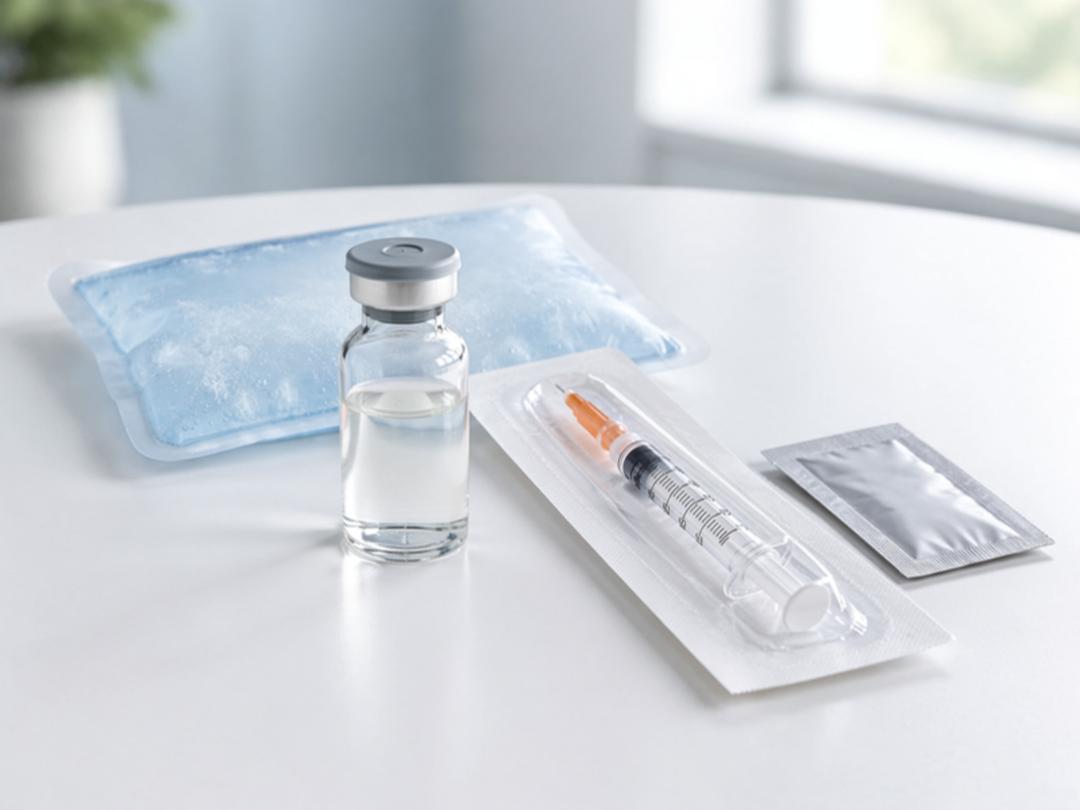
One labeled vial per prescription, fully reconstituted and ready to use, with insulin syringes and alcohol swabs, by FedEx Overnight in refrigerated packaging. Capsule products involve no vial at all.
Storage
Refrigerate at 36 to 46°F (2 to 8°C), never freeze, and use by the beyond-use date on the label. The same rules apply to any peptide once it is in liquid form.
What this page does not do
It gives no mixing steps, volumes or syringe math. Instructions for a powder belong to the company that sold it; PeRx does not prescribe or advise on products it did not supply.
Why there are no mixing instructions here
Every peptide PeRx prescribes arrives already in solution, so a mixing guide would describe a step none of our patients take. It would also describe products we have never seen: powders of unknown purity, strength and sterility, sold without a prescription. Telling someone how many milliliters to add to a vial we know nothing about is not advice we can stand behind. What this page can do is explain the process honestly, show why pharmacies and regulators treat it as a risk point, and lay out what a prescribed vial does differently.
Search "how to reconstitute peptides" and you will find calculators, syringe diagrams and videos, most of them published by the companies that sell the powder. The reason the question exists at all is a quirk of the research-chemical market: peptides are shipped dry because dry peptides are cheap to store and ship, and the buyer is left to turn them into something injectable. That is the entire gap a prescription closes. When a licensed provider writes for a peptide and a state-licensed 503A pharmacy fills it, the pharmacy does the dissolving, the measuring, the sterility work and the labeling, and you receive a vial you can draw from the day it arrives.
So the honest answer to "do peptides need to be reconstituted" is: it depends on where the peptide came from. Powder from a research vendor does. A prescribed, pharmacy-prepared vial does not. The rest of this page explains what happens in each case and why the difference is bigger than convenience.
What "Reconstituting Peptides" Actually Means
Peptides are chains of amino acids, and most of them are unstable in water at room temperature. To ship and store them, manufacturers freeze-dry them: the peptide is dissolved, frozen, and the water is pulled off under vacuum, leaving a dry cake or powder in a sealed vial. The technical word is lyophilized. In that state a peptide can sit for a long time without breaking down, which is exactly why laboratories buy it that way.
Reconstitution is the reverse step: a sterile liquid is added to the vial so the powder dissolves back into a solution that can be drawn into a syringe. In the research market the liquid is usually bacteriostatic water, which is sterile water with a small amount of benzyl alcohol added as a preservative so the vial can be punctured more than once. The amount of liquid added decides the concentration, and the concentration decides how many units of a syringe correspond to a given dose. Every number that follows depends on that one measurement being right.
Three things are worth noticing about that description. First, it is a pharmacy task. Dissolving a drug into a sterile, correctly concentrated solution is what compounding pharmacies are licensed and inspected to do. Second, nothing about the step verifies the powder. If the vial held less peptide than its label said, or a different peptide, or bacterial endotoxins, the solution has all of the same problems plus water. Third, the person doing it at a kitchen table has no way to check their own work. A pharmacy sends its product to a laboratory; a home mixer sends it into their arm.
Why Research-Market Peptides Ship as Powder
Research vendors sell peptides as raw material, labeled for laboratory use and sold without a prescription, a pharmacy or a prescriber anywhere in the chain. Shipping them dry makes sense for that business: the powder tolerates warm transit, it does not need cold storage in a warehouse, and the vendor never has to make a sterile solution or stand behind a concentration. The label typically says the product is for laboratory research and not for human use, and the price reflects the fact that nobody has done the pharmacy’s work. The FDA does not accept the label at face value: in a March 2026 warning letter to a peptide seller it wrote that despite labeling for "laboratory research purposes only," the website showed the products "are intended to be drugs for human use," described the peptides as "drugs intended for injection and require reconstitution," and cited the bacteriostatic water sold alongside them as evidence of that intent.
That business model is also why the mixing guides exist. A vendor that ships powder needs its customers to turn it into something injectable, so it publishes the steps and the calculators. The guides are not a sign that home reconstitution is a normal part of peptide therapy. They are a sign that the product was never finished. Our pages on research peptides versus prescription peptides and where to buy peptides legally go deeper on the two supply chains; the short version is that one of them ends at a pharmacy and one of them ends at you.
What Goes Wrong When You Mix at Home
The clearest evidence comes from the FDA’s own file on compounded GLP-1 injectables, where patients receive a multi-dose vial and draw their own doses. The agency reports adverse events, some requiring hospitalization, that "may be related to dosing errors," and says those errors "resulted from patients measuring and self-administering incorrect doses of the drug, and in some cases, health care professionals miscalculating doses." In a 2024 alert the agency was more specific: patients directed to inject 5 units from a vial drew up 50, and across the reports people gave themselves five to twenty times the intended dose, with "confusion between different units of measurement" named as a cause. A poison-center case series the same year described two patients who took ten times their dose. That is with a vial a pharmacy already prepared at a known concentration. Home reconstitution puts a second calculation in front of the first: the person has to decide the concentration before they can decide the dose, and an error in the first step silently multiplies through every injection that follows.
Concentration errors
Add half the intended volume of liquid and every draw delivers twice the intended dose. Add double and every draw delivers half. Misread the powder’s stated milligrams, confuse milligrams with micrograms, or trust a calculator that assumed a different vial size, and the same thing happens. None of these errors are visible in the syringe. A clear solution at the wrong strength looks exactly like a clear solution at the right one, which is why pharmacies print the concentration on the label and test it rather than estimating it.
Sterility and contamination
A pharmacy prepares injectable solutions inside a controlled environment under USP General Chapter <797>, the sterile-compounding standard, and then tests the finished lot for sterility and bacterial endotoxins. The chapter’s own definition of sterile compounding includes "reconstituting" a drug to create a sterile medication, which is a precise way of saying that the step people do at home is, by the standard’s definition, pharmacy work. A kitchen or bathroom counter is none of those things. Every puncture of a vial stopper is an opportunity for contamination, and the FDA’s general guidance is that multi-dose vials of sterile medication be used within 28 days of the first puncture because contamination risk rises after that. A home-mixed vial starts that clock with an unverified stopper, an unverified powder and an unverified diluent.
Nothing is tested
The step most people skip in their thinking is that reconstitution does nothing to confirm what was in the vial. Potency, identity, sterility, endotoxins and pH are measured on a finished product by a laboratory, not inferred from a clean mixing technique. Our quality testing page shows what those tests look like for a prescribed vial, with a sample certificate of analysis; a powder bought online comes with whatever document the vendor chose to attach, if any. What pharmaceutical-grade peptides means covers why that phrase on a vendor site rarely means what it sounds like.
Temperature on the way to you
Once a peptide is in solution it needs to stay cold. The FDA has received complaints of compounded injectables arriving warm or with inadequate ice packs and recommends that patients not use any injectable that arrives that way. A pharmacy that ships solution has to solve cold-chain shipping; a vendor that ships powder has pushed the temperature problem onto you, starting the moment you add the liquid.
How a 503A Pharmacy Prepares a Ready-to-Use Vial
The sequence at PeRx is short and every step is done by someone licensed to do it. You complete an online eligibility check. A licensed provider reviews it and either prescribes or declines; your card is saved at checkout and charged only on approval, and there is no separate consultation fee. The prescription goes to a state-licensed 503A pharmacy, which compounds the peptide as a sterile solution for you specifically, at the concentration the prescription states, under the sterile-compounding standard. An independent laboratory tests the lot for potency, sterility, endotoxins and pH. The vial is labeled with your name, the pharmacy, the prescriber, the concentration and a beyond-use date, and it ships by FedEx Overnight in refrigerated packaging with the syringes and swabs you need. Getting peptides prescribed online walks through the steps in order.
| Research-market powder | Prescribed PeRx vial | |
|---|---|---|
| Format on arrival | Dry, freeze-dried powder in a sealed vial, plus a separate diluent you buy | Sterile solution, fully reconstituted and ready to use |
| Who sets the concentration | You, by deciding how much liquid to add | The prescription and the pharmacy; the concentration is printed on the label |
| Who checks the result | Nobody; there is no test after mixing | An independent lab tests every lot for potency, sterility, endotoxins and pH |
| Sterility | Depends on your technique and your counter | Prepared under USP <797> and tested before release |
| Label | Vendor label, usually marked for laboratory research only | Your name, the pharmacy, the prescriber, the concentration and a beyond-use date |
| Shipping | Powder at ambient temperature; cold storage starts when you mix it | FedEx Overnight in refrigerated packaging |
| Clinical oversight | None | A licensed provider reviews before the first order and a check-in precedes every renewal |
| Regulatory status | Not made or labeled for human use | A compounded drug, not FDA-approved, prepared under the 503A conditions for an identified patient |
Format on arrival
- Research-market powder
- Dry, freeze-dried powder in a sealed vial, plus a separate diluent you buy
- Prescribed PeRx vial
- Sterile solution, fully reconstituted and ready to use
Who sets the concentration
- Research-market powder
- You, by deciding how much liquid to add
- Prescribed PeRx vial
- The prescription and the pharmacy; the concentration is printed on the label
Who checks the result
- Research-market powder
- Nobody; there is no test after mixing
- Prescribed PeRx vial
- An independent lab tests every lot for potency, sterility, endotoxins and pH
Sterility
- Research-market powder
- Depends on your technique and your counter
- Prescribed PeRx vial
- Prepared under USP <797> and tested before release
Label
- Research-market powder
- Vendor label, usually marked for laboratory research only
- Prescribed PeRx vial
- Your name, the pharmacy, the prescriber, the concentration and a beyond-use date
Shipping
- Research-market powder
- Powder at ambient temperature; cold storage starts when you mix it
- Prescribed PeRx vial
- FedEx Overnight in refrigerated packaging
Clinical oversight
- Research-market powder
- None
- Prescribed PeRx vial
- A licensed provider reviews before the first order and a check-in precedes every renewal
Regulatory status
- Research-market powder
- Not made or labeled for human use
- Prescribed PeRx vial
- A compounded drug, not FDA-approved, prepared under the 503A conditions for an identified patient
Neither column is an FDA-approved drug, and the right-hand column does not become one because a pharmacy prepared it. The difference is accountability: a prescriber decided the product was appropriate for you, a licensed pharmacy made it to a stated concentration, a laboratory confirmed it, and every one of those steps has a name on it. Is peptide therapy safe covers what that oversight does and does not protect against.
BPC-157: The Peptide People Search Alongside Reconstitution
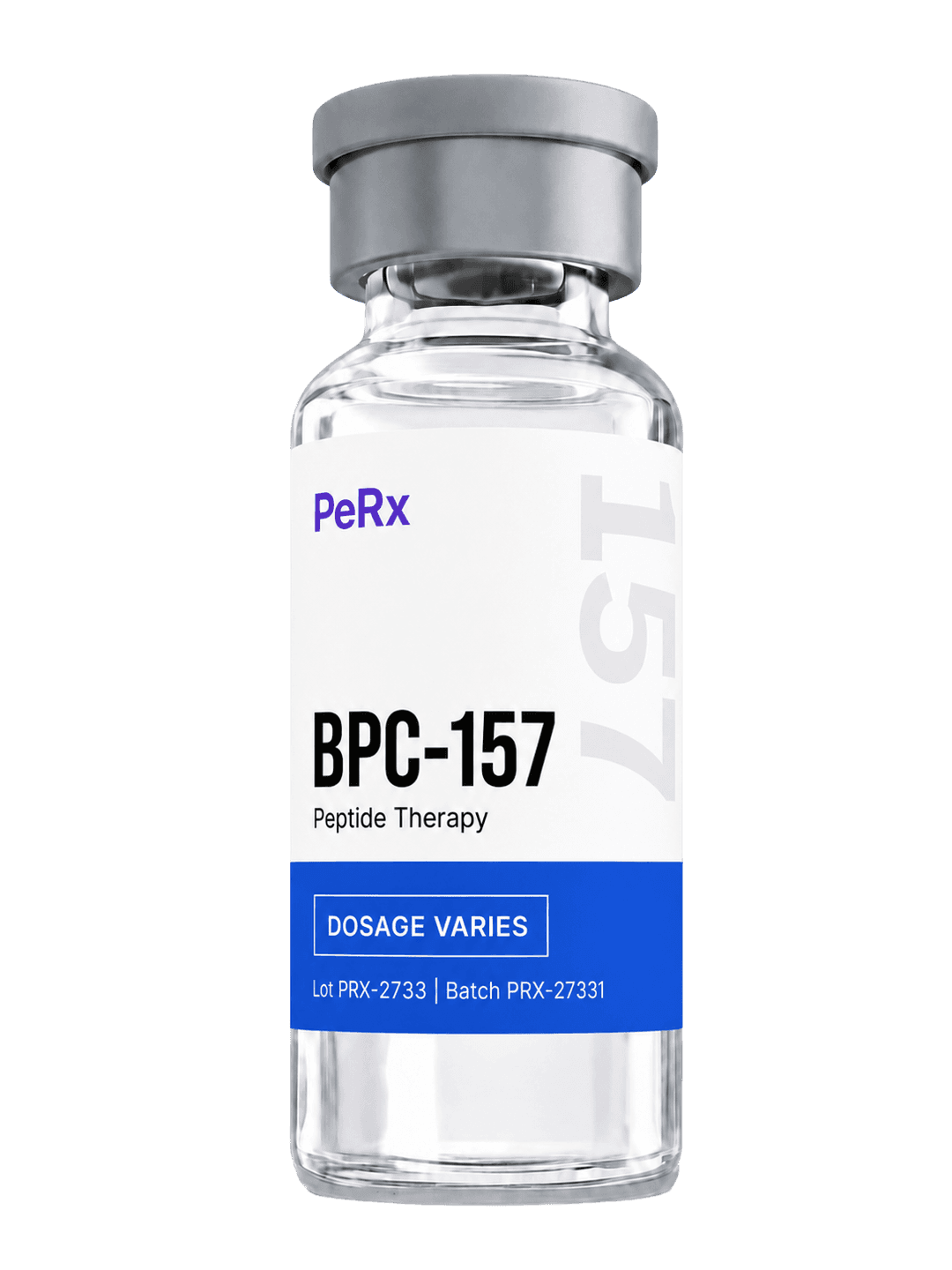
BPC-157 is the peptide most often typed next to "how to reconstitute," because it is the most common research-market powder. At PeRx it is prescribed as a ready-to-use subcutaneous vial compounded by a state-licensed 503A pharmacy, shipped with syringes and swabs, with nothing to mix. For readers who would rather avoid the vial entirely, the same peptide is available as a capsule.
Both are compounded products and not FDA-approved drugs, prescribed only after a licensed provider reviews your eligibility. Prices are published on the pricing page, with the provider review, supplies and refrigerated overnight shipping included and no membership fee.
What Arrives in a PeRx Kit, and What Does Not
The box holds your prescribed vial, fully reconstituted and ready to use, insulin syringes with short 29 to 31 gauge half-inch needles, and alcohol swabs. There is no diluent, no second vial, no calculator and no mixing step, because none of those belong in a patient’s kit. You supply a clean, flat surface and a sharps container. The injection guide shows the seven steps from washing your hands to disposal, and where providers draw the line explains what the review before shipping covers.
Two products skip the vial altogether. The BPC-157 capsules and the BPC/TB-500 capsules are taken by mouth, and the sublingual semaglutide and tirzepatide listed as coming soon are a liquid held under the tongue. Peptides without needles compares those routes with the injectable versions. None of them, and none of the injectables, is ever a powder you prepare.
How Long Does a Peptide Vial Last Once It Is Liquid?
For a PeRx vial the answer is on the label: the pharmacy assigns a beyond-use date to every prescription, and the vial stays stable through that date when it is kept refrigerated at 36 to 46°F. Keep it in the main body of the refrigerator rather than the door, never freeze it, and keep it out of light. A prescription cycle is sized to the vial, so under normal use you finish one before the date arrives.
For a powder someone mixed at home there is no honest number, because nobody measured the starting material or the result. Peptides in solution do degrade: in a published stability study of a freeze-dried peptide drug after reconstitution, some samples formed visible precipitate within two to four weeks, and the freeze-drying step itself made the molecule more prone to clumping. A pharmacy’s beyond-use date, which USP defines as the date after which a compounded sterile preparation must not be used, is assigned conservatively with that kind of data in view. The general rule the FDA gives for any multi-dose vial of sterile medication is to use it within 28 days of the first puncture, and that rule assumes the vial was sterile to begin with. Vendor claims that a reconstituted peptide "lasts for months" rest on nothing a patient can check. How long peptides take to work covers the other sense of the question, the timeline for effects.
When Not to Use a Vial
Whatever the source, do not inject from a vial that arrived warm or without cold packs, that has passed the date on its label, that is cloudy or has visible particles when the solution should be clear, or whose stopper or seal is damaged. For a PeRx vial, message your care team before using anything that looks wrong and the pharmacy will sort out a replacement. For a vial from anywhere else, the only people who can answer questions about it are the people who sold it. The side effects guide lists the injection-site and systemic signs that need a provider regardless of where a product came from.
If You Already Have a Powder Vial From Somewhere Else
This is the situation most people searching the phrase are in, so it deserves a straight answer. PeRx cannot tell you how to prepare it. We did not prescribe it, we do not know what is in it, and any instruction we gave would be a guess dressed up as guidance. The instructions belong to the vendor, and the fact that you need them is itself the problem with the product. If the peptide matters enough to inject, it matters enough to get through a prescription, from a pharmacy that does the preparation and the testing, with a provider who has seen your history. The buying peptides online guide lays out how to tell the two kinds of sellers apart, and the sourcing checklist gives six questions to ask any of them.
Research Powder vs Prescribed Vial: Where the Lines Are
Reconstitution itself is not the legal question; the product is. A peptide sold as powder labeled for laboratory research was not made, tested or labeled for use in people, and the companies that sell it say so on the label. The FDA has told sellers of those powders, in warning letters, that the research label does not change what the product is when it is sold with a diluent to be injected. A compounded peptide from a 503A pharmacy is made, in the words of the statute, "for an identified individual patient based on the receipt of a valid prescription order," by a pharmacy the state licenses, and it is still, in the FDA’s words, not an FDA-approved drug. Those are different legal categories with different oversight, and the second one exists precisely so that nobody has to prepare their own injections. Are peptides legal in 2026 covers the rules in detail, and the gray-market versus compounded comparison shows the same split for GLP-1s.
Getting a Ready-to-Use Peptide Through a Prescription
The process is the same for every PeRx product. Take the 60-second assessment with your goals, health history and medications. A licensed provider reviews it and prescribes or declines; nothing is charged until approval. The pharmacy compounds your vial as a sterile solution and ships it fully reconstituted and ready to use, with syringes and swabs, by FedEx Overnight in refrigerated packaging to all 50 states. A check-in precedes every renewal, where any dose step is decided. Prices from $199 per prescription are on the pricing page, with no membership and no separate consultation fee.
Nothing to mix. Nothing to measure.
Every PeRx peptide arrives as a labeled, lab-tested, ready-to-use vial from a state-licensed 503A pharmacy, after a licensed provider reviews your eligibility.
Peptide Reconstitution FAQs
Related Guides
Continue reading about peptides and protocols that pair well with this guide.
Peptides vs TRT: What Each Actually Does
They get compared constantly, but they work on two different hormone systems. Here is the honest version, from a clinic that sells peptides and does not sell testosterone, so we have no reason to talk you into either.
Why Do Peptides Require a Prescription?
The prescription is not a paywall in front of a supplement. Therapeutic peptides are compounded medications, prepared for one specific patient under a valid prescription at a 503A pharmacy. That single legal requirement is what brings a provider who reads your history, a dose set for your situation, and a pharmacy that tests every batch. Here is what the prescription actually buys you, and what the "research use only" route skips.
Austin Peptide Therapy: 2026 Costs & Telehealth
A plain guide to peptide therapy in Austin: what it costs across local clinics, concierge services, and telehealth, and who tends to use it here. Plus how pharmaceutical-grade peptides reach any Texas address without a clinic visit.
References and Review
Reviewed by Dr. Cory Mellon, MD. The FDA statements on dosing errors, multi-dose vials and warm shipments are quoted from the FDA page cited below, with the date the FDA marks it current; the compounding-status statements come from the FDA compounding pages. PeRx facts come from the injection guide, quality testing and pricing pages. Nothing on this page describes how to prepare a peptide from powder, by design.
U.S. Food and Drug Administration. FDA's concerns with unapproved GLP-1 drugs used for weight loss. Content current as of October 1, 2026. Accessed November 2026. View study
U.S. Food and Drug Administration. FDA alerts health care providers, compounders and patients of dosing errors associated with compounded injectable semaglutide products. Content current as of July 26, 2024. Accessed November 2026. View study
Lambson JE et al., "Administration errors of compounded semaglutide reported to a poison control center: case series," Journal of the American Pharmacists Association, 2023. View study
Merutka G et al., "Stability of lyophilized teriparatide, PTH(1-34), after reconstitution," European Journal of Pharmaceutics and Biopharmaceutics, 2016. View study
Nugrahadi PP et al., "Designing Formulation Strategies for Enhanced Stability of Therapeutic Peptides in Aqueous Solutions: A Review," Pharmaceutics, 2023. View study
U.S. Food and Drug Administration. Warning letter to Lovega LLC dba Pink Pony Peptides, March 31, 2026 (content current as of April 7, 2026). Accessed November 2026. View study
United States Pharmacopeia. General Chapter <797>, Pharmaceutical Compounding: Sterile Preparations, and the USP <797> FAQs (updated December 11, 2023). Accessed November 2026. View study
21 U.S.C. 353a, Pharmacy compounding (section 503A of the Federal Food, Drug, and Cosmetic Act). Legal Information Institute, Cornell Law School. Accessed November 2026. View study
U.S. Food and Drug Administration. Compounding and the FDA: questions and answers. Content current as of September 16, 2025. Accessed November 2026. View study
U.S. Food and Drug Administration. Compounding laws and policies, including the conditions of section 503A. Content current as of December 17, 2024. Accessed November 2026. View study
PeRx. Injection guide; Quality and potency testing; Pricing. perxpeptides.com. Accessed November 2026. View study
Medical Disclaimer
The information provided on this website, including all articles, guides, and educational content, is for informational and educational purposes only and is not intended as medical advice, diagnosis, or treatment. Nothing on this site should be construed as a substitute for professional medical advice from a qualified healthcare provider.
The majority of peptides discussed on this site are not approved by the U.S. Food and Drug Administration (FDA) for the indications described. They are classified as bulk drug substances and are available only through a licensed prescribing provider and compounding pharmacy. All treatments require a valid prescription and provider oversight.
The majority of published research on peptide therapies has been conducted in preclinical (animal) models. While early human data is encouraging, comprehensive clinical trial data remains limited for most peptide compounds. Individual results may vary significantly based on health status, injury type, and other factors. No specific outcomes are guaranteed.
Certain peptides discussed on this site are classified as prohibited substances by the World Anti-Doping Agency (WADA) and are banned by major sports organizations including the NFL, NCAA, UFC, NBA, MLB, NHL, and PGA. If you are subject to anti-doping testing, consult your governing body before considering any peptide therapy.
Statements on this website have not been evaluated by the Food and Drug Administration. Products and therapies discussed are not intended to diagnose, treat, cure, or prevent any disease.
© 2026 Wellness MD Group PC DBA PeRx. All rights reserved.