Peptides Without Needles: Capsules, Sublingual, Nasal
Yes, some peptides can be taken without a needle. Most cannot, and the ones that can are not the same product in a different package. This page puts every needle-free route side by side, grades the evidence for each, says which ones PeRx actually offers, and explains why a jet injector does not belong on the list at all.

In this article
Key Takeaways
- Some peptides can be taken without a needle, but most are built for injection. Stomach acid and enzymes break peptides apart, so a swallowed dose usually delivers a small fraction of an injected one.
- A needle-free route is not a needle-free version of the injection. Evidence differs by route and by peptide, and none has been shown to match injection for most peptides.
- PeRx offers two needle-free products today, BPC-157 capsules and BPC/TB-500 capsules. Sublingual semaglutide and tirzepatide are coming soon. Nothing PeRx sells is intranasal, and it sells no jet injectors.
- Jet injectors are still injections: the device changes, the route does not. If needles are the problem, an insulin syringe, a relaxed technique and a provider conversation solve more than most people expect.
Peptides Without Needles: Quick Facts
Short answer
Yes for a few peptides, no for most. No needle-free route is equivalent to injection for most peptides.
Needle-free at PeRx today
BPC-157 capsules and BPC/TB-500 capsules. Both are oral capsules prescribed by a licensed provider.
Coming soon
Sublingual semaglutide and sublingual tirzepatide, a once-weekly liquid held under the tongue. Not available yet.
Nasal sprays
A research route for a few small peptides. PeRx sells nothing intranasal; Semax ships only inside the injectable Semax/Selank blend.
Jet injectors
Still an injection: pressure pushes the liquid under the skin without a needle. PeRx does not sell them.
Regulatory status
Compounded peptides, injected or not, are not FDA-approved drugs. They are prescribed by a licensed provider and filled by a state-licensed 503A pharmacy.
Can you do peptides without needles? Some, yes. Most peptides are designed for injection, and the needle-free routes that exist are not equivalent to injecting the same molecule. The evidence differs by route and by peptide. Needle aversion is one of the most common reasons people hesitate over peptide therapy, so this page from PeRx lays the options out honestly: what each route does, how strong the evidence is, and what you can actually get. The oral vs injectable peptides guide is the deeper comparison of the two main routes.
How to read the evidence grades on this page
Established: an approved product or controlled human trials. Limited human: small or uncontrolled human studies. Preclinical: cell or animal work only. Anecdotal: user reports and vendor claims. Needle-free routes sit mostly in the last three.
Why Most Peptides Are Injected
Peptides are short chains of amino acids, and the digestive tract is built to take chains like that apart. Stomach acid unfolds them, enzymes cut them, and whatever survives still has to cross the gut wall. Swallowing most peptides therefore delivers very little to the bloodstream. The oral peptides that reached pharmacy shelves got there through engineering: coatings, absorption enhancers, or molecules redesigned to survive the trip, and the approved oral GLP-1 tablet uses an absorption enhancer for exactly that reason. BPC-157 is the unusual case, reported to be stable in gastric juice in preclinical work, which is why it is the one injectable peptide PeRx also offers as a capsule. Everything else on the formulary is an injectable peptide, because under the skin is where the molecule reliably arrives intact. And "needle-free" covers very different things: a capsule, a strip under the tongue, a nasal spray, a cream, an electrical patch and a pressure device that still injects medicine all get the label, and they do not share evidence.
Needle-Free Peptide Options Compared
The table grades each route on the evidence that exists for peptides specifically and says whether PeRx offers it. "Needle free peptides" carries a lot of hopeful marketing, so the grades are deliberately conservative.
| Option | How it works | Evidence grade | Main limit | Offered by PeRx |
|---|---|---|---|---|
| Oral capsule | Swallowed; must survive acid and enzymes, then cross the gut wall | Preclinical stability for BPC-157; no controlled human bioavailability data. Established only for peptides engineered to be oral | Most of the dose is broken down; strongest case is gut-local effects | Yes: BPC-157 capsules and BPC/TB-500 capsules |
| Sublingual (strip or liquid) | Held under the tongue so part absorbs through the mucosa | Limited human for small peptides; no published study for compounded sublingual semaglutide | Partial, variable absorption; the rest meets the gut | Coming soon: sublingual semaglutide and tirzepatide |
| Nasal spray | Absorbed through the nasal lining; a path to the brain is proposed for a few small peptides | Limited human for Semax and Selank (Russian literature) and one bremelanotide trial; animal data otherwise | Only small peptides absorb well; dosing is imprecise | No |
| Topical and iontophoresis | Cream on skin, or a mild current that moves charged molecules through it | Preclinical for peptide therapy; cosmetic data for copper creams; clinic claims unsupported | Skin blocks molecules this size; systemic delivery not shown | No |
| Needle-free jet injector | Pressure pushes liquid through the skin without a needle | Established device for other drugs; still a subcutaneous injection | Changes the device, not the route; compatibility must be confirmed | No |
Oral capsule
- How it works
- Swallowed; must survive acid and enzymes, then cross the gut wall
- Evidence grade
- Preclinical stability for BPC-157; no controlled human bioavailability data. Established only for peptides engineered to be oral
- Main limit
- Most of the dose is broken down; strongest case is gut-local effects
- Offered by PeRx
- Yes: BPC-157 capsules and BPC/TB-500 capsules
Sublingual (strip or liquid)
- How it works
- Held under the tongue so part absorbs through the mucosa
- Evidence grade
- Limited human for small peptides; no published study for compounded sublingual semaglutide
- Main limit
- Partial, variable absorption; the rest meets the gut
- Offered by PeRx
- Coming soon: sublingual semaglutide and tirzepatide
Nasal spray
- How it works
- Absorbed through the nasal lining; a path to the brain is proposed for a few small peptides
- Evidence grade
- Limited human for Semax and Selank (Russian literature) and one bremelanotide trial; animal data otherwise
- Main limit
- Only small peptides absorb well; dosing is imprecise
- Offered by PeRx
- No
Topical and iontophoresis
- How it works
- Cream on skin, or a mild current that moves charged molecules through it
- Evidence grade
- Preclinical for peptide therapy; cosmetic data for copper creams; clinic claims unsupported
- Main limit
- Skin blocks molecules this size; systemic delivery not shown
- Offered by PeRx
- No
Needle-free jet injector
- How it works
- Pressure pushes liquid through the skin without a needle
- Evidence grade
- Established device for other drugs; still a subcutaneous injection
- Main limit
- Changes the device, not the route; compatibility must be confirmed
- Offered by PeRx
- No
Two things to take from the table. No needle-free option has been shown to match injection for most peptides, and the routes with real human data involve small peptides or molecules engineered to be oral. Availability from PeRx is limited to capsules today, with the sublingual GLP-1s coming soon. The recovery peptides page lists that category by route.
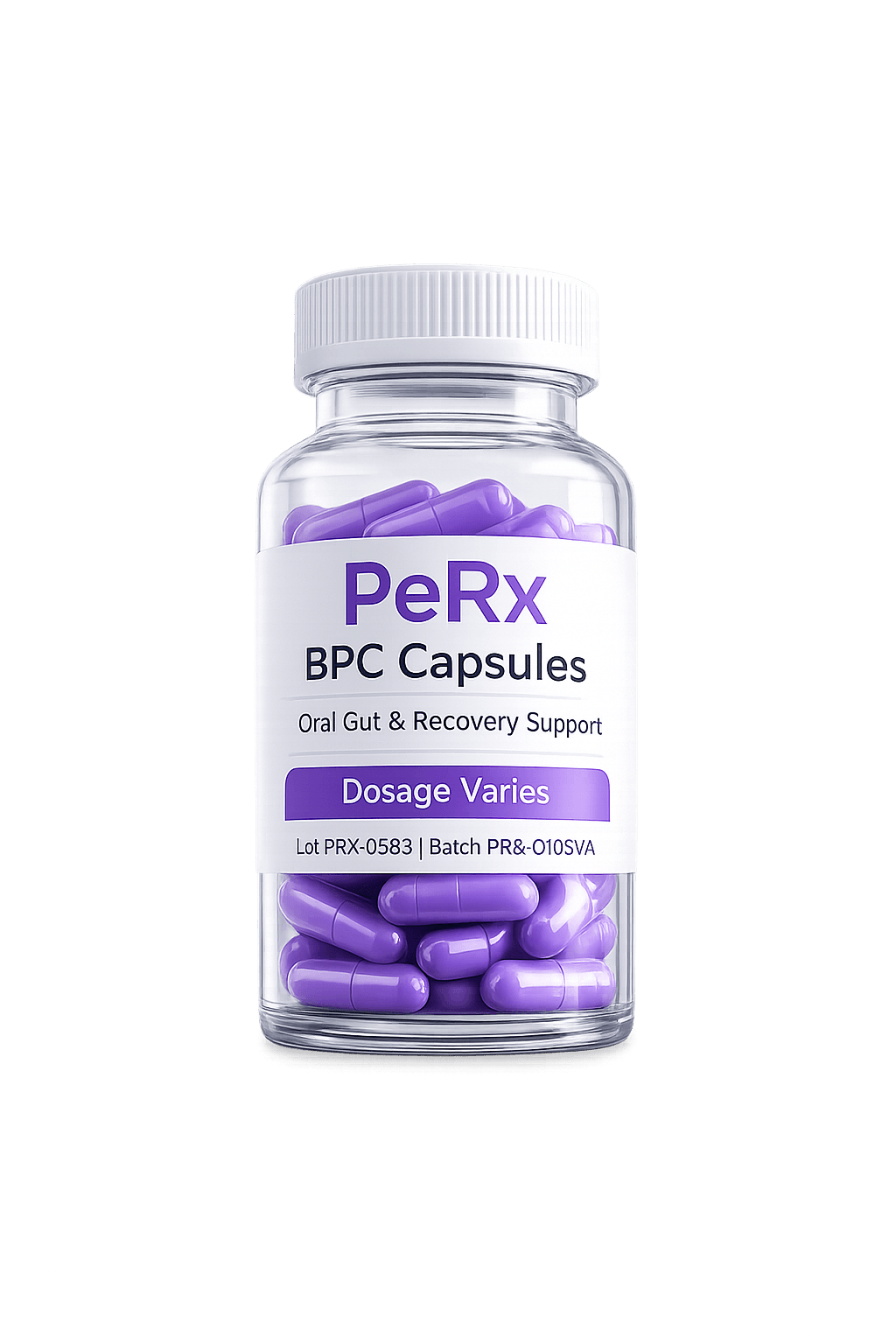
BPC-157 Capsules
The needle-free option that exists today. BPC-157 capsules at PeRx are prescribed by a licensed provider after an eligibility check and filled by a state-licensed 503A pharmacy, every lot independently tested.
They suit people whose goal centers on the gut, or who will not inject and would rather have a capsule than nothing. Compounded BPC-157 is not an FDA-approved drug, and the capsule is an option for people who will not inject, not an equal to the injection.
BPC/TB-500 Capsules
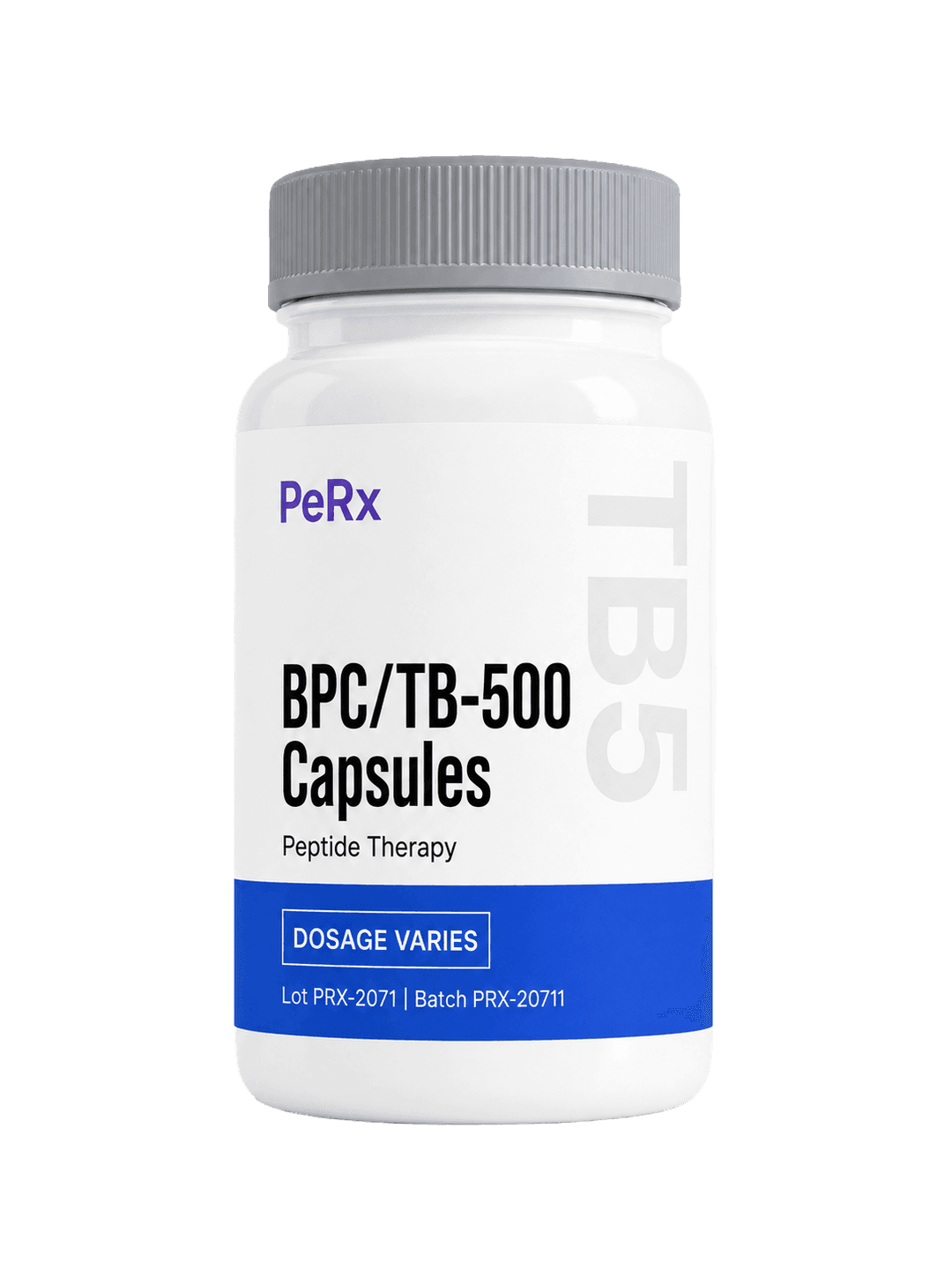
The same two recovery peptides as the injectable combination, in a daily capsule. BPC/TB-500 capsules at PeRx are prescribed, compounded and tested like every other PeRx product.
The oral evidence for TB-500 is thinner than for BPC-157, so a provider weighs whether the capsule or the ready-to-use injectable vial fits the goal. Compounded BPC/TB-500 is not an FDA-approved drug.
Oral Peptides That Work? What the Evidence Says About Capsules
BPC-157 is the peptide people usually mean when they ask about oral peptides that work. It was isolated from a protein in gastric juice and is reported to stay stable in it, which is why it is sold as a capsule at all. The strongest oral evidence relates to gut questions, where the capsule acts where it lands. What does not exist is a controlled human trial showing oral BPC-157 matches the injection for systemic goals such as tendon or joint recovery. PeRx offers the capsules as an option for people who will not inject, not as an equal. The BPC-157 capsules guide and the oral vs injectable BPC-157 comparison cover the gut-versus-tissue trade-off.
Some oral peptide medicines do exist, and they show what it takes. The approved semaglutide tablet pairs the molecule with an absorption enhancer so a usable fraction crosses the stomach lining, and it was engineered for the mouth from the start. Taking an injectable peptide by mouth is a different act: nothing about the molecule was changed to help it survive. The oral sermorelin tablets guide is the clearest example of a peptide that sells well as a tablet and has no published record of working that way.
Sublingual Peptides and Sublingual Semaglutide
Sublingual dosing works by absorption through the mucous membrane under the tongue, which carries part of the dose into the blood before the rest is swallowed and meets the gut. For small molecules the route is well established. For peptides the published evidence is limited: absorption is partial and varies with the molecule, the formulation and how long it is held in place. The sublingual peptides guide covers which peptides make sense this way and why PeRx sublinguals are dissolvable strips rather than droppers.
Sublingual semaglutide is the one most people are searching for. No published study shows that it matches the injection, and compounded sublingual versions are not FDA-approved. The approved products are the semaglutide injections and the semaglutide tablet, and the tablet reaches the blood through an absorption enhancer that a compounded liquid does not share. PeRx is preparing sublingual semaglutide and tirzepatide as a once-weekly liquid held under the tongue, with the strength set by the prescribing provider. Neither is available yet.
Sublingual GLP-1: coming soon
Sublingual semaglutide and sublingual tirzepatide are built and clinically reviewed but not yet available. Both are a once-weekly liquid held under the tongue, prescribed and dose-set exactly as the injections are. The product pages carry the coming-soon status and will change when they open.
Semaglutide (Sublingual)
Coming soon
Tirzepatide (Sublingual)
Coming soon
Nasal Sprays: When They Make Sense
Nasal delivery suits a few small peptides, especially the brain-targeting ones. Nearly all of the human research on Semax and Selank used nasal drops or sprays, because the Russian developers wanted a short path to the brain, and rat studies tracked the peptide into brain tissue after nasal dosing. PT-141 was studied as a nasal spray in women before the approved product became a subcutaneous autoinjector, a story the PT-141 nasal spray guide tells in full. Most peptides are too large or absorb too poorly through the nose, dosing is imprecise, and human evidence exists for only a handful.
Nothing PeRx sells is intranasal. Semax ships only inside the injectable Semax/Selank blend, a vial that ships fully reconstituted and ready to use, and the Semax nasal spray vs injection guide explains the gap between the research route and the prescribed one. A nasal spray bought online is a gray-market product with no prescriber, no pharmacy and no testing behind it.
Topical, Transdermal and Iontophoresis
Skin is a hard barrier for molecules the size of a peptide. Iontophoresis uses a mild electrical current to move charged molecules through it, a real device-based method with a research literature for larger molecules. Evidence for peptide therapy by this route is preclinical, and the clinics advertising it for named peptides have not published data; claims such as "zero systemic side effects" or "faster recovery" need published results, and none exist. Cosmetic copper peptide creams are a separate use: they act on the skin surface and are not a substitute for injectable peptide therapy.
Needle-Free Jet Injectors Are Still Injections
A jet injector uses pressure to push a liquid through the skin without a needle. It changes the device, not the route: the medicine still goes under the skin or into muscle, which is why the devices are studied for insulin and vaccines, not as a way around injecting. Even the companies that sell them say they apply only to medicines already prescribed as injections and do not replace the prescriber's instructions. A prescriber and a pharmacist must confirm that a product and device are compatible. PeRx does not sell these devices.
If Needles Are the Problem: Practical Options
If the needle is the obstacle, the fixes are smaller than most people expect. Ask the provider whether a capsule, sublingual or other form exists for your peptide and fits your goal. If not, know that peptide injections use the same insulin syringe people with diabetes use several times a day, with a needle a fraction of the width of a vaccination needle, and that the vial arrives ready to use with no reconstitution needed. A relaxed technique, rotating sites and a helper for the first few times remove most of the dread. The how to inject peptides guide walks through it, and how to take peptides compares the routes. The right choice is a conversation with the prescriber, not a switch made alone.
Getting Needle-Free Peptides Through a Prescription
The path is the same for a capsule or a vial: an eligibility check, review by a licensed provider who decides whether the product fits, and a prescription filled by a state-licensed 503A pharmacy. Compounded peptides are not FDA-approved drugs in any form. The how to get peptides prescribed online guide covers what the review involves.
Want a needle-free option, or just a better plan for the needle?
New to PeRx: the eligibility check takes about a minute, and a licensed provider reviews every order before it ships. Already a patient: ask your care team about switching form.
Peptides Without Needles: Common Questions
Related Guides
Continue reading about peptides and protocols that pair well with this guide.
BPC-157 Capsules: The Complete Guide
Most peptides are destroyed in the stomach, which is why "peptide pills" are usually a red flag. BPC-157 is the exception with a genuine oral story. This guide covers whether capsules actually work, what the research supports, capsule strengths, the arginate salt question, and why the capsules sold on Amazon are a different product category from a prescription.
Best Peptides in LA: 2026 Aesthetic & Recovery Guide
A plain guide to peptide therapy in Los Angeles, where looking camera-ready drives most of the demand. What it costs across clinics, med spas, and telehealth, and how pharmaceutical-grade peptides reach any LA address without a clinic visit.
July 2026 FDA Peptide Panel: BPC-157 Review
On July 23-24, the FDA's Pharmacy Compounding Advisory Committee will review seven peptides, including BPC-157, TB-500, and Semax. Despite the headlines, this is not a ban, and these peptides are not suddenly "legal again" either. Here is the precise, physician-reviewed picture of where things actually stand and what it means if you use peptide therapy.
References and Review
Drucker DJ. Advances in oral peptide therapeutics. Nat Rev Drug Discov. 2020;19(4):277-289. PMID: 31848464 View study
Buckley ST, Baekdal TA, Vegge A, et al. Transcellular stomach absorption of a derivatized glucagon-like peptide-1 receptor agonist. Sci Transl Med. 2018;10(467):eaar7047. PMID: 30429357 View study
Sikiric P, Rucman R, Turkovic B, et al. Novel cytoprotective mediator, stable gastric pentadecapeptide BPC 157. Vascular recruitment and gastrointestinal tract healing. Curr Pharm Des. 2018;24(18):1990-2001. PMID: 29879879 View study
Rawas-Qalaji M, Thu HE, Hussain Z. Oromucosal delivery of macromolecules: challenges and recent developments to improve bioavailability. J Control Release. 2022;352:726-746. PMID: 36334858 View study
Shevchenko KV, Nagaev IIu, Alfeeva LIu, et al. Kinetics of Semax penetration into the brain and blood of rats after its intranasal administration. Bioorg Khim. 2006;32(1):64-70. In Russian. PMID: 16523722 View study
Diamond LE, Earle DC, Heiman JR, et al. An effect on the subjective sexual response in premenopausal women with sexual arousal disorder by bremelanotide (PT-141), a melanocortin receptor agonist. J Sex Med. 2006;3(4):628-638. PMID: 16839319 View study
Gaikwad SS, Zanje AL, Somwanshi JD. Advancements in transdermal drug delivery: a comprehensive review of physical penetration enhancement techniques. Int J Pharm. 2024;652:123856. PMID: 38281692 View study
Novo Nordisk. Rybelsus and Ozempic tablets (oral semaglutide) prescribing information. DailyMed, label revised January 2026. View study
U.S. Food and Drug Administration. Compounding and the FDA: questions and answers. Accessed November 2026. View study
Medical Disclaimer
The information provided on this website, including all articles, guides, and educational content, is for informational and educational purposes only and is not intended as medical advice, diagnosis, or treatment. Nothing on this site should be construed as a substitute for professional medical advice from a qualified healthcare provider.
The majority of peptides discussed on this site are not approved by the U.S. Food and Drug Administration (FDA) for the indications described. They are classified as bulk drug substances and are available only through a licensed prescribing provider and compounding pharmacy. All treatments require a valid prescription and provider oversight.
The majority of published research on peptide therapies has been conducted in preclinical (animal) models. While early human data is encouraging, comprehensive clinical trial data remains limited for most peptide compounds. Individual results may vary significantly based on health status, injury type, and other factors. No specific outcomes are guaranteed.
Certain peptides discussed on this site are classified as prohibited substances by the World Anti-Doping Agency (WADA) and are banned by major sports organizations including the NFL, NCAA, UFC, NBA, MLB, NHL, and PGA. If you are subject to anti-doping testing, consult your governing body before considering any peptide therapy.
Statements on this website have not been evaluated by the Food and Drug Administration. Products and therapies discussed are not intended to diagnose, treat, cure, or prevent any disease.
© 2026 Wellness MD Group PC DBA PeRx. All rights reserved.