GHK-Cu Before and After: Results, Week by Week
Most GHK-Cu before-and-after pages show a serum result and describe an injection, or describe an injection and cite nothing. The human results that exist come from 12-week trials of creams on the faces of a few dozen women. No published trial has measured what injected GHK-Cu does to anyone. This guide keeps those facts apart from what patients on the injectable protocol report, lays out the week-by-week picture with its sources attached, and shows you how to photograph and track your own skin so the comparison means something.

In this article
Key Takeaways
- Every measured human GHK-Cu result is topical. The 12-week facial and eye-cream trials in roughly 40 to 70 women each reported higher skin density and thickness, less laxity and shallower fine lines. Those are cream results, mostly conference reports summarized by the peptide's discoverer.
- No published human trial has measured outcomes of injected GHK-Cu, at any dose, for skin, hair, scars or anything else. A 2026 systematic evidence map by an independent group called the clinical record sparse and the molecule promising but unproven.
- On the PeRx protocol, 20 units (2 mg) under the skin Monday through Friday, the first "after" almost everyone notices is at the injection site: mild redness or a small bruise, which the prescription label calls normal.
- Patients typically report smoother, better-hydrated skin in the first several weeks and talk about firmness only after two to three months. Those are reports, not measurements, and this page never blends them with the trial data.
- Hair evidence is thin and mostly animal or topical. The in-vitro follicle study most pages cite used AHK-Cu, a different copper peptide, and the one human scalp trial used a GHK complex mixed with another active, so it cannot isolate GHK.
- A before-and-after you can trust needs fixed photo conditions, a baseline written down before dose one, a 12-week minimum, and nothing else changed in the same window. As of October 2026 injectable GHK-Cu is not FDA-approved.
GHK-Cu Before and After Quick Facts
Human skin evidence
12-week topical trials, 41 to 71 women each: density, thickness, laxity, wrinkle depth
Injection evidence
No published human trial of injected GHK-Cu has measured any outcome
First visible "after"
Mild redness or a small bruise at the injection site, gone within days
What patients report
Texture and hydration in the first weeks; firmness at 8 to 12 weeks (anecdote)
Hair
Animal and topical data only; the usual in-vitro citation is a different peptide
What to track
Monthly photos in fixed conditions, a written baseline, 12 weeks minimum
GHK-Cu Before and After: The Honest Version
Search this phrase and you get two kinds of page. One shows a split photo of a cheek after twelve weeks of a blue serum and calls it GHK-Cu, which is accurate. The other describes a subcutaneous injection and borrows the serum's numbers, which is not. The human results that exist are topical: creams applied for 12 weeks to the faces of a few dozen women, reported mostly at a 2002 dermatology meeting and summarized ever since by the peptide's discoverer. As of October 2026, no published trial has given GHK-Cu by injection to people and measured what happened.
So the honest version is built from three piles that never touch: what the topical trials measured, what the injection data shows (animal work, nothing human), and what patients on a prescribed protocol say they notice. The mechanism lives in the GHK-Cu guide and the unit arithmetic in the GHK-Cu dosage chart; this page covers what can change, in what order, and how you would know on your own face.
Three Kinds of Evidence, Kept Apart
Tier one: controlled topical trials. These are the only human GHK-Cu outcome data. Pickart and Margolina's 2018 review collects them: a facial cream used for 12 weeks by 71 women with photoaging, an eye cream used for 12 weeks by 41 women against placebo and a vitamin K cream, and a one-month thigh study that counted collagen in biopsies. The findings were higher skin density and thickness, less laxity and shallower fine lines. The cautions: small groups, conference abstracts rather than full papers, and reviews written by the peptide's discoverer, who also sells copper-peptide skincare.
Pickart L, Margolina A. "Regenerative and Protective Actions of the GHK-Cu Peptide in the Light of the New Gene Data." International Journal of Molecular Sciences, 2018. (Review; section 2.2 summarizes the topical trials.) View study
Pickart L, Vasquez-Soltero JM, Margolina A. "GHK Peptide as a Natural Modulator of Multiple Cellular Pathways in Skin Regeneration." BioMed Research International, 2015. (Review; the "Facial Studies" section.) View study
Tier two: injection data. There is no human tier two. In 2026 a group with no commercial tie to the peptide published a systematic evidence map of everything tested with GHK-Cu through August of that year; their human record is four small topical studies, and they call GHK-Cu promising but unproven. A 2026 sports-medicine primer agrees: no clinical data, dosing and duration unknown. The injection pile contains animal work. In the best-known study, GHK-Cu injected into wound chambers under the skin of rats raised collagen and other matrix proteins dose-dependently. A rat, a wound and a chamber: that is the closest thing to an injection result that exists.
Mateescu DM, Gavrilescu DM, Mincioaga RI, et al. "GHK-Cu as a Bioactive Metallopeptide and Drug-Delivery Cargo: Coordination Chemistry, Formulation Science, Therapeutic Evidence, and a Translational Roadmap." Pharmaceutics, 2026. (Systematic evidence map; search cutoff 12 August 2026.) View study
Mayfield CK, Bolia IK, Feingold CL, et al. "Injectable Peptide Therapy: A Primer for Orthopaedic and Sports Medicine Physicians." American Journal of Sports Medicine, 2026. (Narrative review.) View study
Maquart FX, Bellon G, Chaqour B, et al. "In vivo stimulation of connective tissue accumulation by the tripeptide-copper complex glycyl-L-histidyl-L-lysine-Cu2+ in rat experimental wounds." Journal of Clinical Investigation, 1993. (Animal study.) View study
Tier three: patient reports. People on a prescribed protocol do notice things, and this page says what they report. Every such statement is anecdote: unblinded, unmeasured, and shaped by having paid for the vial. The cleanest demonstration of why that matters is a randomized topical study in 13 people after laser resurfacing: blinded evaluators and computer analysis found no difference between the groups at 12 weeks, yet the GHK-Cu users rated their own improvement significantly higher. Satisfaction moved; the measurements did not.
Miller TR, Wagner JD, Baack BR, Eisbach KJ. "Effects of topical copper tripeptide complex on CO2 laser-resurfaced skin." Archives of Facial Plastic Surgery, 2006. (Randomized topical study, 13 completers.) View study
What the Topical Trials Measured at 4, 8 and 12 Weeks
At about four weeks the signal was histological: in the thigh study, women applied creams for one month and biopsies were examined for collagen, which rose in 70 percent of the GHK-Cu group against 50 percent for vitamin C and 40 percent for retinoic acid. That is the origin of every "beats vitamin C and retinol" line online, from a pilot study in a journal PubMed does not index, on a thigh biopsy, not a face.
At eight weeks, the 2018 review describes a small randomized serum trial reporting less wrinkle volume and depth against a control; that paper also sits outside PubMed, so treat its percentages as reported, not confirmed. At twelve weeks come the results that matter: the 71-woman facial trial and the 41-woman eye-cream trial measured higher skin density and thickness, less laxity, and shallower fine lines. Those are instrument readings, which is why these trials outrank any photo set. They are also cream readings: a cream acts where it is applied, an injection goes wherever circulation takes it, and nothing in these trials says whether a subcutaneous dose reaches the dermis of your face at a concentration that does what the cream did.
Hostynek JJ, Dreher F, Maibach HI. "Human skin penetration of a copper tripeptide in vitro as a function of skin layer." Inflammation Research, 2011. (In-vitro penetration study, not an efficacy result.) View study
What Changes First on the Injectable Protocol, and What Does Not
The PeRx prescription is specific: GHK-Cu at 10 mg/mL in a 5 mL vial, 20 units under the skin once daily, Monday through Friday. That is 0.2 mL, 2 mg per injection and 10 mg a week, with no cycling break; the standalone product is prescribed for continuous use. Three label rules shape your before-and-after: no copper supplements while using it, no vitamin C serums or supplements within two hours of the injection, and mild redness or bruising at the site is normal. Where to inject GHK-Cu covers sites and rotation.
So the first "after" is unglamorous: a pink spot or small bruise where the needle went in, the one reliable effect of injected GHK-Cu, gone within days. Nothing about your face has changed by week one. What patients report next, typically between the third and sixth week, is smoother morning skin and blemishes that settle faster. By eight to twelve weeks the reports shift to firmness: a cheek that feels denser, fine lines that catch less light. Those reports run in the direction the cream trials measured, which is exactly why they must stay labeled as reports.
What does not change is the more useful list: weight, lost facial volume and significantly loose skin. A body transformation credited to GHK-Cu belongs to a GLP-1 medication or a training block, as the peptides before and after guide explains, and the GHK-Cu after GLP-1 weight loss guide is blunt about the other two.
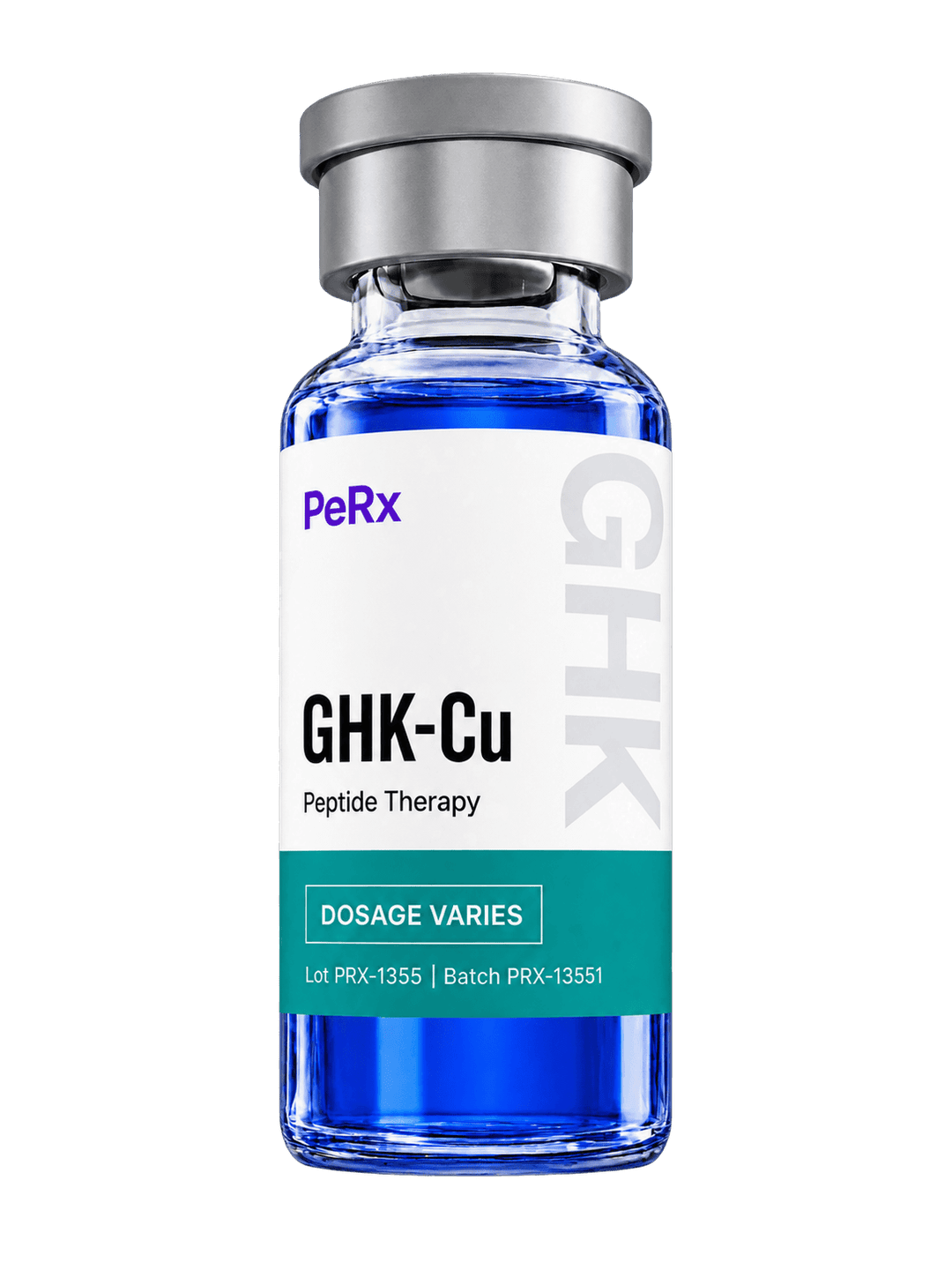
GHK-Cu
PeRx GHK-Cu is prescribed by a licensed provider after a health screening and compounded at a US-based 503A pharmacy at 10 mg/mL. It ships fully reconstituted and ready to use.
$229 per vial, sold as a one-month supply, for continuous Monday-through-Friday use.
Skin: Texture, Firmness and the Appearance of Scars
Skin has the only human data, so it is where a before-and-after can be most honest. Texture and hydration come first in patient reports and appear in the topical trials as clarity and smoothing, which makes them the earliest plausible change and the hardest to photograph: hydration swings with sleep, salt, alcohol and the season far more than any peptide moves it. Firmness is the slower chapter. The cream trials read density and wrinkle depth at 12 weeks, and that is the earliest point at which a matched photo pair has a fair chance of showing anything; the peptides before your wedding guide does the calendar math.
Scars deserve their own honesty. The regenerative story is a wound story, well supported in animals. In people, the first controlled trial of a GHK-Cu product on fresh wounds, a topical gel, began recruiting in February 2026 with primary completion set for February 2027. Nobody has studied injected GHK-Cu on an old scar. Patients report that recent marks seem to settle faster; an old scar changing over months is an occasional report, nothing more.
"Topical GHK-Cu Gel for Acute Skin Wound Healing." ClinicalTrials.gov identifier NCT07437586. Phase 2, randomized, vehicle-controlled; recruiting as of October 2026, primary completion February 2027, no results posted. View study
Skincare forums describe a "copper uglies" phase, duller or rougher skin in the first weeks of a topical copper peptide before things improve. It is anecdote from serum users, never studied, and an injection whose peptide never sits on the skin surface gives no reason to expect it; skin that looks worse at week three usually has a new retinoid, a new sunscreen or a bad sleep week behind it. GHK-Cu vs retinol covers why the two do different jobs; peptides for glowing skin puts GHK-Cu beside the other skin options.
Hair: What the Evidence Actually Covers
Hair is where GHK-Cu before-and-after content is least honest. The animal data is old and real: peptide-copper complexes stimulated follicles in C3H mice in 1991, and a copper-binding peptide enlarged follicles on fuzzy-rat skin in the same era. The human data is thinner than it looks. The follicle study most pages cite, a 2007 in-vitro paper, tested AHK-Cu, a different copper tripeptide. The one controlled scalp trial sprayed a GHK and 5-aminolevulinic acid complex on 45 men with pattern hair loss for six months; hair counts rose against placebo, thickness did not change, and a two-ingredient complex cannot isolate GHK. The newest entry is an 18-person 2026 split-face study of a 2 percent GHK-Cu serum on eyebrows, which the 2026 evidence map calls the strongest human signal while noting it was small and cosmetic.
Trachy RE, Fors TD, Pickart L, Uno H. "The hair follicle-stimulating properties of peptide copper complexes. Results in C3H mice." Annals of the New York Academy of Sciences, 1991. (Animal study.) View study
Uno H, Kurata S. "Chemical agents and peptides affect hair growth." Journal of Investigative Dermatology, 1993. (Animal data.) View study
Lee WJ, Sim HB, Jang YH, et al. "Efficacy of a Complex of 5-Aminolevulinic Acid and Glycyl-Histidyl-Lysine Peptide on Hair Growth." Annals of Dermatology, 2016. (Randomized, placebo-controlled; 45 men; topical two-ingredient spray.) View study
For injected GHK-Cu and hair there is no data of any kind. Some patients report fuller-feeling hair after a few months; some report nothing. Treat any change as a bonus.
The Week-by-Week Picture, Sourced
The usual schedule, rebuilt with one rule: every stage names the pile it came from, and topical measurements and patient reports never share a sentence. It assumes the prescribed protocol and a baseline photo set taken before dose one.
Days 1 to 14
The injection site, and nothing else
Source: the label and patient reports. Redness or a small bruise at the site, gone within days. Nothing else has been measured this early; if your skin already feels different, write it down and do not count it.
Weeks 3 to 6
Texture reports; the one-month biopsy signal
Source: patient reports and the one-month thigh study. People describe smoother morning skin and faster-settling blemishes. The only measurement this early is topical: biopsy collagen rose in 70 percent of women after a month of cream. First repeat photo set at week four.
Weeks 8 to 12
Firmness reports; the topical trial endpoints
Source: patient reports and the 12-week cream trials. Reports shift to firmness and fine lines; the trials measured higher density and thickness, less laxity and shallower wrinkles, in creams. First point at which matched photos can fairly show a difference.
Beyond 12 weeks
Continuous use, no map
Source: nothing. No GHK-Cu study, topical or injected, has reported past 12 weeks except the six-month hair-complex trial. Keep the monthly photo set going and bring it to your provider when you reassess.
How to Run Your Own Before and After
Skin is the one peptide outcome a camera can testify to, which makes it the easiest to fake by accident. Window light changes by the hour, a phone applies smoothing you cannot fully turn off, and a different distance changes how a pore reads. The post-laser study showed that impressions run ahead of measurements, so this design takes your impression out of the loop.
Photos: same room, same lamp, same spot on the floor. Use an interior room with no window light and one fixed lamp, and mark where you stand and where the phone sits at face height. Same time of day, after washing, no makeup, hair back, neutral face, beauty and HDR settings off. Three frames, straight on and both profiles, then a fourth, close, of one area you care about: a cheek, the outer eye, one scar. Repeat on the same calendar day each month, not weekly; skin is noisy day to day and the only human data reads at 12 weeks.
A written baseline, before dose one. Rate texture and firmness from 1 to 10, note how many days a typical blemish takes to flatten, and list every product on your face; once you feel better you will forget how you felt before. One instrument, if you can get it. Clinics measure elasticity with a cutometer and skin thickness with ultrasound. A baseline and a 12-week reading from the same device is the closest a patient gets to a trial endpoint.
The rule that makes it honest
Change nothing else in the window. A new retinoid, a new sunscreen, a laser or microneedling appointment, or a second peptide in the same twelve weeks gives you a before-and-after with several authors and no way to tell which one wrote it. Keep the label rules too: no vitamin C within two hours of the injection, no copper supplements.
Then wait the full twelve weeks; the how long peptides take to work guide explains why each peptide class runs on its own clock. Compare the sets side by side on a screen, and ask someone who does not know which is which to pick the better one.
When You See Nothing
Suppose you did it properly, twelve weeks passed, and the matched photos look the same. The photos first: if the lamp, distance or phone changed, the comparison is void, not negative. The window: eight weeks and a verdict is not a fair trial of a peptide whose only human data reads at twelve. The protocol: missed weekday doses, vitamin C right after the injection, or a copper supplement alongside all take you off the prescription that was written. Then the honest possibility: injected GHK-Cu may not do much for your skin. Nobody has measured what it does for anyone's, so a null result on one face is not a verdict on the molecule.
What to do with that is not to draw more units; the dose is fixed, and a bigger draw only raises the copper figure in the dosage chart. Bring the photo set and the baseline notes to your provider. Sometimes a different peptide fits better, which Epitalon vs GHK-Cu and BPC-157 vs GHK-Cu lay out, or the GHK-Cu and Epitalon vial was the product in question; sometimes the goal was never a GHK-Cu goal, and a good topical routine and sunscreen were the proportionate tool.
Red Flags in GHK-Cu Before-and-After Content
Serum photos under an injection headline. The most common move on this search: a split image of a cheek after twelve weeks of copper-peptide cream, placed under a page about subcutaneous GHK-Cu, transfers a cream's evidence to a route that has none. Trial percentages with the route removed. "Collagen up in 70 percent" and "beats vitamin C and retinol" are topical findings from a few dozen women, accurate only with the word topical attached.
"4,000 genes" as a human result. The figure comes from the Connectivity Map, a computer comparison of how cultured cells respond to compounds. The emphysema paper that put GHK on that map is serious science, but it measured nothing in a living person, and no human study has profiled gene expression after a GHK-Cu injection.
Campbell JD, McDonough JE, Zeskind JE, et al. "A gene expression signature of emphysema-related lung destruction and its reversal by the tripeptide GHK." Genome Medicine, 2012. (Connectivity Map analysis plus cultured fibroblasts; no human treatment.) View study
Pickart L, Vasquez-Soltero JM, Margolina A. "GHK and DNA: resetting the human genome to health." BioMed Research International, 2014. (Review of Connectivity Map and cell data.) View study
A hair study for a different peptide. The 2007 in-vitro follicle study is AHK-Cu. A procedure in the same window. Photos taken across a laser, filler or retinoid start are showing you the procedure. Promises with dates. No GHK-Cu study has produced "visible results in two weeks." No prescriber in sight. Injectable GHK-Cu is prescription-only and, as of October 2026, not FDA-approved for any use; is GHK-Cu FDA approved tracks the federal advisory review of its compounding status. Results imagery with no licensed provider or pharmacy behind it is selling an unregulated product.
Why there are no patient photos on this page
PeRx does not publish patient before-and-after photos or patient stories. Every patient is under a licensed provider's care, and what happened to their skin is private medical information. For a peptide whose injected effects have never been measured, a persuasive photo set would overstate what GHK-Cu did or borrow the result from a serum, a procedure, or good lighting.
Ready to get started?
Pharmaceutical-grade GHK-Cu, prescribed by a licensed provider and shipped to your door in ready-to-use vials. Take the baseline photos first, then run the full twelve weeks.
GHK-Cu Before and After: Common Questions
Related Guides
Continue reading about peptides and protocols that pair well with this guide.
Where to Inject GHK-Cu: Sites and Rotation
GHK-Cu goes under the skin, once a day, five days a week. That schedule puts more demand on your rotation habit than a twice-weekly peptide does, and copper brings two handling rules nothing else in the catalog has. Here is how patients actually run it at home.
GHK-Cu Peptide: Benefits, Injections & Evidence
In 1973, a biochemist at UCSF discovered that young blood makes old cells act young. The molecule responsible was the GHK peptide, a tiny copper-binding tripeptide that drops 60% by age 60 and influences thousands of your genes. Today, TikTok sells it as a $20 face cream. The injectable version does something fundamentally different: it reaches every tissue in your body and signals all of them to start repairing. Here's why that distinction matters more than any skincare trend.
Peptides for Dancers: Achilles and Ankle Repair
How BPC-157, the BPC/TB-500 combo, and NAD+ fit the injuries that define a dancing life: the Achilles that aches before opening night, the foot and ankle overuse that never fully quiets, and the tech-week fatigue that no amount of sleep covers. Organized around the way dancers actually experience the body, and honest about where the science is solid and where it is hopeful.
Medical Disclaimer
The information provided on this website, including all articles, guides, and educational content, is for informational and educational purposes only and is not intended as medical advice, diagnosis, or treatment. Nothing on this site should be construed as a substitute for professional medical advice from a qualified healthcare provider.
The majority of peptides discussed on this site are not approved by the U.S. Food and Drug Administration (FDA) for the indications described. They are classified as bulk drug substances and are available only through a licensed prescribing provider and compounding pharmacy. All treatments require a valid prescription and provider oversight.
The majority of published research on peptide therapies has been conducted in preclinical (animal) models. While early human data is encouraging, comprehensive clinical trial data remains limited for most peptide compounds. Individual results may vary significantly based on health status, injury type, and other factors. No specific outcomes are guaranteed.
Certain peptides discussed on this site are classified as prohibited substances by the World Anti-Doping Agency (WADA) and are banned by major sports organizations including the NFL, NCAA, UFC, NBA, MLB, NHL, and PGA. If you are subject to anti-doping testing, consult your governing body before considering any peptide therapy.
Statements on this website have not been evaluated by the Food and Drug Administration. Products and therapies discussed are not intended to diagnose, treat, cure, or prevent any disease.
© 2026 Wellness MD Group PC DBA PeRx. All rights reserved.