GHK-Cu Dosage Chart: Units, Schedule, Copper Math
Search for a GHK-Cu dosage chart and you get a Reddit thread and a handful of research-vendor pages, all quoting 1 to 2 mg per injection as if a trial had set it. No trial did. The human GHK-Cu data is almost entirely topical, and the injection figures are clinic convention. This page lays out those conventions as the ranges they are, then the one dose a licensed provider actually prescribes through PeRx: 20 units, 2 mg, Monday through Friday, from a 10 mg/mL vial. Units, weekly totals, the copper arithmetic, timing and missed doses, as of October 1, 2026.
In this article
Key Takeaways
- The prescribed GHK-Cu dose at PeRx is 20 units on a U-100 insulin syringe, which is 0.2 mL of a 10 mg/mL vial, so 2 mg of GHK-Cu per injection, once daily Monday through Friday. That is 10 mg per week and 25 doses per 5 mL vial, about five weeks.
- No human trial has established an injectable GHK-Cu dose. The published human work is topical, in creams and serums, and the 1 to 2 mg per injection range quoted across clinic and research-vendor sites is convention, not a trial result. The PeRx dose sits inside that convention and was set by the prescribing physician and the compounding pharmacy, not by a study.
- Units mean nothing without the concentration. At 10 mg/mL, every milligram is 10 units. A research vial at a different strength changes the draw for the same milligram dose, which is where most self-mixing errors come from.
- Copper is about 16 percent of GHK-Cu by weight, so a 2 mg dose carries roughly 0.3 mg of copper. Across a Monday to Friday week that averages about 0.2 mg a day, a quarter of the adult recommended intake and a small fraction of the 10 mg daily upper limit, even if every microgram were absorbed.
- The standalone GHK-Cu prescription runs continuously with no scheduled break. Inside KLOW the same 2 mg per dose runs 6 weeks on and 6 weeks off, because the cycle belongs to the blend, not to GHK-Cu.
- As of October 1, 2026 injectable GHK-Cu is not FDA-approved, was removed from the FDA Category 2 list in April 2026 after its nomination was withdrawn, and is slated for a Pharmacy Compounding Advisory Committee review before the end of February 2027. Nothing about that process has reviewed a dose.
GHK-Cu Dosing at a Glance
Peptide
GHK-Cu, the copper-bound tripeptide glycyl-L-histidyl-L-lysine
How PeRx supplies it
Subcutaneous injection only, 10 mg/mL in a 5 mL vial. No topical, no nasal product.
Prescribed dose
20 units (0.2 mL), which is 2 mg, once daily Monday through Friday
Weekly total
10 mg across five injections
Cycle
Continuous on the standalone product; 6 weeks on, 6 off inside KLOW
Human dosing data
None for injection; the human trials are topical creams and serums
Copper per dose
About 0.3 mg, roughly a third of the daily recommended intake
Cost
$229 per 5 mL vial at PeRx, 25 doses, about five weeks
The GHK-Cu Dosage Chart
A dosage chart is supposed to summarize what trials settled. For injectable GHK-Cu there is nothing to summarize: the human studies behind the collagen and skin-firmness claims used creams and serums, and no published trial has given GHK-Cu under the skin to people at any dose. So an honest chart has two kinds of rows. The first kind is convention, the ranges clinics and research vendors repeat to each other, which are not wrong so much as unanchored. The second kind is the prescription, a fixed number a licensed physician wrote for a pharmacy-set concentration after screening. The chart below labels which is which.
| Context | GHK-Cu amount | Schedule | Standing behind it |
|---|---|---|---|
| PeRx prescribed (standalone vial) | 2 mg per 20-unit dose | Once daily, Monday through Friday, continuous | Physician-prescribed; 503A pharmacy fills at 10 mg/mL |
| PeRx weekly total | 10 mg across 5 doses | Subcutaneous | Same prescription, added up |
| PeRx per 5 mL vial | 50 mg, 25 doses | About five weeks | Vial size times concentration |
| Inside KLOW (PeRx) | 2 mg per 20-unit dose, with BPC-157, KPV and TB-500 | Monday through Friday, 6 weeks on, 6 off | Blend protocol; the cycle belongs to the blend |
| Inside GHK-Cu/Epitalon (PeRx) | 10 mg/mL GHK-Cu plus 2 mg/mL Epitalon in one vial | Per prescription; Epitalon is run in courses | Blend protocol; dose set per patient |
| Clinic convention | 1 to 2 mg per injection | 3 to 5 days per week | Repeated across clinic sites; no trial behind the range |
| Research-market vials | 0.5 to 3 mg per day, self-mixed | Varies by vendor | Vendor convention; the buyer computes the concentration |
| Published human injection trials | None at any dose | None | Nobody has run the study |
PeRx prescribed (standalone vial)
- GHK-Cu amount
- 2 mg per 20-unit dose
- Schedule
- Once daily, Monday through Friday, continuous
- Standing behind it
- Physician-prescribed; 503A pharmacy fills at 10 mg/mL
PeRx weekly total
- GHK-Cu amount
- 10 mg across 5 doses
- Schedule
- Subcutaneous
- Standing behind it
- Same prescription, added up
PeRx per 5 mL vial
- GHK-Cu amount
- 50 mg, 25 doses
- Schedule
- About five weeks
- Standing behind it
- Vial size times concentration
Inside KLOW (PeRx)
- GHK-Cu amount
- 2 mg per 20-unit dose, with BPC-157, KPV and TB-500
- Schedule
- Monday through Friday, 6 weeks on, 6 off
- Standing behind it
- Blend protocol; the cycle belongs to the blend
Inside GHK-Cu/Epitalon (PeRx)
- GHK-Cu amount
- 10 mg/mL GHK-Cu plus 2 mg/mL Epitalon in one vial
- Schedule
- Per prescription; Epitalon is run in courses
- Standing behind it
- Blend protocol; dose set per patient
Clinic convention
- GHK-Cu amount
- 1 to 2 mg per injection
- Schedule
- 3 to 5 days per week
- Standing behind it
- Repeated across clinic sites; no trial behind the range
Research-market vials
- GHK-Cu amount
- 0.5 to 3 mg per day, self-mixed
- Schedule
- Varies by vendor
- Standing behind it
- Vendor convention; the buyer computes the concentration
Published human injection trials
- GHK-Cu amount
- None at any dose
- Schedule
- None
- Standing behind it
- Nobody has run the study
Read the bottom row first and the top row second. The PeRx figure is not a better guess than the convention rows; it is a different kind of thing, a fixed dose of a fixed concentration that a medical director approved as written and that a pharmacy fills the same way every time. Where it differs from the convention rows is accountability: a prescription has a screening record, a label and a pharmacy behind it, and a Reddit protocol has none of those. For the molecule itself and the evidence behind it, start with the GHK-Cu guide; this page stays on the numbers.
Units on an Insulin Syringe
Every GHK-Cu number online is useless until you know the concentration of the vial in your hand. A U-100 insulin syringe is marked in units, 100 units to the milliliter, and units measure volume, not peptide. The conversion is one line of arithmetic: units equals milligrams divided by the vial strength in mg/mL, times 100. At the 10 mg/mL strength PeRx ships, that collapses to a rule you can hold in your head: every milligram is 10 units. The prescribed 2 mg is 20 units. One milligram would be 10 units, three would be 30. The table runs the common figures at that strength.
| Dose | Units on U-100 syringe (at 10 mg/mL) | Volume | Doses per 5 mL vial |
|---|---|---|---|
| 0.5 mg | 5 units | 0.05 mL | 100 |
| 1 mg | 10 units | 0.1 mL | 50 |
| 1.5 mg | 15 units | 0.15 mL | 33 |
| 2 mg (PeRx prescribed) | 20 units | 0.2 mL | 25 |
| 2.5 mg | 25 units | 0.25 mL | 20 |
| 3 mg | 30 units | 0.3 mL | 16 |
0.5 mg
- Units on U-100 syringe (at 10 mg/mL)
- 5 units
- Volume
- 0.05 mL
- Doses per 5 mL vial
- 100
1 mg
- Units on U-100 syringe (at 10 mg/mL)
- 10 units
- Volume
- 0.1 mL
- Doses per 5 mL vial
- 50
1.5 mg
- Units on U-100 syringe (at 10 mg/mL)
- 15 units
- Volume
- 0.15 mL
- Doses per 5 mL vial
- 33
2 mg (PeRx prescribed)
- Units on U-100 syringe (at 10 mg/mL)
- 20 units
- Volume
- 0.2 mL
- Doses per 5 mL vial
- 25
2.5 mg
- Units on U-100 syringe (at 10 mg/mL)
- 25 units
- Volume
- 0.25 mL
- Doses per 5 mL vial
- 20
3 mg
- Units on U-100 syringe (at 10 mg/mL)
- 30 units
- Volume
- 0.3 mL
- Doses per 5 mL vial
- 16
The strength changes the draw
The same 2 mg is 20 units at 10 mg/mL, 40 units at 5 mg/mL and 100 units, a full syringe, at 2 mg/mL. Research vials are sold by total milligrams and mixed by the buyer, so two people following the same 2 mg protocol can be injecting very different amounts if their concentrations differ. A PeRx vial removes that variable: it arrives at a labeled 10 mg/mL, ready to use with no reconstitution needed, and the unit count on the prescription already includes the math.
The two PeRx blends that contain GHK-Cu are filled at the same 10 mg/mL for the GHK-Cu component, which keeps the arithmetic consistent across the catalog. A 20-unit draw of KLOW carries 2 mg of GHK-Cu alongside 0.6 mg each of BPC-157, KPV and TB-500; the KLOW dosage guide runs all four lines at once. A 20-unit draw of the GHK-Cu/Epitalon vial carries 2 mg of GHK-Cu and 0.4 mg of Epitalon. In every case the unit number on your syringe refers to the whole solution, never to one ingredient, and the catalog-wide reference for every PeRx peptide lives in the peptide dosage chart.
Where the Numbers Come From
GHK-Cu has one of the longest research records of any peptide in compounding, which makes the absence of an injection dose more striking, not less. The tripeptide was identified in human plasma in 1973, and the 1977 paper that named it reported a serum factor that made old liver tissue synthesize protein like young tissue. In 1988 Maquart and colleagues showed the copper complex stimulated collagen synthesis in cultured fibroblasts. What followed was topical: creams and serums tested on facial skin, and the collagen, firmness and wrinkle-depth figures that circulate today come from those studies, which Pickart and Margolina summarize in their reviews.
Schlesinger DH, Pickart L, Thaler MM. "Growth-modulating serum tripeptide is glycyl-histidyl-lysine." Experientia. 1977;33(3):324-325. View study
Maquart FX, Pickart L, Laurent M, Gillery P, Monboisse JC, Borel JP. "Stimulation of collagen synthesis in fibroblast cultures by the tripeptide-copper complex glycyl-L-histidyl-L-lysine-Cu2+." FEBS Letters. 1988;238(2):343-346. View study
Pickart L, Margolina A. "Regenerative and Protective Actions of the GHK-Cu Peptide in the Light of the New Gene Data." International Journal of Molecular Sciences. 2018;19(7):2047. View study
Topical doses do not translate into injection doses. A cream delivers a tiny fraction of its GHK-Cu through the skin and the rest stays on the surface; an injection delivers all of it into circulation. Nobody has published the pharmacokinetics of subcutaneous GHK-Cu in people, so there is no measured half-life, no absorption curve and no blood level to target. The one human anchor that exists is the natural one: plasma GHK runs around 200 ng/mL in young adults and falls to roughly 80 ng/mL by age 60, a decline Pickart has used to argue that the peptide matters, but which no injection study has tried to restore to a particular level. The animal work, including the lung-fibrosis and wound models, dosed by body weight in ways that do not convert cleanly to a 20-unit draw.
Pickart L, Vasquez-Soltero JM, Margolina A. "GHK Peptide as a Natural Modulator of Multiple Cellular Pathways in Skin Regeneration." BioMed Research International. 2015;2015:648108. View study
Pickart L. "The human tri-peptide GHK and tissue remodeling." Journal of Biomaterials Science, Polymer Edition. 2008;19(8):969-988. View study
So where did 1 to 2 mg per injection come from? From practice. Compounding pharmacies had to pick a concentration, prescribers had to pick a volume, and the range that emerged across clinics was scaled from the cosmetic literature and from tolerability rather than from a dose-finding study. That is also why the range is as wide as it is. The PeRx prescription sits at 2 mg because that is the number the prescribing physician and the pharmacy agreed on for a 10 mg/mL fill, and it has stayed fixed since. Treat it as a prescription, which it is, and not as a finding, which it is not. The FDA will eventually weigh in on whether GHK-Cu belongs on the 503A compounding list at all, and the FDA status guide tracks that; a dose is not part of what the committee reviews.
What the newer skin data does and does not say
A 2023 study found GHK-Cu and hyaluronic acid together raised collagen IV in cultured fibroblasts and in skin samples outside the body. It is a mechanism result, not a dosing result, and it says nothing about how much GHK-Cu to inject. It appears here because vendor pages cite it as if it did.
Jiang F, Wu Y, Liu Z, et al. "Synergy of GHK-Cu and hyaluronic acid on collagen IV upregulation via fibroblast and ex-vivo skin tests." Journal of Cosmetic Dermatology. 2023;22(9):2598-2604. View study
When to Inject GHK-Cu
Morning or night is one of the most searched GHK-Cu dosing questions and one of the least consequential. Some peptides carry real timing logic: growth hormone secretagogues are injected before sleep to ride the natural GH pulse, and a breakfast dose wastes the mechanism. GHK-Cu has no equivalent. With no human pharmacokinetics there is no known peak, no circadian behavior and no evidence that an evening dose behaves differently from a morning one. The prescription reflects that by naming a frequency, once daily Monday through Friday, and not a clock time.
What the prescription does ask for is consistency. Pick an hour you can hit five days a week and keep it, because the dose that gets skipped is the one that never found a slot in the routine. Most patients land on the morning for logistics. The one practical argument for a time of day is the injection site: mild redness or a small raised spot at the site is the most common thing people notice, and rotating sites a finger-width apart each day matters more than the hour, which where to inject GHK-Cu maps out. Food makes no difference to a subcutaneous injection, so fasted-versus-fed rules do not apply, and the broader best time of day guide covers the peptides where timing does matter.
The one-line answer
Any time of day you can repeat five days a week, at a fresh site each time. The prescription cares about the frequency and the rotation, not the clock.
How Long: Cycle and Duration
Most PeRx peptides are written with a scheduled break, some weeks on followed by some weeks off. Standalone GHK-Cu is the exception: it is prescribed for continuous use, Monday through Friday, with no built-in cycle. That means the practical question is not when the cycle ends but when to reassess, and the honest answer is that the first visible changes people report, in skin texture and in how quickly small blemishes settle, tend to arrive over the first several weeks, with firmness changes taking longer. The how long peptides take to work guide sets realistic clocks for the whole catalog.
The cycle changes when GHK-Cu rides inside a blend, because the cycle belongs to the protocol, not to the ingredient. Inside KLOW the same 2 mg per dose runs for 6 weeks and then stops for 6, a rhythm set for the four-peptide repair protocol as a whole. Inside the GHK-Cu/Epitalon vial the schedule follows Epitalon, which is traditionally run in short courses, and the prescription for the combination sets the on and off periods for both peptides at once; the GHK-Cu/Epitalon guide walks through why the two are paired. If you move from one of those products to the standalone vial, the rules change with the product. The general logic of breaks, and which peptide classes actually need them, lives in the peptide cycling guide.
The Copper Math
The question underneath most GHK-Cu dosing worry is copper. Am I injecting a dangerous amount of a metal? The arithmetic is short. GHK-Cu is one copper ion bound to a tripeptide of about 340 daltons, so copper makes up roughly 16 percent of the complex by weight. A 2 mg dose therefore carries about 0.3 mg of copper. Five doses a week is about 1.6 mg of copper, which averaged over seven days is roughly 0.2 mg per day. The adult recommended dietary intake for copper is 0.9 mg per day and the tolerable upper intake level is 10 mg per day, so the prescribed dose adds about a quarter of a normal daily intake and about 2 percent of the upper limit, and that is the ceiling, assuming every microgram enters the body, which an injection roughly does and a cream does not.
| Measure | Copper delivered |
|---|---|
| Per 2 mg dose | About 0.3 mg |
| Per week (Mon-Fri) | About 1.6 mg |
| Averaged per day | About 0.2 mg |
| Adult recommended daily intake | 0.9 mg |
| Tolerable upper intake level | 10 mg per day |
Per 2 mg dose
- Copper delivered
- About 0.3 mg
Per week (Mon-Fri)
- Copper delivered
- About 1.6 mg
Averaged per day
- Copper delivered
- About 0.2 mg
Adult recommended daily intake
- Copper delivered
- 0.9 mg
Tolerable upper intake level
- Copper delivered
- 10 mg per day
National Institutes of Health, Office of Dietary Supplements. "Copper: Fact Sheet for Health Professionals." Recommended Dietary Allowances and Tolerable Upper Intake Levels for copper. View study
That arithmetic is why copper load is not what screening is for. Screening is for the small number of people whose bodies handle copper abnormally. Wilson disease and the other inherited copper-handling disorders are the clear exclusions, because the problem there is not the amount of copper coming in but the inability to move it out, and any added copper is the wrong direction. Pregnancy, breastfeeding and an active cancer diagnosis are the other standing exclusions on the GHK-Cu prescription. Copper hypersensitivity exists but is rare, and it shows up as skin reactions rather than as systemic toxicity; a site reaction that spreads or persists is the thing to report. The copper in GHK-Cu is chelated, bound to the peptide, which is the form the body transports copper in, and the GHK-Cu guide covers that chemistry.
Bandmann O, Weiss KH, Kaler SG. "Wilson's disease and other neurological copper disorders." The Lancet Neurology. 2015;14(1):103-113. View study
Hostynek JJ, Maibach HI. "Copper hypersensitivity: dermatologic aspects." Dermatologic Therapy. 2004;17(4):328-333. View study
What Changes the Dose, and What Does Not
Almost nothing changes it, which is the point of a fixed prescription. Body weight does not: there is no human data from which a per-kilogram GHK-Cu dose could be derived, so the prescribed 20 units is the same for every adult who passes screening. The goal does not either, at least not in any evidence-based way. People reach for GHK-Cu for skin, for hair, for post-procedure recovery and for connective tissue, and vendor pages sometimes assign different milligram figures to each. No study supports a goal-specific injection dose, and the prescription does not pretend to. Day one and day ninety are the same draw. There is no loading phase and no titration, and drawing more units does not speed anything up; it only raises the copper figure above.
Two things do change what you are taking, and both are worth saying out loud. The first is the product. If your GHK-Cu comes inside KLOW or the GHK-Cu/Epitalon vial, the 2 mg is the same but the schedule and the companions are not, and the blend prescription governs. The second is anything added on top. A topical copper-peptide serum is a different route and a different product, and PeRx does not sell one; using one is not a dosing decision about your injection, but it is worth mentioning at screening so the record is complete. Adding a second injectable GHK-Cu product from a research vendor on top of a prescription is not fine-tuning. It combines an unregulated product of unknown content with a prescribed one, and the screening no longer describes what you are injecting.
If you are on KLOW, KLOW is your GHK-Cu
KLOW already delivers 2 mg of GHK-Cu per dose. Taking standalone GHK-Cu alongside it doubles the copper peptide and the copper without any protocol behind the combination. One product at a time, as prescribed.
What should prompt a message to the care team rather than a change you make yourself: a site reaction that spreads beyond a coin-sized area or lasts more than a couple of days, hives, or anything that feels systemic. Routine lab work is not required to start GHK-Cu, and lab work before starting peptides explains which products do need it and why this one does not. The comparison pages, BPC-157 vs GHK-Cu and Epitalon vs GHK-Cu, are the places to decide whether GHK-Cu is the right product in the first place; nothing on this page should be read as a reason to dose your way toward a different goal.
What a Month of GHK-Cu Costs
The standalone GHK-Cu vial is $229 at PeRx. At 20 units per dose a 5 mL vial holds 25 doses, which on a Monday through Friday schedule is five weeks, so the per-dose cost is a little over nine dollars. The vial ships fully reconstituted and ready to use from a state-licensed 503A pharmacy, refrigerated, with insulin syringes and alcohol swabs in the box, and how to store peptides covers keeping it cold and upright for the five weeks it lasts. KLOW, which carries the same 2 mg of GHK-Cu per dose plus three other peptides, is $349 per vial and runs on its own 6-week cycle. The GHK-Cu/Epitalon vial is $299.
GHK-Cu
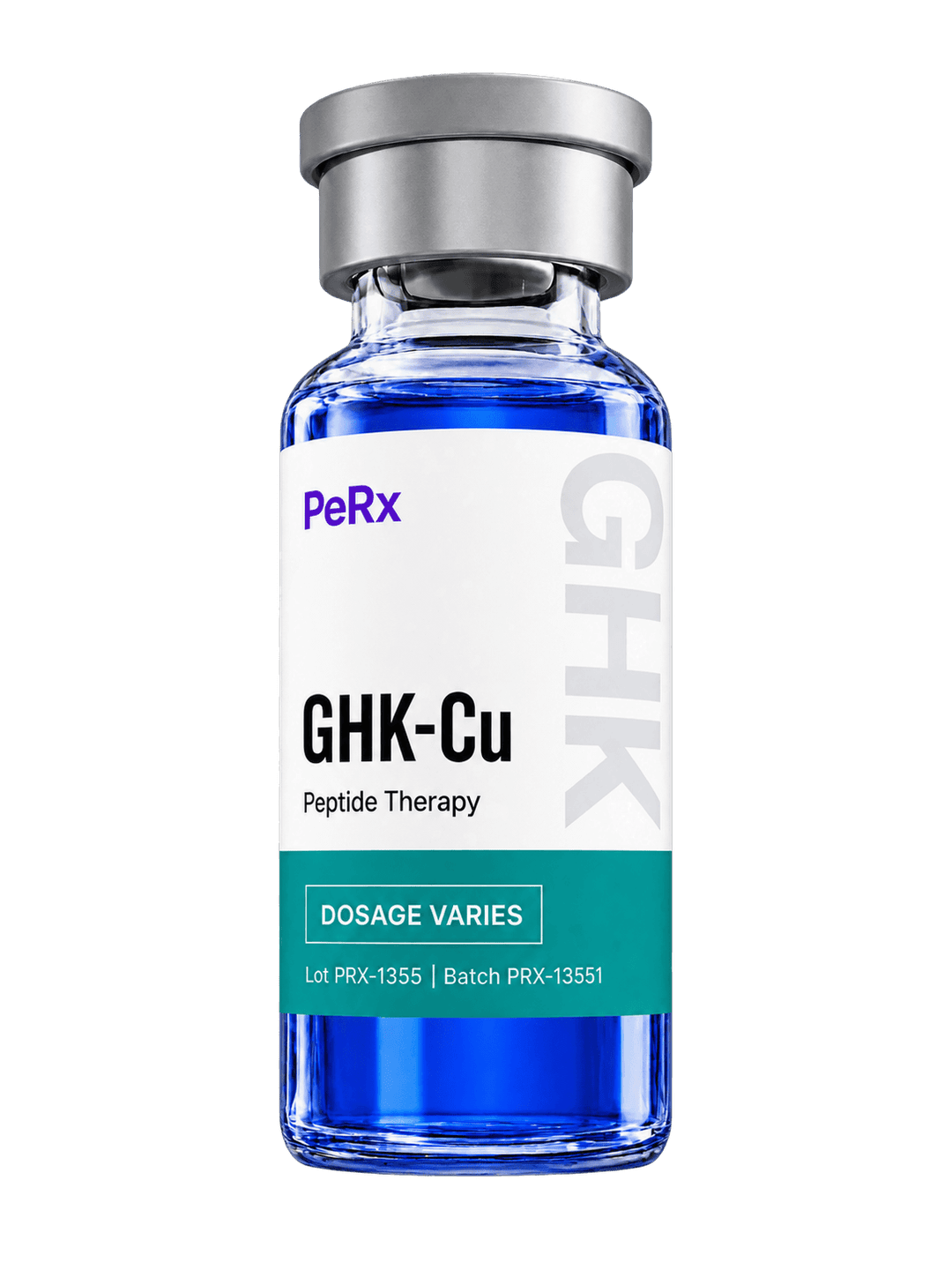
The PeRx GHK-Cu is an injectable, compounded by a US-based 503A pharmacy at 10 mg/mL in a 5 mL vial, prescribed by a licensed provider after screening. It ships fully reconstituted and ready to use, so the 20-unit draw on the prescription is the only number you need.
Twenty-five doses per vial, Monday through Friday, continuous use. $229 per vial.
If You Miss a GHK-Cu Dose
The rule is calendar-based. If you remember on the same day, take the dose when you remember. If the day has passed, skip it and take the next scheduled dose on the next dosing day. Never inject twice to catch up: a double draw doubles the copper figure for no documented gain, and one missed weekday out of twenty-five changes nothing worth correcting. Weekends are not missed doses; Saturday and Sunday off is the schedule as written, so Monday is a normal dose, not a make-up.
If you have stopped for several days because something felt wrong, do not quietly restart. A reaction that made you stop is information the care team should have before the next injection. And if the problem is forgetting rather than a reaction, fix the anchor instead of the dose: tie the injection to something you already do at the same time five days a week, and the gaps usually close on their own. New to subcutaneous injections altogether? How to inject peptides covers the mechanics from the first draw.
Common Questions
Related Guides
Continue reading about peptides and protocols that pair well with this guide.
GHK-Cu Peptide: Benefits, Injections & Evidence
In 1973, a biochemist at UCSF discovered that young blood makes old cells act young. The molecule responsible was the GHK peptide, a tiny copper-binding tripeptide that drops 60% by age 60 and influences thousands of your genes. Today, TikTok sells it as a $20 face cream. The injectable version does something fundamentally different: it reaches every tissue in your body and signals all of them to start repairing. Here's why that distinction matters more than any skincare trend.
GHK-Cu for Skin After GLP-1 Weight Loss
The honest version. Ozempic face is not something the drug did to your skin, it is what a face looks like when it loses fat quickly. That distinction decides which fixes are even in the right category. GHK-Cu has real evidence behind it for collagen and skin quality, and it has hard limits that nobody selling it likes to mention.
GLOW Peptide: What It Is and What Is in the Vial
GLOW is not a peptide. It is a nickname for three of them, GHK-Cu, BPC-157 and TB-500, sold together in one vial, and the name carries no standard recipe. We looked at what the sellers ranking for the term actually list, sorted the claimed benefits by how strong the evidence behind each one is, and laid out what a prescribing clinic dispenses when someone asks for GLOW. Short version: we do not sell it, and you may not need it.
Ready to get started?
Pharmaceutical-grade GHK-Cu, prescribed by a licensed provider, compounded at a US-based 503A pharmacy at a labeled 10 mg/mL, and shipped to your door ready to use with no reconstitution needed.
Medical Disclaimer
The information provided on this website, including all articles, guides, and educational content, is for informational and educational purposes only and is not intended as medical advice, diagnosis, or treatment. Nothing on this site should be construed as a substitute for professional medical advice from a qualified healthcare provider.
The majority of peptides discussed on this site are not approved by the U.S. Food and Drug Administration (FDA) for the indications described. They are classified as bulk drug substances and are available only through a licensed prescribing provider and compounding pharmacy. All treatments require a valid prescription and provider oversight.
The majority of published research on peptide therapies has been conducted in preclinical (animal) models. While early human data is encouraging, comprehensive clinical trial data remains limited for most peptide compounds. Individual results may vary significantly based on health status, injury type, and other factors. No specific outcomes are guaranteed.
Certain peptides discussed on this site are classified as prohibited substances by the World Anti-Doping Agency (WADA) and are banned by major sports organizations including the NFL, NCAA, UFC, NBA, MLB, NHL, and PGA. If you are subject to anti-doping testing, consult your governing body before considering any peptide therapy.
Statements on this website have not been evaluated by the Food and Drug Administration. Products and therapies discussed are not intended to diagnose, treat, cure, or prevent any disease.
© 2026 Wellness MD Group PC DBA PeRx. All rights reserved.