GHK-Cu Side Effects: Measured, Reported, and Unknown
Every GHK-Cu side-effect list online runs on the same thin record: topical cream trials, forum reports, and no published human study of the injection. This page separates what has been measured from what has been reported, works the copper arithmetic in milligrams, explains the vitamin C and copper-supplement rules on the PeRx label, answers the cancer question with the studies that actually exist, and says plainly when a symptom stops being normal.
In this article
Key Takeaways
- The only GHK-Cu side effect with a human record is local: redness, a small bruise or a brief sting at the injection site. The PeRx label calls mild redness or bruising normal. The human trials that exist are topical creams, and the reviews that summarize them report no safety issues.
- No published trial has given GHK-Cu by injection to people, so no rate exists for any injection side effect. Headache, fatigue, nausea and the "copper uglies" come from forums and clinic pages, and this page labels them as anecdote.
- Copper is about 16 percent of GHK-Cu by weight, so a 2 mg dose carries roughly 0.32 mg of copper: about a third of the 0.9 mg adult daily recommended intake and about 3 percent of the 10 mg upper limit. The no-copper-supplements rule exists because copper status has never been measured in injected patients, not because the dose is large.
- Vitamin C serums and supplements are kept two hours away from each injection because ascorbic acid reacts with copper in solution. That is formulation chemistry, not a clinical finding, and nobody has tested the pairing in people.
- On cancer, the 1973 paper that announced the peptide found it stimulated growth of liver tumor cells in culture; later computer and mouse work pointed toward suppression; no study has measured cancer risk in people given GHK-Cu. Nothing is established in either direction, which is why active or recent cancer is a screening flag.
- As of November 2026 injectable GHK-Cu is not an FDA-approved drug, and FDA’s May 14, 2026 update records that the nomination for the injectable route was withdrawn, with an advisory committee review promised before the end of February 2027. Screening excludes Wilson disease and other copper-handling disorders, pregnancy and breastfeeding, and active cancer.
GHK-Cu Side Effects at a Glance
Most common
Site redness, a small bruise or brief sting; the label calls this normal
Measured in humans
Topical creams only; reviews report no safety issues
Injection data
None published; no side-effect rate exists
Copper per 2 mg dose
About 0.32 mg, a third of the daily recommended intake
Label rules
No copper supplements. No vitamin C serum or supplement within 2 hours of a dose
Cancer
Not studied in people either way; a screening flag
FDA status, November 2026
Not approved for injection; the injectable-route nomination for the 503A list was withdrawn
PeRx product
10 mg/mL, 5 mL ready-to-use vial, 20 units Monday through Friday, $229
GHK-Cu Side Effects: The Short Answer
The most common side effect of GHK-Cu injections is the site itself: a pink patch, a small bruise, sometimes a brief sting. The PeRx label covers it in one line, "Mild redness or bruising at the injection site is normal," and that line is the closest thing to a counted side effect this peptide has. Headaches, fatigue, nausea and the "copper uglies" come from forums, not from a study that tallied them.
The human trials are topical: a facial cream for twelve weeks, an eye cream, a thigh-skin collagen study. No published trial has injected GHK-Cu into people, so no measured rate exists for anything that follows an injection.
| Effect | Status | Where it comes from |
|---|---|---|
| Site redness, bruise, brief sting | Expected | PeRx label; the one effect with a record |
| Rash, localized hives, irritation lasting days | Report it | Label instruction; rare sensitivity |
| Headache, tiredness, mild nausea | Anecdote only | Forum lists; never counted |
| "Copper uglies" | Anecdote, topical | Skincare forums; never described for injection |
| Copper toxicity | Not reported | Arithmetic below; no case reported |
| Cancer risk, up or down | Not studied in people | Cell, computer and mouse data only |
Site redness, bruise, brief sting
- Status
- Expected
- Where it comes from
- PeRx label; the one effect with a record
Rash, localized hives, irritation lasting days
- Status
- Report it
- Where it comes from
- Label instruction; rare sensitivity
Headache, tiredness, mild nausea
- Status
- Anecdote only
- Where it comes from
- Forum lists; never counted
"Copper uglies"
- Status
- Anecdote, topical
- Where it comes from
- Skincare forums; never described for injection
Copper toxicity
- Status
- Not reported
- Where it comes from
- Arithmetic below; no case reported
Cancer risk, up or down
- Status
- Not studied in people
- Where it comes from
- Cell, computer and mouse data only
What Has Been Measured (Topical Trials) and What Has Not (Injection)
The human evidence is cosmetic: a facial cream used for 12 weeks by 71 women with photoaged skin, an eye cream tested on 41 women, and a thigh-skin study in which GHK-Cu raised collagen in more volunteers than vitamin C or retinoic acid cream, known mostly through two reviews by Loren Pickart, who discovered the peptide. The reviews state that no safety issues arose in any cosmetic or wound-healing study and that the peptide has been used in cosmetics for decades "without any adverse effects." Pickart founded a company that sells copper peptide products, so the summary is not independent, and those trials scored wrinkles, not adverse events; silence in a cosmetic study is weaker evidence than a counted zero.
Pickart L, Vasquez-Soltero JM, Margolina A. "GHK Peptide as a Natural Modulator of Multiple Cellular Pathways in Skin Regeneration." BioMed Research International. 2015;2015:648108. PMID 26236730. View study
Pickart L, Margolina A. "Regenerative and Protective Actions of the GHK-Cu Peptide in the Light of the New Gene Data." International Journal of Molecular Sciences. 2018;19(7):1987. PMID 29986520. View study
The one independent randomized study of topical GHK-Cu is small. In 2006 facial plastic surgeons randomized patients to GHK-Cu skin care, or none, after carbon dioxide laser resurfacing; thirteen finished. Blinded evaluators found no difference in how fast the post-laser redness cleared and none in wrinkles, though patients using the copper peptide rated their own skin higher. For this page the redness is the point: GHK-Cu on freshly lasered skin neither prolonged nor shortened it.
Miller TR, Wagner JD, Baack BR, Eisbach KJ. "Effects of topical copper tripeptide complex on CO2 laser-resurfaced skin." Archives of Facial Plastic Surgery. 2006;8(4):252-259. PMID 16847171. View study
Injection is a different evidence base. Pickart’s group injected GHK into rats, mice and pigs and reported faster healing of wounds elsewhere on the body; from that work the 2015 review guesses that 100 to 200 mg might be needed in a person, and says even that may be an overestimate. No pharmacokinetic, toxicology or safety study of injected GHK-Cu in humans has been published. The 2 mg PeRx prescribes is a prescribing convention, which the GHK-Cu dosage chart explains.
What the FDA has and has not reviewed
Other compounded peptides got a formal FDA safety evaluation in 2026; GHK-Cu did not. FDA’s May 14, 2026 update to its 503A nominations list records that the GHK-Cu nominations were withdrawn by the nominators, that one nominator then asked to keep a nomination for non-injectable routes only, and that FDA intends to consult its Pharmacy Compounding Advisory Committee before the end of February 2027. As of November 2026 injectable GHK-Cu is not an FDA-approved drug and has no FDA safety evaluation to summarize. The FDA status guide covers the background.
U.S. Food and Drug Administration. "Bulk Drug Substances Nominated for Use in Compounding Under Section 503A of the Federal Food, Drug, and Cosmetic Act." Category 1 entry for GHK-Cu (except for injectable routes of administration). Updated May 14, 2026. View study
Injection-Site Reactions: What Is Normal and What Is Not
GHK-Cu goes under the skin once a day, five days a week. A faint pink patch, a small bruise, and a sting that fades within a minute or two are the expected range. The blue to violet tint of the solution is the copper complex. Some patients find the sting sharper than with other peptides; that is unmeasured. What changes after the sting, week by week, is on GHK-Cu before and after. Rotate sites by a finger-width each day; where to inject GHK-Cu maps the rotation.
The Injection Site, Sorted
Normal
Mild redness or a small bruise, a brief sting, a pea-sized firm spot gone within a day or two.
Contact the care team
Site irritation not resolved within a few days, a mild rash, or localized hives.
Emergency care
Spreading redness with increasing warmth, pus or fever, which signal infection. Swelling of the face, throat or tongue, difficulty breathing, rapid heartbeat or dizziness.
Copper allergy is the question underneath the rash line. Copper has a low sensitization potential in predictive tests, and a 2004 review found unambiguous cases of copper sensitization extremely rare, mostly from intrauterine devices or dental metal. A vial reaction can also come from the peptide or an excipient, so hives or a rash after a dose is a reason to stop and contact the care team.
Hostynek JJ, Maibach HI. "Copper hypersensitivity: dermatologic aspects." Dermatologic Therapy. 2004;17(4):328-333. PMID 15327478. View study
The Copper Question, With the Arithmetic
GHK-Cu is one copper ion held by a three-amino-acid peptide. The peptide weighs about 340 g/mol, the copper ion 63.5, and the complex is listed at roughly 403 g/mol, so copper is 63.5 divided by 403, about 16 percent by weight. A 2 mg dose, the 20 units PeRx prescribes from a 10 mg/mL vial, carries 2 times 0.158, about 0.32 mg of copper. Five doses a week is about 1.6 mg, roughly 0.23 mg a day averaged over the week; the whole 5 mL vial holds about 8 mg across five weeks.
The comparison that matters is dietary. The adult Recommended Dietary Allowance for copper is 0.9 mg a day and the Tolerable Upper Intake Level is 10 mg a day, so an injection day adds about a third of a day’s recommended copper and about 3 percent of the upper limit. The limit was set for copper eaten, of which the gut absorbs only part, while an injection delivers all 0.32 mg; even so, a week of GHK-Cu carries less copper than two days of the recommended diet.
| Measure | Copper |
|---|---|
| Per 2 mg injection | About 0.32 mg |
| Per week, Monday through Friday | About 1.6 mg |
| Averaged per day | About 0.23 mg |
| Adult Recommended Dietary Allowance | 0.9 mg per day |
| Tolerable Upper Intake Level | 10 mg per day |
Per 2 mg injection
- Copper
- About 0.32 mg
Per week, Monday through Friday
- Copper
- About 1.6 mg
Averaged per day
- Copper
- About 0.23 mg
Adult Recommended Dietary Allowance
- Copper
- 0.9 mg per day
Tolerable Upper Intake Level
- Copper
- 10 mg per day
National Institutes of Health, Office of Dietary Supplements. "Copper: Fact Sheet for Health Professionals." Recommended Dietary Allowances and Tolerable Upper Intake Levels for copper. View study
The copper arrives bound: Pickart’s 2015 review summarizes chemistry showing that copper’s redox activity is quieted while the ion is held by the tripeptide, which lets it carry copper into cells without the damage free copper causes. That is test-tube chemistry. And nobody has measured it in a patient: no study has tracked serum copper or ceruloplasmin in people injecting GHK-Cu, so the arithmetic is a calculation, not a lab result.
Screening is for the people the arithmetic does not protect. In Wilson disease the body cannot excrete copper normally and it accumulates in the liver and brain; it is inherited and can first appear at any age. For that disorder and other copper-handling disorders the problem is the direction of the dose, not its size, so GHK-Cu is screened out, as it is for anyone on a copper chelator or zinc therapy for such a condition. A past abnormal copper or ceruloplasmin result belongs on the intake form.
Bandmann O, Weiss KH, Kaler SG. "Wilson’s disease and other neurological copper disorders." The Lancet Neurology. 2015;14(1):103-113. PMID 25496901. View study
Vitamin C, Copper Supplements, and Other Things to Keep Apart
The PeRx prescription carries two rules no other single peptide in the catalog has: "Do not take copper supplements while using this peptide," and "Do not apply Vitamin C serums or take Vitamin C supplements within 2 hours of your injection." Neither comes from a clinical trial, because none exists.
The copper rule is not about toxicity at these amounts. It exists because copper status has never been measured in injected patients, and a single added copper source keeps that unknown interpretable. A standalone copper supplement adds a second variable; a multivitamin that lists copper belongs on your intake form.
The vitamin C rule is chemistry. Ascorbic acid is a reducing agent, and with copper or iron present it reduces the metal to a form that drives free-radical reactions; a 1996 review titled the pairing "catalytic metals, ascorbate and free radicals: combinations to avoid." The two-hour gap applies that to an injection: a vitamin C serum on the site, or a high-dose supplement circulating as the complex is absorbed, is what the rule avoids. That is test-tube chemistry, not a trial in people, and the instruction names serums and supplements; the vitamin C in a meal is not the target.
Buettner GR, Jurkiewicz BA. "Catalytic metals, ascorbate and free radicals: combinations to avoid." Radiation Research. 1996;145(5):532-541. PMID 8619018. View study
What to Keep Apart, and How Firmly
Copper supplements
On the label: none while on GHK-Cu. One added copper source instead of two.
Vitamin C serums and supplements
On the label: none within 2 hours of an injection. Ascorbate-copper chemistry.
Topical copper peptide serums
Not on the label. A different route; PeRx does not sell one. Mention it at screening.
KLOW or the GHK-Cu/Epitalon vial
One product at a time, as prescribed. Each already carries 2 mg of GHK-Cu per dose.
GHK-Cu and Cancer: What Was Studied and What Was Not
The cancer question gets confident answers online in both directions. The first study is uncomfortable for the marketing. The paper that announced the peptide, in Nature New Biology in 1973, is titled "Tripeptide in human serum which prolongs survival of normal liver cells and stimulates growth in neoplastic liver." In culture, the serum factor that kept normal liver cells alive also made liver tumor cells grow. That is a dish of cells, not a cancer in a person.
Pickart L, Thaler MM. "Tripeptide in human serum which prolongs survival of normal liver cells and stimulates growth in neoplastic liver." Nature New Biology. 1973;243(124):85-87. PMID 4349963. View study
The findings cited for the opposite view are computational. In 2010 a Singapore group defined a 54-gene signature marking early-stage colorectal cancers prone to metastasis, then searched the Broad Institute’s Connectivity Map for compounds that reversed them. Two came up, GHK and the plant alkaloid securinine, and GHK reversed about 70 percent of the signature. Pickart’s group later reported from the same database that GHK raises expression of caspase and DNA-repair genes, and their 2018 review describes a 1983 mouse experiment in which GHK-Cu plus vitamin C suppressed a transplanted sarcoma, unpublished until 2014.
Hong Y, Downey T, Eu KW, Koh PK, Cheah PY. "A 'metastasis-prone' signature for early-stage mismatch-repair proficient sporadic colorectal cancer patients and its implications for possible therapeutics." Clinical & Experimental Metastasis. 2010;27(2):83-90. PMID 20143136. View study
Pickart L, Vasquez-Soltero JM, Margolina A. "GHK and DNA: resetting the human genome to health." BioMed Research International. 2014;2014:151479. PMID 25302294. View study
What a Connectivity Map hit is, and is not
The Connectivity Map records how cultured cell lines change gene expression after exposure to a compound. A match between GHK and the reverse of a disease signature is a statistical pattern generated in a dish, a reason to run a study, not a result. The 2012 emphysema study that flagged GHK the same way tested it in cultured lung fibroblasts, not patients. No Connectivity Map result says what injected GHK-Cu does to a tumor in a person.
Campbell JD, McDonough JE, Zeskind JE, et al. "A gene expression signature of emphysema-related lung destruction and its reversal by the tripeptide GHK." Genome Medicine. 2012;4(8):67. PMID 22937864. View study
So the ledger reads: one 1973 cell-culture finding in which the peptide stimulated tumor cells, several computational signals and one mouse experiment pointing toward suppression, and zero human studies of cancer incidence, recurrence or progression in people given GHK-Cu by any route. No animal carcinogenicity study exists either. Calling GHK-Cu anti-cancer reads a database as a trial; saying it feeds tumors reads a 1973 dish the same way. Nothing is established either way, which is why active or recent cancer is a screening flag and a conversation for your oncologist first.
Skin Reactions, Flushing, and the "Copper Uglies" Claim
Search any skincare forum and you will find the "copper uglies," a stretch of weeks in which skin on a copper peptide serum looks worse before it improves. It is anecdote, uncounted, and the usual explanation, that GHK-Cu steps up the enzymes that clear old collagen before new collagen catches up, is a mechanism borrowed from cell studies, not a demonstrated cause. Nothing equivalent has been described for injected GHK-Cu. Nobody has looked, and a cream at cosmetic concentrations is a different exposure from 2 mg into circulation. More in the GHK-Cu guide and in GHK-Cu after GLP-1 weight loss.
Flushing, headache, a tired afternoon and mild nausea appear on peptide forums for nearly every injectable, and GHK-Cu is no exception. None has a number attached or a mechanism that points to this peptide. Our peptide side effects guide covers what is common to the route. If one tracks the injection day after day past the first couple of weeks, report the pattern.
Long-Term Use: The Honest Unknown
Standalone GHK-Cu at PeRx is written for continuous use with no scheduled break. Nobody knows what a year of injected GHK-Cu does, because nobody has studied it: no human pharmacokinetics, no repeat-dose toxicology, no carcinogenicity study, no injected cohort followed over time. Indirectly, the body makes this peptide, plasma levels fall from around 200 ng/mL in young adults to about 80 ng/mL by age 60, and decades of cosmetic use have produced no safety signal. Those are reasons the risk may be low, not measurements of it.
Two long-run questions are specific to this molecule. Copper: at about 1.6 mg a week in a person who handles copper normally, accumulation is not expected, because the body regulates copper through absorption and biliary excretion, but that is dietary physiology, not a blood test in an injected patient. Remodeling: a signal that tells fibroblasts to build and rework tissue, applied continuously, has no documented downside and no documented upside beyond 12-week skin studies. Decide in advance when you will take stock, as peptide long-term safety and peptide safety monitoring lay out.
Who Gets Screened Out, and Why
A licensed provider reviews every intake before GHK-Cu is compounded. What providers review before prescribing covers the general process.
Common GHK-Cu Screening Flags
Wilson disease or another copper-handling disorder
Clear mechanism: added copper is the wrong direction at any amount.
Pregnancy or breastfeeding
No reproductive safety data; the catalog lists both as exclusions.
Active or recent cancer
Nothing established either way; not an addition to make during treatment without an oncologist.
Known copper or metal hypersensitivity
Rare, but the one known allergy pathway. A documented reaction is a reason to decline.
Autoimmune disease or immunosuppressants
Not automatic; nothing is known about GHK-Cu in immune disease. See peptides for autoimmune patients.
Routine lab work is not required to start GHK-Cu; lab work before starting peptides explains why cosmetic and healing peptides generally need none. A past abnormal copper or ceruloplasmin result, or a family history of Wilson disease, belongs on the intake form.
GHK-Cu
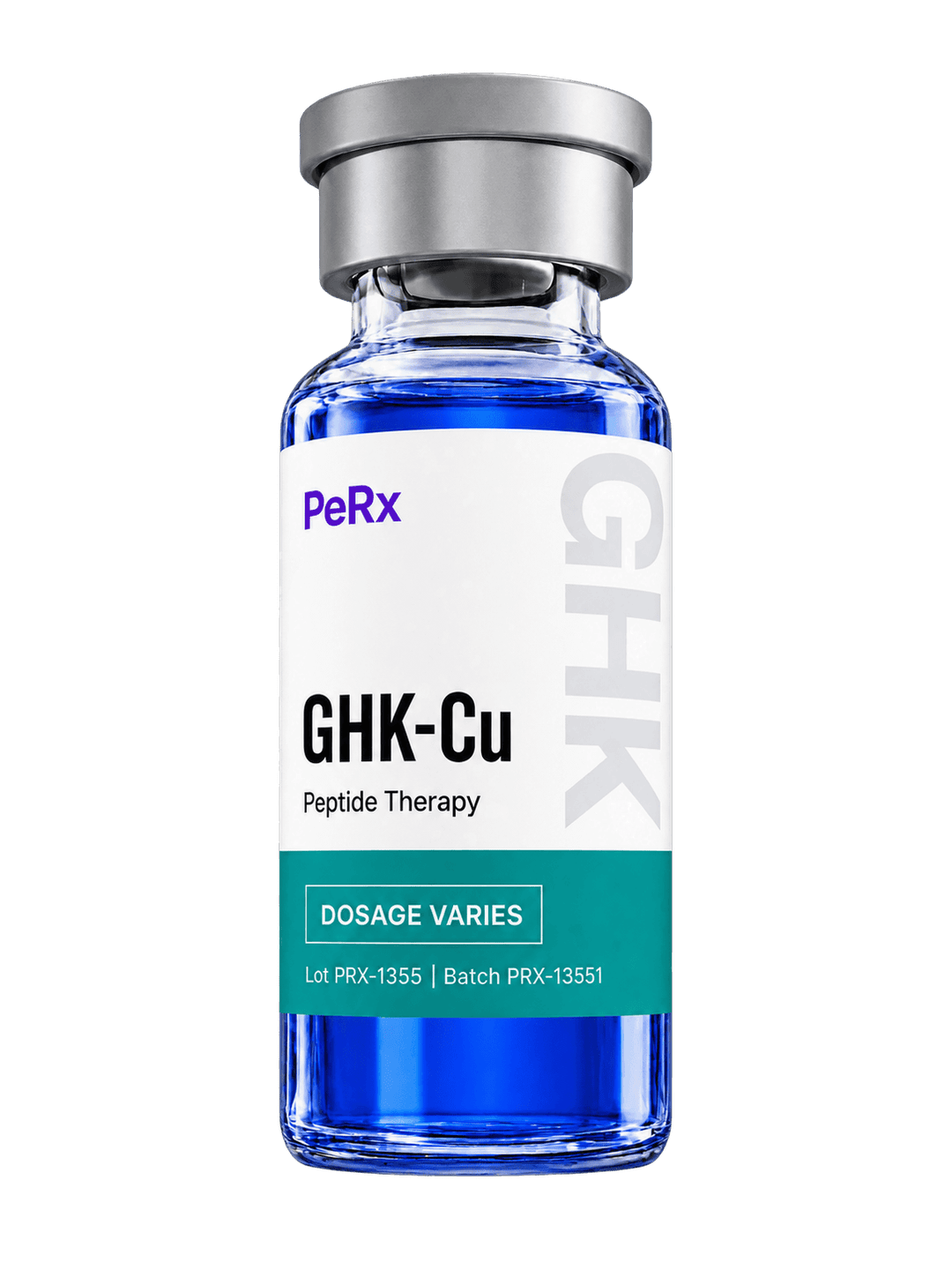
Some side-effect risk with any injectable lives in the vial: a guessed concentration or an unverified source. PeRx GHK-Cu is prescribed by a licensed provider after screening and compounded at a US-based, state-licensed 503A pharmacy at a fixed 10 mg/mL. It ships fully reconstituted and ready to use.
$229 for a 5 mL vial, 25 doses, syringes and alcohol swabs included.
When to Stop and Contact a Clinician
Most of what this page describes needs only a note. A short list needs action, and it is the list on the PeRx prescription.
Stop the injections and act
Call 911 or seek emergency care for signs of infection at the injection site (increasing warmth, pus, or fever), swelling of your face, throat or tongue, difficulty breathing, a rapid heartbeat, or dizziness.
Contact the care team for a mild rash, localized hives, or injection-site irritation that does not resolve within a few days. Do not take the next dose while you wait, and do not restart on your own after a reaction.
Mention at your next contact anything that recurs on injection days, lasts past the first two or three weeks, or changes in the vial itself, such as cloudiness.
GHK-Cu Side Effects: Common Questions
Related Guides
Continue reading about peptides and protocols that pair well with this guide.
Is GHK-Cu FDA Approved? Regulatory Status (2026)
No. GHK-Cu has never entered clinical trials for injection. But it has been used in topical skincare for over 40 years, and the Broad Institute's Connectivity Map revealed it modulates over 4,000 human genes. GHK-Cu is one of the most extensively researched peptides at the molecular level, with zero clinical trial investment. Here is why.
GHK-Cu Peptide: Benefits, Injections & Evidence
In 1973, a biochemist at UCSF discovered that young blood makes old cells act young. The molecule responsible was the GHK peptide, a tiny copper-binding tripeptide that drops 60% by age 60 and influences thousands of your genes. Today, TikTok sells it as a $20 face cream. The injectable version does something fundamentally different: it reaches every tissue in your body and signals all of them to start repairing. Here's why that distinction matters more than any skincare trend.
Boulder Peptide Therapy: 2026 Local Guide
A plain guide to peptide therapy in Boulder: what it costs across local clinics, mobile services, and telehealth, and who tends to use it here. Plus how pharmaceutical-grade peptides reach any Boulder County address without a clinic visit.
Ready to get started?
Pharmacy-compounded GHK-Cu, prescribed by a licensed provider who reviews your health history and medication list first. Ships fully reconstituted and ready to use.
Medical Disclaimer
The information provided on this website, including all articles, guides, and educational content, is for informational and educational purposes only and is not intended as medical advice, diagnosis, or treatment. Nothing on this site should be construed as a substitute for professional medical advice from a qualified healthcare provider.
The majority of peptides discussed on this site are not approved by the U.S. Food and Drug Administration (FDA) for the indications described. They are classified as bulk drug substances and are available only through a licensed prescribing provider and compounding pharmacy. All treatments require a valid prescription and provider oversight.
The majority of published research on peptide therapies has been conducted in preclinical (animal) models. While early human data is encouraging, comprehensive clinical trial data remains limited for most peptide compounds. Individual results may vary significantly based on health status, injury type, and other factors. No specific outcomes are guaranteed.
Certain peptides discussed on this site are classified as prohibited substances by the World Anti-Doping Agency (WADA) and are banned by major sports organizations including the NFL, NCAA, UFC, NBA, MLB, NHL, and PGA. If you are subject to anti-doping testing, consult your governing body before considering any peptide therapy.
Statements on this website have not been evaluated by the Food and Drug Administration. Products and therapies discussed are not intended to diagnose, treat, cure, or prevent any disease.
© 2026 Wellness MD Group PC DBA PeRx. All rights reserved.