Glutathione Injection Dosage: Chart, Units, Cost
Most glutathione dosing numbers online come from IV lounges, where 600 mg or more goes in through a drip in one sitting. PeRx glutathione is a subcutaneous self-injection from a ready-to-use vial at a fixed 200 mg/mL concentration, and the math works differently. This page converts milligrams to insulin-syringe units at that concentration, explains why SubQ doses run smaller and more frequent than IV numbers, and lays out what a month costs, as of August 31, 2026.
In this article
Key Takeaways
- PeRx glutathione comes in a 5 mL vial at 200 mg/mL, 1,000 mg total, ready to use with no reconstitution needed. At that concentration one unit on a U-100 insulin syringe holds 2 mg, so the whole chart is one line of arithmetic: units equals mg divided by 2. A 100 mg dose is 50 units.
- Your provider prescribes the exact dose and schedule on your prescription label, and that label wins over any chart, including this one. Common subcutaneous protocols split a weekly total across two or three small injections rather than one large dose.
- IV-lounge numbers do not convert to subcutaneous self-injection. An IV dose enters the blood all at once and clears fast: in a classic pharmacokinetic study, intravenous glutathione had a plasma half-life of about 14 minutes and urinary excretion rose 300-fold after the infusion.
- Injectable dosing exists because swallowing glutathione mostly does not work. A 3-gram oral dose failed to raise plasma glutathione in the study that defined the problem, which is why delivery that bypasses digestion is the relevant route in the first place.
- Glutathione is $199 per vial at PeRx, one vial per prescription month, provider review and syringes included. That is the lowest-priced item in the catalog and usually less than a single month of weekly IV drips at advertised lounge prices.
Glutathione Dosing at a Glance
Vial
5 mL at 200 mg/mL (1,000 mg total), ready to use
Syringe math
1 unit on a U-100 insulin syringe = 2 mg
Common volumes
100 mg = 50 units (0.5 mL); 200 mg = 100 units (1 mL)
Frequency
Typically 2-3 injections per week, per provider protocol
Route
Subcutaneous, abdomen or thigh
Cost
$199 per vial at PeRx; one vial per prescription month
The Glutathione Injection Dosage Chart
Glutathione dosing looks confusing online because three different products share one name: capsules from a supplement shelf, drip bags at an IV lounge, and prescribed vials for subcutaneous self-injection. The numbers from one do not transfer to the others. This chart is for the third product. PeRx glutathione ships fully reconstituted and ready to use at a fixed concentration of 200 mg per mL, so the conversion from milligrams to insulin-syringe units never changes from vial to vial.
One thing before the table. The dose you inject is the one on your prescription label. A licensed provider reviews your health history and writes the protocol; the rows below exist so you can translate that prescription, or a number you read somewhere else, into marks on a syringe barrel. They are not a menu.
| Dose (mg) | Units on U-100 syringe | Volume (mL) | Doses per 5 mL vial |
|---|---|---|---|
| 50 mg | 25 units | 0.25 mL | 20 |
| 100 mg | 50 units | 0.5 mL | 10 |
| 150 mg | 75 units | 0.75 mL | ~6 |
| 200 mg | 100 units (a full 1 mL syringe) | 1.0 mL | 5 |
| 300 mg | Exceeds a 1 mL syringe | 1.5 mL | ~3 |
| 600 mg | IV-style number; see below | 3.0 mL | 1-2 |
50 mg
- Units on U-100 syringe
- 25 units
- Volume (mL)
- 0.25 mL
- Doses per 5 mL vial
- 20
100 mg
- Units on U-100 syringe
- 50 units
- Volume (mL)
- 0.5 mL
- Doses per 5 mL vial
- 10
150 mg
- Units on U-100 syringe
- 75 units
- Volume (mL)
- 0.75 mL
- Doses per 5 mL vial
- ~6
200 mg
- Units on U-100 syringe
- 100 units (a full 1 mL syringe)
- Volume (mL)
- 1.0 mL
- Doses per 5 mL vial
- 5
300 mg
- Units on U-100 syringe
- Exceeds a 1 mL syringe
- Volume (mL)
- 1.5 mL
- Doses per 5 mL vial
- ~3
600 mg
- Units on U-100 syringe
- IV-style number; see below
- Volume (mL)
- 3.0 mL
- Doses per 5 mL vial
- 1-2
How to read the chart
One vial holds 1,000 mg, and one vial is one prescription month at PeRx. How that 1,000 mg divides across the month is exactly what your provider decides. Notice how fast the last column shrinks as the dose grows: that is the first hint of why subcutaneous protocols use smaller numbers than IV menus do.
How Many Units of Glutathione on an Insulin Syringe?
The arithmetic, once. A U-100 insulin syringe holds 100 units per mL, so each unit is 0.01 mL. At 200 mg per mL, each unit therefore holds 2 mg of glutathione. Divide milligrams by 2 to get units. Multiply units by 2 to get milligrams. That is the entire calculation, and it only holds at this concentration; a vial from another pharmacy at 100 mg/mL or 300 mg/mL uses different math.
If you have injected peptides before, the volumes here will surprise you. Peptide doses are written in micrograms and usually sit under 10 units on the syringe. Glutathione is dosed in milligrams, hundreds of times more material, so a 100 mg dose fills half the barrel. You are not misreading the syringe. The draw is supposed to look big.
The syringe itself is the standard 27 to 31 gauge insulin syringe PeRx includes with every order, and there is a practical ceiling built into it: 1 mL, or 200 mg at this concentration, is a full barrel and about as much volume as one subcutaneous site comfortably takes. Doses above that need a different syringe or a split injection, which is one more reason the label, not a website, sets your number. Site selection and technique are their own topic, covered in where to inject glutathione, and how to take peptides is the primer if this is your first subcutaneous injection of anything.
SubQ vs IV Glutathione Dosing: Why the Numbers Differ
Search for glutathione dosage and most of what ranks is IV-lounge marketing: 600 mg pushes, 1,000 mg drips, sometimes 2,000 mg on a "detox" menu. Then a prescription for subcutaneous glutathione arrives written in hundreds of milligrams per week, and it looks like a typo. It is not. The two routes are doing different things with the same molecule, and converting one number into the other is the single most common dosing mistake patients make.
The pharmacokinetics explain it. When Aebi and colleagues infused 2 grams per square meter of glutathione intravenously into healthy volunteers, plasma levels jumped roughly fifty-fold, then fell with a half-life of about 14 minutes. Urinary excretion of glutathione rose 300-fold in the 90 minutes after the infusion. In plain terms: a large IV dose produces a tall, brief spike, and the kidneys dump a great deal of it into urine on the way down. Big IV numbers are big partly because the route is that leaky.
Aebi S, Assereto R, Lauterburg BH. "High-dose intravenous glutathione in man. Pharmacokinetics and effects on cyst(e)ine in plasma and urine." European Journal of Clinical Investigation. 1991;21(1):103-110. View study
A subcutaneous injection takes the opposite bet. The dose deposits in the fat layer and absorbs gradually rather than arriving all at once, and the protocol repeats it across the week instead of concentrating it into one chair session. Smaller and steadier, versus taller and briefer. Add the volume ceiling from the syringe section and the shape of a SubQ protocol falls out on its own: doses in the 100 to 200 mg range, given more than once a week, rather than a single 600 mg session.
| SubQ self-injection (PeRx) | IV drip or push (lounge) | |
|---|---|---|
| Dose per session | Typically 100-200 mg | Commonly advertised at 600-2,000 mg |
| Frequency | 2-3 times per week | Weekly or occasional |
| Exposure pattern | Gradual absorption from the fat layer | Sharp plasma spike, cleared in minutes |
| Where and how long | At home, about two minutes | Clinic visit, often 30-60 minutes in a chair |
| Who administers | You, with an insulin syringe | A nurse places a line |
| Monthly cost | $199 flat, one vial | Varies; weekly drips at advertised prices often total $400-1,200 |
Dose per session
- SubQ self-injection (PeRx)
- Typically 100-200 mg
- IV drip or push (lounge)
- Commonly advertised at 600-2,000 mg
Frequency
- SubQ self-injection (PeRx)
- 2-3 times per week
- IV drip or push (lounge)
- Weekly or occasional
Exposure pattern
- SubQ self-injection (PeRx)
- Gradual absorption from the fat layer
- IV drip or push (lounge)
- Sharp plasma spike, cleared in minutes
Where and how long
- SubQ self-injection (PeRx)
- At home, about two minutes
- IV drip or push (lounge)
- Clinic visit, often 30-60 minutes in a chair
Who administers
- SubQ self-injection (PeRx)
- You, with an insulin syringe
- IV drip or push (lounge)
- A nurse places a line
Monthly cost
- SubQ self-injection (PeRx)
- $199 flat, one vial
- IV drip or push (lounge)
- Varies; weekly drips at advertised prices often total $400-1,200
None of this makes IV therapy wrong; it is a legitimate route with its own clinical uses. It makes IV dosage charts wrong for a subcutaneous vial. If your only reference points are lounge menus, recalibrate before you draw, because tripling a SubQ dose to match a drip number buys you a sore injection site and more glutathione in your urine, not triple the effect.
Glutathione
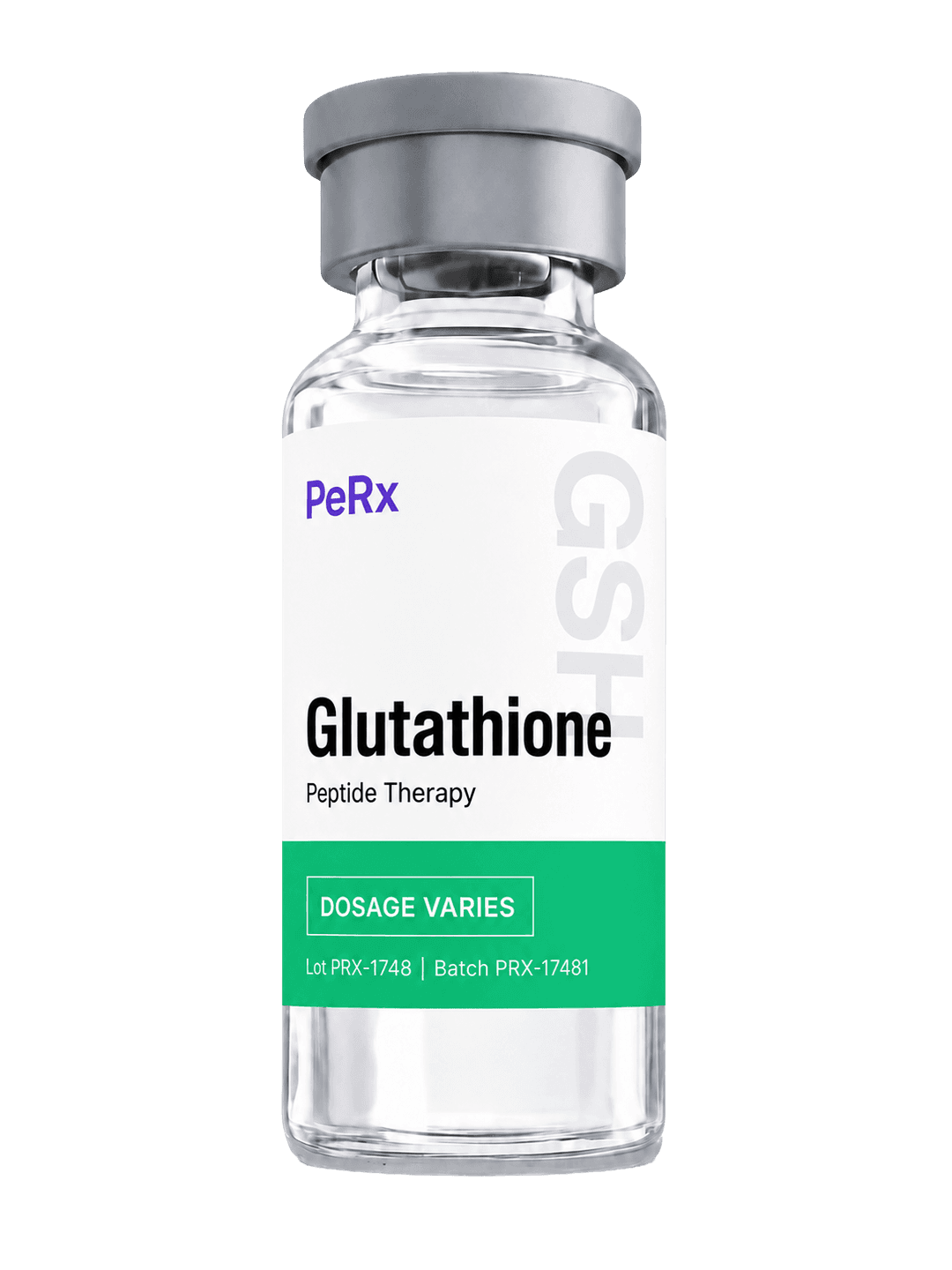
The chart above is one-line arithmetic because the PeRx vial is standardized: glutathione at 200 mg/mL in a 5 mL vial, prescribed by a licensed provider and compounded at a US-based 503A pharmacy. It ships fully reconstituted and ready to use, with insulin syringes included.
At $199 per month it is the most accessible peptide in the catalog, and the subcutaneous route means no IV-lounge appointment and no drip-bar pricing. The label on your vial governs your dose.
How Often to Inject Glutathione
There is no universal schedule in the literature, and anyone who quotes one as settled science is improvising. What exists is a consistent pattern in clinical practice: subcutaneous wellness protocols commonly land on two to three injections per week, spacing the weekly total out rather than front-loading it. Your PeRx provider writes the specific cadence on your prescription, and some protocols run continuously while others cycle weeks on and weeks off.
The logic behind spacing comes from how glutathione behaves in the body. It is not stored in a depot waiting for a monthly refill; every cell synthesizes it, uses it, and turns it over continuously. The research that supports supplementation points the same direction. Richie and colleagues gave oral glutathione daily for six months and watched body stores climb gradually, month over month, rather than jumping after a single dose. Sekhar and colleagues corrected the glutathione deficiency of older adults in about two weeks of daily precursor supplementation. Different routes and different populations, but one shared shape: repletion is a steady process, not an event.
Richie JP Jr, Nichenametla S, Neidig W, et al. "Randomized controlled trial of oral glutathione supplementation on body stores of glutathione." European Journal of Nutrition. 2015;54(2):251-263. View study
Sekhar RV, Patel SG, Guthikonda AP, et al. "Deficient synthesis of glutathione underlies oxidative stress in aging and can be corrected by dietary cysteine and glycine supplementation." American Journal of Clinical Nutrition. 2011;94(3):847-853. View study
Worth stating plainly: those are oral and precursor studies, cited here for the principle of consistency, not as trials of this product. The reason injection is the relevant route at all is older and blunter. Witschi and colleagues gave healthy volunteers 3 grams of glutathione by mouth and could not detect a meaningful rise in plasma glutathione, because the gut dismantles the molecule before it gets in. Swallowing more was never the fix; changing the route was. For the full picture of what glutathione does once it is in circulation, the glutathione guide covers mechanisms and evidence, and this page stays on the numbers.
Witschi A, Reddy S, Stofer B, Lauterburg BH. "The systemic availability of oral glutathione." European Journal of Clinical Pharmacology. 1992;43(6):667-669. View study
Glutathione Dosage for Skin: What the Evidence Shows
A large share of glutathione dosing searches are really skin-tone searches, and that corner of the internet is dense with promised outcomes. Here is what the controlled evidence actually supports. Arjinpathana and Asawanonda ran a randomized, double-blind, placebo-controlled trial of 500 mg per day of oral glutathione for four weeks in 60 subjects and found a statistically significant reduction in melanin index at two of six measured sites. A real signal, and a modest one: oral dosing, four weeks, some sites and not others.
Arjinpathana N, Asawanonda P. "Glutathione as an oral whitening agent: a randomized, double-blind, placebo-controlled study." Journal of Dermatological Treatment. 2012;23(2):97-102. View study
For injected glutathione specifically, no controlled trial has established a dose that reliably produces a given change in skin tone, and the changes reported in lower-quality studies tend to fade after stopping. So there is no "skin whitening dose" to put in the chart above, and PeRx does not prescribe one. Providers prescribe glutathione for antioxidant support; if skin brightness improves along the way, patients tend to be pleased, but a promised shade change is not something the evidence lets an honest clinic sell. The regulatory backdrop, including what FDA approval does and does not cover here, is in is glutathione FDA approved.
If You Miss a Glutathione Dose
Skip it and take your next scheduled dose as planned. Do not double up. A doubled dose means doubled volume in one site, which is the most reliable way to make an injection sore, and the extra material does not bank for later; glutathione turnover is continuous, so a missed injection is a small gap in exposure, not a deficit you owe back. On a two or three day per week schedule, one missed dose barely moves the weekly total. If you find yourself missing often, tell your provider at the renewal check-in so the schedule can be rewritten around your actual week rather than an ideal one.
Does a Higher Glutathione Dose Mean More Side Effects?
Mostly it means more volume. Glutathione is well tolerated at standard subcutaneous doses, and the most common complaint is exactly what you would predict from the chart: larger draws produce more site soreness and occasional redness, which is why splitting a weekly total into smaller injections is easier to live with than concentrating it. Rotation matters more as volume rises; the rotation patterns in the injection site guide are built for this. For sorting a routine site reaction from something that deserves a call, see the peptide side effects guide.
Not dose-dependent: who should not use it
Some exclusions apply at any dose. People with G6PD deficiency should not use glutathione due to hemolysis risk. Anyone on active chemotherapy needs explicit oncologist approval, since several chemo agents work through the oxidative stress glutathione neutralizes. Pregnancy and breastfeeding are also exclusions. These come up at the provider review, which is the point of having one.
What a Month of Glutathione Costs
Glutathione at PeRx is $199 per vial, one vial per prescription month, and it is the lowest-priced item in the catalog. That price includes the provider review, compounding at a US-based 503A pharmacy with third-party testing, overnight refrigerated shipping, insulin syringes, and alcohol swabs. Nothing is charged until a licensed provider approves the prescription; your card is saved at checkout and the charge fires on approval. Prices are visible on the product page once you have an account.
The comparison that matters is the IV lounge, since that is where most people first price glutathione. A single drip or push at advertised rates commonly runs somewhere between $100 and $300 depending on the dose and the city, so a weekly habit lands between $400 and $1,200 a month before the drive and the hour in the chair. A month of subcutaneous vials is a flat $199 and about two minutes per injection at home. Patients building a broader cellular-support protocol often pair it with NAD+; the NAD+ vs glutathione comparison explains how the two differ and why they are frequently prescribed together.
Glutathione Dosage Questions
Related Guides
Continue reading about peptides and protocols that pair well with this guide.
Is Glutathione FDA Approved? Antioxidant Status
Glutathione is the most abundant antioxidant in your body. Oral glutathione supplements are sold everywhere. IV and injectable glutathione are used in clinics worldwide. But the FDA approval picture is more nuanced than you might expect. Here is what glutathione actually is, how different forms are regulated, and what the science supports.
Glutathione Injections: Benefits, Uses & Results
Glutathione is the body's master antioxidant, the molecule behind skin brightening, liver detox, immune resilience, and cellular energy. Here is what injectable glutathione actually does, how it works inside your cells, and why levels fall as you age.
Nashville Peptide Therapy: 2026 Music City Guide
A plain guide to peptide therapy in Nashville: what it costs across local clinics, med spas, and telehealth, who tends to use it in a city built on late hours, and how pharmaceutical-grade peptides reach any Tennessee address without a clinic visit.
Ready to get started?
Pharmaceutical-grade glutathione, prescribed by a licensed provider and shipped to your door fully reconstituted and ready to use, with syringes included.
Medical Disclaimer
The information provided on this website, including all articles, guides, and educational content, is for informational and educational purposes only and is not intended as medical advice, diagnosis, or treatment. Nothing on this site should be construed as a substitute for professional medical advice from a qualified healthcare provider.
The majority of peptides discussed on this site are not approved by the U.S. Food and Drug Administration (FDA) for the indications described. They are classified as bulk drug substances and are available only through a licensed prescribing provider and compounding pharmacy. All treatments require a valid prescription and provider oversight.
The majority of published research on peptide therapies has been conducted in preclinical (animal) models. While early human data is encouraging, comprehensive clinical trial data remains limited for most peptide compounds. Individual results may vary significantly based on health status, injury type, and other factors. No specific outcomes are guaranteed.
Certain peptides discussed on this site are classified as prohibited substances by the World Anti-Doping Agency (WADA) and are banned by major sports organizations including the NFL, NCAA, UFC, NBA, MLB, NHL, and PGA. If you are subject to anti-doping testing, consult your governing body before considering any peptide therapy.
Statements on this website have not been evaluated by the Food and Drug Administration. Products and therapies discussed are not intended to diagnose, treat, cure, or prevent any disease.
© 2026 Wellness MD Group PC DBA PeRx. All rights reserved.