Peptides for Hockey Players: Recovery Protocol
The groin that goes on a hard crossover. The shoulder that eats the boards. How peptide therapy is used for the collision and grinding-season injuries of hockey, and the short recovery windows between games.
In this article
Key Takeaways
- Hockey is a collision sport played on a knife edge, and its injuries reflect that: groin and hip-flexor strains from the skating stride, MCL sprains from the inside edge, AC-joint separations from the boards, and wrist and hand injuries from slashes and blocked shots. Most are soft-tissue and connective-tissue injuries, not muscle tears that heal on their own.
- BPC-157 is the core tool, used for the tendon, ligament, and muscle side of those injuries. The BPC-157/TB-500 combo is the more aggressive option for stubborn or recurring strains, the classic being a groin that will not settle across a season. Both are subcutaneous injection.
- The grinding season, not any single hit, is the other problem. CJC-1295/Ipamorelin is used at night to support the deep-sleep window when growth-hormone-driven repair happens, and NAD+ is used for between-game energy during a compressed schedule.
- Peptides are prescription-only, none are FDA-approved for athletic recovery, and none are painkillers. They are a repair-and-recovery layer under physical therapy and reduced ice time, not a way to skate through a real injury.
- If you play at a tested level, BPC-157, TB-500, and the growth-hormone secretagogues are all WADA-prohibited. This guide is framed for recreational, beer-league, and masters players; tested players should confirm their status with a provider first.
Peptides for Hockey Players: Quick Facts
Primary injuries
Groin and hip-flexor strains, MCL sprains, AC-joint separations, wrist and hand injuries
Core peptide
BPC-157 for tendon, ligament, and muscle repair
Recurring or stubborn
BPC-157/TB-500 combo (single vial, subcutaneous)
Overnight recovery
CJC-1295/Ipamorelin at night for deep-sleep growth-hormone support
Between-game energy
NAD+ during compressed schedules
Testing status
Prohibited in WADA-tested play; confirm with your provider
Third Period, Bad Crossover
The scene
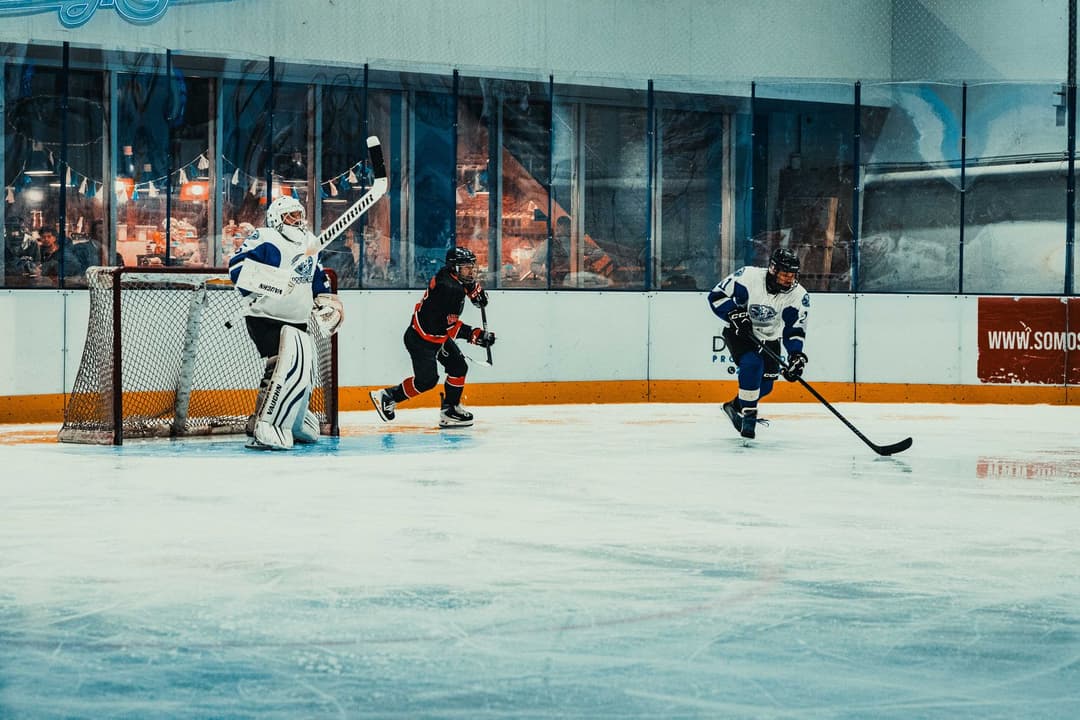
Third period, you are chasing the puck into the corner, and you throw a hard crossover to change direction. Something on the inside of your thigh, high up near the groin, grabs. Not a cramp. The sharp, specific pull of an adductor that has had enough, and you know before you reach the bench that the next two weeks of skating just got complicated. You have a game Thursday. You have another Sunday. The season does not pause for a strain.
Every hockey player has a version of this. The groin that goes on a stride. The knee that buckles when a check catches you on the inside edge. The shoulder that separates against the boards. The wrist that swells after a slash you did not see coming. Hockey is a collision sport played at speed on a slippery surface, and the wear of it does not show up as vague soreness. It shows up as a named injury, in a specific spot, on a schedule that keeps demanding you play through it.
Peptide therapy has become part of how some hockey players manage that. The problem is that almost everything written about peptides online is aimed at bodybuilders chasing size or endurance athletes chasing a race, neither of which is the hockey problem. This guide is built for the skater: what hockey actually injures, how peptides are used for those specific tissues, and how the grinding schedule between games changes the recovery math. When you get a peptide through PeRx, it is prescribed by a licensed provider and compounded in a US-based, FDA-regulated 503A pharmacy, then shipped fully reconstituted and ready to use.
Why Hockey Injuries Are Different
Two things separate hockey injuries from most other sports. The first is that hockey combines high-collision contact (checks, the boards, blocked shots, fights) with high-volume repetitive load (the skating stride, thousands of crossovers a game). So you get both the acute trauma of a contact sport and the overuse strains of an endurance one, stacked on the same body.
The second is the tissue. The injuries that actually keep skaters off the ice are rarely simple muscle tears, which are highly vascular and heal fast. They are the poorly vascularized structures: the adductor tendons, the MCL and other knee ligaments, the AC-joint ligaments, the wrist. Those heal slowly precisely because so little blood reaches them, which is why ice, rest, and ibuprofen so often leave a groin nagging for a month. That poor blood supply is the exact problem the most-used hockey peptide is aimed at.
What Hockey Actually Injures
The injuries of hockey are predictable from the mechanics of the sport, and naming the tissue is the first step to targeting it. No peptide retailer has bothered to map this out for skaters, so here it is.
| Situation on the ice | What gives out | The named injury |
|---|---|---|
| Skating stride, hard crossovers | Inner thigh and hip | Adductor (groin) strain, hip-flexor strain, hip labrum irritation |
| Inside edge, check to the knee | Knee | MCL sprain (the most common hockey knee injury), meniscus |
| Hit into the boards, shoulder-first | Shoulder | AC-joint separation, rotator-cuff strain, labrum |
| Slashes, blocked shots, falls | Wrist and hand | Wrist sprain, tendon and ligament injury, hand contusion |
| Compressed schedule, deep fatigue | Whole body | Cumulative under-recovery, slow tissue turnover, grinding-season depletion |
Skating stride, hard crossovers
- What gives out
- Inner thigh and hip
- The named injury
- Adductor (groin) strain, hip-flexor strain, hip labrum irritation
Inside edge, check to the knee
- What gives out
- Knee
- The named injury
- MCL sprain (the most common hockey knee injury), meniscus
Hit into the boards, shoulder-first
- What gives out
- Shoulder
- The named injury
- AC-joint separation, rotator-cuff strain, labrum
Slashes, blocked shots, falls
- What gives out
- Wrist and hand
- The named injury
- Wrist sprain, tendon and ligament injury, hand contusion
Compressed schedule, deep fatigue
- What gives out
- Whole body
- The named injury
- Cumulative under-recovery, slow tissue turnover, grinding-season depletion
The common thread down the right column is that most of these are soft-tissue and connective-tissue injuries: strains, sprains, and ligament damage rather than muscle ruptures. That is the category BPC-157 is used for, which is why a single peptide covers so much of the hockey injury map. The bottom row, the grind itself, is a different problem that needs a different tool, and it is covered further down.
The Core Tool: BPC-157
BPC-157 is a synthetic peptide modeled on a protective sequence found in gastric tissue, and it is the one most associated with tendon, ligament, and muscle repair. The human research is still limited, but the preclinical body of work is large and consistent: across many animal models it accelerates the healing of tendon, ligament, and muscle, in part by promoting angiogenesis, the growth of new blood vessels into injured tissue. For the groin strains, MCL sprains, and AC-joint ligament damage that define hockey, that mechanism speaks directly to the slow-healing problem.
Chang CH et al., "The promoting effect of pentadecapeptide BPC 157 on tendon healing involves tendon outgrowth, cell survival, and cell migration," J Appl Physiol, 2011; 110(3):774-780. Preclinical (animal and cell models). View study
For skaters, the appeal is that BPC-157 targets the structures that actually derail a season: the adductor tendon from the stride, the ligament side of a knee or shoulder injury, the wrist that will not settle. Players typically run it daily for a focused block while reducing load on the injured area, which is the part that matters most. If you are new to injecting, the mechanics are covered in the where-to-inject BPC-157 guide.
Two cautions that matter for skaters
First, BPC-157 is not a painkiller. It does not numb a groin so you can play Thursday and Sunday, and using it to push through a real strain is how a minor pull becomes a season-ending tear. Reduce the load on the injured structure while it heals. Second, a specific named injury responds better than "everything hurts." If your whole body is wrecked from the schedule, that is a recovery problem, not an injury, and the overnight and between-game tools below are the better fit.
BPC-157 ships as a subcutaneous injection, ready to use with no reconstitution needed. A provider sets the protocol and the form.
The Recurring Groin: BPC-157/TB-500
For a strain that keeps coming back, the BPC-157/TB-500 combo is the more aggressive option. The recurring groin is the classic hockey example: it half-heals, you skate on it, it goes again, and by February it feels chronic. TB-500 is a synthetic fragment related to thymosin beta-4, a protein involved in cell migration, actin regulation, and tissue repair. Its mechanism is complementary to BPC-157 rather than redundant, which is the rationale for combining them. In muscle-injury models, thymosin beta-4 acts as a chemoattractant that draws muscle-precursor cells (myoblasts) to the damaged area to rebuild the tissue.
Tokura Y et al., "Muscle injury-induced thymosin beta4 acts as a chemoattractant for myoblasts," J Biochem, 2011; 149(1):43-48. Preclinical (mouse muscle-injury model). View study
Kumar N, Kumar R, "Thymosin beta4 enhances repair by organizing connective tissue and preventing the appearance of myofibroblasts," Ann N Y Acad Sci, 2010; 1194:79-83. Preclinical. View study
Single versus combo
BPC-157 alone is the common starting point and handles most fresh strains and sprains. The combo tends to come up for the injuries that will not budge: a groin that has recurred three times, an AC-joint that is still cranky two months later, a wrist that keeps re-aggravating. If you want the full mechanistic comparison, the BPC-157 vs TB-500 guide breaks down what each one does. The combo ships as a single vial, subcutaneous injection, ready to use.
The Grind: Overnight Recovery
The single hit is only half of hockey. The other half is the grind: a compressed schedule, back-to-backs, travel, and the slow accumulation of fatigue that no ice bath fully clears. Two peptides address that side, and the first works while you sleep.
CJC-1295/Ipamorelin is a growth-hormone-releasing combination, prompting the body to produce more of its own growth hormone in natural pulses. The reason it is dosed at night is physiological: the majority of daily growth-hormone release happens during slow-wave (deep) sleep, and growth hormone is central to collagen synthesis and connective-tissue turnover. In other words, the overnight window is when your body actually repairs the tissue you loaded that day.
Van Cauter E, Plat L, "Physiology of growth hormone secretion during sleep," J Pediatr, 1996; 128(5 Pt 2):S32-S37. Human physiology review. View study
Used this way, CJC-1295/Ipamorelin is about supporting the deep-sleep repair window through a heavy stretch of the calendar, not fixing a specific acute injury. It is a systemic, longer-arc tool where BPC-157 is the targeted one, and the two address different parts of the same problem: less residual fatigue between games, and better repair of the connective tissue that takes the load. It ships as a subcutaneous injection, ready to use.
Not a substitute for actual sleep
This is worth stating plainly. A growth-hormone secretagogue supports the deep-sleep window; it does not replace the sleep. If you are getting five hours a night through a road trip, no peptide fixes that, and the honest first move is protecting sleep and travel logistics. The peptide is a layer on top of good sleep, not a workaround for bad sleep.
Between-Game Energy: NAD+
The other grinding-season tool is NAD+, used for the between-game energy and cellular-recovery side during a compressed schedule. NAD+ (nicotinamide adenine dinucleotide) is a coenzyme central to how cells produce energy, and levels decline with age and heavy metabolic demand. Skaters in a masters or beer-league context, playing multiple times a week on top of work and family, use it for the deep-fatigue side of the season rather than any single injury.
NAD+ ships as a subcutaneous injection, ready to use. Like the overnight tool, it works over nights and weeks, not on a game-morning timescale. It will not deliver a pre-game boost the way caffeine does, and it does not replace nutrition, hydration, or a real off-day. It is the between-game recovery layer for players whose problem is the schedule as much as any hit.
What a Recovery Block Looks Like
For a specific injury like a fresh adductor strain, a focused block usually runs several weeks. This is an illustration of the general arc, not a prescription; a provider sets your actual protocol and duration.
Week 1
Offload and start
Reduce ice time and skating load on the injured side. Begin daily BPC-157 (or the BPC-157/TB-500 combo for a recurring strain). Early signal is sometimes felt in the first week or two, but do not read a lack of pain as permission to skate hard.
Week 4
Rebuild capacity
With the acute injury calmer, connective-tissue repair is underway. This is where CJC-1295/Ipamorelin at night earns its place, supporting the overnight repair window as you reintroduce load. Progressive skating and strength work, not a straight return to full games.
Week 8
Return and maintain
For most strains and sprains, meaningful connective-tissue change accrues over roughly six to eight weeks of consistent work. Return to full play should track the tissue, not the calendar. NAD+ through a heavy stretch of the schedule supports the between-game recovery side once you are back.
Season, Travel, and Testing Status
A few practical realities specific to hockey. First, the schedule fights you: the sport asks you to play on a strained groin, and the discipline of offloading a real injury is harder than the peptide protocol itself. That discipline is the part that actually determines whether you heal.
Second, travel. All of these ship as prescription medications in original labeled vials, TSA-permitted in carry-on with refrigerated packaging. A soft cooler with two frozen gel packs holds the 36-46°F storage window for a day or two, which covers normal road trips. The vials arrive overnight in that same kind of refrigerated packaging, third-party tested for purity, so what shows up matches the label.
Testing status: know before you start
This guide is written for recreational, beer-league, and masters hockey, where there is no anti-doping testing. If you play at a level covered by WADA or a national testing program (elite, national-team, some collegiate and pro pathways), BPC-157 and TB-500 are prohibited at all times, and the growth-hormone secretagogues in CJC-1295/Ipamorelin fall under the prohibited S2 hormone category. There is no therapeutic use exemption for BPC-157. Confirm your testing status with your provider before starting anything, and treat "I did not know" as no defense under strict liability.
Peptides for Hockey Players: Common Questions
Related Guides
Continue reading about peptides and protocols that pair well with this guide.
Peptide Therapy in Chicago: Cost and Telehealth
A plain guide to peptide therapy in Chicago: what it costs across local clinics, concierge services, and telehealth, and who tends to use it here. Plus how pharmaceutical-grade peptides reach any Chicago address without a clinic visit.
Lab Work Before Starting Peptides
The honest answer to "what bloodwork do I need before peptides?" is: it depends on the peptide, and for many of them the answer is none. Some sites will tell you to buy a full baseline panel before anything, because they sell the panel. Here is the real picture, which peptides typically need no labs, where a provider may want to check IGF-1 and a metabolic panel, and why the decision belongs to the provider reviewing your history rather than to a checklist.
Peptides for Trial Lawyers: Litigator Stack
Trial weeks run on adrenaline, four hours of sleep, and hours hunched over exhibits. This is how litigators think about a peptide protocol built for stress resilience, protected sleep, and cognitive stamina, not for winning the verdict.
Ready to get started?
Pharmaceutical-grade peptides, prescribed by a licensed provider and compounded in a US-based, FDA-regulated 503A pharmacy, shipped fully reconstituted and ready to use. Browse the individual peptides to read about what each one does.
Medical Disclaimer
The information provided on this website, including all articles, guides, and educational content, is for informational and educational purposes only and is not intended as medical advice, diagnosis, or treatment. Nothing on this site should be construed as a substitute for professional medical advice from a qualified healthcare provider.
The majority of peptides discussed on this site are not approved by the U.S. Food and Drug Administration (FDA) for the indications described. They are classified as bulk drug substances and are available only through a licensed prescribing provider and compounding pharmacy. All treatments require a valid prescription and provider oversight.
The majority of published research on peptide therapies has been conducted in preclinical (animal) models. While early human data is encouraging, comprehensive clinical trial data remains limited for most peptide compounds. Individual results may vary significantly based on health status, injury type, and other factors. No specific outcomes are guaranteed.
Certain peptides discussed on this site are classified as prohibited substances by the World Anti-Doping Agency (WADA) and are banned by major sports organizations including the NFL, NCAA, UFC, NBA, MLB, NHL, and PGA. If you are subject to anti-doping testing, consult your governing body before considering any peptide therapy.
Statements on this website have not been evaluated by the Food and Drug Administration. Products and therapies discussed are not intended to diagnose, treat, cure, or prevent any disease.
© 2026 Wellness MD Group PC DBA PeRx. All rights reserved.