Peptides for Touring Musicians: Sleep on Tour
A different city every night, wired after the show, a bus bunk doing the work of a bed. How peptide therapy is used for the broken sleep, circadian drift, and daytime fatigue of tour life.
In this article
Key Takeaways
- Tour life attacks sleep in three ways at once: shallow, fragmented sleep in a moving bus bunk; circadian drift from constantly shifting show and travel times; and the wired-but-tired adrenaline crash after a performance that makes falling asleep hard even when you are exhausted.
- Three peptides map to those problems: DSIP biases sleep toward deep, slow-wave sleep so short windows feel more restorative; the Pinealon/PE-22-28/Selank blend supports circadian timing and the post-show wind-down; and NAD+ supports daytime energy and clears the brain fog.
- This is the same family of tools that pilots use for jet lag and truckers use for shift work, but the road-musician problem is its own thing: the issue is less about crossing time zones and more about adrenaline at 11pm followed by a 6am lobby call.
- None of these are hypnotics or stimulants, and none replace the behavioral anchors that do most of the work: controlling light, caffeine timing, and protecting a consistent sleep window when the schedule allows it. Everything here is prescription-only.
Wired at 1am, Lobby Call at 6
The scene
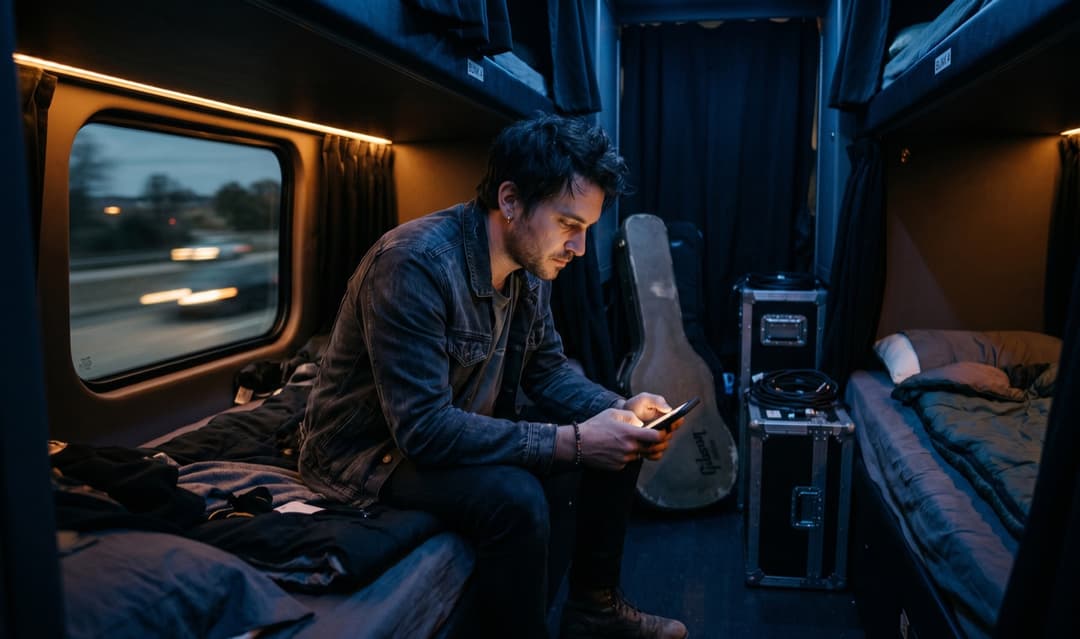
The encore ended at 11. Load-out, a shower if the venue had one, and now you are in the bunk at 1am with the bus rolling toward the next city. Your body is still running on the adrenaline of two hours in front of a few thousand people, your mind is doing a play-by-play of the set, and the lobby call for press is at 6. You are exhausted in a way that has nothing to do with being able to fall asleep.
Anyone who has spent a real stretch on the road knows this state. It is not insomnia in the clinical sense, and it is not laziness or poor discipline. It is the predictable result of asking a body to peak on a stage at 10pm, sleep horizontally in a moving vehicle by midnight, and be coherent for an interview at sunrise. Do that for nine months and the deficit compounds. When you get a peptide through PeRx, it is prescribed by a licensed provider and compounded in a US-based, FDA-regulated 503A pharmacy, the same regulated pathway many everyday prescriptions go through.
Buxton OM et al., "Adverse metabolic consequences in humans of prolonged sleep restriction combined with circadian disruption," Science Translational Medicine, 2012. View study
Tour managers, crew, and artists have all started asking the same question: is there something beyond melatonin and a bottle of wine that actually helps. Peptide therapy comes up often, and most of what is written about it online is either generic sleep listicles or gray-market vendors. This guide is built around what tour life actually does to sleep, and the three peptides that map to those specific problems.
Three Problems, Not One
The reason a single sleep aid never quite fixes tour sleep is that there is not a single problem. There are three, and they stack.
Shallow sleep
Sleep architecture
Drifting clock
Circadian timing
Daytime fade
Cellular energy
Trying to solve all three with one knockout pill is why so many touring musicians end up cycling through sleep medications that leave them groggy and still unrested. Matching a tool to each problem is the more deliberate approach.
The Sleep You Do Get: DSIP
DSIP, Delta Sleep-Inducing Peptide, is one of the most-studied unapproved peptides in neuroscience, with research stretching back to its discovery in 1974 and several hundred papers since. The important thing to understand about it is what it is not: it is not a sedative or a hypnotic. It does not knock you out the way a benzodiazepine or a strong antihistamine does.
Research associates DSIP with a shift in the architecture of the sleep you get toward slow-wave (deep) sleep, rather than with sedation. For a touring musician, that mechanism is the relevant one. The problem on the road is rarely total sleeplessness. It is that four or five hours in a rattling bunk are shallow and unrefreshing. Athletes and crew who use DSIP report that the first several hours of sleep feel more restorative even when the total time is the same. The human evidence is older and thinner than the marketing suggests, so it is used off-label and prescription-only, and you are aiming to improve the quality of a short window rather than extend it.
Schoenenberger GA & Monnier M, "Characterization of a delta-electroencephalogram-(sleep)-inducing peptide," Proceedings of the National Academy of Sciences, 1977; 74(3):1282-1286. (Original isolation and naming of DSIP for its delta-wave, slow-wave sleep activity.)
Timing
DSIP is typically taken 30 to 60 minutes before the intended sleep window, set to the destination or next-day schedule rather than to how you feel. It is a subcutaneous injection, like the other peptides here, not a nasal spray. It is not for use before anything requiring full alertness.
The Clock: The Pinealon/Selank Blend
The second problem is timing. After weeks of late shows and shifting travel, the internal clock loses its anchor, and the most maddening symptom is the wired-but-tired state after a performance. A show is a large adrenaline and cortisol event, and those hormones do not switch off when the lights come up. The body stays physiologically aroused for hours, which is why lying down at 1am does not mean sleeping at 1am.
The Pinealon/PE-22-28/Selank blend is the tool used for this layer. Pinealon is a short peptide studied for its effects on the pineal region and circadian signaling, and Selank has an anxiolytic, calming profile without sedation. Combined, the blend is used to support circadian timing and take the edge off the post-show nervous-system arousal that keeps musicians staring at a bunk ceiling. It is the same blend that appears in the pilots and crew jet-lag protocol, used here for a different journey.
Zozulia AA et al., "Efficacy and possible mechanisms of action of a new peptide anxiolytic selank in the therapy of generalized anxiety disorders and neurasthenia," Zhurnal Nevrologii i Psikhiatrii imeni S.S. Korsakova, 2008. (Russian-published clinical study of Selank.) View study
The honest limit
No peptide overrides the circadian clock the way light and consistent meal timing do. The blend supports the wind-down and the timing, but it works layered on top of the behavioral anchors, not instead of them. Morning daylight, controlled evening light, and capping caffeine after soundcheck still do the heaviest lifting. Anyone selling a circadian reset in a vial alone is overselling it.
The Daytime Fade: NAD+
The third problem shows up in daylight. Cumulative sleep debt is not just a nighttime issue; it produces the flat, foggy afternoons where soundcheck feels like wading through mud and the second and third coffees stop landing. A lot of that is downstream of NAD+, a coenzyme central to how cells produce and manage energy, which gets depleted faster under chronic stress and short sleep.
NAD+ therapy is used to support that daytime energy and mental clarity when the nights are unavoidably short. It does not substitute for sleep, and it is not a stimulant in the caffeine sense. It supports the underlying cellular energy machinery so that the functional hours of the day are more functional. For a touring crew that cannot simply sleep more, that is often the most practical lever. The energy-focused peptides are collected on the best peptides for energy page.
How This Differs From Pilots and Truckers
The same three peptides come up for airline crews and long-haul drivers, because all three groups are fighting disrupted sleep and circadian drift. But the problems are not identical, and it is worth being clear about the difference.
Pilots and flight attendants are mostly fighting transmeridian jet lag, the eastbound-versus-westbound asymmetry of crossing many time zones quickly. Long-haul truckers are fighting shift work and the need to stay alert behind the wheel, where safety is the central concern. The touring musician problem is its own animal: not so much time zones as adrenaline at 11pm, a moving bed at midnight, and a different room and routine every single day. The wired-after-the-show state is the signature of this persona, and it is why the circadian and wind-down tools matter as much as the deep-sleep one.
Kecklund G & Axelsson J, "Health consequences of shift work and insufficient sleep," BMJ, 2016. (Review of the health effects of circadian disruption and short sleep in shift-type schedules.) View study
Living With It On a Bus
The practical objections to peptide therapy on tour are real, and they have answers.
Keeping it cold. Peptide therapy ships ready to use and needs refrigeration at 36 to 46°F. A small soft cooler with two reusable ice packs holds that window for 24 to 48 hours, and venue and bus fridges are everywhere on a tour. For longer stretches between stops, a quality hard cooler holds the window for several days. This is the same cold-chain problem truckers solve, and it is manageable.
Fitting it to the schedule. The dosing anchors to the schedule you want, not the one your body is on. DSIP before the sleep window, the Pinealon/Selank blend in the wind-down, NAD+ to support the working day. On a tour with a regular show-and-travel rhythm, that becomes a routine quickly.
Getting it legally. All of these are prescription-only in the US and are not FDA-approved as sleep or energy products. That means a real evaluation by a licensed provider and a legitimate pharmacy, not a vial bought off an unregulated website while on the road. The intake captures your full medication list so the provider can flag interactions before anything ships. Every batch is third-party tested for purity, and each order ships fully reconstituted and ready to use, delivered overnight in refrigerated packaging.
Peptides for Touring Musicians: Common Questions
Related Guides
Continue reading about peptides and protocols that pair well with this guide.
Peptides for Commercial Fishermen: Lower-Back Pain
For the people who lift for a living: deckhands, warehouse crews, movers, framers, and anyone whose lower back and shoulders take a beating every shift. How peptide therapy is used for the strain of heavy physical work.
Nausea & Gut Issues on GLP-1s: What Helps
GI side effects are the single biggest reason patients stop Ozempic, Wegovy, and Mounjaro. Here is why GLP-1 receptor activation hits the gut so hard, which simple changes resolve most cases, and which peptide helps when the basics have not been enough.
Peptides for Ultra-Runners: 100-Mile Recovery
Ultra-distance breaks the body in ways road racing never does: race-day gut shutdown, IT-band and tendon overuse, deep muscle damage, a post-race immune dip, and wrecked sleep. Here is how MOTS-c, BPC-157, NAD+, and Thymosin Alpha-1 map to each, with an honest read on WADA and on what training still has to do.
Learn more about peptide therapy
Peptide therapy in the US is prescription-only and requires evaluation by a licensed provider. Browse the individual peptides to read about what each one does, or start with the primer.
Medical Disclaimer
The information provided on this website, including all articles, guides, and educational content, is for informational and educational purposes only and is not intended as medical advice, diagnosis, or treatment. Nothing on this site should be construed as a substitute for professional medical advice from a qualified healthcare provider.
The majority of peptides discussed on this site are not approved by the U.S. Food and Drug Administration (FDA) for the indications described. They are classified as bulk drug substances and are available only through a licensed prescribing provider and compounding pharmacy. All treatments require a valid prescription and provider oversight.
The majority of published research on peptide therapies has been conducted in preclinical (animal) models. While early human data is encouraging, comprehensive clinical trial data remains limited for most peptide compounds. Individual results may vary significantly based on health status, injury type, and other factors. No specific outcomes are guaranteed.
Certain peptides discussed on this site are classified as prohibited substances by the World Anti-Doping Agency (WADA) and are banned by major sports organizations including the NFL, NCAA, UFC, NBA, MLB, NHL, and PGA. If you are subject to anti-doping testing, consult your governing body before considering any peptide therapy.
Statements on this website have not been evaluated by the Food and Drug Administration. Products and therapies discussed are not intended to diagnose, treat, cure, or prevent any disease.
© 2026 Wellness MD Group PC DBA PeRx. All rights reserved.