PT-141 Dosage Chart: Units, Limits, Men vs Women
Every other dosage chart on this site describes a daily or nightly routine. PT-141 is the exception: you dose it per event, not per day, and the two numbers that matter most are ceilings, not schedules. This page converts milligrams to insulin-syringe units at the PeRx concentration, anchors everything to the one FDA-approved reference dose, and answers the men-versus-women question with the data that actually exists, as of September 8, 2026.

In this article
Key Takeaways
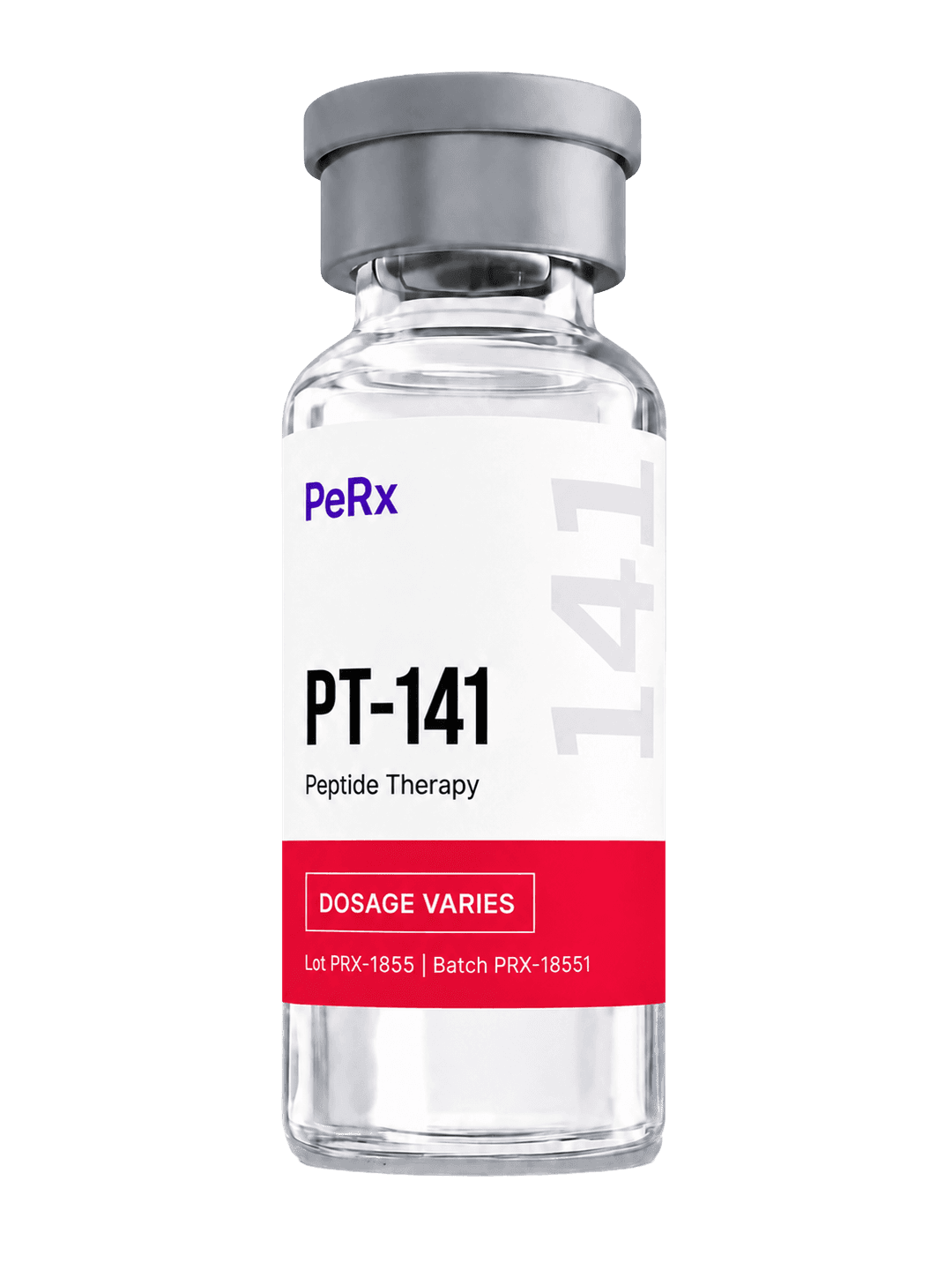
- PeRx PT-141 comes in a 5 mL vial at 2 mg/mL, and it ships fully reconstituted and ready to use. At that concentration one unit on a U-100 insulin syringe holds 20 mcg, so units equals milligrams times 50. The prescribed 1.75 mg dose is 87.5 units, or 0.875 mL.
- The anchor for every serious PT-141 dosage chart is the FDA label for Vyleesi, the approved brand of bremelanotide: 1.75 mg subcutaneously, as needed, at least 45 minutes before anticipated sexual activity.
- PT-141 is dosed per event, not per day. The limits are ceilings: no more than one dose in any 24-hour period, and no more than 8 doses per month. Both exist for specific, documented reasons, a transient blood-pressure rise and a cumulative pigmentation risk.
- There is no separate published subcutaneous dose for men. The molecule is the same, but the labeled 1.75 mg figure comes from trials in premenopausal women with HSDD; use in men is off-label prescriber judgment built on that same reference point.
- A dosage calculator is unnecessary at a fixed concentration. Multiply milligrams by 50 to get units, once, and the answer never changes from vial to vial.
- One 5 mL vial holds five full 1.75 mg doses. In the Vyleesi phase 3 program most participants used two to three doses per month, so a vial is realistically one to two months of typical use, at $229 at PeRx.
PT-141 Dosing at a Glance
Vial
5 mL at 2 mg/mL (10 mg total), ready to use
Prescribed dose
1.75 mg = 87.5 units on a U-100 insulin syringe = 0.875 mL
When
As needed, at least 45 minutes before anticipated activity
Schedule
Per event. There is no daily schedule.
Limits
Max 1 dose per 24 hours; no more than 8 doses per month
Cost
$229 per vial at PeRx; about 5 full doses per vial
The PT-141 Dosage Chart
Most peptide dosage charts describe a routine: inject this much, at this time, this many days per week. A PT-141 chart cannot work that way, because PT-141 is not a routine. It is an as-needed dose taken before an anticipated event, and the schedule column that anchors every other chart in our catalog simply does not exist here. What replaces it is a pair of hard ceilings, one per 24 hours and 8 per month, which this page covers in their own section. First, the conversion table.
The arithmetic, once. A U-100 insulin syringe holds 100 units per mL, so each unit is 0.01 mL. At the PeRx concentration of 2 mg per mL, one unit holds 20 mcg, which makes the conversion unusually clean: units equals milligrams times 50. The chart below works out the values you will see quoted, with doses per vial counted in full doses.
| Dose (mg) | Units on U-100 syringe | Volume (mL) | Full doses per 5 mL vial |
|---|---|---|---|
| 0.5 mg | 25 units | 0.25 mL | 20 |
| 1 mg | 50 units | 0.5 mL | 10 |
| 1.25 mg | 62.5 units (draw to 62) | 0.625 mL | 8 |
| 1.5 mg | 75 units | 0.75 mL | 6 |
| 1.75 mg (FDA-labeled reference; PeRx prescribed) | 87.5 units (draw to 87) | 0.875 mL | 5 |
| 2 mg | 100 units (a full 1 mL syringe) | 1 mL | 5 |
0.5 mg
- Units on U-100 syringe
- 25 units
- Volume (mL)
- 0.25 mL
- Full doses per 5 mL vial
- 20
1 mg
- Units on U-100 syringe
- 50 units
- Volume (mL)
- 0.5 mL
- Full doses per 5 mL vial
- 10
1.25 mg
- Units on U-100 syringe
- 62.5 units (draw to 62)
- Volume (mL)
- 0.625 mL
- Full doses per 5 mL vial
- 8
1.5 mg
- Units on U-100 syringe
- 75 units
- Volume (mL)
- 0.75 mL
- Full doses per 5 mL vial
- 6
1.75 mg (FDA-labeled reference; PeRx prescribed)
- Units on U-100 syringe
- 87.5 units (draw to 87)
- Volume (mL)
- 0.875 mL
- Full doses per 5 mL vial
- 5
2 mg
- Units on U-100 syringe
- 100 units (a full 1 mL syringe)
- Volume (mL)
- 1 mL
- Full doses per 5 mL vial
- 5
Read the chart correctly
The lower rows exist so you can translate doses quoted on forums and other clinics into our units, not so you can pick a number you like. The dose you inject is the one on your prescription label, and at PeRx that is 1.75 mg. This chart is only valid at 2 mg/mL; a vial from another pharmacy at a different concentration makes every row wrong.
This page stays on the numbers. For what PT-141 actually is, a melanocortin receptor agonist that works on desire through the brain rather than on blood flow, start with the PT-141 pillar guide. For the practical run-through of an evening with it, the 45-minute lead time, what onset feels like, and how long the window lasts, that all lives in how to use PT-141 and is not repeated here.
The Vyleesi Reference Dose
PT-141 is one of the few compounded peptides with an FDA-approved sibling to anchor its numbers. Bremelanotide was approved in June 2019 under the brand name Vyleesi, a prefilled autoinjector for premenopausal women with acquired, generalized hypoactive sexual desire disorder. The label is specific: inject 1.75 mg subcutaneously in the abdomen or thigh, as needed, at least 45 minutes before anticipated sexual activity. Do not take more than one dose in 24 hours, and more than 8 doses per month is not recommended.
VYLEESI (bremelanotide injection) Prescribing Information. AMAG Pharmaceuticals. FDA approval June 2019. View study
Two honest caveats come with borrowing that anchor. First, compounded PT-141 is not Vyleesi. The FDA-approved product is a 1.75 mg autoinjector; the compounded version is a multi-dose vial you draw from with an insulin syringe, prepared by a 503A pharmacy under a prescription, and it has not itself been through FDA approval. The active molecule is the same, the delivery and the regulatory status are not. Second, the label leaves real questions open. It states plainly that the duration of efficacy after each dose is unknown and the optimal administration window has not been fully characterized, which is why the 45-minute figure is a floor, not a precise onset time.
Dhillon S, Keam SJ. "Bremelanotide: First Approval." Drugs. 2019;79(14). View study
One more label detail worth knowing because it calibrates expectations: the approval rested on two 24-week randomized trials in 1,247 premenopausal women, and most participants used the drug two to three times per month and no more than once a week. The labeled regimen was never a daily protocol, even in the trials that created it. If a chart you find elsewhere presents PT-141 as a daily peptide, it is describing something the evidence base does not.
PT-141 Units on an Insulin Syringe
The 1.75 mg dose is 0.875 mL at our concentration, which makes syringe choice matter more than it does for most peptides. A 0.3 mL or 0.5 mL insulin syringe physically cannot hold it. You need a standard 1 mL U-100 syringe, and the draw fills it most of the way, to 87.5 units. Standard 1 mL syringes are marked in whole units, so draw to 87 or 88; the 10 mcg difference between those marks is well under one percent of the dose and clinically meaningless.
Drawing 0.875 mL takes a few seconds longer than the tiny draws used for nightly peptides, and injecting it does too. Push slowly. Site choice follows the label: abdomen or thigh, rotated between uses. Technique, angle, and what a normal site reaction looks like are covered step by step in where to inject PT-141, so this page will not duplicate it.
The practical version
One vial, one 1 mL insulin syringe, drawn to 87 units. Inject subcutaneously in the abdomen or thigh at least 45 minutes before you expect to need it. Return the vial to the refrigerator. That is the entire protocol; there is nothing to schedule.
PT-141 Dosage for Men vs Women
This is the most-asked question about PT-141 dosing and it deserves a straight answer rather than two invented numbers. The molecule is identical in men and women; melanocortin receptors do not check your sex before responding. What differs is the evidence. Every number on the FDA label, the 1.75 mg dose, the 45-minute lead time, the 40 percent nausea rate, comes from trials in premenopausal women with HSDD. The label says explicitly that Vyleesi is not indicated for men, or for postmenopausal women, and is not indicated to enhance sexual performance.
That does not mean men were never studied. Bremelanotide began its development life as a candidate for erectile dysfunction and was trialed in men before the program refocused on female HSDD, a history the approval reviews document. What men do not have is a completed approval pathway producing a labeled subcutaneous dose of their own. In practice, prescribers who use PT-141 off-label in men generally work from the same 1.75 mg per-event reference point, because it is the only dose with a full safety package behind it. At PeRx the prescribed dose is 1.75 mg regardless of sex.
Mayer D, Lynch SE. "Bremelanotide: New Drug Approved for Treating Hypoactive Sexual Desire Disorder." Annals of Pharmacotherapy. 2020;54(7). View study
For women, the fuller story, what HSDD actually is, how the approval trials measured desire, and how PT-141 compares with the other approved option, is the subject of PT-141 for women. For men weighing it against the PDE5 inhibitors they already know, PT-141 vs Viagra walks through why a desire drug and an erection drug are answering different questions. Neither group gets a different chart. Same molecule, same concentration, same 87.5 units.
Body weight does not change the number either. The trials used a single fixed dose across participants, not mg-per-kg dosing, and no published data supports scaling the dose to size. A larger person does not need a larger draw.
The PT-141 24-Hour and Monthly Limits
Because PT-141 has no daily schedule, the limits do the work a schedule normally does, and both come straight from the label with documented reasons behind them.
The 24-hour limit exists because of blood pressure. Each dose produces a transient rise, a maximal increase of about 6 mmHg systolic and 3 mmHg diastolic peaking two to four hours after injection, with a small drop in heart rate, and both usually return to baseline within 12 hours. Doses spaced too closely risk additive effects, so the label caps it at one per 24 hours. The same physiology is why Vyleesi is contraindicated in uncontrolled hypertension and known cardiovascular disease, and why the PeRx intake questionnaire asks about both.
The monthly limit exists mostly because of pigmentation. Bremelanotide is a melanocortin agonist, chemically descended from a tanning-peptide research program, and frequent dosing can darken patches of skin, including the face, gums, and breasts. At up to 8 doses per month this focal hyperpigmentation showed up in about 1 percent of trial patients. Dosed daily for 8 days it appeared in 38 percent, and it did not resolve in everyone who stopped. People with darker skin were more likely to develop it. That steep dose-frequency curve is the whole argument for the cap: stay at or under 8 per month and the risk is small, dose like it is a daily peptide and it is not.
The first dose is the roughest
Nausea is the most common side effect, reported by 40 percent of trial patients overall but by 21 percent after the first dose, falling to about 3 percent on subsequent doses. Plan the first try for a low-stakes evening. The full picture, including flushing, headache, and the rare but real interaction with oral naltrexone, is in the PT-141 side effects guide.
One label rule that translates directly to compounded use: Vyleesi carries a stop rule, discontinue after 8 weeks if symptoms have not improved. That is a useful discipline for any as-needed peptide. If several properly timed doses have done nothing for you, the answer is a conversation with your provider, not a bigger draw.
The PT-141 Dosage Calculator Question
A meaningful share of the people searching for PT-141 dosing are looking for a calculator, and the honest answer is that at a fixed concentration you do not need one. Calculators exist for products where the concentration is a variable, powders whose final strength depends on how much diluent was added, so every user faces a different arithmetic problem. A PeRx vial ships fully reconstituted and ready to use at 2 mg/mL, every time. That reduces the entire calculator to one multiplication: units equals milligrams times 50. The prescribed 1.75 mg is 87.5 units. Done.
The only other math worth doing is supply math, and per-event dosing changes how that works too. A 10 mg vial is five full 1.75 mg doses, so at the trial-typical two to three uses per month one vial covers one to two months, and even at the 8-dose monthly ceiling you would use fewer than two vials. Nasal spray products complicate this arithmetic with their own per-spray strengths and absorption questions; that format, which PeRx does not sell, is covered separately in PT-141 nasal spray.
PT-141
Every conversion on this page comes from one fact: PeRx PT-141 is compounded at a US-based 503A pharmacy at a fixed 2 mg/mL and prescribed by a licensed provider after a health questionnaire. The vial ships cold overnight with insulin syringes and swabs included, ready to use with no reconstitution needed.
One vial is $229 and holds five full doses at the prescribed 1.75 mg. Nothing is charged until a provider approves the prescription.
Common Questions
Related Guides
Continue reading about peptides and protocols that pair well with this guide.
How to Use PT-141: Timing and Injection
PT-141 is an on-demand peptide, so the practical questions are about timing more than anything else. Here is when to inject before activity, the step-by-step subcutaneous technique, how long the effects last, and how often you can dose.
PT-141 Nasal Spray vs Injection: The Honest Story
PT-141 nasal spray is a real product category. Compounding pharmacies and online vendors sell it, and PeRx does not. The intranasal version of bremelanotide was shelved during drug development after inconsistent absorption and blood pressure concerns, and the FDA-approved form became a subcutaneous injection instead. This guide covers that history, the honest absorption comparison, and what PeRx offers, as of September 2026.
Is It Safe to Buy Peptides Online?
The honest answer is that it depends entirely on the source. "Buying peptides online" covers two opposite things: unregulated research-chemical websites, and licensed telehealth backed by a real provider and an FDA-regulated pharmacy. One of those is safe. This guide shows you how to tell them apart.
Ready to get started?
Pharmaceutical-grade PT-141, prescribed by a licensed provider and shipped cold to your door ready to use with no reconstitution needed.
Medical Disclaimer
The information provided on this website, including all articles, guides, and educational content, is for informational and educational purposes only and is not intended as medical advice, diagnosis, or treatment. Nothing on this site should be construed as a substitute for professional medical advice from a qualified healthcare provider.
The majority of peptides discussed on this site are not approved by the U.S. Food and Drug Administration (FDA) for the indications described. They are classified as bulk drug substances and are available only through a licensed prescribing provider and compounding pharmacy. All treatments require a valid prescription and provider oversight.
The majority of published research on peptide therapies has been conducted in preclinical (animal) models. While early human data is encouraging, comprehensive clinical trial data remains limited for most peptide compounds. Individual results may vary significantly based on health status, injury type, and other factors. No specific outcomes are guaranteed.
Certain peptides discussed on this site are classified as prohibited substances by the World Anti-Doping Agency (WADA) and are banned by major sports organizations including the NFL, NCAA, UFC, NBA, MLB, NHL, and PGA. If you are subject to anti-doping testing, consult your governing body before considering any peptide therapy.
Statements on this website have not been evaluated by the Food and Drug Administration. Products and therapies discussed are not intended to diagnose, treat, cure, or prevent any disease.
© 2026 Wellness MD Group PC DBA PeRx. All rights reserved.