PT-141 Nasal Spray vs Injection: The Honest Story
PT-141 nasal spray is a real product category. Compounding pharmacies and online vendors sell it, and PeRx does not. The intranasal version of bremelanotide was shelved during drug development after inconsistent absorption and blood pressure concerns, and the FDA-approved form became a subcutaneous injection instead. This guide covers that history, the honest absorption comparison, and what PeRx offers, as of September 2026.

In this article
Key Takeaways
- PT-141 nasal sprays exist in the market, sold by some compounding pharmacies and by unregulated online vendors. No nasal form of bremelanotide has ever been FDA approved, and PeRx does not carry one. The PeRx PT-141 is a prescribed subcutaneous injection.
- The nasal spray is not a new idea. Intranasal bremelanotide was the original development plan in the mid-2000s, and it was abandoned: the FDA placed a clinical hold on the nasal program in 2007 after blood pressure elevations, and absorption through the nose proved inconsistent.
- Palatin Technologies reformulated the drug as a subcutaneous injection, which produced lower and more predictable blood levels. That version passed the Phase III RECONNECT trials and was approved as Vyleesi on June 21, 2019, as a subcutaneous autoinjector.
- Every piece of FDA-reviewed efficacy and safety data for bremelanotide comes from the subcutaneous route. A nasal spray dose depends on mucosal condition, congestion, and technique, so the amount absorbed varies from use to use in a way an injection does not.
- Needle aversion is a legitimate reason people look for a spray. The counterpoint is that the injection uses a small insulin syringe into the fat layer, and it is the only route with approved human data. If you still want nasal, this guide lists the questions to ask any vendor first.
PT-141 Nasal Spray Quick Facts
Nasal Spray FDA Status
Never approved; intranasal development halted in 2007
Approved Form
Subcutaneous injection (Vyleesi autoinjector, 2019)
Why Nasal Was Dropped
Inconsistent absorption and blood pressure concerns
Who Sells Nasal Today
Third-party compounding pharmacies and online vendors
What PeRx Carries
Subcutaneous PT-141 vial, prescribed, from $229
How PeRx PT-141 Is Used
On-demand injection about 45 minutes before activity
Search for PT-141 and a nasal spray version shows up almost immediately. Some compounding pharmacies offer one. Plenty of online vendors sell one. So a reasonable person concludes that PT-141 comes in two interchangeable formats, a spray and a shot, and that the spray is simply the more pleasant option.
The real story is more specific, and it is worth knowing before you spend money on either format. A nasal version of this exact drug was already tried, at scale, by the company that developed it. It was abandoned mid-development, and the reasons it was abandoned are the same reasons to be careful with the sprays sold today. PeRx does not carry a PT-141 nasal spray. The PT-141 that PeRx dispenses is a subcutaneous injection prescribed by a licensed provider, and this guide explains honestly why that route won.
What PT-141 Nasal Spray Is
PT-141 is the development name for bremelanotide, a melanocortin receptor agonist that works on desire circuits in the brain rather than on blood flow. The full background, mechanism, and dosing picture is in the complete PT-141 guide. A PT-141 nasal spray is that same peptide dissolved in a solution and packaged in a metered spray bottle, meant to be absorbed through the lining of the nose instead of injected under the skin.
The appeal is obvious, and it is not irrational. Needle aversion is common and real. A spray feels casual in a way a syringe does not, especially for a medication that is used on-demand before intimacy rather than on a daily schedule. There is no sharps disposal, nothing to draw up, and nothing that looks medical sitting on the nightstand. Vendors know all of this, which is why the spray format gets marketed heavily.
Who actually sells it splits into two groups. Some licensed compounding pharmacies prepare intranasal bremelanotide for prescribers who order it, which at least means a pharmacist, a prescription, and a regulated facility are involved. The larger group is unregulated online vendors, often the same sites that sell peptides labeled for research purposes, which are products not manufactured or tested for human use at all. Neither group is selling an FDA-approved product, because no nasal form of bremelanotide has ever been approved. That is not a technicality. The approved drug exists, and it is an injection, for reasons that come next.
Why Vyleesi Is an Injection, Not a Spray
Here is the part most nasal spray listings leave out: the nasal route was the original plan. In the mid-2000s, Palatin Technologies and its then-partner King Pharmaceuticals ran clinical trials of an intranasal bremelanotide formulation for both erectile dysfunction and female sexual dysfunction. The spray was convenient and fast-acting, and the program looked promising.
Then, in 2007, the FDA placed a clinical hold on the intranasal program. The concern was blood pressure. Bremelanotide causes a transient rise in blood pressure by its nature, and the nasal route made that problem worse: absorption through the nasal lining produced higher and less predictable peak blood levels than intended, and those spikes raised safety flags the program could not resolve. Development of the nasal spray was halted.
Palatin reformulated the drug as a subcutaneous injection. The shallow shot into the fat layer produced lower, slower, and far more consistent blood levels, which brought the blood pressure effect into a range regulators could evaluate. That subcutaneous formulation went through the two large Phase III RECONNECT trials in over 1,200 premenopausal women with hypoactive sexual desire disorder, and on June 21, 2019 the FDA approved it under the brand name Vyleesi. The approved product is a single-dose subcutaneous autoinjector. The full approval picture, including what the label does and does not cover, is in the PT-141 FDA status guide.
Dhillon S, Keam SJ, "Bremelanotide: First Approval," Drugs, 2019. View study
The Short Version
A PT-141 nasal spray is not an innovation the drug company failed to think of. It is the format the drug company tried first and walked away from, after the FDA halted it over erratic absorption and blood pressure concerns. The injection is not the inconvenient version of PT-141. It is the version that passed.
Nasal vs Subcutaneous PT-141: Absorption
Set the history aside and the pharmacology tells the same story. Once bremelanotide is in the bloodstream, the route it took to get there stops mattering; the molecule reaches the same melanocortin receptors either way. The entire question is how much reaches the bloodstream, and how repeatably.
Subcutaneous injection answers that question well. The dose is measured in a syringe, deposited in the fat layer, and absorbed along a predictable curve, with peak levels around an hour after injection. The approved 1.75 mg dose, the roughly 45-minute onset window, the nausea rates, and the blood pressure data in the label were all established on this route. When your provider adjusts your dose, they are adjusting a number that means the same thing every time you inject it.
Nasal absorption is a different animal. How much drug crosses the nasal lining depends on the condition of the mucosa that day, congestion, allergies, spray technique, head position, and whether part of the dose drips down the throat and is swallowed, where a peptide is broken down in digestion. The same labeled spray can deliver meaningfully different amounts on different days. For some drugs that variability is tolerable. For a compound with a known blood pressure effect, it was exactly the property that ended the nasal program. And because development stopped, there is no approved human dataset for any nasal dose sold today; vendors set their own concentrations without outcome data behind them.
Mayer D, Lynch SE, "Bremelanotide: New Drug Approved for Treating Hypoactive Sexual Desire Disorder," Annals of Pharmacotherapy, 2020. View study
| Factor | Third-Party Nasal Spray | Subcutaneous PT-141 |
|---|---|---|
| FDA status | Never approved; development halted in 2007 | The approved route (Vyleesi, 2019) |
| Human trial data | Early trials stopped before completion | Full Phase III program (RECONNECT) |
| Dose delivered | Varies with mucosa, congestion, technique | Measured in the syringe, delivered fully |
| Absorption pattern | Higher, less predictable peaks reported in development | Lower, consistent, well-characterized curve |
| Blood pressure data | The unresolved concern that halted the program | Characterized in the approved label |
| Oversight | Ranges from compounding pharmacies to unregulated vendors | Prescribed by a licensed provider |
FDA status
- Third-Party Nasal Spray
- Never approved; development halted in 2007
- Subcutaneous PT-141
- The approved route (Vyleesi, 2019)
Human trial data
- Third-Party Nasal Spray
- Early trials stopped before completion
- Subcutaneous PT-141
- Full Phase III program (RECONNECT)
Dose delivered
- Third-Party Nasal Spray
- Varies with mucosa, congestion, technique
- Subcutaneous PT-141
- Measured in the syringe, delivered fully
Absorption pattern
- Third-Party Nasal Spray
- Higher, less predictable peaks reported in development
- Subcutaneous PT-141
- Lower, consistent, well-characterized curve
Blood pressure data
- Third-Party Nasal Spray
- The unresolved concern that halted the program
- Subcutaneous PT-141
- Characterized in the approved label
Oversight
- Third-Party Nasal Spray
- Ranges from compounding pharmacies to unregulated vendors
- Subcutaneous PT-141
- Prescribed by a licensed provider
What PeRx Offers Instead
PeRx made the boring choice on purpose: the route with the approved data. There is no nasal spray in the PeRx catalog, for PT-141 or anything else, and there are no plans to add one while the evidence looks the way it does.
PT-141 (Bremelanotide)
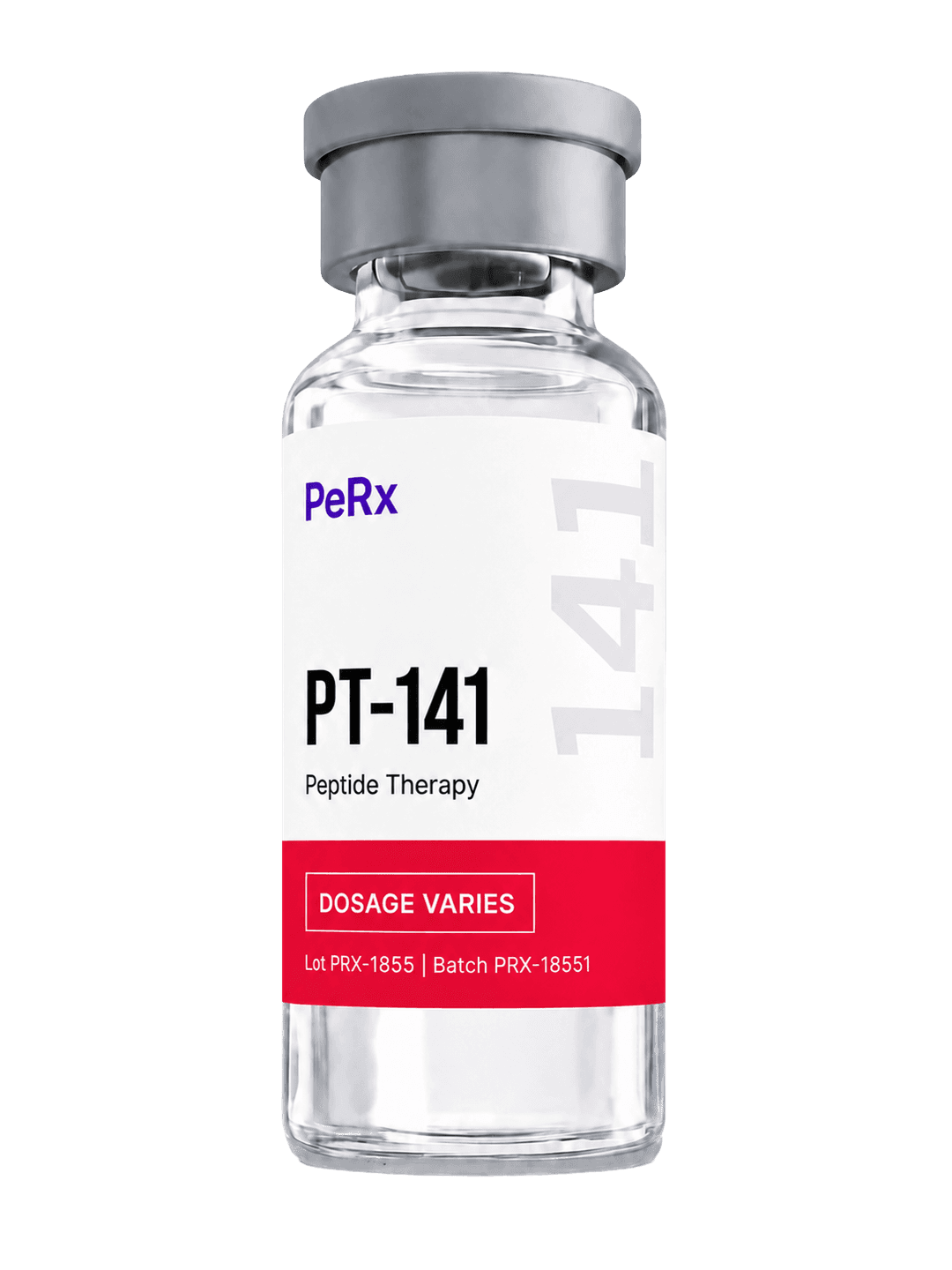
The PeRx PT-141 is a subcutaneous vial prescribed by a licensed provider after an online health screening, compounded by a US 503A pharmacy, and third-party tested for purity. It ships fully reconstituted and ready to use, with insulin syringes included, so there is no mixing and nothing to measure out beyond drawing your prescribed dose.
It is an on-demand medication, not a daily one. You inject about 45 minutes before activity, no more than once in 24 hours, and a single vial typically lasts months at that cadence. Pricing starts at $229 per vial.
If the injection itself is the sticking point, it is a smaller event than most people picture. The needle is a 27 to 31 gauge insulin syringe, half an inch long, placed into the fat of the abdomen or thigh rather than muscle. Most first-timers report it is easier than expected. How to use PT-141 walks through the complete routine from refrigerator to injection, where to inject PT-141 maps the sites and rotation, and the PT-141 dosage chart covers how providers structure dosing. For a broader look at why swallowing or absorbing peptides tends to fail where injection succeeds, the PT-141 oral vs injectable guide covers the same logic from another angle.
Provider, Not Guesswork
Bremelanotide raises blood pressure transiently regardless of route, which is why it is contraindicated in uncontrolled hypertension and cardiovascular disease. With PeRx, a licensed provider reviews your health history before prescribing and remains available for questions afterward. That screening step exists for any form of this drug, and it is the piece most nasal spray checkout pages skip.
Questions to Ask Any Nasal Vendor
Maybe you have read all of the above and still prefer a spray. That is your call to make, and needle aversion is not a character flaw. Some compounding pharmacies do prepare intranasal bremelanotide under a prescription, and a prescriber may have their own reasoning for offering it. What you should not do is buy a spray from whichever site ranks first. Before handing over money to any vendor, get real answers to these questions.
Is a prescription and a licensed pharmacy involved? Bremelanotide is a prescription drug. A legitimate compounded version comes from a licensed pharmacy after a prescriber evaluates you. A site that sells it with no prescription is not operating inside that system, and products labeled for research purposes are not manufactured for human use.
Can they show third-party testing? Ask for a certificate of analysis for the actual lot: identity, purity, and concentration verified by an independent lab. A vendor who cannot produce one is asking you to spray an unverified solution into your nose on faith.
What is the per-spray dose, and how was it chosen? There is no FDA-validated intranasal dose of bremelanotide, so every vendor concentration is an in-house decision. Ask what data supports the number on the label and how consistent the metered pump is from spray to spray. Vague answers here are the whole ballgame.
Who screened your blood pressure? The reason the original nasal program died was blood pressure behavior under erratic absorption. Anyone using bremelanotide in any form should have hypertension and cardiovascular history reviewed by a clinician first. If nobody in the transaction asked about your blood pressure, that is your answer about the operation as a whole.
How is it stored and shipped? Peptides degrade with heat and time. Ask about cold-chain shipping and refrigeration requirements. A peptide solution that spent a week in a hot mail truck may contain a lot less active drug than the label claims, which compounds the absorption variability you are already accepting.
PT-141 Nasal Spray Questions
Related Guides
Continue reading about peptides and protocols that pair well with this guide.
Where to Inject PT-141: Sites & Technique
PT-141 is a subcutaneous injection you give about 45 minutes before activity. Because it works centrally in the brain rather than at the injection site, the site you choose is about comfort and rotation, not effect. Here is the practical site map, the step-by-step technique, and how to rotate.
Is PT-141 FDA Approved? Yes, As Vyleesi
This one is complicated. The molecule in PT-141 (bremelanotide) is FDA-approved as Vyleesi for treating hypoactive sexual desire disorder in premenopausal women. But the compounded version used in peptide therapy is prescribed off-label for broader sexual health applications in both men and women. Same molecule, different regulatory paths.
Where to Inject NAD+: Sites, Rotation, Sting
NAD+ is a subcutaneous injection, and it has a reputation for stinging more than most peptides. The good news is that the sting is almost entirely a technique problem. Where you put the needle, how slowly you push, and how you rotate all change the experience more than the molecule does. Here is the practical site-and-technique guide patients ask for after their first NAD+ vial arrives.
Ready to get started?
PT-141 prescribed by a licensed provider, compounded by a US 503A pharmacy, third-party tested, and shipped to your door fully reconstituted and ready to use.
Medical Disclaimer
The information provided on this website, including all articles, guides, and educational content, is for informational and educational purposes only and is not intended as medical advice, diagnosis, or treatment. Nothing on this site should be construed as a substitute for professional medical advice from a qualified healthcare provider.
The majority of peptides discussed on this site are not approved by the U.S. Food and Drug Administration (FDA) for the indications described. They are classified as bulk drug substances and are available only through a licensed prescribing provider and compounding pharmacy. All treatments require a valid prescription and provider oversight.
The majority of published research on peptide therapies has been conducted in preclinical (animal) models. While early human data is encouraging, comprehensive clinical trial data remains limited for most peptide compounds. Individual results may vary significantly based on health status, injury type, and other factors. No specific outcomes are guaranteed.
Certain peptides discussed on this site are classified as prohibited substances by the World Anti-Doping Agency (WADA) and are banned by major sports organizations including the NFL, NCAA, UFC, NBA, MLB, NHL, and PGA. If you are subject to anti-doping testing, consult your governing body before considering any peptide therapy.
Statements on this website have not been evaluated by the Food and Drug Administration. Products and therapies discussed are not intended to diagnose, treat, cure, or prevent any disease.
© 2026 Wellness MD Group PC DBA PeRx. All rights reserved.