Sermorelin Before and After: What Really Changes
Search this phrase and you get clinic photo galleries and dramatic split images. Almost none of them show what sermorelin actually does, because sermorelin works by nudging your own growth hormone rhythm, and most of what changes never appears in a photo. This guide goes domain by domain through what typically changes, what it feels like, what you can measure, and how to run a before-and-after on yourself that you can actually trust.

In this article
Key Takeaways
- Sermorelin prompts your own pituitary to release growth hormone in natural pulses. That produces gradual, physiological change, not a dramatic transformation, so any jaw-dropping "sermorelin before and after" photo almost certainly reflects diet, training, or a GLP-1 medication instead.
- The changes people typically report arrive in a sequence: sleep first within the early weeks, steadier energy and recovery over the following month or two, and slow, modest body-composition and skin changes over several months.
- Most of the real "after" is invisible. Consolidated sleep, easier mornings, faster recovery between workouts, and steadier daytime energy never show up in a photo, which is exactly why marketing ignores them.
- Body composition is the one domain a camera could eventually capture, and even there the published human data shows modest shifts in lean mass over about four months, not a physique overhaul.
- You can run a better before-and-after on yourself than any clinic gallery: a sleep tracker, a training log, tape or DEXA measurements, and labs through your regular physician, all started before day one.
- Everything here describes typically reported patterns and small human studies, not promised outcomes. Individual response varies widely, and a fair trial takes months, not weeks.
Sermorelin Before and After Quick Facts
Sleep
The first change, commonly within 2 to 4 weeks; felt, never photographed
Energy and recovery
Build over roughly 4 to 8 weeks; a training log captures it
Body composition
Slowest and most modest, over 3 to 6 months with training
Skin
Subtle thickness and quality changes over months, faint in photos
Dramatic photos online
Usually diet, training, or GLP-1 results, not sermorelin
Best evidence
Your own baseline: sleep tracker, tape or DEXA, training log, labs
Sermorelin Before and After: The Honest Version
Here is the problem with almost every sermorelin before-and-after you will find: the compound and the format are mismatched. Sermorelin is a growth hormone-releasing hormone analog. It signals your pituitary to release more of your own growth hormone in natural pulses, inside your body’s normal feedback loops. That design is exactly why physicians like it, and exactly why it cannot produce a dramatic split image. The changes people typically report are a night of sleep that stops fragmenting, a recovery day that stops being necessary, a slow shift in the fat-to-lean ratio over months. Three of those four are invisible, and the fourth is gradual enough that a camera mostly shrugs.
So when a clinic gallery shows a visibly leaner, more muscular body labeled "sermorelin, 12 weeks," you should assume the heavy lifting was done by something else: a training block, a diet phase, or increasingly a GLP-1 medication whose results got relabeled. Semaglutide and tirzepatide genuinely change how people look over months, and their photos have flooded every peptide-adjacent search. Sermorelin is not that class of drug, and the sermorelin vs semaglutide guide walks through how differently the two actually work.
This guide covers what changes, domain by domain, and how to verify each change in yourself. If your question is when each change arrives, week by week, that is a different question with its own dedicated page: how long does sermorelin take to work maps the full onset timeline, and we will not repeat its schedule here. For the mechanism and history behind the peptide, start with the full sermorelin guide. And if you are weighing peptides more broadly, the general peptides before and after guide applies this same honest-expectations lens across every goal we prescribe for.
| Domain | What changes | When it becomes noticeable | How to measure it |
|---|---|---|---|
| Sleep | Deeper, more consolidated sleep; fewer wake-ups; easier mornings | Commonly within 2 to 4 weeks, sometimes the first several nights | Sleep tracker wake counts and deep-sleep minutes; morning 1-10 rested rating |
| Energy and recovery | Steadier daytime energy; less lingering soreness; better training tolerance | Builds over roughly 4 to 8 weeks | Daily energy rating; training log volume, loads, and recovery notes |
| Body composition | Gradual, modest shift in fat-to-lean ratio, strongest with training | Over about 3 to 6 months of consistent use | Monthly tape measurements or periodic DEXA; monthly fixed-condition photos |
| Skin | Slow gains in skin thickness and overall quality | Months, on the same clock as body composition | Monthly photos in identical light; mostly something you feel, not see |
| Hair | Occasionally reported fullness changes; weakest evidence of any domain | Months, if at all | Honestly hard to measure; treat any change as a bonus, not a goal |
Sleep
- What changes
- Deeper, more consolidated sleep; fewer wake-ups; easier mornings
- When it becomes noticeable
- Commonly within 2 to 4 weeks, sometimes the first several nights
- How to measure it
- Sleep tracker wake counts and deep-sleep minutes; morning 1-10 rested rating
Energy and recovery
- What changes
- Steadier daytime energy; less lingering soreness; better training tolerance
- When it becomes noticeable
- Builds over roughly 4 to 8 weeks
- How to measure it
- Daily energy rating; training log volume, loads, and recovery notes
Body composition
- What changes
- Gradual, modest shift in fat-to-lean ratio, strongest with training
- When it becomes noticeable
- Over about 3 to 6 months of consistent use
- How to measure it
- Monthly tape measurements or periodic DEXA; monthly fixed-condition photos
Skin
- What changes
- Slow gains in skin thickness and overall quality
- When it becomes noticeable
- Months, on the same clock as body composition
- How to measure it
- Monthly photos in identical light; mostly something you feel, not see
Hair
- What changes
- Occasionally reported fullness changes; weakest evidence of any domain
- When it becomes noticeable
- Months, if at all
- How to measure it
- Honestly hard to measure; treat any change as a bonus, not a goal
Sleep: The First Change
If sermorelin has a signature "before and after," it is a night of sleep, which is why no marketing page leads with it. Growth hormone’s largest natural pulse happens during deep, slow-wave sleep, and sermorelin is typically injected before bed to align with that rhythm. What people commonly report in the early weeks is not sedation but consolidation: falling asleep more easily, waking less at 3 a.m., and getting up feeling like the night actually did something. The sermorelin dosage chart covers why the bedtime, empty-stomach timing matters so much for this effect.
What does it feel like? Mostly like the absence of a problem: no 2 a.m. ceiling-staring, less willpower needed to get out of bed, and around week three the realization that you cannot remember the last bad night. That last detail matters for tracking, because subjective sleep memory is terrible, and once you sleep well for two weeks you genuinely forget how bad it was. A baseline written down before day one is the only honest "before."
What is measurable: a wearable sleep tracker gives you wake counts, deep-sleep minutes, and resting heart rate trends, all of which move if your sleep architecture improves. No tracker? A morning journal works: number of remembered wake-ups and a 1-10 rested rating, thirty seconds a day. What never shows in a photo: all of it. Sleep is the single most commonly reported sermorelin change and the single least marketable one, which tells you most of what you need to know about the photo galleries.
Energy and Recovery
The second domain builds on the first. As sleep stabilizes and growth hormone pulses support tissue repair, people typically report a steadier kind of daytime energy over roughly the first one to two months: less afternoon fade, no stimulant edge, just fewer moments of running on empty. Alongside it comes the recovery change, which regular trainers tend to notice first. Soreness that used to linger for two days clears in one. A hard session does not wreck the next one. You stop planning your week around recovery days.
What is measurable: a daily 1-10 energy rating logged at the same time each day, plus a caffeine count, gives you a real trend line in a month. For recovery, your training log is the instrument you already keep: volume, loads, quality sessions per week, soreness notes. If those numbers drift up over two months while nothing else changed, that is your before-and-after. And once again, none of it photographs. A person with steady energy and quick recovery looks exactly like a person without them, which is why the domain that changes daily life most is absent from every transformation gallery ever posted.
The two-minute setup that beats every photo
Before your first dose: note your typical night wake-ups, rate your energy for one baseline week, and write down what your training week looks like. That is the whole setup. Ninety days later you will have an answer about your own response that no clinic gallery could ever give you.
Body Composition: The Slow One
This is the domain everyone searching "sermorelin before and after" actually wants, so it deserves the most precision. Growth hormone supports fat breakdown and lean-tissue maintenance through indirect pathways, and because sermorelin works through your own pulsatile release, the effect is gradual and capped by your body’s feedback loops. The typically reported pattern is a slow recomposition over about three to six months: a modest shift in the fat-to-lean ratio, better muscle tone in people who train, and clothes fitting differently before the mirror says much.
The human data matches that modesty. In one of the better-known studies, healthy elderly men took nightly GHRH(1-29) injections for 16 weeks and showed measurable gains in lean body mass, without dramatic weight change. A companion line of research in older adults found body-composition shifts alongside rises in IGF-1 over similar timeframes. These are real, measured effects. They are also exactly the size of effect that a casual photo cannot capture and a marketing department cannot resist inflating.
Vittone J, Blackman MR, Busby-Whitehead J, et al. "Effects of single nightly injections of growth hormone-releasing hormone (GHRH 1-29) in healthy elderly men." Metabolism, 1997. (Small human study; gains in lean body mass over 16 weeks of nightly injections.) View study
Khorram O, Laughlin GA, Yen SS. "Endocrine and metabolic effects of long-term administration of [Nle27]growth hormone-releasing hormone-(1-29)-NH2 in age-advanced men and women." Journal of Clinical Endocrinology and Metabolism, 1997. (Human study of a GHRH(1-29) analog; body composition and skin changes over 16 weeks.) View study
What is measurable: monthly tape measurements at fixed landmarks, or a DEXA scan at baseline and again around month four if you want the gold standard. Monthly photos in strictly identical conditions can eventually register the change too. What a photo will never show is whether the change came from sermorelin, from your training block, or from better sleep quietly improving your eating and workouts. Those inputs are tangled by design. Sermorelin is the supporting actor in a body-composition story where training and nutrition remain the leads, and any clinic that casts it as the star is selling something.
One more honesty checkpoint: sermorelin is the gentler option in its own class. People who want a stronger growth hormone signal sometimes step up to CJC-1295/Ipamorelin, which stimulates release through two pathways; the CJC-1295 vs sermorelin comparison covers that tradeoff. And sermorelin is not a weight-loss drug at all. If a photo shows twenty visibly lost pounds, think GLP-1, not GHRH.
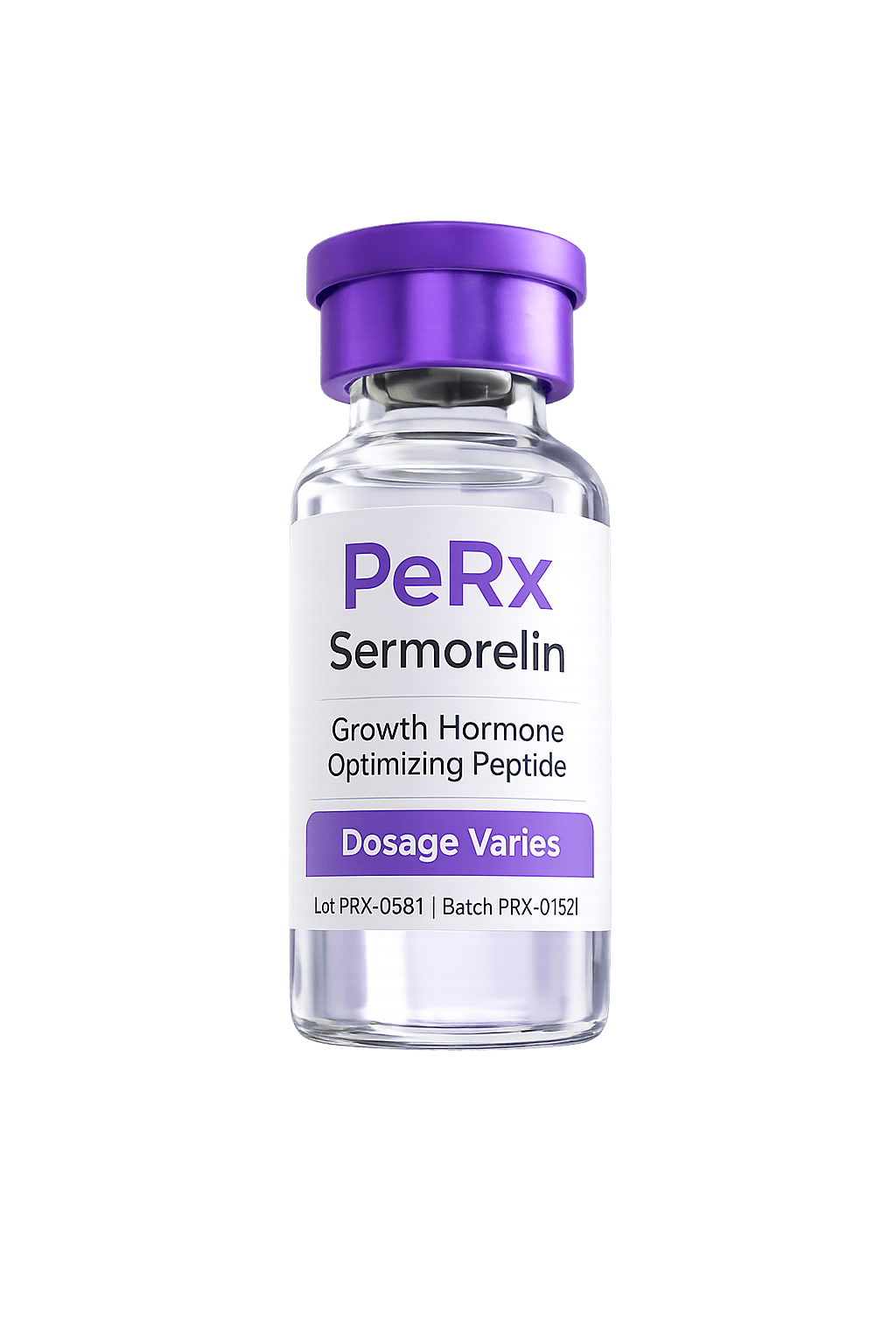
Sermorelin
Sermorelin at PeRx is prescribed by a licensed provider after a health review and compounded at a US-based 503A pharmacy. It ships to your door fully reconstituted and ready to use, with everything needed for the bedtime subcutaneous injection.
$229 for a one-month supply. The typically reported arc runs sleep first, energy and recovery next, and slow body-composition change over a full cycle, so it suits people optimizing sleep, recovery, and gradual recomposition rather than chasing rapid visible change.
Skin and Hair
Skin runs on the same slow clock as body composition, and it is the domain where the research contains a genuinely interesting detail: the Khorram study of a GHRH(1-29) analog in older adults measured an increase in skin thickness over 16 weeks. Growth hormone and IGF-1 support collagen synthesis, so a slow improvement in skin quality is mechanistically plausible and occasionally reported: skin that feels a bit more resilient, looks slightly less thin, recovers faster from a hard week. Notice the adjectives. Slightly. A bit. This is a months-long, at-the-margin change, not a cosmetic procedure.
Photographically, skin is almost a trap. Lighting, hydration, sleep, and makeup swing skin appearance day to day far more than any peptide does month to month, which is why dramatic skin before-and-afters are the easiest kind to fake. Monthly photos in ruthlessly identical conditions, same room, same light, same distance, same time of day, no filter, can register a real change by month three or four. Anything shot looser than that is comparing lighting setups, not skin.
Hair deserves one honest paragraph: it has the weakest evidence of any domain here. Some people report fuller-feeling hair after months on growth hormone peptides, the mechanism is not well established for this use, and no controlled data supports expecting it. Treat any hair change as an unadvertised bonus. A sermorelin ad leading with hair restoration is a red flag, not a feature.
How to Track Your Own Before and After
You cannot audit a clinic’s gallery, but you can run a clean experiment on yourself, and with sermorelin the instruments map neatly onto the domains above. The whole setup takes fifteen minutes before your first dose.
Sleep: tracker or journal, started at baseline. A wearable gives you wake counts, deep-sleep minutes, and trends for free. Without one, log remembered wake-ups and a 1-10 rested rating each morning. Capture at least one baseline week before starting, because your memory of "before" degrades fast once sleep improves.
Body: tape monthly, DEXA if you are serious, photos only in fixed conditions. Tape at the same landmarks, same time of day, monthly, not weekly; body measurements are noisy and fixed intervals smooth the noise. A baseline DEXA repeated around month four is the most honest body-composition instrument available to a normal person. Photos are optional: front, side, and back, identical setup written down so you can replicate it, monthly at most.
Training: the log you already keep. Volume, loads, session quality, soreness notes. Recovery changes show up here before they show up anywhere else.
Labs: through your regular physician. Growth hormone works partly through IGF-1, and IGF-1 is what physicians typically measure to see whether a growth hormone peptide is doing anything: a baseline level before you start and a follow-up during the cycle. Pair it with whatever routine panels your physician already runs. The goal is optimization within a healthy range, not maximal elevation, and interpreting those numbers is your physician’s job, not a chart on a clinic’s sales page.
Then leave it alone and let time pass. Judge sleep after the early weeks, energy after two months, and body composition only after the full arc that the onset timeline guide lays out. Evaluating a six-month change at week three is the most common self-inflicted disappointment in growth hormone peptide therapy.
When You Feel Nothing
Suppose you tracked honestly, a fair window passed, and the numbers did not move. That is real information with a short list of explanations, checked in order. First, the trial itself: skipped doses, injections right after a large meal, or chronically wrecked sleep all blunt the response, because food dampens growth hormone release and the biggest pulse depends on deep sleep. Second, your starting point: published work shows age and adiposity strongly shape GH secretion, so two people on identical protocols can respond very differently, and someone already sleeping well and training hard has less low-hanging fruit for sermorelin to pick.
Iranmanesh A, Lizarralde G, Veldhuis JD. "Age and relative adiposity are specific negative determinants of the frequency and amplitude of growth hormone (GH) secretory bursts and the half-life of endogenous GH in healthy men." Journal of Clinical Endocrinology and Metabolism, 1991. View study
Third, the honest possibility: you may be a modest responder. Sermorelin’s gentleness is a feature, and the price of working inside your own feedback loops is that the ceiling is your own physiology. If a fair, consistent trial produced nothing measurable, bring your tracked data and your IGF-1 results to your provider. Sometimes the answer is a different protocol, sometimes a stronger growth hormone approach, sometimes the conclusion that this pathway is not your bottleneck. The what to do when a peptide does not seem to work guide walks through those next steps. What the answer is never: quietly increasing your own dose, or concluding from a clinic’s photo gallery that you must be doing it wrong.
Red Flags in Sermorelin Marketing
Because this search is wall-to-wall marketing, here is a field guide for reading sermorelin results content skeptically. No single flag proves deception. Two or three together and you should assume it.
The result does not match the mechanism. Dramatic fat loss, visible abs, or a face transformation credited to sermorelin alone. A GHRH analog working through your own pulsatile release cannot produce GLP-1-sized weight change or surgery-sized facial change. When the claimed effect exceeds what the pathway can deliver, the photo came from somewhere else.
HGH results wearing a sermorelin label. Some galleries recycle imagery and figures from direct growth hormone injection, a different therapy with a different risk profile and stronger effects. The sermorelin vs HGH guide explains the gap; any page blurring the two is blurring it on purpose.
No timeline, no protocol, no conditions. A meaningful comparison states the interval, the dose, and what else the person was doing, and holds photo conditions fixed. Two undated photos in different lighting are two photos, not evidence. A reverse image search takes ten seconds and regularly traces transformation photos to stock libraries and fitness influencers.
Promises with dates, or no prescriber in sight. "Feel 20 years younger in 30 days" is incompatible with how this peptide works; honest expectations come with ranges and the word "typically." And sermorelin is a prescription peptide: a site selling results imagery without a licensed provider, a health review, and a pharmacy behind it is selling unregulated product, and the photos are the least of the problems.
Why PeRx shows no patient photos
PeRx publishes no patient before-and-after photos and no patient stories. Our patients are under the care of licensed providers, and their outcomes are private medical information. For a peptide whose main effects are invisible, a persuasive photo gallery would either overstate what sermorelin did or borrow the result from something else. We would rather teach you to measure your own.
Ready to get started?
Pharmaceutical-grade sermorelin, prescribed by a licensed provider and shipped to your door in ready-to-use vials. Set your baseline, give it a fair window, and run a before-and-after you can actually trust.
Sermorelin Before and After: Common Questions
Related Guides
Continue reading about peptides and protocols that pair well with this guide.
Sermorelin Peptide: Benefits, Dosing & How It Works
Every growth hormone peptide used today traces its lineage back to this molecule. Sermorelin was once FDA-approved, then abandoned for commercial reasons. Now it's having a second act as the safest entry point into growth hormone optimization. The peptide that was too gentle for children turned out to be exactly what adults needed.
Is Sermorelin FDA Approved? Yes Until 2008
Sermorelin has a unique regulatory history. It was FDA-approved in 1997 as Geref Diagnostic for testing pituitary function, and its therapeutic form (Geref) was used for pediatric growth hormone deficiency. Then the manufacturer discontinued it in 2008. Today Sermorelin is only available as a compounded medication. Here is the full story.
Peptides for Powerlifters: Joint and Tendon Repair
The SI flare four weeks out from a meet. The elbow that ends a bench cycle. How peptide therapy is used for the connective-tissue injuries that come from moving the heaviest weights you can.
Medical Disclaimer
The information provided on this website, including all articles, guides, and educational content, is for informational and educational purposes only and is not intended as medical advice, diagnosis, or treatment. Nothing on this site should be construed as a substitute for professional medical advice from a qualified healthcare provider.
The majority of peptides discussed on this site are not approved by the U.S. Food and Drug Administration (FDA) for the indications described. They are classified as bulk drug substances and are available only through a licensed prescribing provider and compounding pharmacy. All treatments require a valid prescription and provider oversight.
The majority of published research on peptide therapies has been conducted in preclinical (animal) models. While early human data is encouraging, comprehensive clinical trial data remains limited for most peptide compounds. Individual results may vary significantly based on health status, injury type, and other factors. No specific outcomes are guaranteed.
Certain peptides discussed on this site are classified as prohibited substances by the World Anti-Doping Agency (WADA) and are banned by major sports organizations including the NFL, NCAA, UFC, NBA, MLB, NHL, and PGA. If you are subject to anti-doping testing, consult your governing body before considering any peptide therapy.
Statements on this website have not been evaluated by the Food and Drug Administration. Products and therapies discussed are not intended to diagnose, treat, cure, or prevent any disease.
© 2026 Wellness MD Group PC DBA PeRx. All rights reserved.