Tesamorelin Dosage Chart: Units, Timing, Cost
Tesamorelin dosing numbers found online disagree with each other for a reason: three different Egrifta labels say 2 mg, 1.4 mg, and 1.28 mg, and none of them describe a compounded vial. This page sorts out the three labels, converts milligrams to insulin-syringe units at the 3 mg/mL concentration PeRx ships, and covers timing, cycle length, missed doses, and what a month costs, as of August 31, 2026.
In this article
Key Takeaways
- Tesamorelin is unusual among compounded peptides in having an FDA-approved reference dose. The original Egrifta label specifies 2 mg subcutaneously once daily, the dose used in both Phase 3 trials.
- The 2 mg, 1.4 mg, and 1.28 mg figures all describe the same drug in different formulations. Egrifta SV (1.4 mg) and Egrifta WR (1.28 mg) deliver tesamorelin more efficiently per labeled milligram, and the FDA labels state the formulations are not substitutable. None of the three numbers is a dose reduction.
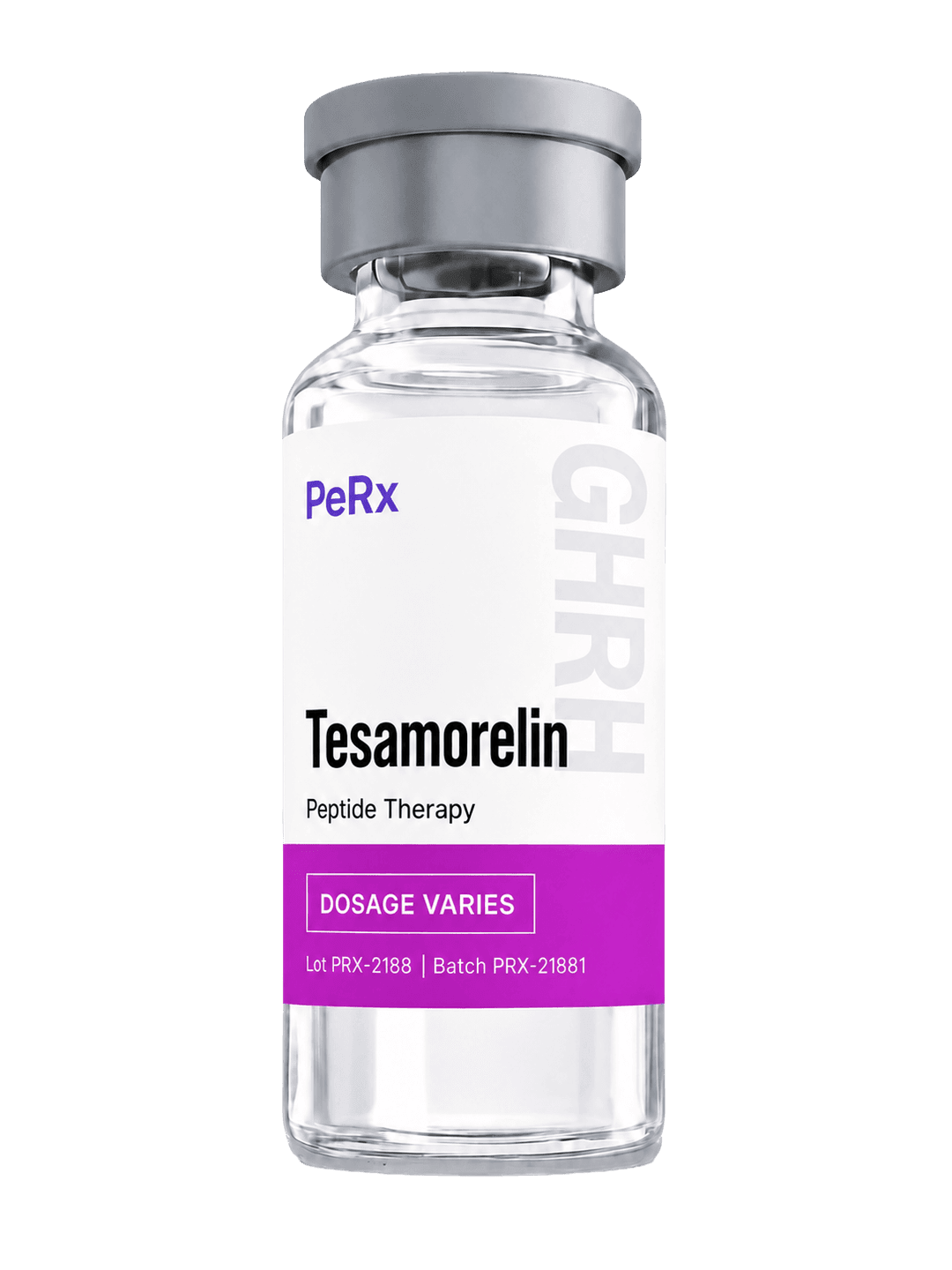
- PeRx tesamorelin ships fully reconstituted at 3 mg/mL in a 5 mL vial. At that concentration one unit on a U-100 insulin syringe holds 0.03 mg, so units equals milligrams times 33.3. The full 2 mg reference dose is 67 units, which is 0.67 mL.
- The chart on this page translates label numbers into syringe units. It does not pick your dose. Your provider prescribes your protocol, and the prescription label on your vial governs what you draw.
- Tesamorelin is a once-daily injection into the abdomen, and consistency matters more than clock time. Neither the approved labeling nor the trials require a particular hour.
- Tesamorelin is $229 per vial at PeRx, one vial per prescription month, with provider review, syringes, and refrigerated overnight shipping included.
Tesamorelin Dosing at a Glance
Vial
5 mL at 3 mg/mL (15 mg total), ready to use
FDA reference dose
2 mg subcutaneously once daily (original Egrifta label)
Syringe math
1 mg = 33 units on a U-100 insulin syringe; 2 mg = 67 units (0.67 mL)
When
Once daily, same time each day; the label names the abdomen
Monitoring
IGF-1, fasting glucose, HbA1c
Cost
$229 for the monthly vial through PeRx
The Tesamorelin Dosage Chart
Most peptides in the compounding space have no official dose, only conventions. Tesamorelin is the exception. It is FDA approved under the brand name Egrifta for HIV-associated lipodystrophy, and the original label states the dose plainly: 2 mg by subcutaneous injection, once a day. Both Phase 3 trials that earned the approval used that number. So when someone asks what the tesamorelin dose is, there is an actual answer on file with the FDA, which is rare enough in this space to be worth saying twice.
What the Egrifta label cannot tell you is how to draw that dose from a compounded vial, because the branded product and the compounded one are packaged differently. PeRx tesamorelin ships fully reconstituted and ready to use at a fixed concentration of 3 mg per mL in a 5 mL vial. The chart below converts milligram doses into insulin-syringe units at that concentration. The top rows are there so you can translate figures quoted elsewhere; the 2 mg row is the FDA reference. The dose you actually inject is the one your provider prescribed, printed on your label.
| Dose | Units on U-100 syringe | Volume (mL) | Doses per 5 mL vial |
|---|---|---|---|
| 0.5 mg | 16.7 units (draw to 17) | 0.17 mL | 30 |
| 1 mg | 33.3 units (draw to 33) | 0.33 mL | 15 |
| 1.28 mg (Egrifta WR label) | 42.7 units (draw to 43) | 0.43 mL | ~11 |
| 1.4 mg (Egrifta SV label) | 46.7 units (draw to 47) | 0.47 mL | ~10 |
| 2 mg (original Egrifta label) | 66.7 units (draw to 67) | 0.67 mL | 7 |
0.5 mg
- Units on U-100 syringe
- 16.7 units (draw to 17)
- Volume (mL)
- 0.17 mL
- Doses per 5 mL vial
- 30
1 mg
- Units on U-100 syringe
- 33.3 units (draw to 33)
- Volume (mL)
- 0.33 mL
- Doses per 5 mL vial
- 15
1.28 mg (Egrifta WR label)
- Units on U-100 syringe
- 42.7 units (draw to 43)
- Volume (mL)
- 0.43 mL
- Doses per 5 mL vial
- ~11
1.4 mg (Egrifta SV label)
- Units on U-100 syringe
- 46.7 units (draw to 47)
- Volume (mL)
- 0.47 mL
- Doses per 5 mL vial
- ~10
2 mg (original Egrifta label)
- Units on U-100 syringe
- 66.7 units (draw to 67)
- Volume (mL)
- 0.67 mL
- Doses per 5 mL vial
- 7
The chart translates. Your label decides.
These rows exist to convert numbers you will encounter, on FDA labels, in published trials, or in a prescription written elsewhere, into marks on the syringe in your hand. They are not a menu. Your PeRx provider prescribes your protocol during the intake review, and the instructions on your prescription label override anything on this page.
Why Egrifta Says 2 mg, 1.4 mg, and 1.28 mg
Search for an Egrifta dose and you will find three different numbers, all of them correct. The confusion comes from the fact that Theratechnologies has shipped tesamorelin in three formulations since the 2010 approval, and each got its own labeled dose. The original Egrifta was 2 mg once daily, drawn from two 1 mg vials of powder that had to be mixed with diluent before each injection. Egrifta SV arrived in 2019 as a single 2 mg vial mixed with 0.5 mL of diluent, with a labeled dose of 1.4 mg in 0.35 mL. Egrifta WR, labeled in March 2025, is a multi-dose vial holding a week of injections at 8 mg per mL, with a labeled dose of 1.28 mg in 0.16 mL.
| Egrifta (2010) | Egrifta SV (2019) | Egrifta WR (2025) | |
|---|---|---|---|
| Labeled daily dose | 2 mg | 1.4 mg | 1.28 mg |
| Vial format | Two 1 mg vials per dose, mixed daily | One 2 mg single-dose vial, mixed daily | One 11.6 mg multi-dose vial, mixed weekly |
| One vial covers | Half of one dose | One dose | Seven daily doses |
| Injection volume | Per original label | 0.35 mL | 0.16 mL |
Labeled daily dose
- Egrifta (2010)
- 2 mg
- Egrifta SV (2019)
- 1.4 mg
- Egrifta WR (2025)
- 1.28 mg
Vial format
- Egrifta (2010)
- Two 1 mg vials per dose, mixed daily
- Egrifta SV (2019)
- One 2 mg single-dose vial, mixed daily
- Egrifta WR (2025)
- One 11.6 mg multi-dose vial, mixed weekly
One vial covers
- Egrifta (2010)
- Half of one dose
- Egrifta SV (2019)
- One dose
- Egrifta WR (2025)
- Seven daily doses
Injection volume
- Egrifta (2010)
- Per original label
- Egrifta SV (2019)
- 0.35 mL
- Egrifta WR (2025)
- 0.16 mL
The shrinking milligram number is not a dose reduction and not a sign that 2 mg was too much. Each newer formulation delivers tesamorelin more efficiently, so a smaller labeled amount produces exposure comparable to the original 2 mg. That is also why the FDA labels state flatly that the formulations are not substitutable: 1.4 mg of SV is not a lower dose than 2 mg of the original, it is the same treatment in a different package. If you see a forum post claiming the FDA cut the tesamorelin dose, this is the misreading behind it.
For a compounded vial, the number that matters is the pharmacology, and the pharmacology was established at 2 mg. In the pivotal trial published in the New England Journal of Medicine, 2 mg daily reduced visceral fat by about 15 percent over 26 weeks. The second Phase 3 trial used the same dose and confirmed the result. That is why 2 mg daily remains the reference point prescribers start from, whatever the branded packaging currently says.
Falutz J, Allas S, Blot K, et al. "Metabolic effects of a growth hormone-releasing factor in patients with HIV." New England Journal of Medicine. 2007;357(23):2359-2370. View study
Approved product vs compounded product
Egrifta is the FDA-approved product, and its approval covers one indication: reduction of excess abdominal fat in HIV-associated lipodystrophy. Compounded tesamorelin from a 503A pharmacy is prescribed off-label by a licensed provider and is not an FDA-approved product. The trial results above describe the approved drug in that patient population. They set the reference dose; they are not a promise of what a compounded prescription will do for you.
How Many Units of Tesamorelin on an Insulin Syringe at 3 mg/mL?
The arithmetic, once. A U-100 insulin syringe holds 100 units per mL, so one unit is 0.01 mL. At 3 mg per mL, one unit therefore holds 0.03 mg of tesamorelin. To go from milligrams to units, multiply by 33.3. To go from units to milligrams, multiply by 0.03. One milligram is 33 units, and the full 2 mg reference dose is 67 units, which is 0.67 mL.
That last number has a practical consequence. A 2 mg draw at this concentration does not fit in the 0.3 mL and 0.5 mL insulin syringes many people use for other peptides; it needs a 1 mL syringe. Smaller prescribed doses fit smaller syringes. PeRx includes syringes appropriate for your prescription with every order, so match the barrel to the volume on your label rather than forcing a large dose into a small syringe across two injections.
Drawing technique is simple but worth doing precisely at these volumes: pull air into the syringe equal to your dose, inject the air into the vial, invert, draw past your mark, then push back to the exact line to clear bubbles. The where to inject tesamorelin guide walks through site selection on the abdomen, rotation, and the full step-by-step, and how to take peptides is the general primer if this is your first subcutaneous injection. For what tesamorelin actually does once it is in, the tesamorelin guide covers the mechanism and the clinical evidence in depth.
Tesamorelin
The units math above assumes the PeRx vial: tesamorelin at 3 mg/mL, prescribed by a licensed provider and compounded at a US-based 503A pharmacy with third-party testing. It ships fully reconstituted and ready to use, with insulin syringes included, so none of the Egrifta diluent steps on this page apply to it.
One vial covers the prescription month at $229, and your prescription label carries the exact draw your provider chose. No specialty-pharmacy insurance maze, no vial-and-diluent kit.
When to Inject Tesamorelin
Tesamorelin is a once-daily injection, and the approved labeling is specific about the where and silent about the when. The site is the abdomen, rotated between injections. The hour of the day is not specified, and neither Phase 3 trial required one. What matters is even exposure, which means picking a time you can hit every day and keeping it.
In practice patients split into two camps. Morning injectors like the routine: the vial comes out with the coffee, and travel or late dinners never interfere. Evening injectors reason that growth hormone is naturally released in its largest pulse during early deep sleep, so a bedtime dose lines up with the rhythm the peptide is trying to amplify. Both are defensible, the difference is small next to the value of consistency, and your provider may specify one on your label. If the label names a time, that settles it.
One related question comes up often: does tesamorelin require an empty stomach? The Egrifta label imposes no fasting rule, so no. Some prescribers still suggest keeping the injection a couple of hours away from large meals, on the general endocrine logic that rising blood glucose blunts growth hormone release. Treat that as optimization, not requirement, and follow your own label if it says otherwise.
Tesamorelin Cycle and Duration
The clinical trials measured their primary endpoints at 26 weeks, and the extension phases ran to 52. Two findings from those extensions shape how prescribers think about duration. Patients who stayed on tesamorelin through the full year held their visceral fat reductions. Patients switched to placebo at 26 weeks watched the fat return toward baseline. Tesamorelin augments a signal; it does not rebuild the machinery that generates it, so the effect lasts as long as the signal does.
Falutz J, Potvin D, Mamputu JC, et al. "Effects of tesamorelin, a growth hormone-releasing factor, in HIV-infected patients with abdominal fat accumulation: a randomized placebo-controlled trial with a safety extension." Journal of Acquired Immune Deficiency Syndromes. 2010;53(3):311-322. View study
Compounded protocols therefore tend to run in multi-month blocks with reassessment rather than indefinitely by default. At PeRx a prescription covers a defined number of monthly vials, and continuing past it means a renewal check-in with the provider. The useful labs to bring to that conversation are IGF-1, which integrates your growth hormone exposure into one number, and fasting glucose or HbA1c, because GH nudges glucose handling and the trials tracked both. A waist measurement taken the same way each month is the cheapest outcome measure there is. If you came to tesamorelin to deal with a stubborn midsection after weight loss medication, tesamorelin after GLP-1s covers that specific timeline and what the non-HIV trial data shows.
What a Month of Tesamorelin Costs
Tesamorelin at PeRx is $229 per vial, one vial per prescription month. The price includes the provider review, compounding by a US-based 503A pharmacy, third-party purity testing, overnight refrigerated shipping, insulin syringes, and alcohol swabs. Nothing is charged until a licensed provider approves the prescription; checkout saves your card, and the charge fires on approval. Current pricing is on the tesamorelin product page once you have an account.
The branded comparison is less useful than it sounds. Egrifta is a specialty drug priced for an insurance-reimbursed rare-indication market, and patients who qualify for it access it through coverage rather than cash. The compounded and branded products also sit in different regulatory lanes: one is FDA approved for a specific diagnosis, the other is prescribed off-label patient by patient. If you are weighing tesamorelin against the other growth hormone peptides at a similar price point, sermorelin vs ipamorelin vs tesamorelin is the head-to-head comparison.
If You Miss a Tesamorelin Dose
Skip it and take the next dose at the normal time. Do not double up. Tesamorelin works by adding to a daily growth hormone pulse, and two injections stacked into one day do not produce twice the release, because somatostatin feedback caps how hard the pituitary will respond. A single missed day in a multi-month protocol is noise.
A missed week is different, mostly logistically. The vial keeps: PeRx tesamorelin stays refrigerated at 36 to 46 degrees Fahrenheit and is stable for several weeks handled cleanly, so pausing for travel does not waste the vial as long as it stays cold. Just resume the daily schedule when you are back and let the prescription month run its course. If injections keep getting missed because of side effects rather than schedule, that is a message to your care team, and the peptide side effects guide covers which reactions are routine and which are not.
Common Questions
Related Guides
Continue reading about peptides and protocols that pair well with this guide.
Tesamorelin Peptide: Benefits, Dosage & Visceral Fat
Most peptides in the compounding space have animal studies and early clinical signals. Tesamorelin has two Phase 3 randomized controlled trials, 816 patients, CT-measured visceral fat data, and an FDA approval. It is a synthetic analog of growth hormone-releasing hormone that triggers your pituitary to produce its own GH in a natural, pulsatile pattern. The result: targeted visceral fat loss without the side effects of injecting growth hormone directly.
Tesamorelin Side Effects: What the Trials Report
The most reported tesamorelin side effects in its clinical trials were injection-site reactions, joint and muscle pain, and swelling. The ones that need a call to your doctor are allergic reactions and changes in blood sugar. Tesamorelin is FDA-approved as Egrifta for reducing excess abdominal fat in adults with HIV-associated lipodystrophy. Evidence for any other use is limited, and every number on this page comes from that label.
Peptides for Rowers: Rib, Back and Wrist Repair
The sharp catch in the ribs on the drive, the lower back that has stopped cooperating after a week of long pieces, the wrist that burns on the feather. How peptide therapy is used for the connective-tissue and overuse injuries the rowing stroke produces.
Ready to get started?
Pharmaceutical-grade tesamorelin, prescribed by a licensed provider and shipped to your door ready to use with no mixing required.
Medical Disclaimer
The information provided on this website, including all articles, guides, and educational content, is for informational and educational purposes only and is not intended as medical advice, diagnosis, or treatment. Nothing on this site should be construed as a substitute for professional medical advice from a qualified healthcare provider.
The majority of peptides discussed on this site are not approved by the U.S. Food and Drug Administration (FDA) for the indications described. They are classified as bulk drug substances and are available only through a licensed prescribing provider and compounding pharmacy. All treatments require a valid prescription and provider oversight.
The majority of published research on peptide therapies has been conducted in preclinical (animal) models. While early human data is encouraging, comprehensive clinical trial data remains limited for most peptide compounds. Individual results may vary significantly based on health status, injury type, and other factors. No specific outcomes are guaranteed.
Certain peptides discussed on this site are classified as prohibited substances by the World Anti-Doping Agency (WADA) and are banned by major sports organizations including the NFL, NCAA, UFC, NBA, MLB, NHL, and PGA. If you are subject to anti-doping testing, consult your governing body before considering any peptide therapy.
Statements on this website have not been evaluated by the Food and Drug Administration. Products and therapies discussed are not intended to diagnose, treat, cure, or prevent any disease.
© 2026 Wellness MD Group PC DBA PeRx. All rights reserved.