CJC-1295 Peptide: What It Is, DAC vs No DAC
CJC-1295 is a lab-made version of the hormone that tells your pituitary to release growth hormone. The complication is that two different molecules are sold under that one name, one built to last a week and one built to clear quickly, and almost every published human result belongs to only one of them. This guide sorts out which is which, what the evidence covers, and why we had to pick a side.
In this article
Key Takeaways
- CJC-1295 is a synthetic analog of growth hormone-releasing hormone (GHRH). It does not supply growth hormone. It signals the pituitary to release more of your own, and it is neither a steroid nor HGH.
- Two different molecules share the name. CJC-1295 with DAC carries an albumin-binding anchor and had a measured half-life of 5.8 to 8.1 days in healthy adults. CJC-1295 without DAC, also called Modified GRF 1-29, is the 29-amino-acid backbone alone: short-acting and dosed daily.
- Nearly all published human data is on the DAC form. An FDA review presented in December 2024 found no peer-reviewed clinical or nonclinical studies of the no-DAC form, which is the version used in the CJC-1295/Ipamorelin blends clinics commonly prescribe, ours included.
- The DAC form does not erase growth hormone pulses. In the one human pulsatility study, pulse frequency and size were unchanged while the trough level between pulses rose 7.5-fold. The raised floor is the real physiological difference.
- PeRx prescribes only the no-DAC form, and only inside the CJC-1295/Ipamorelin blend ($299 per month), taken as an evening subcutaneous injection. There is no standalone CJC-1295 vial and no DAC product here.
- CJC-1295 is not FDA-approved in either form. An FDA advisory committee voted on December 4, 2024 against adding any of five CJC-1295 forms to the 503A compounding list, and WADA prohibits it at all times under section S2.
CJC-1295 Quick Facts
Full Name
CJC-1295, a tetrasubstituted analog of GHRH (1-29), sold with or without DAC
Type
Synthetic growth hormone-releasing hormone (GHRH) analog
Origin
ConjuChem Biotechnologies, Montreal; first described in 2005
Primary Mechanism
Activates the pituitary GHRH receptor so the gland releases its own GH
Primary Uses
Studied for raising GH and IGF-1; used for body composition, recovery, sleep
At PeRx
No-DAC form only, inside the CJC-1295/Ipamorelin blend, subcutaneous
What Is CJC-1295?
CJC-1295 is a synthetic copy of growth hormone-releasing hormone, the signal your hypothalamus sends to the pituitary when it wants growth hormone released. It is not growth hormone, and it cannot do anything a working pituitary was not already capable of. It turns up the request. The gland still decides how to answer, and the brake hormone somatostatin still has its say.
It exists because natural GHRH makes a terrible drug. In 1986 Lawrence Frohman and colleagues injected it into healthy volunteers and clocked its half-life at 6.8 minutes. A plasma enzyme clips the first two amino acids off almost immediately, and what remains has less than a thousandth of the original activity.
Frohman LA, Downs TR, Williams TC, et al. "Rapid enzymatic degradation of growth hormone-releasing hormone by plasma in vitro and in vivo." Journal of Clinical Investigation. 1986;78(4):906-13. View study
The first 29 amino acids of GHRH carry its receptor activity. That fragment became sermorelin, FDA-approved from 1997 until its manufacturer discontinued it in 2008. ConjuChem Biotechnologies of Montreal took the same fragment and changed it twice. First came four amino acid swaps at positions 2, 8, 15, and 27, including a D-alanine at position 2 that removes the spot where the enzyme cuts. Then came an extra lysine on the tail carrying a reactive group that bonds to albumin, the most abundant protein in blood. ConjuChem called that second trick the Drug Affinity Complex, or DAC. In the 2005 paper describing it, the molecule stayed detectable in rat plasma beyond 72 hours.
Jetté L, Léger R, Thibaudeau K, et al. "Human growth hormone-releasing factor (hGRF)1-29-albumin bioconjugates activate the GRF receptor on the anterior pituitary in rats: identification of CJC-1295 as a long-lasting GRF analog." Endocrinology. 2005;146(7):3052-8. Rat and cell-culture study. View study
CJC-1295 DAC vs No DAC: The Short Answer
CJC-1295 with DAC is a once-weekly molecule. CJC-1295 without DAC is a once-daily molecule. They are not two strengths of one product. The DAC version keeps the albumin anchor, circulates for about a week, and is dosed in milligrams. The no-DAC version, also sold as Modified GRF 1-29 or Mod GRF, is the four-substitution backbone with the anchor left off. It acts briefly, is dosed in micrograms, and is the form typically used in CJC-1295/Ipamorelin blends. Doses, schedules, and study results do not transfer from one to the other.
| CJC-1295 with DAC | CJC-1295 no DAC (Mod GRF 1-29) | |
|---|---|---|
| What it is | 30 residues: the modified GHRH backbone plus a lysine linker that bonds to albumin | 29 residues: the modified GHRH backbone alone |
| How long it lasts | Half-life 5.8 to 8.1 days, measured in healthy adults | Short-acting. About 30 minutes is the figure in general use; no published human study has measured it |
| Dosing rhythm | Roughly once a week | Once daily, usually in the evening |
| Dose scale | Milligrams | Micrograms |
| Growth hormone pattern | Pulses continue on top of a raised baseline (trough GH up 7.5-fold in the one human study) | One amplified pulse, then back to baseline until the next dose |
| Published human data | Three small studies in healthy adults (two papers, 2006), plus a Phase 2 trial stopped early and never published | None found in an FDA review presented in December 2024 |
| Can a dose be walked back? | No. Drug stayed measurable for 10 to 13 days after one injection | Yes. Skip a night and the signal is gone |
| At PeRx | Not offered | The form in the CJC-1295/Ipamorelin blend |
What it is
- CJC-1295 with DAC
- 30 residues: the modified GHRH backbone plus a lysine linker that bonds to albumin
- CJC-1295 no DAC (Mod GRF 1-29)
- 29 residues: the modified GHRH backbone alone
How long it lasts
- CJC-1295 with DAC
- Half-life 5.8 to 8.1 days, measured in healthy adults
- CJC-1295 no DAC (Mod GRF 1-29)
- Short-acting. About 30 minutes is the figure in general use; no published human study has measured it
Dosing rhythm
- CJC-1295 with DAC
- Roughly once a week
- CJC-1295 no DAC (Mod GRF 1-29)
- Once daily, usually in the evening
Dose scale
- CJC-1295 with DAC
- Milligrams
- CJC-1295 no DAC (Mod GRF 1-29)
- Micrograms
Growth hormone pattern
- CJC-1295 with DAC
- Pulses continue on top of a raised baseline (trough GH up 7.5-fold in the one human study)
- CJC-1295 no DAC (Mod GRF 1-29)
- One amplified pulse, then back to baseline until the next dose
Published human data
- CJC-1295 with DAC
- Three small studies in healthy adults (two papers, 2006), plus a Phase 2 trial stopped early and never published
- CJC-1295 no DAC (Mod GRF 1-29)
- None found in an FDA review presented in December 2024
Can a dose be walked back?
- CJC-1295 with DAC
- No. Drug stayed measurable for 10 to 13 days after one injection
- CJC-1295 no DAC (Mod GRF 1-29)
- Yes. Skip a night and the signal is gone
At PeRx
- CJC-1295 with DAC
- Not offered
- CJC-1295 no DAC (Mod GRF 1-29)
- The form in the CJC-1295/Ipamorelin blend
So which is better? It depends on which problem you would rather have. DAC wins on convenience, one injection a week instead of seven, and it is the only form with human pharmacokinetic data. No-DAC wins on control and on how closely the hormone pattern resembles a normal night. Clinics that pair it with ipamorelin, this one included, generally land on no-DAC, for reasons covered below.
DAC Does Not Flatten the Pulses
You will read almost everywhere that the DAC form replaces pulses with a flat line. The one human study that checked found something more specific. Ionescu and Frohman drew blood every 20 minutes overnight from healthy men aged 20 to 40, before and one week after a single DAC injection. Pulse frequency and pulse size were unchanged. What moved was the floor: trough growth hormone between pulses rose 7.5-fold, mean GH rose 46 percent, and IGF-1 rose 45 percent. The concern with DAC is a baseline that does not come back down.
Ionescu M, Frohman LA. "Pulsatile secretion of growth hormone (GH) persists during continuous stimulation by CJC-1295, a long-acting GH-releasing hormone analog." Journal of Clinical Endocrinology and Metabolism. 2006;91(12):4792-7. Healthy men, single dose of the DAC form. View study
How to Tell Which CJC-1295 Is in a Vial
The naming mess is not only a consumer problem. When FDA chemists reviewed CJC-1295 for an advisory committee in December 2024, they opened by noting "inconsistent naming conventions." CJC-1295 is a common name with no official nonproprietary name behind it, and the agency ended up evaluating five substances built on two distinct active molecules. Both nominators named a no-DAC form while submitting identifiers and clinical references that belonged to the DAC form.
The confusion has a traceable origin. In 2009, Norwegian police and customs handed an unlabeled preparation to the national doping control laboratory. Mass spectrometry found a 29-amino-acid peptide matching what was being marketed as CJC-1295. Twenty-nine residues is the backbone without the lysine anchor. The FDA review cites that report as the first appearance of the no-DAC form in the literature, so the short-acting version entered the record through a seizure and not a clinical trial.
Henninge J, Pepaj M, Hullstein I, Hemmersbach P. "Identification of CJC-1295, a growth-hormone-releasing peptide, in an unknown pharmaceutical preparation." Drug Testing and Analysis. 2010;2(11-12):647-50. View study
In practice, four clues settle it. The label. A pharmacy-dispensed vial should say "without DAC," "no DAC," or "Modified GRF 1-29" if that is what it holds. "CJC-1295" alone tells you nothing: the original papers use the bare name for the DAC molecule, and the FDA review used it for the form without DAC. The dose units. Milligrams point to DAC, micrograms to no-DAC. The schedule. Weekly means DAC, nightly means no-DAC. The paperwork. A certificate of analysis lists sequence length and molecular weight. The DAC form is 30 residues and about 3,647 daltons. The no-DAC form is 29 residues and lighter.
If a seller cannot answer the DAC question in one sentence, that is an answer of its own. The failure mode is a thousandfold dosing error, the subject of our CJC-1295/Ipamorelin dosage chart.
How CJC-1295 Works
Both forms do the same thing at the receptor. They bind the GHRH receptor on the somatotroph cells of the anterior pituitary, and the cell responds by making and releasing growth hormone. That GH travels to the liver, which answers with IGF-1, the hormone behind much of what people attribute to growth hormone. The peptide borrows an existing signal and makes it louder or longer.
GHRH Receptor Signal
Binds the same pituitary receptor as natural GHRH, prompting somatotroph cells to make and release growth hormone.
Built to Survive
Four amino acid swaps, including D-alanine at position 2, block the plasma enzyme that disables natural GHRH within minutes.
Feedback Stays On
Somatostatin and IGF-1 feedback still regulate the pituitary, unlike injected HGH, which bypasses the gland.
IGF-1 Downstream
The liver converts the added GH into IGF-1. In human trials of the DAC form, IGF-1 rose 1.5 to 3-fold.
The feedback point usually gets oversold. A GHRH analog cannot force unlimited growth hormone out of the pituitary, because somatostatin keeps cutting release off. That is a real margin over injecting the hormone itself, covered in peptides vs HGH, but it is not immunity: at the highest dose in the Teichman trial, IGF-1 went above the normal range.
CJC-1295 is rarely used alone. GHRH sets how much growth hormone the gland is ready to release, and a second pathway, the ghrelin receptor, helps trigger the release. Pairing it with a ghrelin-receptor agonist such as ipamorelin works both switches. See why we pair CJC-1295 with ipamorelin and the full CJC-1295/Ipamorelin guide. This page stays with the single molecule.
What the Human Research Actually Shows
Start with the limitation, because it shapes everything else. The published human record consists of two papers from 2006 covering three small studies in healthy adults, all using the DAC form, none longer than 49 days, and none measuring muscle, fat, sleep, or any outcome a patient would care about. They measured hormones. Everything else said about CJC-1295 is inference from those hormone changes, from animal work, or from clinical habit.
1982
GHRH is isolated
Guillemin and colleagues identify growth hormone-releasing factor from a pancreatic tumor that had caused acromegaly.
2005
CJC-1295 is described
ConjuChem publishes the albumin-binding analog. Rat data only.
2010
The no-DAC form surfaces
A Norwegian doping laboratory identifies a 29-residue version in a seized vial. No trial of that form has followed.
1986
The 6.8-minute problem
Frohman shows plasma enzymes disable injected GHRH within minutes.
2006
Human studies, one halted trial
Teichman and Ionescu publish hormone data in healthy adults. A Phase 2 trial in HIV lipodystrophy is terminated after a participant dies.
2024
FDA advisory vote
An FDA committee votes against adding any of five CJC-1295 forms to the 503A list.
The main trial is Teichman and colleagues. It was really two randomized, double-blind, placebo-controlled studies in healthy adults aged 21 to 61: single ascending doses in the first, two or three weekly or biweekly doses in the second. After one injection, mean growth hormone rose 2 to 10-fold for six days or longer and IGF-1 rose 1.5 to 3-fold for 9 to 11 days. After repeated doses, IGF-1 stayed above baseline for up to 28 days. The authors reported no serious adverse reactions.
Teichman SL, Neale A, Lawrence B, et al. "Prolonged stimulation of growth hormone (GH) and insulin-like growth factor I secretion by CJC-1295, a long-acting analog of GH-releasing hormone, in healthy adults." Journal of Clinical Endocrinology and Metabolism. 2006;91(3):799-805. DAC form. View study
"No serious adverse reactions" is accurate and incomplete. When FDA staff went back through the paper for the 2024 committee, they reported that 94 percent of subjects in the first study had an adverse event after a single injection, with injection-site reactions in roughly 70 percent of those given the drug. In the repeat-dose study, every subject on active drug had one. Headache, flushing, diarrhea, nausea, transient dizziness and low blood pressure, and what reviewers called systemic vasodilatory reactions were also recorded. None was classed as serious. It is still a busier picture than "well tolerated" suggests.
Then there is the trial that never published. ConjuChem moved the DAC form into a Phase 2 study in people with HIV-associated lipodystrophy. According to the FDA review, a participant developed chest discomfort two hours after an eleventh weekly dose, an ECG confirmed an acute heart attack, and the participant died about an hour later. The attending physician judged the most likely cause to be symptom-free coronary artery disease with a ruptured plaque. The study was terminated, its data were never released, and development did not resume. FDA reviewers described their own sources for this as anecdotal reports, which tells you how thin the public record is.
The Gap Nobody Advertises
All of the above is DAC data. The FDA summary put it bluntly: "There are no peer-reviewed references with nonclinical or clinical data to assess safety and effectiveness of CJC-1295 free base or CJC-1295 acetate," which are the no-DAC forms. Reviewers could not find a study establishing that the no-DAC molecule is pharmacologically active. It almost certainly is, being a stabilized version of a fragment once FDA-approved as sermorelin. But that is reasoning, and anyone selling no-DAC CJC-1295, us included, should say so.
US Food and Drug Administration, Pharmacy Compounding Advisory Committee. Meeting transcript, Topic 1: CJC-1295-related bulk drug substances. December 4, 2024. Source for the naming discussion, adverse event summary, Phase 2 account, and committee votes. View study
CJC-1295 Benefits: What Is Claimed vs What Is Shown
Benefit lists for CJC-1295 read the same on every site because they are lists of what growth hormone does, pasted under the name of a peptide that raises it. That is a reasonable hypothesis and a weak proof. Here are the usual claims with the evidence tier attached.
| Area | What is claimed | Evidence tier |
|---|---|---|
| GH and IGF-1 levels | Higher growth hormone and IGF-1 | Human trials, DAC form only: GH up 2 to 10-fold, IGF-1 up 1.5 to 3-fold |
| Muscle growth | More lean mass, easier gains | No CJC-1295 trial measured it. Injected GH itself added lean mass without adding strength |
| Fat loss | Less body fat, especially abdominal | No CJC-1295 trial. The related GHRH analog tesamorelin has Phase 3 data, in HIV lipodystrophy |
| Sleep | Deeper sleep, often the first thing people mention | Patient reports only. Never measured in a CJC-1295 study |
| Recovery, skin, aging | Faster recovery, better skin, slower aging | Inferred from GH physiology. No direct evidence in either form |
GH and IGF-1 levels
- What is claimed
- Higher growth hormone and IGF-1
- Evidence tier
- Human trials, DAC form only: GH up 2 to 10-fold, IGF-1 up 1.5 to 3-fold
Muscle growth
- What is claimed
- More lean mass, easier gains
- Evidence tier
- No CJC-1295 trial measured it. Injected GH itself added lean mass without adding strength
Fat loss
- What is claimed
- Less body fat, especially abdominal
- Evidence tier
- No CJC-1295 trial. The related GHRH analog tesamorelin has Phase 3 data, in HIV lipodystrophy
Sleep
- What is claimed
- Deeper sleep, often the first thing people mention
- Evidence tier
- Patient reports only. Never measured in a CJC-1295 study
Recovery, skin, aging
- What is claimed
- Faster recovery, better skin, slower aging
- Evidence tier
- Inferred from GH physiology. No direct evidence in either form
CJC-1295 for Muscle Growth
Plenty of people arrive at CJC-1295 through a muscle-growth search, and it is the claim in greatest need of a reality check. No study has measured muscle mass or strength in anyone taking CJC-1295. The closest usable evidence is from growth hormone itself. A systematic review in the Annals of Internal Medicine pooled randomized trials of injected GH in lean, fit adults averaging 27 years old and found lean body mass rose by 2.1 kilograms. Strength did not improve. Exercise capacity did not improve either, and swelling and fatigue were more common in the treated groups. Part of that added lean mass may be retained water, a known effect of growth hormone.
Liu H, Bravata DM, Olkin I, et al. "Systematic review: the effects of growth hormone on athletic performance." Annals of Internal Medicine. 2008;148(10):747-58. Evidence on injected GH, not on CJC-1295. View study
A secretagogue produces a smaller, feedback-limited rise than the doses in those trials, so expecting more from CJC-1295 than injected GH delivered is hard to justify. The realistic case is modest support for body composition and recovery in someone whose training, protein, and sleep are already in order, judged over months. More in our guide to peptide therapy for muscle growth.
Why We Prescribe No-DAC, and What It Costs You
A clinic that prescribes CJC-1295 has to choose a form, and the choice is less obvious than most articles make it sound. The DAC form has the human data and the easy schedule. We chose the other one, for three reasons.
The trough. Growth hormone in a healthy adult sits near zero for most of the day and arrives in bursts, the largest in early deep sleep. A short-acting GHRH analog at bedtime enlarges that burst and then gets out of the way. The DAC form keeps the bursts but lifts the quiet periods between them more than sevenfold, and with weekly dosing that floor never settles. Nobody has shown the raised floor to be harmful, and nobody has shown it to be safe over years.
Reversibility. If a nightly dose leaves you flushed, puffy in the hands, or with a headache, you skip the next one and the signal is gone. A DAC injection cannot be taken back, and in the published data the drug remained measurable for 10 to 13 days after a single shot. For a compound with a short human safety record, we would rather be able to stop on a day's notice than a fortnight's.
Where the safety signals sit. The near-universal injection-site reactions, the vasodilatory episodes, the increased heart rate the FDA cites, and the halted Phase 2 trial all belong to the DAC molecule. That does not prove the no-DAC form is cleaner, because nobody has run the study that would show it. It does mean the documented problems attach to the form we do not prescribe.
Now the costs, plainly. You inject every evening instead of once a week. And you are taking the form with less direct human evidence, on the strength of reasoning: same receptor and same short-acting behavior as sermorelin, with better resistance to breakdown. If that trade does not sit well with you, plain sermorelin is the conservative single-pathway choice, and CJC-1295 vs sermorelin covers how the two differ.
Ideal for
Adults with body composition, recovery, or sleep goals who are comfortable with a nightly subcutaneous injection and want the option to stop on short notice. People who accept that support for the no-DAC form rests on mechanism and clinical experience more than on trials, and who want a labeled, pharmacy-dispensed vial with the form stated on it.
Consider alternatives if
If you want once-weekly dosing, we do not offer the DAC form. If visceral fat is the specific target, tesamorelin is the GHRH analog with Phase 3 data, in people with HIV lipodystrophy. Athletes under anti-doping rules cannot use any of these. Pregnancy, breastfeeding, and active or recent cancer are exclusions at screening.
Safety and Screening
Beyond the trial findings above, expect the effects that follow from higher growth hormone in general: water retention, puffy or tingling hands, joint aches, and a nudge toward higher blood sugar. FDA reviewers noted that the risks printed on every approved growth hormone label have not been shown to be absent with CJC-1295. Mention diabetes or prediabetes on the intake, because growth hormone pushes against insulin.
Two uncertainties get taken seriously at screening. No carcinogenicity study of CJC-1295 has been run, and FDA pharmacologists noted DNA-damage signals in laboratory testing of the DAC form and said pituitary overgrowth from long-term stimulation cannot be ruled out. None of that has been seen in people, but the published human exposure is small and lasted weeks. Because growth hormone and IGF-1 are growth signals, active or recent cancer excludes you. So do pregnancy and breastfeeding, where no data exists.
FDA and Anti-Doping Status
The Regulatory Picture, September 2026
CJC-1295 is not an FDA-approved drug in either form, for any use. On September 29, 2023, the FDA added it to Category 2 of its interim list for 503A compounding, the group flagged for potential significant safety risks, citing immunogenicity, impurity characterization, and reports of increased heart rate and systemic vasodilatory reactions. The companies that had nominated it later withdrew, which took it out of that category, and the agency reviewed it anyway. On December 4, 2024, the Pharmacy Compounding Advisory Committee voted against adding any of five forms to the list of substances 503A pharmacies may compound: 0 to 13 on four of them and 1 to 12 on CJC-1295 acetate. Ipamorelin received the same recommendation at the committee's October 2024 meeting. These votes are advisory and do not bind the agency.
That is a less comfortable summary than most clinic pages offer, and it is the accurate one. The FDA category document updated May 14, 2026 lists CJC-1295 in no category at all, which leaves its compounding status unsettled in either direction. It was not part of the April 2026 action that moved twelve other peptides out of Category 2, having already left that list, and it was not on the agenda of the July 2026 committee meeting. We will update this section when the picture changes. Related reading: is CJC-1295/Ipamorelin FDA approved and FDA-approved peptides.
Anti-doping is simpler. The 2026 World Anti-Doping Agency Prohibited List names CJC-1295 in section S2.2.4, alongside CJC-1293, sermorelin, and tesamorelin, as a GHRH analog prohibited at all times, in and out of competition. Ipamorelin is named in the same section. If you compete under WADA, USADA, or a league policy built on that list, neither form is an option. Peptide therapy for athletes goes through what is and is not permitted.
How to Get CJC-1295
There are two supply chains. Research-chemical sites sell powder labeled not for human use, in whichever form the supplier happened to send, with no prescription and no verification. The prescription route starts with a health intake, goes to a licensed provider for review, and ends with a vial from a US 503A compounding pharmacy whose label states which form it contains. Research peptides vs prescription peptides covers the gap.
If you came looking for a standalone CJC-1295 vial, we do not carry one. A GHRH analog alone works one of the two switches that control growth hormone release, so the prescribed format builds the second one in. There is no DAC product either, for the reasons above.
CJC-1295/Ipamorelin
No-DAC CJC-1295 and ipamorelin in one 5 mL vial, at 1.2 mg/mL and 2 mg/mL, compounded by a US 503A pharmacy. One small subcutaneous injection in the evening sets both doses at once. It ships fully reconstituted and ready to use, packed cold, and the insulin syringes and alcohol swabs come in the same box.
From $299 for a one-month supply. Checkout stores your card without charging it, and the charge goes through only once a provider has approved the prescription.
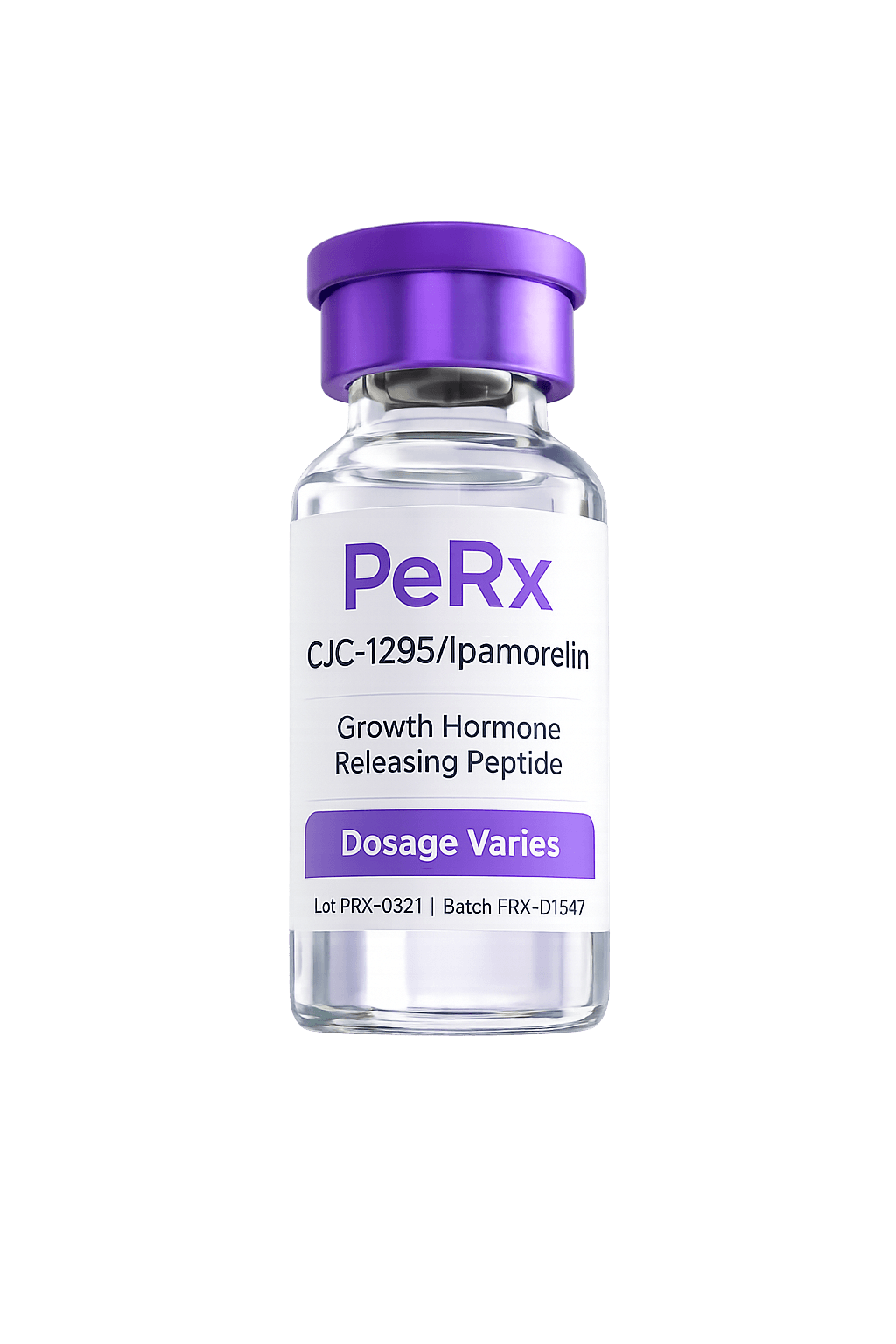
Your PeRx provider prescribes the protocol, and the label on your vial is the final word on dose. The dosage chart converts syringe units to micrograms, and where to inject CJC-1295/Ipamorelin covers placement. Still deciding among the growth hormone peptides? Start with the sermorelin, ipamorelin, and tesamorelin comparison.
CJC-1295: Common Questions
Related Guides
Continue reading about peptides and protocols that pair well with this guide.
CJC-1295 Ipamorelin: The Complete Guide
CJC-1295 Ipamorelin pairs a GHRH signal that primes growth hormone release with a clean pulse trigger that fires it. After age 30, your body produces roughly 15% less growth hormone every decade. This stack doesn't replace what you've lost with synthetic hormones. It tells your body to start making more of its own again. Together, the two peptides form the most popular growth hormone optimization protocol in peptide therapy.
Is CJC-1295/Ipamorelin FDA Approved? (2026 Answer)
The short answer is no. CJC-1295 and Ipamorelin are not FDA-approved drugs. They are compounded medications, prescribed by licensed providers and prepared by regulated pharmacies. Here is what that actually means for you, how it compares to FDA-approved peptides, and why the distinction matters less than most people think.
MOTS-c and Semaglutide: Can You Combine Them?
Ask this question online and you get two kinds of answers. Retail sites say yes and quote fat-loss percentages that do not exist anywhere in the literature. Cautious sites say nothing has been studied and stop there. Both halves are doing part of the job. This page does the whole thing: what is actually known, including the analog trial almost nobody mentions, and how a prescribing clinic thinks about the combination in practice.
Soule S, King JA, Millar RP. "Incorporation of D-Ala2 in growth hormone-releasing hormone-(1-29)-NH2 increases the half-life and decreases metabolic clearance in normal men." Journal of Clinical Endocrinology and Metabolism. 1994;79(4):1208-11. View study
Ready to get started?
Pharmaceutical-grade CJC-1295/Ipamorelin, the no-DAC form in one ready-to-use vial, delivered to your door with everything you need.
Medical Disclaimer
The information provided on this website, including all articles, guides, and educational content, is for informational and educational purposes only and is not intended as medical advice, diagnosis, or treatment. Nothing on this site should be construed as a substitute for professional medical advice from a qualified healthcare provider.
The majority of peptides discussed on this site are not approved by the U.S. Food and Drug Administration (FDA) for the indications described. They are classified as bulk drug substances and are available only through a licensed prescribing provider and compounding pharmacy. All treatments require a valid prescription and provider oversight.
The majority of published research on peptide therapies has been conducted in preclinical (animal) models. While early human data is encouraging, comprehensive clinical trial data remains limited for most peptide compounds. Individual results may vary significantly based on health status, injury type, and other factors. No specific outcomes are guaranteed.
Certain peptides discussed on this site are classified as prohibited substances by the World Anti-Doping Agency (WADA) and are banned by major sports organizations including the NFL, NCAA, UFC, NBA, MLB, NHL, and PGA. If you are subject to anti-doping testing, consult your governing body before considering any peptide therapy.
Statements on this website have not been evaluated by the Food and Drug Administration. Products and therapies discussed are not intended to diagnose, treat, cure, or prevent any disease.
© 2026 Wellness MD Group PC DBA PeRx. All rights reserved.