Ipamorelin Peptide: What It Does, Doses, Evidence
Ipamorelin is a five-amino-acid peptide that tells the pituitary to release a pulse of growth hormone. Its reputation rests on one word, selective, and that word traces back to a 1998 experiment in pigs. The human record is narrower than most pages admit: one dosing study by IV infusion and a surgical program that failed. This guide covers what ipamorelin does, where the dose numbers online come from, what FDA reviewers concluded in 2024, and why we only prescribe it paired.
In this article
Key Takeaways
- Ipamorelin is a synthetic five-amino-acid peptide from Novo Nordisk, first described in 1998. It activates the ghrelin receptor so the pituitary releases a pulse of its own growth hormone. It is not growth hormone and it is not a steroid.
- The "selective" label comes from a pig study. ACTH and cortisol did not rise even at more than 200 times the dose needed to release growth hormone, while GHRP-6 and GHRP-2 raised both. We could not find a published human study that measured cortisol or prolactin after ipamorelin.
- The human record is one IV dosing study in healthy men (half-life about two hours, one GH pulse peaking near 40 minutes) and a Phase 2 program for postoperative ileus that did not beat placebo. FDA reviewers found no human pharmacokinetic or safety data for the subcutaneous route.
- No trial has tested a subcutaneous ipamorelin dose. The 100 to 300 mcg figures online are clinic and community convention. PeRx publishes no standalone dose: in both of our blends ipamorelin is fixed at 2 mg/mL, which is 20 mcg per syringe unit, and your label sets the units.
- PeRx prescribes ipamorelin only paired, as CJC-1295/Ipamorelin or Tesamorelin/Ipamorelin, each $299 per month by subcutaneous injection. Tesamorelin vs Ipamorelin explains why those two belong in one vial rather than on a shortlist. The synergy between the two growth hormone pathways was shown in men with GHRP-6, not with ipamorelin itself.
- Ipamorelin is not FDA-approved. The FDA placed ipamorelin acetate in Category 2 in September 2023, and on October 29, 2024 its advisory committee voted 0 in favor, 12 against, with 1 abstention on adding either form to the 503A compounding list. WADA prohibits it at all times under S2.2.4.
Ipamorelin Quick Facts
Full Name
Ipamorelin (Aib-His-D-2-Nal-D-Phe-Lys-NH2), a synthetic pentapeptide
Type
Growth hormone secretagogue; ghrelin receptor (GHS-R1a) agonist
Origin
Novo Nordisk, Denmark; first described in 1998
Primary Mechanism
Activates the ghrelin receptor so the pituitary releases a pulse of its own GH
Primary Uses
Studied for GH release and postoperative ileus; used for body composition, recovery, sleep
At PeRx
Only inside two blends, CJC-1295/Ipamorelin and Tesamorelin/Ipamorelin, subcutaneous
What Is Ipamorelin?
Ipamorelin is a lab-made peptide five amino acids long. It belongs to a family called growth hormone secretagogues, compounds that prompt the pituitary gland to release growth hormone it has already made. It is not growth hormone and it is not a steroid. It copies one action of ghrelin, the stomach hormone best known for hunger, which also happens to be one of the two main signals behind a growth hormone pulse.
It came out of Novo Nordisk in Denmark. In the 1990s its chemists started from an older compound named GHRP-1 and removed pieces to see what still worked. Dropping the two amino acids in the middle left a pentapeptide that released growth hormone about as strongly as GHRP-6, the reference compound of the day. Raun and colleagues published it in 1998 under a title that became its sales pitch: the first selective growth hormone secretagogue.
Raun K, Hansen BS, Johansen NL, et al. "Ipamorelin, the first selective growth hormone secretagogue." European Journal of Endocrinology. 1998;139(5):552-61. Cell, rat, and pig data. View study
Novo Nordisk never brought it to market. The molecule resurfaced a decade later under a different sponsor, Helsinn Therapeutics, for a different job entirely: restarting the gut after bowel surgery. Nearly all of the human exposure comes from that program.
How Ipamorelin Works
Growth hormone release runs on two accelerators and a brake. One accelerator is growth hormone-releasing hormone (GHRH), which tells pituitary cells to make and release GH. The other is the ghrelin receptor, which triggers release through a separate pathway. The brake is somatostatin. Ipamorelin presses the second accelerator. Using blockers of each receptor, the Novo Nordisk team showed it works through the same receptor as GHRP-6 and not through the GHRH receptor.
How Ipamorelin Works
Four things that define how ipamorelin behaves
Ghrelin Receptor Signal
Binds GHS-R1a, the receptor ghrelin uses, and prompts the pituitary to release stored GH.
One Pulse, Then Gone
In healthy men, GH peaked about 40 minutes after an IV dose and was near baseline by six hours.
Narrow Hormone Footprint
In pigs, ACTH and cortisol did not rise even at more than 200 times the GH-releasing dose.
Feedback Stays On
Somatostatin and IGF-1 still limit how much GH the gland releases, unlike injected HGH.
The growth hormone it releases travels to the liver, which answers with IGF-1, the slower, steadier hormone behind most of what gets attributed to growth hormone. IGF-1 is also why this whole class carries cautions around blood sugar and cancer history. How a secretagogue differs from injecting the hormone itself is covered in peptides vs HGH.
What "Selective" Actually Means
Every ipamorelin page uses the word selective. Few say in which animal. The older secretagogues, GHRP-6 and GHRP-2, released growth hormone but also pushed up ACTH and cortisol, the stress-hormone axis. In conscious pigs, ipamorelin did not. ACTH and cortisol after ipamorelin looked no different from what GHRH itself produced, and that held at doses more than 200 times the dose needed for a half-maximal GH response.
| Ipamorelin | GHRP-6 | GHRP-2 | |
|---|---|---|---|
| GH-releasing potency in pigs (ED50) | 2.3 nmol/kg | 3.9 nmol/kg | 0.6 nmol/kg |
| ACTH and cortisol in pigs | No rise beyond GHRH, even past 200 times the GH dose | Raised | Raised |
| Prolactin, FSH, LH, TSH in pigs | Unchanged | Unchanged | Unchanged |
| Cortisol measured in humans | Not reported in the published human studies | Cortisol and prolactin roughly doubled at the top dose in 18 men (Bowers 1990) | Not reviewed here |
GH-releasing potency in pigs (ED50)
- Ipamorelin
- 2.3 nmol/kg
- GHRP-6
- 3.9 nmol/kg
- GHRP-2
- 0.6 nmol/kg
ACTH and cortisol in pigs
- Ipamorelin
- No rise beyond GHRH, even past 200 times the GH dose
- GHRP-6
- Raised
- GHRP-2
- Raised
Prolactin, FSH, LH, TSH in pigs
- Ipamorelin
- Unchanged
- GHRP-6
- Unchanged
- GHRP-2
- Unchanged
Cortisol measured in humans
- Ipamorelin
- Not reported in the published human studies
- GHRP-6
- Cortisol and prolactin roughly doubled at the top dose in 18 men (Bowers 1990)
- GHRP-2
- Not reviewed here
Two details get lost in the retelling. The first is prolactin. It is routinely listed as something ipamorelin avoids, yet in that pig study none of the three compounds moved prolactin, so it was never what set ipamorelin apart. The second is the species. We could not find a published human study that measured cortisol or prolactin after ipamorelin. Selectivity in people is a reasonable expectation from the animal work. It is not a measured result.
The Appetite Claim
Pages that promise ipamorelin "does not raise appetite" are describing an absence of data. Ipamorelin activates the receptor of the hunger hormone. In a rat model of postoperative ileus, repeated dosing increased food intake and body weight gain, and in a separate 12-week rat study the animals on ipamorelin gained weight. Appetite has never been measured in a human ipamorelin study, so some hunger after a dose is plausible and so is none.
Venkova K, Mann W, Nelson R, Greenwood-Van Meerveld B. "Efficacy of ipamorelin, a novel ghrelin mimetic, in a rodent model of postoperative ileus." Journal of Pharmacology and Experimental Therapeutics. 2009;329(3):1110-6. Rat study. View study
What the Human Research Actually Shows
Here is the whole published human record as FDA reviewers found it in 2024: one dosing study in healthy men and one trial in surgical patients, both by IV infusion. No published human study has given ipamorelin under the skin, the way every clinic prescribes it, and no trial has measured muscle, fat, sleep, or recovery.
The dosing study came from Novo Nordisk and the University at Buffalo. Healthy men received one of five doses as a 15-minute IV infusion, eight volunteers at each level. Ipamorelin behaved predictably. Blood levels rose in proportion to dose, the terminal half-life was about two hours, and growth hormone came out as a single episode that peaked around 40 minutes and then fell away. FDA reviewers reading the same paper noted that GH was back to very low levels by six hours at every dose.
Gobburu JV, Agersø H, Jusko WJ, Ynddal L. "Pharmacokinetic-pharmacodynamic modeling of ipamorelin, a growth hormone releasing peptide, in human volunteers." Pharmaceutical Research. 1999;16(9):1412-6. Healthy men, IV infusion. View study
Then came the surgical program. Ghrelin-receptor drugs speed up the gut, and after bowel surgery the gut often stalls for days, a problem called postoperative ileus. Helsinn ran a Phase 2 trial in 117 adults having bowel resections, giving 0.03 mg per kilogram by IV twice a day for up to a week. It did not work. Patients on ipamorelin tolerated a solid meal at a median of 25.3 hours against 32.6 hours on placebo, a gap that was not statistically significant, and no secondary measure separated the groups. A larger dose-finding trial, registered with 320 patients, is marked completed with no results posted to ClinicalTrials.gov, and FDA reviewers wrote that development was reportedly discontinued.
Beck DE, Sweeney WB, McCarter MD; Ipamorelin 201 Study Group. "Prospective, randomized, controlled, proof-of-concept study of the Ghrelin mimetic ipamorelin for the management of postoperative ileus in bowel resection patients." International Journal of Colorectal Disease. 2014;29(12):1527-34. View study
What FDA Reviewers Added
That failed program is still the largest body of human safety data ipamorelin has. The authors called the drug well tolerated, with adverse events in 87.5 percent of the ipamorelin group and 94.8 percent on placebo. Going through the same paper in 2024, FDA staff pulled out what the summary left in the tables. Low potassium occurred in 12.5 percent of patients on ipamorelin against 3.4 percent on placebo. Insomnia ran 10.7 percent against 5.2. High blood sugar at discharge ran 14.3 percent against 8.6. Two patients in the ipamorelin group died, both after colon cancer surgery complicated by a leak at the surgical join. Reviewers wrote that it is unclear whether the deaths were drug-related, and that their occurrence, together with the potassium and glucose findings, "raises safety concerns about the use of ipamorelin in compounding." These were surgical inpatients on about 2 mg per IV dose, a very different setting from a healthy adult taking a fraction of that under the skin. It is also the only controlled safety data there is.
US Food and Drug Administration. "FDA Briefing Document: Ipamorelin-Related Bulk Drug Substances (Ipamorelin (free base) and Ipamorelin acetate)." Pharmacy Compounding Advisory Committee meeting, October 29, 2024. View study
Ipamorelin Doses: What Studies Used vs What Gets Prescribed
Most searches about ipamorelin are dose searches, so here is the uncomfortable part. No published human study has tested a subcutaneous ipamorelin dose, and FDA reviewers found no pharmacokinetic information for that route. The numbers in circulation have very different pedigrees.
| Source | Route and dose | Who received it | What it tells you |
|---|---|---|---|
| Gobburu 1999 dosing study | IV over 15 minutes, once; 4.21 to 140.45 nmol/kg, roughly 3 to 100 mcg per kg | Healthy men | Half-life and the shape of the GH pulse |
| Beck 2014 Phase 2 trial | IV, 0.03 mg/kg twice daily for up to 7 days | Adults after bowel resection | Short-term tolerability at high IV doses. No efficacy |
| Online protocols | Subcutaneous, commonly 100 to 300 mcg, one to three times a day | Clinic patients and self-experimenters | Convention. One widely read guide calls its own schedule community-derived |
| PeRx blend vials | Subcutaneous; 20 mcg of ipamorelin in each syringe unit | Patients with an approved prescription | The units on your label are your dose |
Gobburu 1999 dosing study
- Route and dose
- IV over 15 minutes, once; 4.21 to 140.45 nmol/kg, roughly 3 to 100 mcg per kg
- Who received it
- Healthy men
- What it tells you
- Half-life and the shape of the GH pulse
Beck 2014 Phase 2 trial
- Route and dose
- IV, 0.03 mg/kg twice daily for up to 7 days
- Who received it
- Adults after bowel resection
- What it tells you
- Short-term tolerability at high IV doses. No efficacy
Online protocols
- Route and dose
- Subcutaneous, commonly 100 to 300 mcg, one to three times a day
- Who received it
- Clinic patients and self-experimenters
- What it tells you
- Convention. One widely read guide calls its own schedule community-derived
PeRx blend vials
- Route and dose
- Subcutaneous; 20 mcg of ipamorelin in each syringe unit
- Who received it
- Patients with an approved prescription
- What it tells you
- The units on your label are your dose
So how much ipamorelin per day? We do not publish a standalone ipamorelin dose, because we do not prescribe standalone ipamorelin. In both of our blends the pharmacy fixes ipamorelin at 2 mg per mL, which works out to 20 mcg in every unit on a U-100 insulin syringe. The partner peptide rides along in a fixed ratio, so a single draw sets both doses.
Ipamorelin in a PeRx Blend Vial
Concentration
2 mg/mL in both blends, 5 mL vial
Per syringe unit
20 mcg of ipamorelin (U-100 insulin syringe)
10 units
200 mcg of ipamorelin
15 units
300 mcg of ipamorelin
Your dose
The number of units printed on your prescription label
Your PeRx provider prescribes the protocol, and the label is the final word. The CJC-1295/Ipamorelin dosage chart has the full unit-by-unit conversion for that blend, with timing around food and sleep.
Ipamorelin Benefits: What Is Claimed vs What Is Shown
Ipamorelin benefit lists are growth hormone benefit lists with a different name on top. Ipamorelin raises GH, GH does certain things, so ipamorelin is assumed to do them. Only the first link has been measured.
| Claim | What supports it | Evidence tier |
|---|---|---|
| Raises growth hormone | Single IV doses produced a clear GH pulse in healthy men | Human study, IV route |
| Leaner body, less belly fat | No ipamorelin study has measured fat or muscle | Inferred from GH physiology |
| Stronger bones | Rats gained bone mineral over 12 weeks in step with gaining body weight. Bone density by volume did not change | Animal |
| Deeper sleep, recovery, skin | Patient reports. Never measured in an ipamorelin study | Anecdote |
Raises growth hormone
- What supports it
- Single IV doses produced a clear GH pulse in healthy men
- Evidence tier
- Human study, IV route
Leaner body, less belly fat
- What supports it
- No ipamorelin study has measured fat or muscle
- Evidence tier
- Inferred from GH physiology
Stronger bones
- What supports it
- Rats gained bone mineral over 12 weeks in step with gaining body weight. Bone density by volume did not change
- Evidence tier
- Animal
Deeper sleep, recovery, skin
- What supports it
- Patient reports. Never measured in an ipamorelin study
- Evidence tier
- Anecdote
Svensson J, Lall S, Dickson SL, et al. "The GH secretagogues ipamorelin and GH-releasing peptide-6 increase bone mineral content in adult female rats." Journal of Endocrinology. 2000;165(3):569-77. Rat study. View study
Ipamorelin has been shown to do one thing in humans, which is release a pulse of growth hormone. Everything past that is borrowed, and borrowed does not mean false. What is missing is any measure of how large the effects are or how many people get them. For what realistic change looks like with the paired product, see the CJC-1295/Ipamorelin guide.
Why We Only Prescribe Ipamorelin Paired
If you came here hoping to buy ipamorelin alone, we do not carry it. The reason is physiological. A ghrelin-receptor agonist triggers release, but how much growth hormone is ready to be released depends on the GHRH signal. Work one accelerator and you get a pulse. Work both and the pulse is larger than the two added together.
The evidence for that synergy is real, and it comes with a caveat. In 1990 Bowers and colleagues gave 18 healthy men a growth hormone-releasing peptide, GHRH, or both. Low doses of the two together released more growth hormone than the sum of each alone. The peptide in that study was GHRP-6, ipamorelin's predecessor at the same receptor. No published human study has tested ipamorelin alongside a GHRH analog, so the pairing rests on a shared mechanism and on clinical experience.
Bowers CY, Reynolds GA, Durham D, Barrera CM, Pezzoli SS, Thorner MO. "Growth hormone (GH)-releasing peptide stimulates GH release in normal men and acts synergistically with GH-releasing hormone." Journal of Clinical Endocrinology and Metabolism. 1990;70(4):975-82. Study of GHRP-6, not ipamorelin. View study
We offer two pairings. CJC-1295/Ipamorelin uses the short-acting, no-DAC form of CJC-1295 as the GHRH half, a choice explained in our CJC-1295 guide and in why we pair the two. Tesamorelin/Ipamorelin swaps in tesamorelin, the GHRH analog with Phase 3 trials behind it for abdominal fat in HIV-associated lipodystrophy. For the single-pathway alternative, see ipamorelin vs sermorelin.
Ideal for
Adults with body composition, recovery, or sleep goals who are comfortable with a subcutaneous injection, want both growth hormone pathways in one labeled pharmacy vial, and accept that support for ipamorelin rests on mechanism and clinical experience more than on trials.
Consider alternatives if
If you want one peptide with a long clinical history, look at sermorelin. If visceral fat is the specific target, tesamorelin has the trial data. Athletes under anti-doping rules cannot use ipamorelin. Pregnancy, breastfeeding, and active or recent cancer are exclusions at screening, and diabetes or prediabetes belongs on your intake.
Safety and Screening
Day to day, people report the effects that follow from more growth hormone: water retention, tingling or puffy hands, mild headache, and sometimes hunger shortly after a dose. FDA reviewers noted that nothing shows ipamorelin is free of the risks printed on approved growth hormone products, glucose intolerance and fluid retention among them. The blood sugar readings in the surgical trial fit that pattern.
Three unknowns get taken seriously at screening. FDA found no published genotoxicity, reproductive, or carcinogenicity studies of ipamorelin, and called the animal toxicity work that does exist too limited in scope and duration to inform safety. That is why active or recent cancer excludes you, as it does for every peptide that raises GH and IGF-1, and why pregnancy and breastfeeding do too. Separately, because ghrelin receptors also sit in the brain's reward circuits, FDA pharmacologists raised the theoretical possibility of reinforcing effects while noting that no study has shown it. The agency's adverse event database held two non-serious reports through September 2023, which says more about how rarely compounded products get reported than about safety.
FDA and Anti-Doping Status
The Regulatory Picture, September 2026
Ipamorelin is not an FDA-approved drug for any use. On September 29, 2023, the FDA placed ipamorelin acetate in Category 2 of its interim compounding lists, the group flagged for potential significant safety risks. Its stated reasons were possible immune reactions from peptide aggregation or impurities, the difficulty of characterizing a peptide built with unnatural amino acids, and the surgical trial, summarized as "serious adverse events including death when ipamorelin was administered intravenously for improving gastric motility." The companies that had nominated ipamorelin for pharmacy compounding under section 503A later withdrew, which took it off that list, and the agency reviewed it anyway. On October 29, 2024, the Pharmacy Compounding Advisory Committee voted on whether each form should be added to the list of substances 503A pharmacies may compound. The result was 0 in favor, 12 against, and 1 abstention, for ipamorelin free base and again for ipamorelin acetate. The votes are advisory and do not bind the agency.
Where that leaves things: the FDA category document updated May 14, 2026 lists ipamorelin in no 503A category at all, while ipamorelin acetate remains in Category 2 for 503B outsourcing facilities. Its status for pharmacy compounding is unsettled, and we would rather say so plainly. Ipamorelin was not part of the April 2026 action on twelve other peptides and was not on the July 2026 committee agenda. CJC-1295 went through the same process five weeks later with a similar outcome, covered in our CJC-1295 guide. Related reading: is CJC-1295/Ipamorelin FDA approved.
US Food and Drug Administration. Summary minutes, Pharmacy Compounding Advisory Committee meeting, October 29, 2024. View study
Anti-doping is clear-cut. The 2026 World Anti-Doping Agency Prohibited List names ipamorelin in section S2.2.4 among the growth hormone secretagogues, next to ibutamoren (MK-677) and ghrelin itself, prohibited at all times. If you compete under WADA, USADA, or a league policy built on that list, ipamorelin is not an option in any blend. Peptide therapy for athletes covers what is and is not permitted.
How to Get Ipamorelin
Ipamorelin reaches people through two channels. Research-chemical sites sell it marked not for human use, with no prescription and no check on what is in the vial. The prescription route runs through a health intake, review by a licensed provider, and a labeled vial from a US 503A compounding pharmacy. Research peptides vs prescription peptides covers the gap between the two.
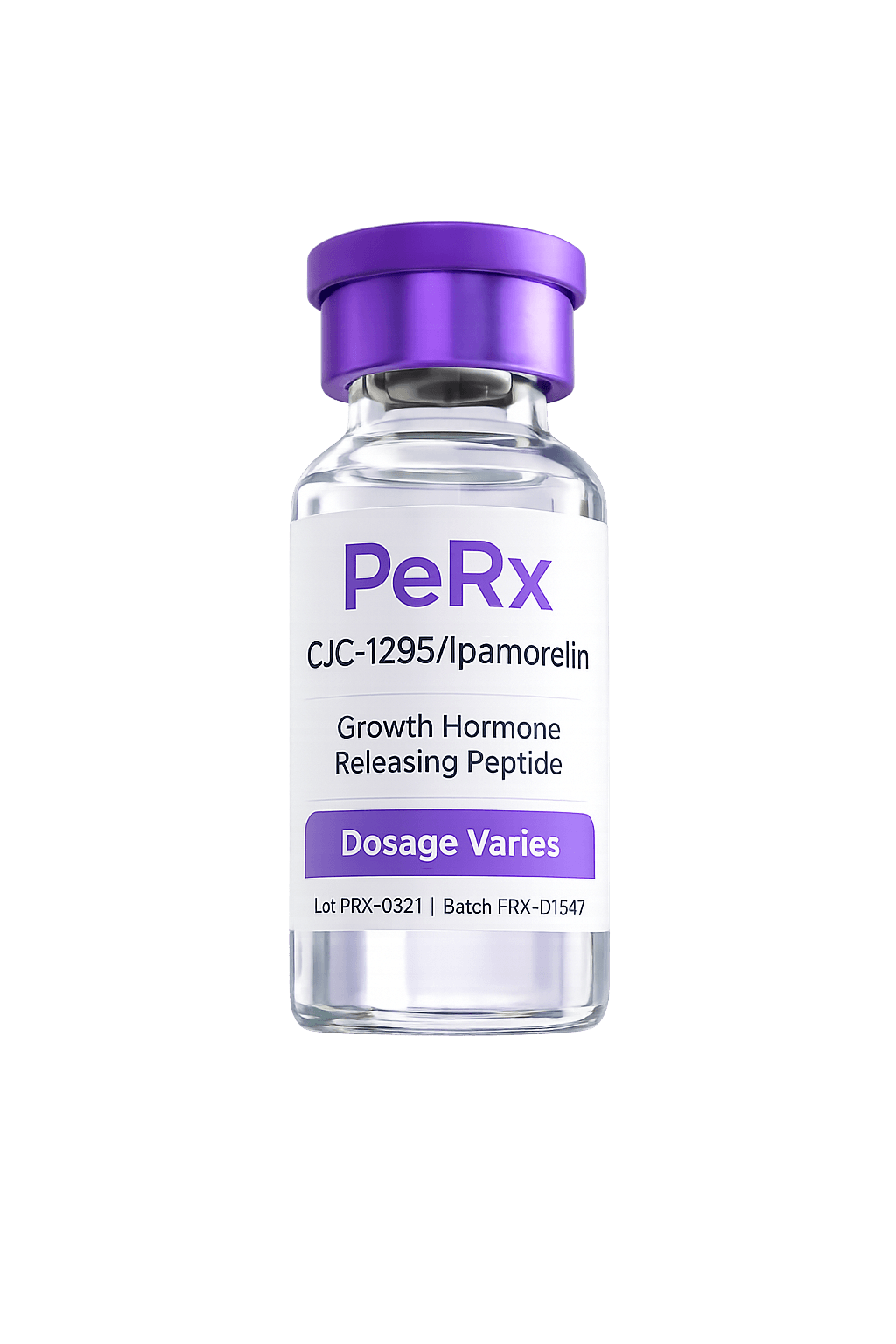
CJC-1295/Ipamorelin
No-DAC CJC-1295 at 1.2 mg/mL with ipamorelin at 2 mg/mL in one 5 mL vial, taken as a single evening injection under the skin. From $299 for a one-month supply.
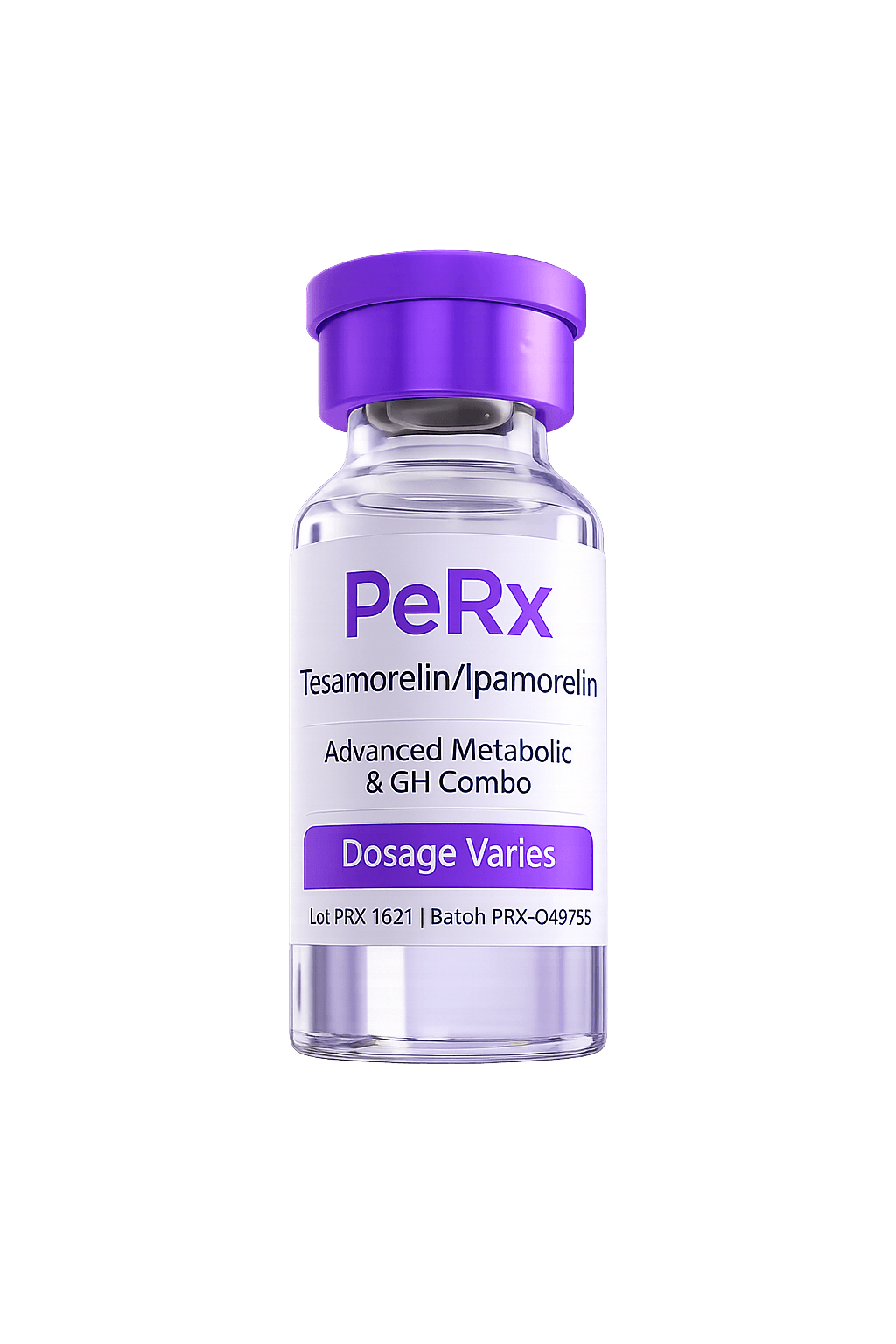
Tesamorelin/Ipamorelin
Tesamorelin at 3 mg/mL with ipamorelin at 2 mg/mL in one 5 mL vial, the pairing built around the GHRH analog studied for abdominal fat. From $299 for a one-month supply.
Both vials ship fully reconstituted and ready to use, in cold packaging, with insulin syringes and alcohol swabs included. Nothing is charged at checkout. The card on file is billed only after a provider approves the prescription. See where to inject CJC-1295/Ipamorelin for technique, or the sermorelin, ipamorelin, and tesamorelin comparison if you are still choosing.
Ipamorelin: Common Questions
Related Guides
Continue reading about peptides and protocols that pair well with this guide.
Is CJC-1295/Ipamorelin FDA Approved? (2026 Answer)
The short answer is no. CJC-1295 and Ipamorelin are not FDA-approved drugs. They are compounded medications, prescribed by licensed providers and prepared by regulated pharmacies. Here is what that actually means for you, how it compares to FDA-approved peptides, and why the distinction matters less than most people think.
CJC-1295 Ipamorelin: The Complete Guide
CJC-1295 Ipamorelin pairs a GHRH signal that primes growth hormone release with a clean pulse trigger that fires it. After age 30, your body produces roughly 15% less growth hormone every decade. This stack doesn't replace what you've lost with synthetic hormones. It tells your body to start making more of its own again. Together, the two peptides form the most popular growth hormone optimization protocol in peptide therapy.
FDA-Approved Peptides: The Full List (2026)
Peptide drugs have been FDA-approved for over forty years, from recombinant insulin in 1982 to tirzepatide in 2022. Most of the peptides people actually search for, though, are not on that list. This guide lays out every FDA-approved peptide drug with its brand names and approval year, explains the difference between an approved drug, a compounded medication, and a research chemical, and covers where the 2026 FDA compounding review left peptides like BPC-157. Current as of August 2026.
Frieboes RM, Antonijevic IA, Held K, et al. "Hexarelin decreases slow-wave sleep and stimulates the secretion of GH, ACTH, cortisol and prolactin during sleep in healthy volunteers." Psychoneuroendocrinology. 2004;29(7):851-60. Study of hexarelin, not ipamorelin. View study
Ready to get started?
Pharmaceutical-grade ipamorelin, paired with CJC-1295 or tesamorelin in one ready-to-use vial, delivered to your door with everything you need.
Medical Disclaimer
The information provided on this website, including all articles, guides, and educational content, is for informational and educational purposes only and is not intended as medical advice, diagnosis, or treatment. Nothing on this site should be construed as a substitute for professional medical advice from a qualified healthcare provider.
The majority of peptides discussed on this site are not approved by the U.S. Food and Drug Administration (FDA) for the indications described. They are classified as bulk drug substances and are available only through a licensed prescribing provider and compounding pharmacy. All treatments require a valid prescription and provider oversight.
The majority of published research on peptide therapies has been conducted in preclinical (animal) models. While early human data is encouraging, comprehensive clinical trial data remains limited for most peptide compounds. Individual results may vary significantly based on health status, injury type, and other factors. No specific outcomes are guaranteed.
Certain peptides discussed on this site are classified as prohibited substances by the World Anti-Doping Agency (WADA) and are banned by major sports organizations including the NFL, NCAA, UFC, NBA, MLB, NHL, and PGA. If you are subject to anti-doping testing, consult your governing body before considering any peptide therapy.
Statements on this website have not been evaluated by the Food and Drug Administration. Products and therapies discussed are not intended to diagnose, treat, cure, or prevent any disease.
© 2026 Wellness MD Group PC DBA PeRx. All rights reserved.