Compounded Semaglutide vs Ozempic: What Is Different
They share one active ingredient and almost nothing else. Ozempic is an FDA-approved pen made by Novo Nordisk; compounded semaglutide is prepared by a pharmacy for one patient, usually in a vial, and has never been through FDA review. This page sets the two side by side, gives the FDA position with dates, and explains how prescribing works at PeRx.

In this article
Key Takeaways
- Ozempic and compounded semaglutide are meant to contain the same active ingredient, semaglutide. Beyond that they are different products: one is FDA-approved and factory-made, the other is prepared by a pharmacy and has never been reviewed or tested in a clinical trial.
- Ozempic is approved for type 2 diabetes and for lowering cardiovascular and kidney risks in people who have it. It is not approved for weight loss; Wegovy is the approved semaglutide product for weight management.
- Since the semaglutide shortage ended in February 2025, a compounded version that is essentially a copy of an approved product is restricted. The FDA has said a semaglutide plus vitamin B12 product can still be a copy, and that a prescriber documenting a significant difference for an individual patient is how the law treats a product that is not.
- At PeRx, compounded semaglutide with vitamin B12 is prescribed after a provider review, compounded from semaglutide base by a state-licensed 503A pharmacy, and listed on the public pricing page. It is compounded, not an FDA-approved drug.
Compounded Semaglutide vs Ozempic: Quick Facts
Same active ingredient
Both are meant to contain semaglutide. Compounded versions must be made from semaglutide base; the FDA says the sodium and acetate salts are different ingredients.
Who makes it
Ozempic: Novo Nordisk, in FDA-reviewed manufacturing. Compounded: a licensed pharmacy, per prescription, for one named patient.
FDA status
Ozempic is an FDA-approved drug. Compounded semaglutide is not FDA-approved and has not been reviewed for safety, effectiveness or quality.
Approved uses
Ozempic: type 2 diabetes, plus cardiovascular and kidney risk reduction in people with it. Not weight loss. Compounded: none; prescribed at a provider’s judgment.
Trial evidence
Ozempic’s approval rests on trials of Ozempic. No clinical trial has tested compounded semaglutide, so equivalence cannot be claimed.
At PeRx
Compounded semaglutide with vitamin B12, from semaglutide base, by a state-licensed 503A pharmacy. $249 per month on the public pricing page. Compounded, not FDA-approved.
If you are weighing compounded semaglutide vs Ozempic, the short answer is this: they are supposed to share one active ingredient, semaglutide, and they are otherwise different products. Ozempic is an FDA-approved prefilled pen made by Novo Nordisk under a reviewed manufacturing process. Compounded semaglutide is prepared by a pharmacy for an individual patient, usually supplied in a vial, and it is not FDA-approved, has not been tested in a clinical trial, and sits under a set of compounding rules that have changed more than once since 2025. The rest of this page lays out exactly where the two part ways, what the FDA currently says, and how a compounded prescription works at PeRx.
FDA compounding status checked on November 23, 2026
Every regulatory statement on this page comes from an FDA page read on the date above, cited in the references with the date the FDA marks it current. Compounding rules change; if you are reading this later, check the FDA pages linked at the end before relying on a date.
Compounded Semaglutide vs Ozempic: Side by Side
| Ozempic | Compounded semaglutide | |
|---|---|---|
| Active ingredient | Semaglutide, the molecule Novo Nordisk manufactures, in the base form. | Semaglutide. The FDA says it must be the base form; semaglutide sodium and semaglutide acetate are different active ingredients with no lawful basis for use. PeRx’s pharmacy compounds from semaglutide base. |
| Who makes it | Novo Nordisk, in manufacturing the FDA reviewed and inspects. | A licensed pharmacy, one prescription at a time, for a named patient. At PeRx, a state-licensed 503A pharmacy. |
| FDA status | FDA-approved drug. | Not FDA-approved. The FDA does not review compounded drugs for safety, effectiveness or quality before they are dispensed. |
| Approved uses | Glycemic control in adults with type 2 diabetes; lowering the risk of major cardiovascular events in adults with type 2 diabetes and established cardiovascular disease; lowering the risk of kidney decline and cardiovascular death in adults with type 2 diabetes and chronic kidney disease. Not approved for weight loss. | None. A provider prescribes it at their own judgment; at telehealth services the usual purpose is weight management. |
| Form and delivery | A prefilled, multi-dose pen that dials the dose, with a new pen needle for each weekly injection. | Usually a vial that is drawn up with a syringe. At PeRx the vial ships fully reconstituted and ready to use, with syringes and swabs in the box. |
| Other ingredients | Semaglutide plus the inactive ingredients listed on the label. | Varies by pharmacy. Some add vitamin B12. The FDA has said a semaglutide plus B12 product can still be essentially a copy of the approved drug. PeRx’s product contains B12. |
| Quality oversight | FDA approval of the product and its manufacturing, with ongoing inspection. | State board of pharmacy licensing. The FDA does not test batches. PeRx’s pharmacy tests each lot for potency, sterility, endotoxins and pH, and a sample certificate is published on the quality testing page. |
| Clinical trial evidence | Approval rests on clinical trials of Ozempic itself. | None. No trial has tested a compounded semaglutide product, so neither equivalence nor a difference can be claimed. |
| Availability today | Available at retail and mail-order pharmacies with a prescription. | Restricted since the shortage ended in February 2025. Allowed per patient where the prescriber documents a significant difference from the approved product, or within the discretion the FDA has stated. Status checked November 23, 2026. |
| Monthly cost | List price $1,027.51 per pen at every strength on Novo Nordisk’s list-price page (read November 2026). What a patient pays depends on insurance. | $249 per month at PeRx on the public pricing page, including the provider review, supplies and shipping. Different products, so not a like-for-like comparison. |
Active ingredient
- Ozempic
- Semaglutide, the molecule Novo Nordisk manufactures, in the base form.
- Compounded semaglutide
- Semaglutide. The FDA says it must be the base form; semaglutide sodium and semaglutide acetate are different active ingredients with no lawful basis for use. PeRx’s pharmacy compounds from semaglutide base.
Who makes it
- Ozempic
- Novo Nordisk, in manufacturing the FDA reviewed and inspects.
- Compounded semaglutide
- A licensed pharmacy, one prescription at a time, for a named patient. At PeRx, a state-licensed 503A pharmacy.
FDA status
- Ozempic
- FDA-approved drug.
- Compounded semaglutide
- Not FDA-approved. The FDA does not review compounded drugs for safety, effectiveness or quality before they are dispensed.
Approved uses
- Ozempic
- Glycemic control in adults with type 2 diabetes; lowering the risk of major cardiovascular events in adults with type 2 diabetes and established cardiovascular disease; lowering the risk of kidney decline and cardiovascular death in adults with type 2 diabetes and chronic kidney disease. Not approved for weight loss.
- Compounded semaglutide
- None. A provider prescribes it at their own judgment; at telehealth services the usual purpose is weight management.
Form and delivery
- Ozempic
- A prefilled, multi-dose pen that dials the dose, with a new pen needle for each weekly injection.
- Compounded semaglutide
- Usually a vial that is drawn up with a syringe. At PeRx the vial ships fully reconstituted and ready to use, with syringes and swabs in the box.
Other ingredients
- Ozempic
- Semaglutide plus the inactive ingredients listed on the label.
- Compounded semaglutide
- Varies by pharmacy. Some add vitamin B12. The FDA has said a semaglutide plus B12 product can still be essentially a copy of the approved drug. PeRx’s product contains B12.
Quality oversight
- Ozempic
- FDA approval of the product and its manufacturing, with ongoing inspection.
- Compounded semaglutide
- State board of pharmacy licensing. The FDA does not test batches. PeRx’s pharmacy tests each lot for potency, sterility, endotoxins and pH, and a sample certificate is published on the quality testing page.
Clinical trial evidence
- Ozempic
- Approval rests on clinical trials of Ozempic itself.
- Compounded semaglutide
- None. No trial has tested a compounded semaglutide product, so neither equivalence nor a difference can be claimed.
Availability today
- Ozempic
- Available at retail and mail-order pharmacies with a prescription.
- Compounded semaglutide
- Restricted since the shortage ended in February 2025. Allowed per patient where the prescriber documents a significant difference from the approved product, or within the discretion the FDA has stated. Status checked November 23, 2026.
Monthly cost
- Ozempic
- List price $1,027.51 per pen at every strength on Novo Nordisk’s list-price page (read November 2026). What a patient pays depends on insurance.
- Compounded semaglutide
- $249 per month at PeRx on the public pricing page, including the provider review, supplies and shipping. Different products, so not a like-for-like comparison.
Read the table top to bottom and the pattern is consistent: the ingredient is meant to be the same, and everything that gives a drug its guarantees is different. Approval, manufacturing oversight, trial evidence and a standardized dosing device all sit on the Ozempic side. What sits on the compounded side is a licensed pharmacy, a prescriber, state oversight, and whatever testing the pharmacy chooses to do and publish.
What Is the Same
Both products should contain semaglutide, a GLP-1 receptor agonist that lowers blood sugar and appetite by acting on the same receptors the gut hormone GLP-1 acts on. The weight loss peptides page explains the mechanism, so one sentence will do here. Because the molecule is the same, the digestive side effects are expected to be similar in kind: nausea, vomiting, diarrhea, constipation and abdominal discomfort, which our guide to nausea and gut symptoms on GLP-1s covers. The phrase to notice is "should contain." The same ingredient is the goal of a legitimate compounded prescription, not a guarantee that applies to every vial sold under the name, which is why the sourcing and testing questions further down matter.
What Is Different
FDA Approval and Review
Ozempic went through FDA review of its safety, its effectiveness and the way it is manufactured, and it carries an approved label. That label, revised in May 2026, lists three uses: glycemic control in adults with type 2 diabetes, lowering the risk of major cardiovascular events in adults with type 2 diabetes and established heart disease, and lowering the risk of kidney decline and cardiovascular death in adults with type 2 diabetes and chronic kidney disease. Weight loss is not on it. The approved semaglutide product for weight management is Wegovy, a separate product with its own label. Compounded drugs do not go through any of that review, and the FDA does not approve them. A compounded semaglutide prescription is written at a provider’s own clinical judgment.
Manufacturing and Ingredient Form
Ozempic is made in a standardized, inspected factory process. Compounded semaglutide is prepared by a licensed pharmacist from a bulk active ingredient for a specific patient. Two things about that ingredient matter. First, the form: the FDA has warned that some products sold by compounders use semaglutide salts, semaglutide sodium or semaglutide acetate, which it says are different active ingredients from the one in the approved drugs, with no lawful basis for use in compounding. A legitimate compounded product is made from semaglutide base, and PeRx’s pharmacy compounds from semaglutide base. Second, the additives: a number of pharmacies prepare semaglutide together with vitamin B12. The FDA addressed that combination directly in 2026, as the regulatory section below explains, and it does not change the ingredient question; B12 is an added vitamin, not a different drug.
Delivery
Ozempic comes as a prefilled, multi-dose pen that dials the dose, with a fresh pen needle each week. Since January 2026 the Ozempic name also covers an oral semaglutide tablet that shares a label with Rybelsus; this page compares the injection pen. Compounded semaglutide is usually supplied as a vial that the patient draws up with a syringe, which is one reason the FDA has logged dosing errors with compounded products: a vial asks the user to measure. At PeRx the vial ships fully reconstituted and ready to use, with syringes and alcohol swabs in the box, and the strength for each cycle is set by the prescribing provider, with dose steps decided at each renewal check-in rather than left to the patient.
Semaglutide
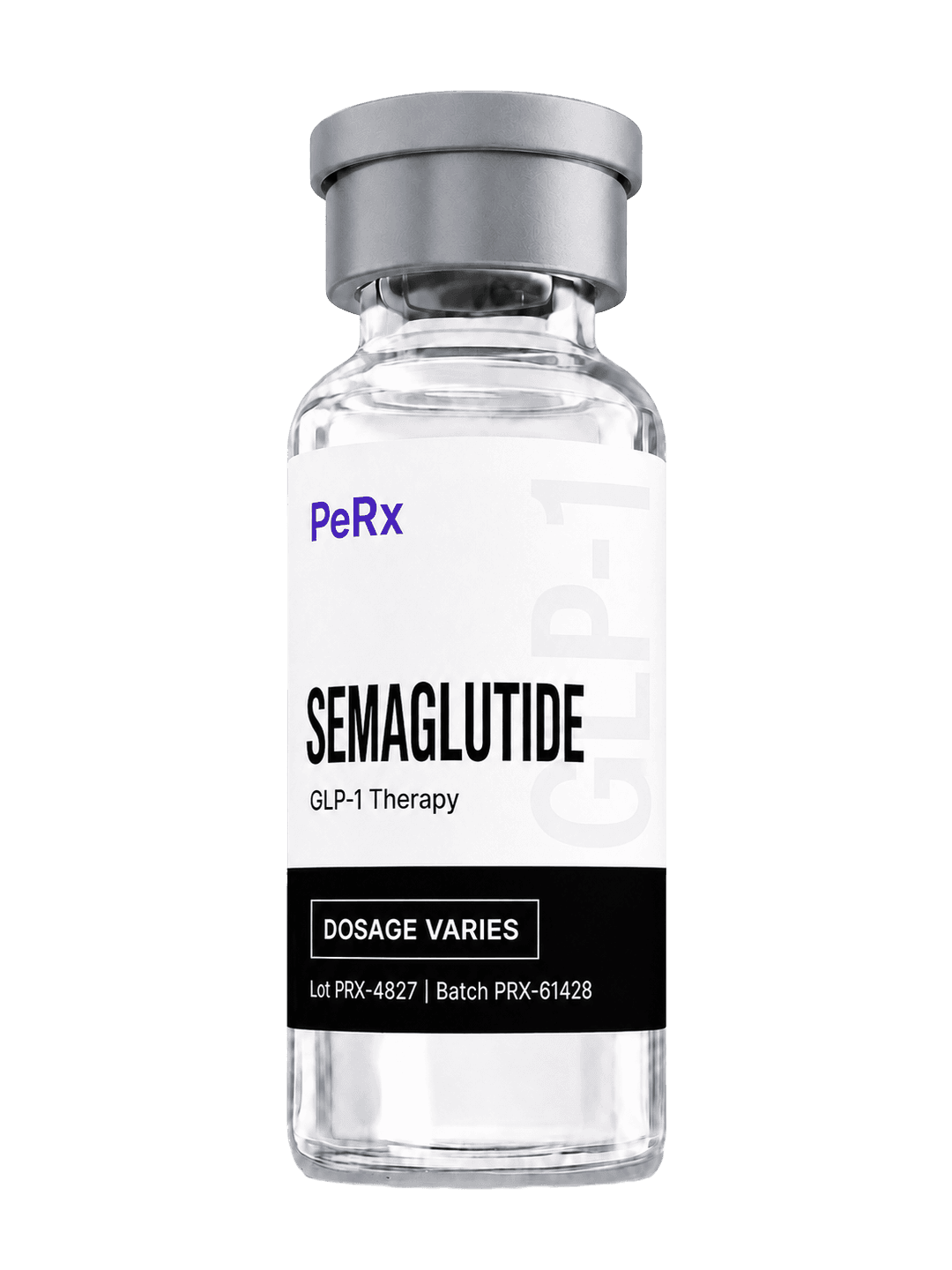
Compounded semaglutide at PeRx is prepared with vitamin B12 from semaglutide base by a state-licensed 503A pharmacy, prescribed by a licensed provider after an eligibility check, and shipped as one ready-to-use vial per 28 days on a renewal you can cancel, pause or skip in one step.
It is compounded, not an FDA-approved drug, and it is not Ozempic or Wegovy. No clinical trial has tested it. The provider decides whether a compounded product is appropriate for you, and for some patients an approved product is the right choice.
Is Compounded Semaglutide Safe?
Here is what is known and what is not. Compounded semaglutide has not been tested in clinical trials, and the FDA does not review its quality before it is dispensed, so there is no product-level safety record to point to. What exists is the FDA’s own account of the problems it has seen. On its page about unapproved GLP-1 drugs, current as of October 1, 2026, the agency reports that as of May 31, 2026 it had received 990 adverse event reports associated with compounded semaglutide and more than 730 associated with compounded tirzepatide. It says many of those reports describe the same kinds of events seen with the approved products, that some were serious and some patients sought medical care for nausea, vomiting, diarrhea, abdominal pain and constipation, and that it cannot tell from the reports how many were caused by the drug. It also notes that state-licensed pharmacies are not required to report adverse events to the FDA, so the compounded numbers are probably an undercount.
The FDA’s specific concerns are concrete and avoidable. Dosing errors, where patients measured and injected the wrong amount from a vial or a professional miscalculated, some of which led to hospital visits. Products made from semaglutide salts rather than the base. Products that arrived warm, outside the recommended storage temperature. Those are sourcing and handling problems, and they point to what reduces risk: a real prescription from a licensed provider who has reviewed your history, a state-licensed pharmacy that compounds from semaglutide base and tests each lot, a strength set by the prescriber rather than measured out by guesswork, and a provider review before every renewal. How PeRx tests its peptides shows what lot testing looks like, and our comparison of gray-market GLP-1s and compounded products explains why "research use only" vials are a different category of risk altogether.
Is Compounded Semaglutide as Effective as Ozempic?
Nobody knows, and anyone who tells you otherwise is guessing. The clinical trials behind semaglutide used Novo Nordisk’s products, and no compounded version has been studied, so equivalence cannot be claimed in either direction. A compounded product that contains the stated amount of semaglutide base would be expected to act like semaglutide, but "expected" is not "shown," and that is the honest limit of what can be said.
Compounded Semaglutide: FDA Status and Availability
Compounded semaglutide became widely available because Ozempic and Wegovy were on the FDA’s drug shortage list, and a drug on that list may be compounded in quantity. The timeline since then, taken from the FDA’s own compounding statement (content current as of April 1, 2026), runs as follows. On February 21, 2025 the FDA determined the shortage of semaglutide injection products was resolved. It then gave compounders a wind-down period: state-licensed pharmacies and physicians compounding under section 503A had until April 22, 2025, and outsourcing facilities under section 503B until May 22, 2025. Both periods have ended. Since then, a compounded drug that is essentially a copy of an approved product may not be compounded regularly or in inordinate amounts.
What counts as a copy is where the vitamin B12 question lands. The same FDA statement says the agency may consider a product that combines semaglutide with another ingredient such as vitamin B12 to be essentially a copy when it is given by the same route and the amounts of semaglutide and B12 are within ten percent of the strengths of the respective commercial products. The FDA’s January 2018 guidance on copies uses that same ten percent test for "similar strength." The exception is written into the statute itself: a compounded drug is not a copy if a prescriber makes a change for an identified patient that, in the prescriber’s judgment, produces a significant difference for that patient, and documents it. The FDA has also said it does not intend to act against a compounder that fills four or fewer prescriptions of a given copy product in a calendar month. In September 2026 the agency applied this reasoning in a warning letter to a large compounding pharmacy over a semaglutide and B12 product it said was being compounded regularly and in inordinate amounts.
What this means in plain terms
Compounded semaglutide is not banned and it is not freely available the way it was during the shortage. It is prescribed one patient at a time, and the prescriber’s documented reason for the individual patient is what the law looks at. The rules can change again; this page shows the date it was checked, and the FDA statement is linked in the references. Compounded drugs are never FDA-approved. For the wider legal picture see are peptides legal in 2026 and FDA-approved peptides, and for the pharmacy side, 503A vs 503B pharmacies.
Compounded Semaglutide Online: How Prescribing Works
A legitimate semaglutide online prescription follows a short path. You complete an eligibility check. A licensed provider reviews your history and the conditions that rule a GLP-1 out, such as a personal or family history of medullary thyroid cancer, MEN 2, pregnancy or a history of pancreatitis. If the provider decides a compounded product is appropriate for you and documents why, a state-licensed pharmacy fills the prescription and ships it. The provider reviews again before each renewal, and dose steps are decided at those check-ins. The provider also decides when an approved product is the better choice; for some patients it is. Our guide to getting peptides prescribed online walks through the PeRx version step by step, and semaglutide vs tirzepatide compares the two compounded GLP-1s PeRx offers.
The red flags are the mirror image. No named prescriber. No named, state-licensed pharmacy. A product labeled "research use only," which means it was never meant for a person. A vial with no strength on the label or no instructions on how much to draw. A price that is low because the ingredient is a salt bought for laboratory use. Is it safe to buy peptides online covers how to check each of these.
Cost: Ozempic vs Compounded Semaglutide
Ozempic’s list price is $1,027.51 per pen at every strength, according to Novo Nordisk’s own list-price page as read in November 2026, and what a patient actually pays depends on insurance coverage, which for a weight-management purpose is often none. PeRx’s compounded semaglutide is $249 per month on the pricing page, and that figure includes the provider review, syringes and swabs, and shipping, with no membership fee. The two are different products with different guarantees, so the gap in price is not a measure of value, and our peptide therapy cost guide explains what each kind of figure does and does not include.
Want to know whether a provider would consider compounded semaglutide for you?
New to PeRx: the eligibility check takes about a minute, and a licensed provider reviews every order before a pharmacy fills it. Already a patient: message your care team with questions about your protocol.
Compounded Semaglutide vs Ozempic FAQs
Related Guides
Continue reading about peptides and protocols that pair well with this guide.
What Is Compounded Semaglutide? Is It Safe?
Compounded semaglutide is the same active molecule as Ozempic and Wegovy, prepared by a licensed pharmacy for one named patient instead of manufactured under an FDA approval. That one sentence carries a lot of legal weight. This page unpacks it: what compounding is, how the compounded product differs from the brands, what changed between 2022 and 2026, and what a legitimate prescription looks like from inside a clinic that writes them.
AOD-9604 vs Semaglutide: The Honest Comparison
One of these is a fragment of growth hormone whose obesity program missed its primary endpoint in 2007 and was shelved. The other belongs to the most effective weight loss drug class medicine has produced. Most pages comparing them never mention the first part. This one starts with it, because what the failed trial means, and what it does not mean, is the whole comparison.
BPC-157 Before and After: Realistic Timelines
Nobody has run a controlled human trial of BPC-157 for an injury, so every before-and-after timeline online is an estimate built from rat studies and self-reported recovery. This page lays those estimates out tissue by tissue, tendons, gut, joints and muscle, says what normal healing would be doing in each window anyway, and attaches an evidence label to every claim.
References and Review
FDA statements are cited with the date the FDA marks each page current. The Ozempic facts come from its prescribing information on DailyMed. The page is reviewed by Dr. Cory Mellon, MD, and the compounding status is re-checked on the date shown at the top.
U.S. Food and Drug Administration. FDA clarifies policies for compounders as national GLP-1 supply begins to stabilize. Content current as of April 1, 2026. Accessed November 2026. View study
U.S. Food and Drug Administration. FDA's concerns with unapproved GLP-1 drugs used for weight loss. Content current as of October 1, 2026. Accessed November 2026. View study
U.S. Food and Drug Administration. Compounded drug products that are essentially copies of a commercially available drug product under section 503A of the Federal Food, Drug, and Cosmetic Act: guidance for industry. January 2018. View study
U.S. Food and Drug Administration. Warning letter to a 503A compounding pharmacy regarding semaglutide/cyanocobalamin and tirzepatide products. Dated September 18, 2026. Accessed November 2026. View study
Novo Nordisk. Ozempic (semaglutide) injection prescribing information. DailyMed, label revised May 2026. View study
Novo Nordisk. Ozempic list price and insurance coverage explained. NovoCare. Accessed November 2026. View study
PeRx. Pricing; Quality testing. perxpeptides.com. Accessed November 2026. View study
Medical Disclaimer
The information provided on this website, including all articles, guides, and educational content, is for informational and educational purposes only and is not intended as medical advice, diagnosis, or treatment. Nothing on this site should be construed as a substitute for professional medical advice from a qualified healthcare provider.
The majority of peptides discussed on this site are not approved by the U.S. Food and Drug Administration (FDA) for the indications described. They are classified as bulk drug substances and are available only through a licensed prescribing provider and compounding pharmacy. All treatments require a valid prescription and provider oversight.
The majority of published research on peptide therapies has been conducted in preclinical (animal) models. While early human data is encouraging, comprehensive clinical trial data remains limited for most peptide compounds. Individual results may vary significantly based on health status, injury type, and other factors. No specific outcomes are guaranteed.
Certain peptides discussed on this site are classified as prohibited substances by the World Anti-Doping Agency (WADA) and are banned by major sports organizations including the NFL, NCAA, UFC, NBA, MLB, NHL, and PGA. If you are subject to anti-doping testing, consult your governing body before considering any peptide therapy.
Statements on this website have not been evaluated by the Food and Drug Administration. Products and therapies discussed are not intended to diagnose, treat, cure, or prevent any disease.
© 2026 Wellness MD Group PC DBA PeRx. All rights reserved.