BPC-157 Before and After: Realistic Timelines
Nobody has run a controlled human trial of BPC-157 for an injury, so every before-and-after timeline online is an estimate built from rat studies and self-reported recovery. This page lays those estimates out tissue by tissue, tendons, gut, joints and muscle, says what normal healing would be doing in each window anyway, and attaches an evidence label to every claim.

In this article
Key Takeaways
- Almost all BPC-157 evidence comes from rat injury models. In people, there are three small pilot studies with no control group, no placebo and no blinding, plus one registered phase 1 trial that never posted results.
- What people report arrives in a fixed order: less pain and less post-activity soreness inside the first two weeks, freer movement by week four, better training tolerance by week eight, and slow structural change over months. Pain is the fastest marker and the least reliable one.
- Timelines differ by tissue. Muscle, with its rich blood supply, is reported to settle fastest. Tendon and ligament, with poor blood supply, remodel over months no matter what is injected.
- Rehab, load management, sleep and protein have decades of human evidence behind them and they drive most recovery outcomes. No peptide has been shown to replace them.
- BPC-157 is not FDA approved for any use. Compounded BPC-157 is prescribed by a licensed provider and filled by a state-licensed 503A pharmacy, and PeRx publishes no before-and-after photos or testimonials for it because none are verified.
BPC-157 Before and After: Quick Facts
Controlled human trials
None. Three small uncontrolled pilot studies with the same lead author, plus one registered phase 1 trial with no posted results.
Strongest evidence
Rat tendon, ligament, muscle and gut injury models, mostly from one group in Zagreb.
What people report first
A quieter ache and less soreness after activity, often inside two weeks. Anecdotal.
What takes longest
Tendon and ligament remodeling, measured in months with or without a peptide.
Photos and testimonials
PeRx publishes none for BPC-157, because none are verified.
Regulatory status
Not an FDA-approved drug. Available by prescription from a licensed provider, filled by a state-licensed 503A pharmacy.
There are no controlled human trials of BPC-157 for injury recovery. Every BPC-157 before and after timeline, including the one on this page, is an estimate assembled from rat studies and from people describing their own recovery. What those people describe is fairly consistent: less pain first, usually within a few weeks, and structural change months later, if at all.
This page walks through that pattern for tendons and ligaments, the gut, joints and muscle, giving each window what people report, what normal healing would be doing anyway, and an evidence label. It shows no photos and quotes no testimonials, because PeRx has none that can be verified. For what BPC-157 is and how it is prescribed, start with the complete BPC-157 guide; this page is only about results.
The evidence key used on this page
Established means repeated controlled human trials. Limited human means a small study in people with no control group. Preclinical means animal research. Mechanistic means cell or tissue experiments that explain how something might work. Anecdotal means user reports with no measurement. Nothing about BPC-157 sits in the first category.
What Does "BPC-157 Before and After" Actually Mean?
When someone says BPC-157 gave them results, they are bundling four different things. Less pain is the first and the fastest. Tissue healing, meaning collagen laid down and organized in a tendon or ligament, is the slowest. Better function, loading a joint or finishing a run without a flare, tends to follow pain rather than structure. Imaging change, a tendon that looks different on ultrasound or MRI, is the only one of the four that cannot be faked or misremembered, and almost no BPC-157 report includes it.
Feeling better arrives long before tissue finishes remodeling, which is why a "healed in four weeks" story and a re-injury story so often come from the same person. The pain settled, the training load went back up, and the tendon underneath had not caught up. Something else changes in every one of these stories too: the person rested, started physical therapy, slept more, or stopped lifting through pain. An anecdote cannot separate any of that from the peptide.
What Is BPC-157, and What Is It Studied For?
What BPC-157 Is
BPC-157 is a synthetic chain of 15 amino acids copied from part of a protein found in human gastric juice. It was first studied for the stomach lining, and the injury research grew out of that. The table below is the entire evidence map in five lines. Notice which row is missing.
| Tissue | Where the evidence comes from | Evidence level |
|---|---|---|
| Tendon, ligament, muscle | Rat transection and crush models: Achilles tendon, medial collateral ligament, calf muscle | Preclinical |
| Gut | Rodent ulcer, mucosal injury and inflammation models | Preclinical |
| Bone and nerve | Rodent fracture and nerve injury models | Preclinical, emerging |
| Joints | One retrospective knee-pain chart review, 16 people | Limited human |
| Controlled human trials | None published for any tissue | Missing |
Tendon, ligament, muscle
- Where the evidence comes from
- Rat transection and crush models: Achilles tendon, medial collateral ligament, calf muscle
- Evidence level
- Preclinical
Gut
- Where the evidence comes from
- Rodent ulcer, mucosal injury and inflammation models
- Evidence level
- Preclinical
Bone and nerve
- Where the evidence comes from
- Rodent fracture and nerve injury models
- Evidence level
- Preclinical, emerging
Joints
- Where the evidence comes from
- One retrospective knee-pain chart review, 16 people
- Evidence level
- Limited human
Controlled human trials
- Where the evidence comes from
- None published for any tissue
- Evidence level
- Missing
How It Is Proposed to Work
Four mechanisms come up repeatedly, and every one is an animal or cell-culture finding: new blood vessel growth through the VEGF receptor pathway, better-organized collagen in healing rat tendon, calmer inflammatory signaling in rodent injury models, and protection of the gut lining in rodents given ulcer-causing drugs. The BPC-157 mechanism of action post goes through each pathway, and BPC-157 vs TB-500 compares the two most commonly paired repair peptides. None of these mechanisms has been confirmed in human tissue.
What the Research Actually Shows
Animal Studies
Researchers cut a rat Achilles tendon clean through, give BPC-157 or saline daily, and compare the tendons over two weeks; treated rats showed stronger tendons on mechanical testing, better-organized collagen and better function on a walking test. A later study cut the medial collateral ligament and followed healing for 90 days, with the peptide helping whether injected, mixed into drinking water or applied as a cream. A third crushed the calf muscle and found faster recovery of function, even in rats given a corticosteroid that normally slows muscle healing. The theme is faster repair of the same kind, not a new kind of repair. The ceiling matters too: a rat tendon is a few millimeters across, rodent doses do not translate directly, and many compounds that work in rodents fail in people.
Human Studies
As of October 2026, the human record is three small pilot studies, all sharing a lead author and all run at private clinics in Florida. The first is a retrospective chart review of 17 people given BPC-157 into the knee for mixed causes of knee pain; 16 were reached by phone six months to a year later, and 14 said their pain had improved, with no control group, no imaging and no validated scoring tool. The second gave a single injection around the bladder lining to 12 women with interstitial cystitis, who rated their own response on a questionnaire. The third infused BPC-157 intravenously into two adults and found no changes in blood work. In every case, patients knew what they received and reported their own outcomes.
Independent reviewers agree. A 2025 scoping review from the University of Utah counted exactly those three pilot studies and called BPC-157 investigational, and a 2026 primer in the American Journal of Sports Medicine described the knee series as a single case series with significant methodological flaws. One phase 1 safety trial was registered on ClinicalTrials.gov in December 2015 by a Croatian sponsor; its status is listed as unknown and no results were posted. No phase 2 or phase 3 trial exists.
Why the Evidence Gap Exists
The reasons are mostly economic. BPC-157 is cheap to synthesize and off patent, so no company stands to recover the cost of a large trial. The animal research is concentrated in one group in Zagreb and the human pilots in one clinic, so nobody has replicated anyone. Human absorption, duration of action and long-term safety are all uncharacterized. None of that proves BPC-157 does nothing. It means the honest label on almost every claim is preclinical or anecdotal.
BPC-157 Results Timeline: Week by Week
No BPC-157 timeline has been validated in a controlled human trial. The windows below are what people commonly report, placed next to what normal healing is doing at the same time. For the narrower question of when to expect anything at all, see how long BPC-157 takes to work; this section is about what changes, and in what order.
Weeks 1 to 2
Mostly sensation
A quieter background ache, less soreness the day after activity, sometimes less swelling. Some people notice nothing. Label: anecdotal.
Weeks 3 to 4
Movement changes
Better range of motion and less morning stiffness. Normal healing is moving into early remodeling at the same time. Label: anecdotal, with a plausible preclinical mechanism.
Weeks 5 to 8
Function catches up
Loading a tendon in training without a flare the next day. Rehab and load management dominate this window. Label: anecdotal.
Week 8 and beyond
Slow remodeling
Collagen keeps reorganizing for months. Reports plateau. Nobody has data on whether any change lasts. Label: anecdotal.
Weeks 1 to 2: Mostly Sensation
The earliest reports are about how an injury feels, not what it is. A meaningful share of people report nothing in this window. Structural change cannot happen in fourteen days; collagen does not reorganize that fast in any species. Whatever is felt here is pain signaling or inflammation shifting, which is also what rest and a lighter training load produce on their own.
Weeks 3 to 4: Movement Changes
This is where reports start to converge: a shoulder that tolerates its full range again, a knee that handles stairs, an ankle no longer stiff first thing in the morning. The body is doing something relevant here regardless, because an acute injury is moving out of its inflammatory phase and into early remodeling.
Weeks 5 to 8: Function Catches Up
Reports shift from comfort to capacity: a tendon that can be loaded in training without a flare the next day. This is also the window where rehabilitation decides outcomes. Progressive loading tells a tendon to lay collagen down along the lines of stress, and a person who has spent six weeks doing it properly will see this change with or without a peptide.
Week 8 and Beyond: Slow Remodeling
Tendon and ligament collagen turns over slowly, so deep injuries keep remodeling for months. One clinic quotes two to six months for tendon recovery, an estimate rather than a measured outcome, and it matches what most reports describe. Reports plateau here. Nobody has followed BPC-157 users long enough to say whether any change holds after a course ends, and the broader peptide therapy results timeline makes the same point for every peptide on it.
BPC-157
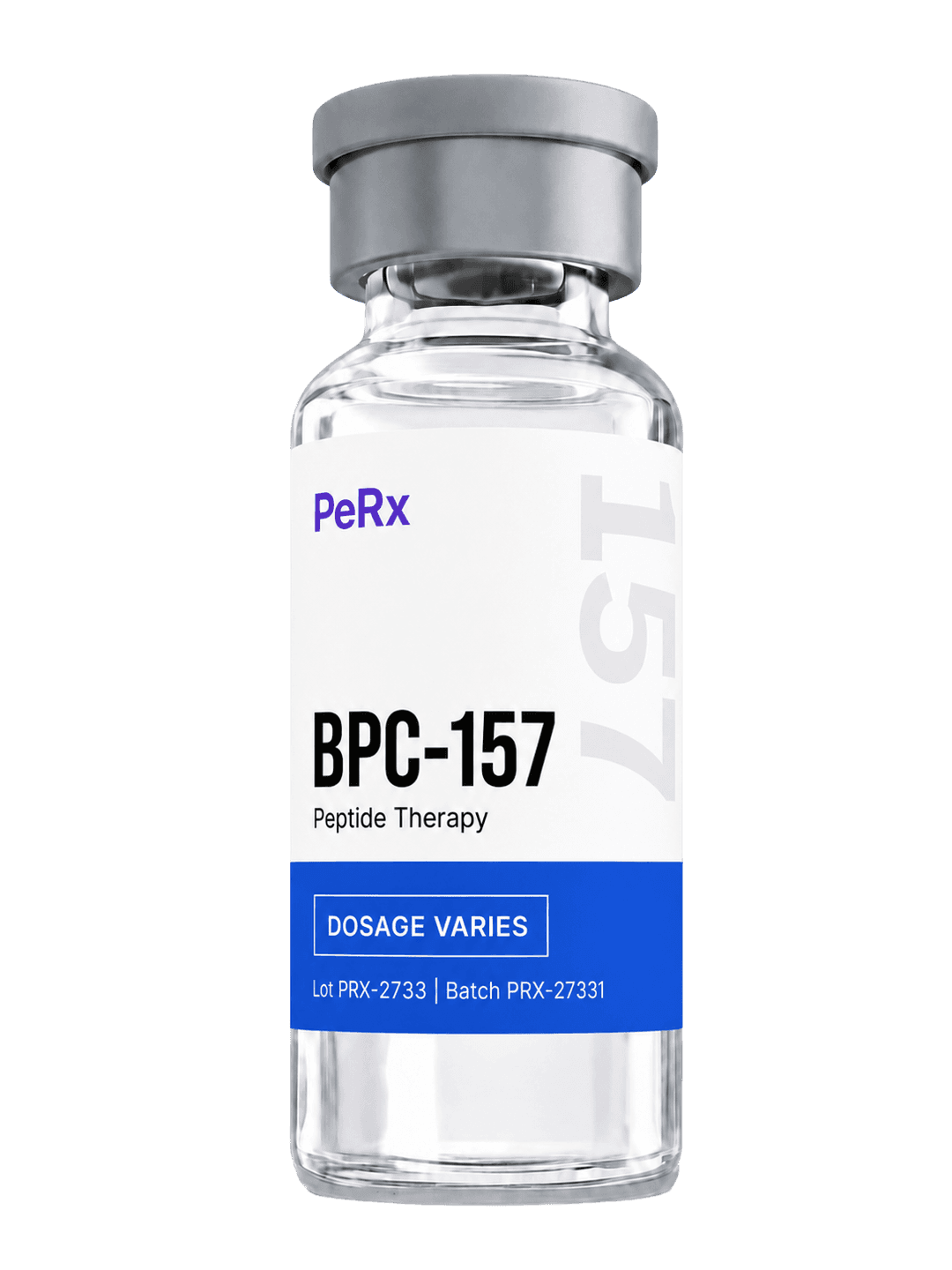
One vial, one month, ready to use. BPC-157 at PeRx ships fully reconstituted and ready to use, prescribed by a licensed provider after an eligibility check and compounded at a state-licensed 503A pharmacy, with every lot independently tested for potency, sterility, endotoxins and pH.
The label states the concentration, the prescribed dose arrives on paper with it, and the insulin syringes are in the box. Compounded BPC-157 is not an FDA-approved drug.
BPC-157 Before and After by Use Case: Tendons, Gut and Joints
Tendons and Ligaments
This is the most-researched use and the one with the longest timelines. The animal work rests on rat Achilles tendon and medial collateral ligament models, and the human reports cluster around Achilles, rotator cuff, patellar tendon and ACL or MCL recovery, often after surgery. The timelines run to months because of blood supply: tendons and ligaments are poorly vascularized, so the cells that rebuild them arrive slowly and the collagen they produce takes months to align. People describe the ache easing in the first month, loading without a flare by the second, and a sense that the tissue is "solid" in the third or fourth. Label: preclinical, with no controlled human trial.
Gut
The research started here, because the peptide comes from a gastric protein. Rodent models of drug-induced stomach damage, intestinal injury and inflammation report protection and faster repair of the lining. The human gut evidence is anecdotal. People describe less bloating and a calmer stomach after meals, usually within the first month, and these are among the least reliable things anyone can self-report, because gut comfort moves with diet, stress, sleep and expectation. How PeRx approaches gut health peptides explains which products a provider considers for digestion. Label: preclinical for the lining, anecdotal for symptoms.
Joints
Joints hold the only direct human data, and it is thin. In the 2021 knee series, 14 of 16 people reached by phone said a single intra-articular injection had helped their pain. It measured what people said, six months to a year after the fact, with no imaging, no control group and no standard pain scale. Shoulder, elbow and hip reports rest on anecdote and on the animal tendon work. What people describe for joints is less pain on stairs in the first month, then more tolerance for activity; whether anything changes inside the joint is unknown. The peptides for joint pain post compares the options. Label: limited human for knee pain, anecdotal elsewhere.
Muscle and Other Soft Tissue
Muscle has the best blood supply of any tissue on this page, which is why strains are reported to settle fastest and why the rat crush studies show shorter windows than the tendon work. People describe a pulled hamstring or calf feeling usable again in two to three weeks, which overlaps almost completely with the natural course of a mild strain. Two things BPC-157 is not: it is not a muscle-building peptide, and there is no meaningful evidence that it causes weight loss. The Wolverine stack post covers the common pairing with TB-500. Label: preclinical.
BPC-157 Results: What to Expect
The table collapses the sections above into one view, and the middle column is the part most before-and-after pages leave out: what the body would be doing with rest and rehab alone.
| Area | Commonly reported window | What normal healing is doing | Evidence level |
|---|---|---|---|
| Tendon | Pain eases weeks 2 to 4; loading without flare weeks 6 to 12 | Inflammation, then months of slow collagen alignment under load | Preclinical |
| Ligament | Stability and comfort weeks 4 to 12, longer after surgery | Weeks of proliferation, months of remodeling; surgical protocol sets the pace | Preclinical |
| Muscle | Strain feels usable in 2 to 3 weeks | Mild strains recover in 2 to 3 weeks on their own | Preclinical |
| Joint | Less pain on stairs within a month | Depends entirely on the cause; many joint complaints fluctuate | Limited human (knee series only) |
| Gut | Less bloating, calmer digestion within a month | Symptoms shift with diet, stress and sleep on any timescale | Preclinical for the lining; anecdotal for symptoms |
| General soreness | Less day-after soreness inside 2 weeks | Soreness drops on its own with a lower training load | Anecdotal |
Tendon
- Commonly reported window
- Pain eases weeks 2 to 4; loading without flare weeks 6 to 12
- What normal healing is doing
- Inflammation, then months of slow collagen alignment under load
- Evidence level
- Preclinical
Ligament
- Commonly reported window
- Stability and comfort weeks 4 to 12, longer after surgery
- What normal healing is doing
- Weeks of proliferation, months of remodeling; surgical protocol sets the pace
- Evidence level
- Preclinical
Muscle
- Commonly reported window
- Strain feels usable in 2 to 3 weeks
- What normal healing is doing
- Mild strains recover in 2 to 3 weeks on their own
- Evidence level
- Preclinical
Joint
- Commonly reported window
- Less pain on stairs within a month
- What normal healing is doing
- Depends entirely on the cause; many joint complaints fluctuate
- Evidence level
- Limited human (knee series only)
Gut
- Commonly reported window
- Less bloating, calmer digestion within a month
- What normal healing is doing
- Symptoms shift with diet, stress and sleep on any timescale
- Evidence level
- Preclinical for the lining; anecdotal for symptoms
General soreness
- Commonly reported window
- Less day-after soreness inside 2 weeks
- What normal healing is doing
- Soreness drops on its own with a lower training load
- Evidence level
- Anecdotal
Every window in that table is what people report, not an outcome anyone has measured for this peptide in a controlled trial.
Why BPC-157 Before and After Results Vary So Much
What Changes the Timeline
Two people with "a bad Achilles" can be describing different diseases. An acute tear from last month is an inflammatory injury with a repair sequence already underway. A tendinopathy that has nagged for three years is degenerative, not inflammatory: the collagen is disorganized, the blood supply is poor, and there is no active healing to speed up. Chronic injuries are the slowest responders in every account. Age slows collagen turnover, diabetes and smoking impair repair through blood flow, body composition changes the load every tendon carries, and training volume during the course probably explains more variation between reports than anything else. Product quality is the hidden variable for anyone using unverified material.
What Helps Recovery Regardless of the Peptide
Progressive strength work and physical therapy, enough protein, sleep, hydration, sensible load management and mobility work have decades of human evidence behind them, and no compound has been shown to replace any of them. People who lost weight quickly on a GLP-1 medicine and went straight back to heavy lifting are worth naming, and the tendon injuries after GLP-1 weight loss post explains why their tendons lag their strength. There is no accepted guideline for timing a dose around a workout; that decision belongs to the prescriber, not a forum.
How to Read BPC-157 Reviews, Reddit Reports and Photos
BPC-157 reviews skew positive for a reason that has nothing to do with the peptide: people who felt nothing rarely write it up, and people who felt better want to tell someone. Photos add a different problem. A picture shows swelling, posture and lighting, all of which change from one day to the next, and it cannot show tendon structure. A six-week gap between two photos is six weeks of natural healing whatever else happened in between.
Four questions sort the useful BPC-157 before and after reports from the rest. What else changed: rest, rehab, sleep, training load, another medicine? What would natural healing have done in the same window? Who is telling the story, and what do they gain if you believe it? And does the account mention anyone who saw no effect? The peptides before and after guide applies the same test across every peptide, as does the MOTS-c before and after post. PeRx publishes no testimonials or photos for BPC-157 and does not link to forum threads.
BPC-157 Before and After vs Natural Healing
Natural healing is the comparison every BPC-157 story is secretly making. Its timelines come from decades of follow-up on real injuries: a grade one hamstring strain is usually back to sport in two to three weeks, and an ACL reconstruction follows a rehab protocol measured in months. The BPC-157 human record is a few dozen people reporting their own pain.
| Natural recovery | BPC-157 added | |
|---|---|---|
| Pain | Settles over weeks as inflammation resolves | Reported to settle sooner; anecdotal |
| Tissue remodeling | Months, driven by progressive load | Faster in rats; unmeasured in people |
| Physical therapy | Essential | Still essential |
| Evidence base | Decades of human follow-up | Rat models and three uncontrolled pilots |
| Long-term data | Known outcomes by injury type | None |
Pain
- Natural recovery
- Settles over weeks as inflammation resolves
- BPC-157 added
- Reported to settle sooner; anecdotal
Tissue remodeling
- Natural recovery
- Months, driven by progressive load
- BPC-157 added
- Faster in rats; unmeasured in people
Physical therapy
- Natural recovery
- Essential
- BPC-157 added
- Still essential
Evidence base
- Natural recovery
- Decades of human follow-up
- BPC-157 added
- Rat models and three uncontrolled pilots
Long-term data
- Natural recovery
- Known outcomes by injury type
- BPC-157 added
- None
Natural recovery is far better documented, and rehabilitation is essential either way.
BPC-157 Safety, Side Effects and Unknowns
Long-term human safety data for BPC-157 do not exist. The longest follow-up in any human report is roughly a year, by phone, in the uncontrolled knee series, and no dose has been established for people by a controlled trial. The reported mild effects are injection-site irritation and redness, headache, nausea and dizziness, reported rather than measured against a comparison group. More in BPC-157 side effects.
One theoretical question deserves a plain statement. The mechanism most often credited for BPC-157 is the growth of new blood vessels, and whether promoting that in a person with a condition where new vessel growth is unwanted could matter has not been studied; a provider should know about any such history before prescribing. Injuries also get misdiagnosed. A "tendon strain" that is actually a partial tear, a stress fracture or referred pain from a joint will not respond to anything aimed at the wrong tissue, so a clinician should assess an injury first. Doses are not discussed on this page; what the published studies gave is in the BPC-157 dosage chart.
Is BPC-157 FDA Approved? Where It Stands Today
BPC-157 is not FDA approved for any use, and compounded BPC-157 is not FDA approved either. Compounding means a state-licensed pharmacy prepares a drug for an individual patient under a prescription; the product itself has not been through the FDA approval process.
The regulatory position moved twice in 2026. In April, the FDA removed BPC-157 and eleven other peptides from Category 2 of its interim policy on bulk substances for 503A compounding, without adding them to the 503A bulks list. On July 23 and 24, the Pharmacy Compounding Advisory Committee reviewed seven of those peptides and recommended BPC-157 for the bulks list by an 8 to 6 vote with one abstention. That recommendation is advisory and non-binding; placing a substance on the list requires formal rulemaking, which takes a year or more. As of October 2026, that is where it stands. The is BPC-157 FDA approved post, the FDA peptide review of July 2026 summary and what to do about the BPC-157 and TB-500 FDA changes cover the detail. Athletes subject to anti-doping rules should read the disclosures on the injury recovery peptides page first.
Getting BPC-157 Through a Prescription
The path is short. You complete an eligibility check, a licensed provider reviews your health history and the injury you are describing, and if a prescription is written a state-licensed 503A pharmacy fills it and ships the vial ready to use with no reconstitution needed. The provider follows up at renewal. Compounded BPC-157 is not an FDA-approved drug, and PeRx does not sell research-grade or unprescribed products. Injectable and oral forms are not interchangeable for every goal; the oral vs injectable BPC-157 comparison explains why, and how to get peptides prescribed online covers the process. Lot testing is described on the quality testing page, and the recovery peptides category shows what else a provider might consider.
Want to know if BPC-157 fits your injury?
New here? The eligibility check takes about a minute, and a licensed provider reviews every order before it ships. Already a patient? Message your care team about your results or your next course.
Prefer capsules?
BPC-157 Capsules
Combined recovery
BPC/TB-500
BPC-157 Before and After FAQs
Related Guides
Continue reading about peptides and protocols that pair well with this guide.
Is BPC-157 FDA Approved in 2026? The Honest Answer
No. BPC-157 has never been submitted for FDA approval and has never entered formal clinical trials. It is available as a compounded medication prescribed by licensed providers. Despite being the most widely used peptide in therapy, its entire evidence base comes from preclinical research. Here is what that means and why millions of people use it anyway.
How Long Does BPC-157 Take to Work?
The honest answer is that it depends on what you are treating. No human randomized trial has pinned down a precise onset for BPC-157, so the ranges below come from preclinical research and clinical-practice observation. This guide breaks the timeline down by use type, explains what speeds it up or slows it down, and covers when to check back in with your provider.
Muscle Growth Peptides 2026: What Actually Works
Peptides are signaling tools, not muscle-building shortcuts. The useful clinical question isn't whether they build muscle. It's which pathway you're trying to influence, whether the effect is big enough to matter alongside training and nutrition, and whether you've matched the mechanism to the actual bottleneck.
References and Review
Every evidence label on this page can be checked against the sources below. Regulatory statements point to the FDA-status posts linked above.
Staresinic M, Sebecic B, Patrlj L, et al. Gastric pentadecapeptide BPC 157 accelerates healing of transected rat Achilles tendon and in vitro stimulates tendocytes growth. J Orthop Res. 2003;21(6):976-983. View study
Cerovecki T, Bojanic I, Brcic L, et al. Pentadecapeptide BPC 157 (PL 14736) improves ligament healing in the rat. J Orthop Res. 2010;28(9):1155-1161. View study
Pevec D, Novinscak T, Brcic L, et al. Impact of pentadecapeptide BPC 157 on muscle healing impaired by systemic corticosteroid application. Med Sci Monit. 2010;16(3):BR81-88. View study
Sikiric P, Rucman R, Turkovic B, et al. Novel cytoprotective mediator, stable gastric pentadecapeptide BPC 157. Vascular recruitment and gastrointestinal tract healing. Curr Pharm Des. 2018;24(18):1990-2001. View study
Lee E, Padgett B. Intra-articular injection of BPC 157 for multiple types of knee pain. Altern Ther Health Med. 2021;27(4):8-13. View study
Lee E, Walker C, Ayadi B. Effect of BPC-157 on symptoms in patients with interstitial cystitis: a pilot study. Altern Ther Health Med. 2024;30(10):12-17. View study
Lee E, Burgess K. Safety of intravenous infusion of BPC157 in humans: a pilot study. Altern Ther Health Med. 2025;31(5):20-24. View study
McGuire FP, Martinez R, Lenz A, Skinner L, Cushman DM. Regeneration or risk? A narrative review of BPC-157 for musculoskeletal healing. Curr Rev Musculoskelet Med. 2025;18(12):611-619. View study
Mayfield CK, Bolia IK, Feingold CL, et al. Injectable peptide therapy: a primer for orthopaedic and sports medicine physicians. Am J Sports Med. 2026;54(1):223-229. View study
PharmaCotherapia d.o.o. PCO-02 safety and pharmacokinetics trial: phase I pilot study in healthy volunteers (BPC-157). ClinicalTrials.gov NCT02637284, first posted December 22, 2015; status unknown, no results posted. View study
Medical Disclaimer
The information provided on this website, including all articles, guides, and educational content, is for informational and educational purposes only and is not intended as medical advice, diagnosis, or treatment. Nothing on this site should be construed as a substitute for professional medical advice from a qualified healthcare provider.
The majority of peptides discussed on this site are not approved by the U.S. Food and Drug Administration (FDA) for the indications described. They are classified as bulk drug substances and are available only through a licensed prescribing provider and compounding pharmacy. All treatments require a valid prescription and provider oversight.
The majority of published research on peptide therapies has been conducted in preclinical (animal) models. While early human data is encouraging, comprehensive clinical trial data remains limited for most peptide compounds. Individual results may vary significantly based on health status, injury type, and other factors. No specific outcomes are guaranteed.
Certain peptides discussed on this site are classified as prohibited substances by the World Anti-Doping Agency (WADA) and are banned by major sports organizations including the NFL, NCAA, UFC, NBA, MLB, NHL, and PGA. If you are subject to anti-doping testing, consult your governing body before considering any peptide therapy.
Statements on this website have not been evaluated by the Food and Drug Administration. Products and therapies discussed are not intended to diagnose, treat, cure, or prevent any disease.
© 2026 Wellness MD Group PC DBA PeRx. All rights reserved.