MOTS-c Benefits: What the Evidence Supports
Almost every benefit attributed to MOTS-c traces back to a mouse, a cell culture, or a blood test measuring the peptide your own mitochondria already make. This page grades each claim by what was measured, what it was measured in, and whether anyone has given injected MOTS-c to a person and looked.

In this article
Key Takeaways
- No completed study has given injected MOTS-c to a person and measured a benefit. The FDA evaluation dated May 11, 2026 searched the published literature and identified no clinical studies of MOTS-c administered to humans by any route, so every benefit below is graded on animal, cell, or observational evidence.
- The strongest preclinical signal is metabolic. In the 2015 discovery study, MOTS-c prevented diet-induced obesity and insulin resistance in mice, and a seven-day course restored insulin sensitivity in middle-aged mice to the level of young animals.
- The exercise findings are two different things wearing one name. Injected MOTS-c improved treadmill and grip-strength performance in mice, while in humans exercise raised the body’s own MOTS-c roughly twelve-fold in muscle. The second is not evidence for the first.
- Human data on MOTS-c is almost entirely observational and points in inconsistent directions. Circulating levels run lower in people with type 2 diabetes and in obese boys, yet in lean adults higher levels tracked with more insulin resistance, not less.
- The one human trial of a MOTS-c-type molecule tested an analog, not MOTS-c. Over four weeks it lowered ALT 21%, AST 28% and glucose 6% against placebo in 20 people with fatty liver, with a trend toward lower body weight. Those are biomarkers in a Phase 1 safety study, not proven outcomes.
- Weight loss is the most oversold claim. No human has been shown to lose weight on MOTS-c, there is no weight-loss dose with a trial behind it, and PeRx does not prescribe it as a weight-loss treatment.
- A Phase 2a trial (NCT07505745) began recruiting in February 2026 and will report insulin sensitivity in adults with prediabetes. Primary completion is estimated for February 2027, so the first real answer is over a year away.
MOTS-c Benefits at a Glance
What It Is
A 16-amino-acid peptide encoded in mitochondrial DNA, discovered 2015
Best-Supported Effect
Insulin sensitivity and glucose handling, in mice
Strongest Human Signal
An analog lowered liver enzymes and glucose in a 20-person safety study
Weakest Evidence
Weight loss, bone density, longevity in people
Tested in Humans?
No completed trial of MOTS-c itself. One Phase 2a recruiting since Feb 2026
How PeRx Supplies It
Subcutaneous 2 mg/mL vial, prescribed after screening, $229
What Are the Benefits of MOTS-c?
MOTS-c is studied for insulin sensitivity, glucose control, body composition, exercise capacity, and markers of healthy aging. The qualifier belongs in the same breath: those findings come from mice, cell cultures, and blood samples measuring the peptide people already produce. No completed study has injected MOTS-c into a person and measured whether any of it follows. That does not make the science weak. It makes the claims premature, and the difference is worth understanding before you spend anything.
What the FDA reviewers actually wrote
Preparing for the July 2026 advisory meeting, FDA staff searched PubMed, Embase, the Cochrane database and several clinical references. They reported that they "did not identify clinical studies evaluating administration of MOTS-c-related BDSs in human subjects," and concluded there is "a lack of evidence to evaluate the effectiveness" of MOTS-c for the uses it was nominated for: insulin resistance, obesity, osteoporosis, vascular calcification, muscle and fat metabolism, and longevity. That list is not a set of proven benefits. It is the list of things somebody asked the agency to consider, and the agency said it could not evaluate.
How to Read the Evidence Grades
Pages listing MOTS-c benefits rarely say where each one came from, which lets a mouse study and a human trial sit side by side looking equally solid. Every claim below carries a tier instead, ordered by how much weight a finding can bear. The jump from tier 2 to tier 1 is the one almost nothing about MOTS-c has made yet.
| Tier | What it means | How much MOTS-c evidence sits here |
|---|---|---|
| Tier 1: Human trial | People were given the peptide and an outcome was measured against a control | None. One Phase 2a study is recruiting, results estimated 2027 |
| Tier 2: Analog trial | People were given a modified version of the molecule | One four-week study in 20 people, reported by press release |
| Tier 3: Human observation | The body’s own MOTS-c was measured and correlated with something | Several studies. Correlation only, no peptide given |
| Tier 4: Animal | Mice or rats were injected and outcomes measured | The bulk of it, and the source of nearly every benefit claim |
| Tier 5: Cell | Cultured cells responded to the peptide | The mechanism work, including the AMPK and nuclear findings |
Tier 1: Human trial
- What it means
- People were given the peptide and an outcome was measured against a control
- How much MOTS-c evidence sits here
- None. One Phase 2a study is recruiting, results estimated 2027
Tier 2: Analog trial
- What it means
- People were given a modified version of the molecule
- How much MOTS-c evidence sits here
- One four-week study in 20 people, reported by press release
Tier 3: Human observation
- What it means
- The body’s own MOTS-c was measured and correlated with something
- How much MOTS-c evidence sits here
- Several studies. Correlation only, no peptide given
Tier 4: Animal
- What it means
- Mice or rats were injected and outcomes measured
- How much MOTS-c evidence sits here
- The bulk of it, and the source of nearly every benefit claim
Tier 5: Cell
- What it means
- Cultured cells responded to the peptide
- How much MOTS-c evidence sits here
- The mechanism work, including the AMPK and nuclear findings
MOTS-c Benefits, Graded
| Claimed benefit | What was measured | Tier |
|---|---|---|
| Insulin sensitivity | Glucose infusion rate up about 30% in clamp studies in mice; age-related resistance reversed after 7 days | Tier 4 (animal) |
| Blood glucose | Glucose fell 6% versus placebo over 4 weeks, using an analog | Tier 2 (analog) |
| Body composition | Mice on a high-fat diet gained less weight at identical calorie intake | Tier 4 (animal) |
| Exercise capacity | Treadmill time and distance improved in young, middle-aged and old mice | Tier 4 (animal) |
| Muscle preservation | Myostatin and atrophy signaling fell in mice and cultured myotubes | Tier 4 and 5 |
| Liver fat markers | ALT down 21% and AST down 28% versus placebo, using an analog | Tier 2 (analog) |
| Bone density | Bone loss suppressed in ovariectomized mice over 12 weeks | Tier 4 (animal) |
| Longevity | A non-significant trend toward longer median and maximum lifespan in mice; a genetic association in Japanese cohorts | Tier 3 and 4 |
| Energy and vitality | Never measured in any species as an outcome | None |
Insulin sensitivity
- What was measured
- Glucose infusion rate up about 30% in clamp studies in mice; age-related resistance reversed after 7 days
- Tier
- Tier 4 (animal)
Blood glucose
- What was measured
- Glucose fell 6% versus placebo over 4 weeks, using an analog
- Tier
- Tier 2 (analog)
Body composition
- What was measured
- Mice on a high-fat diet gained less weight at identical calorie intake
- Tier
- Tier 4 (animal)
Exercise capacity
- What was measured
- Treadmill time and distance improved in young, middle-aged and old mice
- Tier
- Tier 4 (animal)
Muscle preservation
- What was measured
- Myostatin and atrophy signaling fell in mice and cultured myotubes
- Tier
- Tier 4 and 5
Liver fat markers
- What was measured
- ALT down 21% and AST down 28% versus placebo, using an analog
- Tier
- Tier 2 (analog)
Bone density
- What was measured
- Bone loss suppressed in ovariectomized mice over 12 weeks
- Tier
- Tier 4 (animal)
Longevity
- What was measured
- A non-significant trend toward longer median and maximum lifespan in mice; a genetic association in Japanese cohorts
- Tier
- Tier 3 and 4
Energy and vitality
- What was measured
- Never measured in any species as an outcome
- Tier
- None
Insulin sensitivity and glucose
This is the best-supported claim and the reason the peptide exists in the literature at all. In the 2015 discovery paper, Lee and colleagues showed MOTS-c inhibits the folate cycle and the purine synthesis tethered to it, which activates AMPK, the same energy sensor metformin works through. Mice on a high-fat diet given 0.5 mg/kg daily for eight weeks were protected from obesity and from the rise in insulin that goes with it, and calorie intake was identical between groups, so eating less does not explain it. Seven days of treatment raised the glucose infusion rate about 30% in clamp studies, and muscle from 12-month-old mice regained insulin sensitivity comparable to 3-month-old animals.
Lee C, Zeng J, Drew BG, et al. "The mitochondrial-derived peptide MOTS-c promotes metabolic homeostasis and reduces obesity and insulin resistance." Cell Metabolism. 2015;21(3):443-454. PMID 25738459. View study
The nearest human echo comes from CB4211, a modified analog developed by CohBar, a company co-founded by the senior author of that discovery paper. In the four-week Phase 1b stage, 20 adults with obesity and fatty liver received 25 mg daily under the skin (11 people) or placebo (9). Against placebo, ALT fell 21%, AST fell 28% and glucose fell 6%, each reported as statistically significant, with a trend toward lower body weight. Liver fat measured by imaging dropped in both groups by almost the same amount, which is a useful reminder of how much a placebo arm moves. Results came by press release in August 2021, were never published in a journal, and the company moved to liquidate after its merger was terminated in November 2023.
Exercise capacity and muscle
Two separate findings get merged into one claim here, and pulling them apart changes what the evidence says. In mice, Reynolds and colleagues gave MOTS-c by injection and measured performance: treated animals ran longer and further on a treadmill, and mice started on an intermittent late-life course at roughly 24 months improved in grip strength, stride length and a 60-second walking test. In humans, the same paper measured something different. Ten sedentary young men rode a stationary bike, and their own MOTS-c rose about twelve-fold in muscle and roughly 1.5 to 1.6-fold in circulation, returning toward baseline after four hours of rest. Nobody was injected with anything.
Reynolds JC, Lai RW, Woodhead JST, et al. "MOTS-c is an exercise-induced mitochondrial-encoded regulator of age-dependent physical decline and muscle homeostasis." Nature Communications. 2021;12(1):470. PMID 33473109. View study
That human half is genuinely interesting biology. It is also the opposite arrow from the one a buyer cares about: exercise produces MOTS-c, which is not the same as MOTS-c producing the benefits of exercise. A related mouse and cell study found MOTS-c lowered myostatin, a brake on muscle growth, which is a plausible mechanism for the performance results and still sits at tier 4. Endurance-specific context lives in our guide on peptides for endurance athletes, with the caveat that this peptide is banned in tested sport.
Kumagai H, Coelho AR, Wan J, et al. "MOTS-c reduces myostatin and muscle atrophy signaling." American Journal of Physiology. Endocrinology and Metabolism. 2021;320(4):E680-E690. PMID 33554779. View study
Bone, heart, and longevity
These are the thinnest of the commonly listed benefits. Bone rests on two rodent and cell studies: ovariectomized mice given 5 mg/kg daily for 12 weeks lost less bone on micro-CT, and a separate study found MOTS-c pushed rat marrow stem cells toward bone-forming cells in culture. A 2025 rat study reported improved cardiac mitochondrial respiration in diabetic hearts. On longevity, the late-life mouse experiment showed a trend toward longer median and maximum lifespan that did not reach significance, and the authors wrote that larger groups would be needed. The human longevity angle is a genetic hypothesis, not a finding: a 2015 paper suggested that a variant in the MOTS-c coding region specific to Northeast Asian populations might help explain Japanese longevity, and said more research was needed. A later study linked that same variant to higher type 2 diabetes prevalence in men. Genetics is not a treatment result.
Ming W, Lu G, Xin S, et al. "Mitochondria related peptide MOTS-c suppresses ovariectomy-induced bone loss via AMPK activation." Biochemical and Biophysical Research Communications. 2016;476(4):412-419. PMID 27237975. View study
Hu BT, Chen WZ. "MOTS-c improves osteoporosis by promoting osteogenic differentiation of bone marrow mesenchymal stem cells via TGF-β/Smad pathway." European Review for Medical and Pharmacological Sciences. 2018;22(21):7156-7163. PMID 30468456. View study
Pham T, Taberner A, Hickey A, et al. "Mitochondria-derived peptide MOTS-c restores mitochondrial respiration in type 2 diabetic heart." Frontiers in Physiology. 2025;16:1602271. PMID 40661667. View study
Fuku N, Pareja-Galeano H, Zempo H, et al. "The mitochondrial-derived peptide MOTS-c: a player in exceptional longevity?" Aging Cell. 2015;14(6):921-923. PMID 26289118. View study
Zempo H, Kim SJ, Fuku N, et al. "A pro-diabetogenic mtDNA polymorphism in the mitochondrial-derived peptide, MOTS-c." Aging (Albany NY). 2021;13(2):1692-1717. PMID 33468709. View study
Your Own MOTS-c vs an Injection
Most human MOTS-c research measures the peptide in blood and correlates it with something. That work is real, and it is routinely quoted as though it were evidence for injecting. Two problems come with it. The first is direction: an association cannot tell you whether low MOTS-c drives a condition, results from it, or simply travels alongside it. The second is that the associations themselves do not line up neatly.
| Human observation | What was found | What it does not show |
|---|---|---|
| Type 2 diabetes | Serum MOTS-c significantly lower in people with diabetes across 225 subjects | Whether raising it changes the disease |
| Childhood obesity | Levels lower in obese boys and correlated with insulin-resistance markers, but not in girls | A cause, a direction, or anything about treatment |
| Lean vs obese adults | Levels were similar in both groups. In lean people only, higher MOTS-c tracked with more insulin resistance | The simple "more is better" story the marketing uses |
| Healthy aging men | Circulating levels fell with age while muscle expression ran about 1.5-fold higher in older men | That an injection reproduces either pattern |
Type 2 diabetes
- What was found
- Serum MOTS-c significantly lower in people with diabetes across 225 subjects
- What it does not show
- Whether raising it changes the disease
Childhood obesity
- What was found
- Levels lower in obese boys and correlated with insulin-resistance markers, but not in girls
- What it does not show
- A cause, a direction, or anything about treatment
Lean vs obese adults
- What was found
- Levels were similar in both groups. In lean people only, higher MOTS-c tracked with more insulin resistance
- What it does not show
- The simple "more is better" story the marketing uses
Healthy aging men
- What was found
- Circulating levels fell with age while muscle expression ran about 1.5-fold higher in older men
- What it does not show
- That an injection reproduces either pattern
The third row is the one worth sitting with. If higher circulating MOTS-c were straightforwardly better, you would not expect it to track with worse insulin sensitivity in lean adults. The authors read it as the peptide responding to metabolic status rather than setting it, which is a different model of what MOTS-c is for.
Cataldo LR, Fernández-Verdejo R, Santos JL, Galgani JE. "Plasma MOTS-c levels are associated with insulin sensitivity in lean but not in obese individuals." Journal of Investigative Medicine. 2018;66(6):1019-1022. PMID 29593067. View study
Ramanjaneya M, Bettahi I, Jerobin J, et al. "Mitochondrial-Derived Peptides Are Down Regulated in Diabetes Subjects." Frontiers in Endocrinology. 2019;10:331. PMID 31214116. View study
Du C, Zhang C, Wu W, et al. "Circulating MOTS-c levels are decreased in obese male children and adolescents and associated with insulin resistance." Pediatric Diabetes. 2018. PMID 29691953. View study
D'Souza RF, Woodhead JST, Hedges CP, et al. "Increased expression of the mitochondrial derived peptide, MOTS-c, in skeletal muscle of healthy aging men is associated with myofiber composition." Aging (Albany NY). 2020;12(6):5244-5258. PMID 32182209. View study
The unanswered pharmacology question
FDA reviewers found no study of what an injected dose does in a body, in any species. The one relevant laboratory result they identified showed MOTS-c broken down rapidly when incubated in human blood, and they wrote that it "remains to be determined whether exogenous administration of MOTS-c to humans can generate pharmacologically active concentrations of the peptide over time." Until someone measures that, the chain from injection to benefit has a missing first link.
The Dose Gap Nobody Mentions
Even granting the mouse results, there is an arithmetic problem between those studies and what gets prescribed. Animal doses do not transfer to people directly, and the FDA’s own conversion guidance uses a body-surface-area factor of 12.3 for mice. Run the two headline studies through it and they land in very different places.
| Study | Mouse dose | Rough human equivalent | Versus clinic patterns |
|---|---|---|---|
| Reynolds 2021 (performance) | 15 mg/kg/day | About 85 mg a day for a 70 kg adult, near 600 mg a week | Roughly 40 to 120 times the 5 to 15 mg weekly range clinics use |
| Lee 2015 (metabolic) | 0.5 mg/kg/day | About 2.8 mg a day, near 20 mg a week | The same order of magnitude as clinic patterns |
Reynolds 2021 (performance)
- Mouse dose
- 15 mg/kg/day
- Rough human equivalent
- About 85 mg a day for a 70 kg adult, near 600 mg a week
- Versus clinic patterns
- Roughly 40 to 120 times the 5 to 15 mg weekly range clinics use
Lee 2015 (metabolic)
- Mouse dose
- 0.5 mg/kg/day
- Rough human equivalent
- About 2.8 mg a day, near 20 mg a week
- Versus clinic patterns
- The same order of magnitude as clinic patterns
Two things follow. The metabolic findings were produced at a dose a person could plausibly receive, which is a point in their favor and rarely mentioned. The performance findings were not, so the treadmill result most often used to sell MOTS-c came from an exposure far above anything prescribed. Surface-area conversion is a rough starting-dose tool, not a precise translation, and nobody has run the pharmacokinetic study that would settle it. Dosing itself belongs to the MOTS-c dosage chart.
MOTS-c for Weight Loss
Searches for a MOTS-c weight-loss dose are common, so here is the direct answer: there is not one. No dose has been tested against weight in a human trial, which means any number presented as a weight-loss protocol was chosen by inference. The underlying evidence is the mouse work, where animals on a high-fat diet gained less weight at matched calorie intake, plus a trend toward lower body weight in the four-week analog study that did not reach the bar its other endpoints cleared.
FDA staff noted that obesity is a serious condition with approved treatments already available, and declined to evaluate obesity as a proposed use because the nomination lacked the information to support it. PeRx does not prescribe MOTS-c as a weight-loss treatment. If fat loss is the actual goal, our guides on whether peptides help you lose weight and the best peptides for fat loss cover the options with real outcome data, including the GLP-1 medications. Anyone already on one should read MOTS-c and semaglutide before adding anything.
What People Report Noticing
Separate from the literature, there is what patients say. It belongs in its own category: uncontrolled, unblinded, and exactly the kind of thing a placebo produces reliably. The analog trial is the reminder, since liver fat improved nearly as much on placebo as on drug.
Weeks 1-2
Mostly nothing, or the injection itself
The common report is no perceptible change. Some people describe steadier energy across the afternoon. Since many protocols place the dose fasted or before training, a change in routine is running alongside the peptide from day one.
Weeks 3-6
Where training reports cluster
When people describe something, it is usually about sessions: a bit more work before fatigue, or feeling recovered sooner. Nothing has been measured in a person, and a training block improves performance on its own.
Weeks 6-12
What a number could show
Anything that shows up as data rather than impression sits here: fasting glucose, HbA1c, waist measurements. Those are the endpoints the Phase 2a trial is built around, and the only honest way to tell effect from expectation.
Realistic timelines across the catalog are covered in how long peptides take to work, and the case where nothing happens is covered in what if a peptide does not work for you.
Who It Fits, and Who It Does Not
Ideal for
Adults who understand they are buying an early-evidence peptide and want the metabolic and exercise-capacity angle specifically. People who track something objective, such as fasting glucose, HbA1c, waist circumference or training data, so there is a number to judge against. People whose expectations sit at "this may do nothing noticeable," because that is a legitimate outcome here.
Consider alternatives if
Anyone whose goal is weight loss, where treatments with human outcome data exist. Anyone taking insulin, a sulfonylurea or another glucose-lowering medication, which is a screening conversation before anything else. People with active or recent cancer, or who are pregnant or breastfeeding. Athletes under anti-doping rules, since MOTS-c is prohibited at all times under WADA section 4.4.1 as an AMPK activator and USADA considers a therapeutic use exemption highly unlikely. Anyone who needs a peptide with proven human results, where BPC-157 or the growth hormone peptides have more behind them.
The full safety picture, including blood sugar and the cancer question, is in MOTS-c side effects. The intake review itself is covered in what providers review before prescribing.
MOTS-c
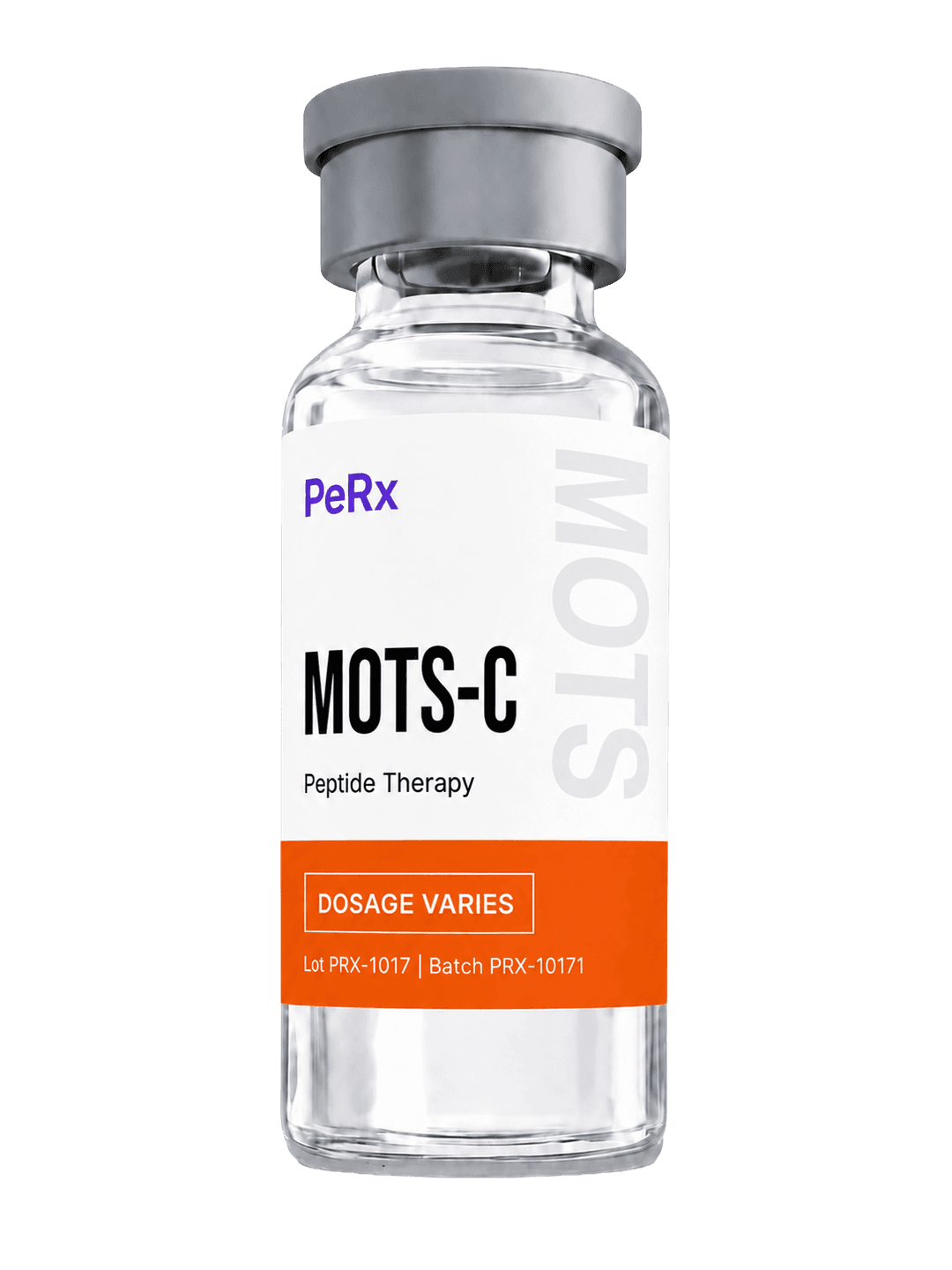
PeRx MOTS-c is prescribed by a licensed provider after a health and medication review, compounded by a US-based 503A pharmacy at a fixed 2 mg/mL, and tested for potency and sterility. It arrives ready to use with no reconstitution needed, so the concentration on the label is the concentration in the vial.
That fixed concentration matters more here than for most peptides. FDA reviewers observed that certificates of analysis circulating for MOTS-c typically report a purity number and nothing about aggregates or impurities, and a peptide of unverified identity is a poor starting point for judging whether anything worked. $229 for a one-month supply, with syringes and swabs included.
What the Phase 2a Trial Will Answer
A randomized, double-blind, placebo-controlled Phase 2a study called MOTS-MET (NCT07505745) began recruiting on February 2, 2026. It plans about 120 adults aged 18 to 65 with prediabetes and a BMI between 27 and 40, randomized one to one to a fixed daily subcutaneous dose or placebo for 12 weeks, with both arms receiving lifestyle counseling. The primary measures are insulin sensitivity by the Matsuda index at 12 weeks and treatment-emergent adverse events through week 16. HbA1c, fasting glucose, two-hour glucose and anti-drug antibodies are secondary. Primary completion is estimated for February 14, 2027.
What it will and will not settle
It should answer: whether injected MOTS-c improves insulin sensitivity against placebo in one specific population, at one dose, over 12 weeks, and whether people develop antibodies to it.
It will not answer: anything about weight loss as an endpoint, athletic performance, longevity, bone density, or people without prediabetes. It is a single mid-size study, and mid-size studies get overturned.
One process note, because it gets conflated with evidence. On July 23, 2026 the Pharmacy Compounding Advisory Committee voted 7 to 5, with two abstentions, to recommend MOTS-c for the 503A bulks list, against the FDA staff position. That vote is advisory, nothing has been finalized as of September 2026, and the regulatory status remains unsettled. A committee recommending that pharmacies be allowed to compound something is not a finding that it works. The FDA panel vote and MOTS-c FDA status pages have the detail.
MOTS-c Benefits: Common Questions
Related Guides
Continue reading about peptides and protocols that pair well with this guide.
MOTS-c Dosage Chart: Units, Protocols & Effects
MOTS-c is the 16-amino-acid mitochondrial peptide your body releases during exercise. This guide leads with what most readers came for: a real dosage chart with per-injection amounts, insulin syringe unit conversions, weekly totals, and cycle lengths. Then it covers the AMPK mechanism, the metformin comparison, the 2015 USC discovery story, and an honest read of the evidence.
Is MOTS-c FDA Approved? Mitochondrial Peptide Status
No. MOTS-C was only discovered in 2015. It is the newest peptide in clinical use and the first peptide ever found to be encoded by mitochondrial DNA rather than nuclear DNA. That discovery, from Changhan David Lee's lab at USC, upended decades of assumptions about where bioactive peptides come from. Here is what we know so far.
What Are Peptides? A Plain-English Guide
Peptides are short chains of amino acids, and your body has been making them since before you were born. This is the definitional guide from a clinic that prescribes them: the chemistry without the textbook, the peptides you already have, how prescription peptides differ from the ones in face cream, and what actually happens between an intake form and a vial.
Ready to get started?
Pharmacy-compounded MOTS-c, prescribed by a licensed provider after reviewing your health history. Ships fully reconstituted and ready to use.
Medical Disclaimer
The information provided on this website, including all articles, guides, and educational content, is for informational and educational purposes only and is not intended as medical advice, diagnosis, or treatment. Nothing on this site should be construed as a substitute for professional medical advice from a qualified healthcare provider.
The majority of peptides discussed on this site are not approved by the U.S. Food and Drug Administration (FDA) for the indications described. They are classified as bulk drug substances and are available only through a licensed prescribing provider and compounding pharmacy. All treatments require a valid prescription and provider oversight.
The majority of published research on peptide therapies has been conducted in preclinical (animal) models. While early human data is encouraging, comprehensive clinical trial data remains limited for most peptide compounds. Individual results may vary significantly based on health status, injury type, and other factors. No specific outcomes are guaranteed.
Certain peptides discussed on this site are classified as prohibited substances by the World Anti-Doping Agency (WADA) and are banned by major sports organizations including the NFL, NCAA, UFC, NBA, MLB, NHL, and PGA. If you are subject to anti-doping testing, consult your governing body before considering any peptide therapy.
Statements on this website have not been evaluated by the Food and Drug Administration. Products and therapies discussed are not intended to diagnose, treat, cure, or prevent any disease.
© 2026 Wellness MD Group PC DBA PeRx. All rights reserved.