MOTS-c Side Effects: What Is Known and What Is Not
Every MOTS-c side-effect list online shares one problem: no study of injected MOTS-c in people has ever reported results, so none of those lists has a number behind it. This page sorts the evidence into what was measured in humans (almost nothing, mostly on an analog), what FDA reviewers flagged in 2026, and what users report, with straight answers on blood sugar, cancer, and the heart.

In this article
Key Takeaways
- No study of injected MOTS-c in people has reported results, so no side-effect rate has ever been measured. The FDA evaluation dated May 11, 2026 identified no clinical studies or human exposure data for MOTS-c by any route of administration.
- The closest human data comes from CB4211, a modified MOTS-c analog. Its four-week Phase 1b trial reported no serious adverse events, and injection-site reactions were the only adverse event seen in more than 10% of treated subjects. The same program paused dosing in 2018 over persistent bumps under the skin at injection sites.
- FDA searches of its adverse event database running through March 9, 2025 retrieved zero MOTS-c reports. Compounding pharmacies generally do not report into that system, so the zero reflects missing measurement more than demonstrated safety.
- The most practical flag is blood sugar. MOTS-c works through AMPK, improved glucose handling in mice, and its analog lowered glucose 6% in people, so insulin, sulfonylureas, metformin and GLP-1 medications all belong on your intake form. No human interaction study exists.
- On cancer, nothing is established in either direction. A 2024 lab study found MOTS-c slowed ovarian tumor growth in mice, a 2018 cell study found it increased inflammatory secretions from senescent cells, and no carcinogenicity study has ever been run. That uncertainty is why active or recent cancer is a screening flag.
- MOTS-c is prohibited at all times under WADA section S4.4 as an AMPK activator. PeRx supplies it by prescription only, as a 2 mg/mL subcutaneous vial at $229, after a licensed provider reviews your health history.
MOTS-c Side Effects at a Glance
Human trials of MOTS-c itself
None completed. First Phase 2a began recruiting February 2026
Closest human data
CB4211 analog: 20 people, 4 weeks, press release only
Notable finding in that program
Injection-site reactions, including persistent bumps under the skin
FDA adverse event reports
None retrieved in FAERS searches through March 9, 2025
Toxicology studies
None identified by FDA, of any type
Main practical flag
Glucose-lowering medication (theoretical low blood sugar)
How PeRx supplies it
Subcutaneous, 2 mg/mL ready-to-use vial, screened Rx, $229
MOTS-c Side Effects: What Has Been Measured in Humans
Search for MOTS-c side effects and the same short list comes back everywhere: injection-site redness, a tired first week, the odd headache, mild nausea. None of those lists has a number behind it, because no trial of injected MOTS-c in people has ever reported results. When the FDA evaluated MOTS-c for the compounding bulks list, its review dated May 11, 2026 said the agency had not identified "any clinical studies or human exposure data for MOTS-c via any route of administration," and concluded that the potential safety risks in humans "are unknown." The evidence that does exist sorts into four tiers, and keeping them apart is most of the work of reading about this peptide honestly.
| Evidence tier | What exists | What it can tell you |
|---|---|---|
| Humans, MOTS-c itself | No completed trial. One Phase 2a study recruiting since February 2026 | Nothing yet. First counted adverse events arrive after 2027 |
| Humans, CB4211 analog | One Phase 1a/1b trial, reported by press release only | Injection-site reactions were the consistent finding. No serious events in four weeks |
| Animals | Rodent efficacy studies. No dedicated toxicology | No toxicity was reported, and no study was designed to look for it |
| User reports | Forums, clinic anecdotes, a USADA summary of online buyers | Which symptoms people blame on MOTS-c. Not how often, and not whether it caused them |
Humans, MOTS-c itself
- What exists
- No completed trial. One Phase 2a study recruiting since February 2026
- What it can tell you
- Nothing yet. First counted adverse events arrive after 2027
Humans, CB4211 analog
- What exists
- One Phase 1a/1b trial, reported by press release only
- What it can tell you
- Injection-site reactions were the consistent finding. No serious events in four weeks
Animals
- What exists
- Rodent efficacy studies. No dedicated toxicology
- What it can tell you
- No toxicity was reported, and no study was designed to look for it
User reports
- What exists
- Forums, clinic anecdotes, a USADA summary of online buyers
- What it can tell you
- Which symptoms people blame on MOTS-c. Not how often, and not whether it caused them
The second row is the only time a MOTS-c-type molecule has gone into people under trial conditions. CohBar, a company co-founded by the senior author of the MOTS-c discovery paper, built a modified analog called CB4211. The safety story started early. In November 2018 the company suspended dosing to address injection-site reactions it called mild but "unexpectedly persistent," described as painless bumps that could be felt under the skin. Dosing later resumed, and the study finished in April 2021.
Topline results came by press release in August 2021. In the four-week Phase 1b portion, 20 adults with obesity and fatty liver disease received 25 mg of CB4211 under the skin daily (11 people) or placebo (9). The company reported no serious adverse events, and the only adverse events in more than 10% of treated subjects were injection-site reactions described as transient and generally mild to moderate. The results were never published in a journal, the registry record shows no posted results, and CohBar moved to liquidate in late 2023.
CohBar, Inc. "A Phase 1a/1b Study of CB4211 in Healthy Non-obese Subjects and Subjects With Nonalcoholic Fatty Liver Disease." ClinicalTrials.gov identifier NCT03998514. Completed April 2021; no results posted to the registry. View study
Two cautions. CB4211 was engineered to behave better as a drug than the natural peptide, so its tolerability is only a hint about MOTS-c. And eleven treated people over four weeks cannot surface anything rare or slow. What the program does establish is that the one effect a MOTS-c-type injection has reliably produced in humans is a local skin reaction.
The first row is finally changing. A randomized, placebo-controlled Phase 2a study of MOTS-c itself (NCT07505745) began recruiting in February 2026: adults with prediabetes and overweight or obesity, a daily subcutaneous dose for 12 weeks, about 120 participants planned. Treatment-emergent adverse events through week 16 are a primary outcome, which makes it the first study built to count MOTS-c side effects in people. Primary completion is estimated for February 2027. The wider evidence picture lives in our MOTS-c guide, and MOTS-c benefits grades each claimed effect by what was actually measured.
What Users Report (Anecdote, Labelled as Such)
With no trial to consult, what circulates online is user report. The most useful public summary comes from an unexpected source, the US Anti-Doping Agency, which notes that "among people who claim to purchase MOTS-c online, there are many reported side effects, including increased heart rate or heart palpitations, injection site irritation, insomnia, local or generalized immune reactions, and fever." The caveats are built into that sentence. These are people who claim to have bought MOTS-c online, with nobody verifying what was in the vial or how much they injected. A fever after injecting an untested research powder says as much about endotoxin and technique as about the peptide.
| Reported effect | Status | What is behind it |
|---|---|---|
| Injection-site redness, soreness, small lumps | Expected | Comes with the route, and the one effect the analog trial documented |
| A tired or flat day after dosing | Anecdote only | Common in forums, never measured. The folate explanation is a hypothesis |
| Headache, mild nausea | Anecdote only | Unquantified, and hard to separate from fasted dosing |
| Faster heart rate, palpitations, insomnia | Anecdote only | Listed by USADA from online buyers of unverified product |
| Fever, hives, widespread rash | Possible immune reaction | FDA named immunogenicity as an unassessed risk. Stop and get care |
| Low blood sugar | Theoretical | Plausible alongside glucose-lowering drugs. No human data |
Injection-site redness, soreness, small lumps
- Status
- Expected
- What is behind it
- Comes with the route, and the one effect the analog trial documented
A tired or flat day after dosing
- Status
- Anecdote only
- What is behind it
- Common in forums, never measured. The folate explanation is a hypothesis
Headache, mild nausea
- Status
- Anecdote only
- What is behind it
- Unquantified, and hard to separate from fasted dosing
Faster heart rate, palpitations, insomnia
- Status
- Anecdote only
- What is behind it
- Listed by USADA from online buyers of unverified product
Fever, hives, widespread rash
- Status
- Possible immune reaction
- What is behind it
- FDA named immunogenicity as an unassessed risk. Stop and get care
Low blood sugar
- Status
- Theoretical
- What is behind it
- Plausible alongside glucose-lowering drugs. No human data
Several of these are tangled up with how MOTS-c is used. Protocols often place the injection in a fasted morning window or shortly before training, and a fasted workout can produce a headache and a flat afternoon with no peptide involved. One theory popular online blames the slump on folate, since in cell studies MOTS-c acts by inhibiting the folate cycle on its way to activating AMPK. Nobody has measured folate status, or fatigue, in a person given MOTS-c, so treat it as a guess. The baseline across injectable peptides is in the peptide side effects guide, and site rotation is covered in where to inject MOTS-c.
Lee C, Zeng J, Drew BG, et al. "The mitochondrial-derived peptide MOTS-c promotes metabolic homeostasis and reduces obesity and insulin resistance." Cell Metabolism. 2015;21(3):443-454. PMID 25738459. View study
What FDA Reviewers Flagged in 2026
The evaluation FDA staff prepared for the July 2026 advisory committee meeting is the most thorough public safety review of MOTS-c that exists. Its central finding is a list of blanks.
What the FDA Review Looked For and Did Not Find
Pharmacokinetics
No study in animals or people. One lab study found MOTS-c breaks down rapidly in human blood in a test tube, which led reviewers to question whether an injected dose holds active levels over time.
Toxicology
No acute, repeat-dose, genetic, reproductive or carcinogenicity studies identified.
Molecular target
Unknown, which reviewers wrote makes it "difficult to predict which organs are likely to be affected."
Immunogenicity
Never assessed. FDA noted that peptides can clump into aggregates, that dosing under the skin is generally more immunogenic than intravenous dosing, and that it could not rule the risk out.
Adverse event reports
None retrieved from FAERS in searches running through March 9, 2025.
Immunogenicity is the least intuitive item on that list. An immune response to an injected peptide can be silent, can blunt the peptide’s effect over time, or, in the agency’s general description of peptide products, can produce antibodies that neutralize the body’s own version of the molecule. MOTS-c is something your mitochondria already make, and nobody has looked for anti-MOTS-c antibodies in anyone. Much of the risk tracks product quality. Reviewers named aggregates and synthesis impurities, and observed that most certificates of analysis for MOTS-c list a purity figure with nothing on either. Our guide to reading a peptide COA covers what that testing does and does not show.
Zero reports is not a safety record
FDA’s own footnote explains the empty search: compounders under section 503A generally do not report adverse events to the agency, so unless a patient or clinician files a MedWatch report, FDA may never hear of a problem. An empty database for a peptide with no measured human exposure mostly means nobody is counting.
None of this stopped the committee. On July 23, 2026 the Pharmacy Compounding Advisory Committee voted 7 to 5, with two abstentions, to recommend MOTS-c for the 503A bulks list, against the staff position. The vote is advisory, the agency has finalized nothing as of September 2026, and MOTS-c remains unapproved for any use. More in is MOTS-c FDA approved and our write-up of the FDA panel vote.
U.S. Food and Drug Administration. "FDA Briefing Document for MOTS-c-Related Bulk Drug Substances (MOTS-c (free base) and MOTS-c acetate)." Pharmacy Compounding Advisory Committee Meeting, July 23-24, 2026. Evaluation dated May 11, 2026. View study
Knoop A, Thomas A, Thevis M. "Development of a mass spectrometry based detection method for the mitochondrion-derived peptide MOTS-c in plasma samples for doping control purposes." Rapid Communications in Mass Spectrometry. 2019;33(4):371-380. PMID 30394592. View study
MOTS-c and Blood Sugar: The Interaction to Plan For
If one MOTS-c side effect deserves planning, it is low blood sugar in people already taking something that lowers it. The evidence is indirect, so here is the chain. MOTS-c activates AMPK, the same energy-sensing switch metformin works through. In the 2015 discovery study it prevented diet-induced and age-related insulin resistance in mice. In the CB4211 trial, glucose fell 6% in the treated group against no change on placebo after four weeks. Layer that on insulin or a sulfonylurea, drugs that can cause hypoglycemia by themselves, and you have a combination nobody has studied.
Timing sharpens the concern. Many protocols put the dose in a fasted morning window or 30 to 60 minutes before exercise, the two situations where blood sugar already runs lowest. Shakiness, sweating, sudden hunger, a pounding heartbeat or foggy thinking after a dose are the symptoms to recognize, and a reason to eat fast-acting carbohydrate instead of pushing through the workout.
This is why the intake form asks about diabetes medication. List insulin, sulfonylureas, metformin, SGLT2 inhibitors and GLP-1 medications so the reviewing provider can judge whether MOTS-c is appropriate alongside them. Nothing here is a reason to change a diabetes drug. Two pairings have their own pages, MOTS-c vs metformin and MOTS-c with semaglutide, and the short version of both is that no human study has tested the combination.
MOTS-c Side Effects and Cancer: What Has Been Studied
A peptide that flips a master metabolic switch and enters the cell nucleus sounds like something a tumor might care about, so the question is fair. Start with what is missing. The FDA review identified no carcinogenicity studies and no genotoxicity studies of MOTS-c. Regulators normally expect carcinogenicity work for a drug meant to be used for six months or more, continuously or in repeated courses, and for MOTS-c it has never been done.
The laboratory signals that exist point in different directions. In a 2024 study, MOTS-c levels were lower in blood and tumor tissue from ovarian cancer patients, and giving MOTS-c to cancer cells and tumor-bearing mice slowed growth, with no systemic toxicity reported in the animals. That is one group, one cancer type, lab models. Against it sits a 2018 cell study from the USC group behind the discovery: in human fibroblasts pushed into senescence, adding MOTS-c modestly increased parts of the inflammatory mix those cells secrete. And AMPK is a known two-way street in cancer biology. It restrains growth signaling, yet it can also help established tumor cells survive energy stress. A 2013 review in Cancer Research put the question in its title: "AMPK: a contextual oncogene or tumor suppressor?"
Yin Y, Li Y, Ma B, et al. "Mitochondrial-Derived Peptide MOTS-c Suppresses Ovarian Cancer Progression by Attenuating USP7-Mediated LARS1 Deubiquitination." Advanced Science. 2024;11(43):e2405620. PMID 39321430. View study
Kim SJ, Mehta HH, Wan J, et al. "Mitochondrial peptides modulate mitochondrial function during cellular senescence." Aging (Albany NY). 2018;10(6):1239-1256. PMID 29886458. View study
Liang J, Mills GB. "AMPK: a contextual oncogene or tumor suppressor?" Cancer Research. 2013;73(10):2929-2935. PMID 23644529. View study
The human study most often cited here says less than people assume. Dieli-Conwright and colleagues measured the body’s own MOTS-c in breast cancer survivors during a 16-week exercise program. Nobody was injected with anything, so it says nothing about giving MOTS-c to someone with a cancer history.
Dieli-Conwright CM, Sami N, Norris MK, et al. "Effect of aerobic and resistance exercise on the mitochondrial peptide MOTS-c in Hispanic and Non-Hispanic White breast cancer survivors." Scientific Reports. 2021;11(1):16916. PMID 34413391. View study
Put together: no evidence that MOTS-c causes or accelerates cancer, no evidence that it protects against it, and no study capable of settling either. A seller describing it as anti-cancer is a full category of research ahead of the data. The screening question about active or recent malignancy exists because of this uncertainty. When a mechanism touches growth and energy pathways and the toxicology is blank, someone in or near cancer treatment should not add it without their oncologist involved.
Heart Rate, Palpitations, and the Heart Question
The palpitation reports above drive most heart-related searches. The published heart research concerns the body’s own MOTS-c or rodents. A Mayo Clinic group found lower circulating MOTS-c in patients with coronary endothelial dysfunction, which is an observation about a biomarker. No study has tracked heart rate, rhythm or blood pressure in people given MOTS-c. The CB4211 trial listed vital signs and 12-lead ECGs among its primary safety measures and the company reported no serious adverse events, but no cardiac data were ever published.
Qin Q, Delrio S, Wan J, et al. "Downregulation of circulating MOTS-c levels in patients with coronary endothelial dysfunction." International Journal of Cardiology. 2018;254:23-27. PMID 29242099. View study
So a racing heart after a dose has three plausible explanations nobody can rank: the peptide, a dip in blood sugar, or something else in an unverified vial. Whatever the cause, palpitations that persist, chest pain, fainting or shortness of breath mean stop and get medical care the same day. An existing rhythm problem or heart disease belongs on your intake.
MOTS-c Long-Term Side Effects: The Honest Unknown
Long-term is where the blank is widest: no human exposure data at any duration, no repeat-dose animal toxicology, no carcinogenicity work. Nobody can describe what a year of MOTS-c does. Clinic protocols typically run 8 to 12 weeks followed by a break, and that structure is precautionary. Sustained AMPK activation by this route has never been studied, and a scheduled stop creates a natural point to reassess. Immunogenicity is the long-run issue that gets the least attention: if antibodies form, the likeliest consequence is a peptide that quietly stops working. Our look at peptide long-term safety puts MOTS-c in the group with the least accumulated human experience.
What to Watch For in the First Weeks
Days 1-3
The injection site
Brief redness, mild soreness or a small bruise is the expected range and usually fades within a day. Given the CB4211 history, watch for firm bumps under the skin that linger. Persistent ones are worth a photo and a note to your prescriber. Rotate sites from the first dose.
Weeks 1-2
Energy and blood sugar
Online accounts place the tired days, headaches and mild nausea mostly here. If you dose fasted or before training, notice whether symptoms track the peptide or the empty stomach. On glucose-lowering medication, know the signs of low blood sugar before the first injection.
Weeks 2-4
Anything that is not fading
Expected nuisances should be shrinking by now. If you notice insomnia or a faster pulse, note when it happens relative to the injection. Hives, a spreading rash, fever or flu-like symptoms after a dose suggest an immune reaction and are a reason to stop, not to wait it out.
End of cycle
The reassessment point
Anything that lasted beyond two to three weeks, or worsened with dosing, should already have been reported. The scheduled break shows what resolves when the peptide stops.
Who Gets Screened Out, and Why
With no human safety database, the exclusion logic runs on mechanism and on missing evidence. The screening flags below are what tends to get an intake declined, or sent back with questions, along with the reasoning behind each one.
Common Screening Flags for MOTS-c
Insulin, sulfonylureas, other glucose-lowering drugs
The one interaction with a clear mechanism. Additive blood sugar lowering is plausible and unstudied.
Active or recent cancer
Carcinogenicity has never been studied and the lab signals conflict. Generally off the table without oncologist involvement.
Pregnancy or breastfeeding
No reproductive or developmental toxicity studies exist in any species. In cell studies MOTS-c acts by inhibiting the folate cycle, a pathway pregnancy depends on.
Autoimmune disease or immunosuppressant therapy
MOTS-c changed T-cell behavior in a mouse model of autoimmune diabetes, and FDA flagged immunogenicity as unassessed. What either means for a person with immune disease is unknown.
Tested competitive athletes
Prohibited at all times under WADA section S4.4 as an AMPK activator. USADA considers a therapeutic use exemption highly unlikely.
Significant heart, liver or kidney disease
No organ-specific safety data exists, and reviewers could not predict which organs MOTS-c affects.
Kong BS, Min SH, Lee C, Cho YM. "Mitochondrial-encoded MOTS-c prevents pancreatic islet destruction in autoimmune diabetes." Cell Reports. 2021;36(4):109447. PMID 34320351. View study
A flag is the start of a decision, and the licensed provider reviewing your history makes the final call. What that review looks at is laid out in what providers review before prescribing.
MOTS-c
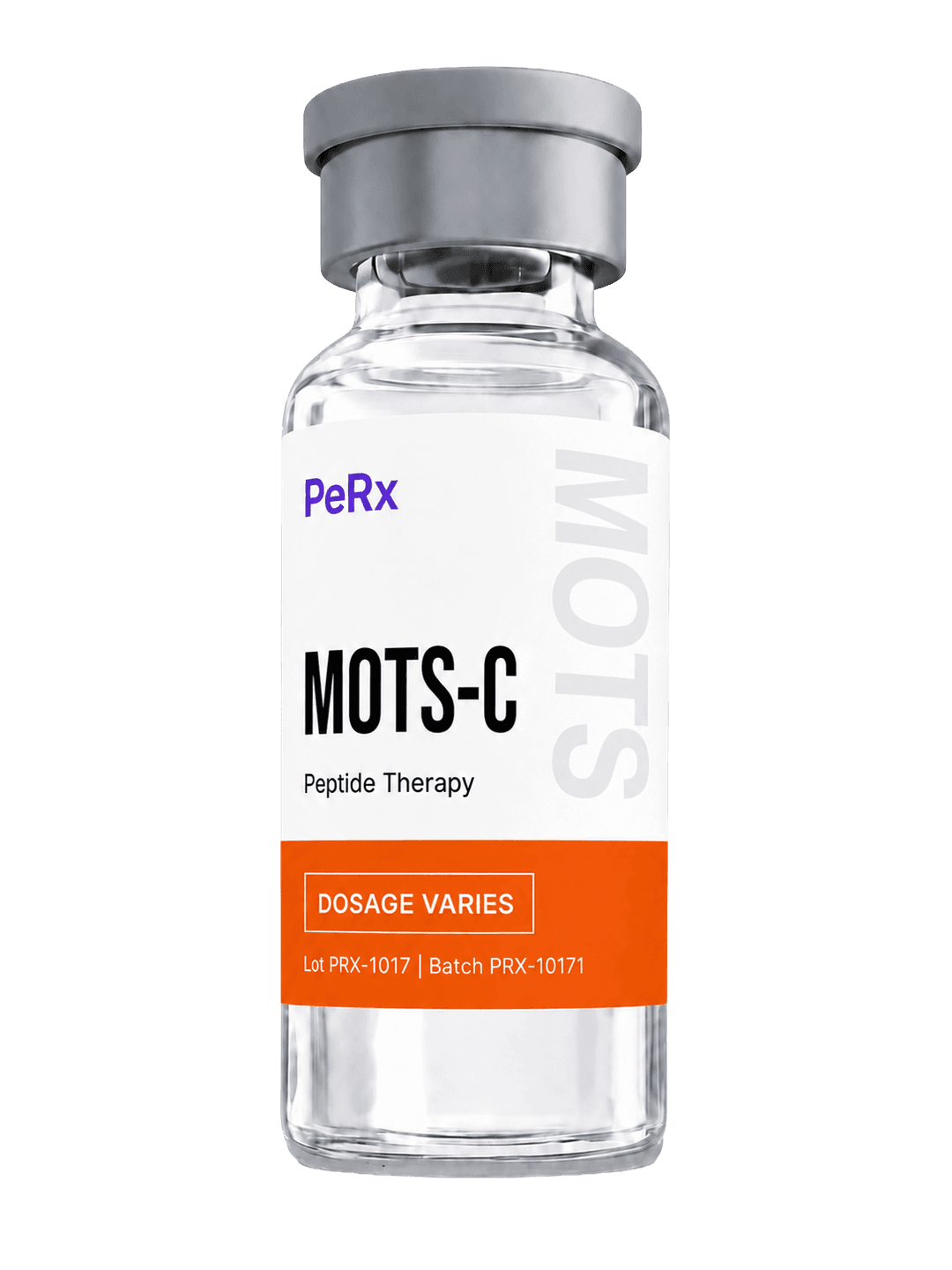
Half of what FDA reviewers worried about is the molecule. The other half is the vial: aggregates, synthesis impurities, endotoxin and unverified identity. PeRx MOTS-c is prescribed by a licensed provider after a health screening, compounded at a US-based 503A pharmacy at a fixed 2 mg/mL, and tested for potency and sterility. It ships fully reconstituted and ready to use, so there is no powder to mix and no concentration to work out.
Screening cannot turn unknown risks into known ones, but it catches the situations the mechanism points to, like a sulfonylurea on your medication list, before anything ships. $229 for a one-month supply, syringes and swabs included.
When to Stop and Contact a Clinician
Stop dosing and get in touch if you notice
Low blood sugar symptoms that recur: shakiness, sweating, confusion or a pounding heart after dosing, especially on diabetes medication. Treat the low first, then report it.
Signs of an immune reaction: hives, a widespread rash, fever or flu-like symptoms after an injection. Swelling of the face or throat, or trouble breathing, needs emergency care.
Heart symptoms: palpitations that persist, chest pain, fainting or shortness of breath.
An injection site that is getting worse: spreading redness, increasing warmth or swelling after 24 to 48 hours, pus, or firm lumps that do not settle.
Anything new that lasts: a symptom that persists beyond two to three weeks or intensifies with continued dosing. With no trial database to compare against, a clinician is the check, and an FDA MedWatch report is how the empty adverse-event record starts to fill in.
MOTS-c Side Effects: Common Questions
Related Guides
Continue reading about peptides and protocols that pair well with this guide.
MOTS-c Dosage Chart: Units, Protocols & Effects
MOTS-c is the 16-amino-acid mitochondrial peptide your body releases during exercise. This guide leads with what most readers came for: a real dosage chart with per-injection amounts, insulin syringe unit conversions, weekly totals, and cycle lengths. Then it covers the AMPK mechanism, the metformin comparison, the 2015 USC discovery story, and an honest read of the evidence.
Is MOTS-c FDA Approved? Mitochondrial Peptide Status
No. MOTS-C was only discovered in 2015. It is the newest peptide in clinical use and the first peptide ever found to be encoded by mitochondrial DNA rather than nuclear DNA. That discovery, from Changhan David Lee's lab at USC, upended decades of assumptions about where bioactive peptides come from. Here is what we know so far.
Peptides for Long-Haul Truckers: On-Road Recovery
How peptide therapy can support the body through interrupted sleep, hours of seated vibration, and the cognitive fade that builds late in a long run.
Ready to get started?
Pharmacy-compounded MOTS-c, prescribed by a licensed provider who reviews your health history and medication list first. Ships fully reconstituted and ready to use.
Medical Disclaimer
The information provided on this website, including all articles, guides, and educational content, is for informational and educational purposes only and is not intended as medical advice, diagnosis, or treatment. Nothing on this site should be construed as a substitute for professional medical advice from a qualified healthcare provider.
The majority of peptides discussed on this site are not approved by the U.S. Food and Drug Administration (FDA) for the indications described. They are classified as bulk drug substances and are available only through a licensed prescribing provider and compounding pharmacy. All treatments require a valid prescription and provider oversight.
The majority of published research on peptide therapies has been conducted in preclinical (animal) models. While early human data is encouraging, comprehensive clinical trial data remains limited for most peptide compounds. Individual results may vary significantly based on health status, injury type, and other factors. No specific outcomes are guaranteed.
Certain peptides discussed on this site are classified as prohibited substances by the World Anti-Doping Agency (WADA) and are banned by major sports organizations including the NFL, NCAA, UFC, NBA, MLB, NHL, and PGA. If you are subject to anti-doping testing, consult your governing body before considering any peptide therapy.
Statements on this website have not been evaluated by the Food and Drug Administration. Products and therapies discussed are not intended to diagnose, treat, cure, or prevent any disease.
© 2026 Wellness MD Group PC DBA PeRx. All rights reserved.