NAD Injections: What They Do, Cost, and Side Effects
Search for NAD injections and you mostly get IV lounges selling drips at several hundred dollars a session. This is the version the marketing leaves out: what a NAD injection actually is, which benefits the research supports, what side effects look like, honest dosing and cost numbers, and why a small daily subcutaneous shot at home has become the more practical way to take it.

In this article
Key Takeaways
- A NAD injection delivers nicotinamide adenine dinucleotide, the coenzyme every cell uses for energy metabolism and DNA repair, directly into the body instead of through the digestive tract.
- Age-related NAD+ decline is well documented in human tissue. What injections do for healthy adults is far less studied, so honest expectations matter more than marketing.
- Subcutaneous NAD+ absorbs slowly and rarely causes the flushing, chest pressure, and nausea that fast IV drips are known for.
- A common at-home protocol is one small injection Monday through Friday. PeRx prescribes NAD+ at $229 per month, while IV lounges commonly advertise $300 to $800 for a single drip.
- Most people who respond describe steadier energy and clearer focus building over weeks, not a dramatic overnight change. Anyone promising more is selling something.
NAD Injection Quick Facts
Full Name
Nicotinamide Adenine Dinucleotide (NAD+)
Type
Coenzyme, technically not a peptide
What It Does
Fuels cellular energy production, DNA repair, and sirtuin enzyme activity
How It Is Taken
Subcutaneous injection at home (PeRx) or IV infusion at a clinic
Typical Protocol
One small injection daily, Monday through Friday
Price
$229 per month through PeRx, prescription required
The search results for NAD injections are a strange place. Nearly every page is written by an IV therapy lounge selling the same thing: a multi-hour drip, commonly $300 to $800 a session, wrapped in language about cellular rejuvenation and celebrity clients. What almost none of them mention is that the drip format exists partly because of a side-effect problem, that the same molecule can be self-injected at home in under a minute, and that the honest evidence picture is more modest than the brochures suggest.
This guide covers the injection itself: what a NAD injection is, which benefits have research behind them, side effects, dosing, cost, and what before-and-after actually looks like. If you want the deep dive on the molecule, the sirtuin biology, and the full history from its 1906 discovery to the Harvard longevity labs, that lives in our complete NAD+ guide. This page is for the practical decision: is a NAD injection worth doing, and if so, which kind.
What Is a NAD Injection?
NAD+ (nicotinamide adenine dinucleotide) is a coenzyme found in every living cell. It is not exotic. It is one of the most fundamental molecules in biology, involved in hundreds of enzymatic reactions, including the ones that convert food into cellular energy inside your mitochondria. It also serves as fuel for two enzyme families that matter a lot in aging research: sirtuins, which regulate gene expression and cellular stress responses, and PARPs, which repair damaged DNA.
The reason anyone injects it comes down to two facts. First, NAD+ levels fall with age. A 2012 study by Massudi and colleagues measuring human tissue samples found that NAD+ declines substantially across adulthood while markers of oxidative stress rise. That decline is one of the more consistent findings in aging biochemistry. Second, NAD+ taken as a plain oral supplement is broken down in the digestive tract, which is why the oral market sells precursors like NMN and NR instead of NAD+ itself. An injection sidesteps the gut entirely and delivers the actual molecule.
Massudi H, Grant R, Braidy N, Guest J, et al. Age-associated changes in oxidative stress and NAD+ metabolism in human tissue. PLoS One. 2012;7(7):e42357. View study
A NAD injection, then, is simply NAD+ in sterile solution delivered past the digestive system. It comes in two main formats. IV infusion runs the molecule directly into a vein over one to several hours at a clinic. Subcutaneous injection places a small dose into the fat layer under the skin, where it absorbs gradually. The molecule is identical. The experience, the side-effect profile, and the price are very different, which is the subject of most of this article.
Not technically a peptide
NAD+ is a coenzyme built from nucleotides, not a chain of amino acids, so it is not strictly a peptide. It gets grouped with peptide therapies because it is prescribed, shipped, and injected the same way. At PeRx it sits in the same catalog as true peptides and follows the same physician-prescribed model.
NAD Injection Benefits: What the Research Supports
It helps to separate three tiers of evidence, because NAD marketing routinely blurs them. Tier one is established biochemistry. NAD+ is required for mitochondrial energy production, DNA repair, and sirtuin signaling, and its decline with age is linked to many of the cellular changes we associate with aging. A 2021 review in Nature Reviews Molecular Cell Biology by Covarrubias and colleagues lays this out in detail, and this tier is not controversial.
Covarrubias AJ, Perrone R, Grozio A, Verdin E. NAD+ metabolism and its roles in cellular processes during ageing. Nat Rev Mol Cell Biol. 2021;22(2):119-141. View study
Tier two is repletion evidence: can you actually raise NAD+ levels in humans? Yes. A 2018 trial by Martens and colleagues in Nature Communications found that six weeks of oral nicotinamide riboside raised blood NAD+ by roughly 60% in healthy middle-aged and older adults and was well tolerated. That study used an oral precursor rather than an injection, but it established the core point that age-related NAD+ decline is not fixed. Injection delivers the finished molecule directly, without depending on the conversion steps that precursors require.
Martens CR, Denman BA, Mazzo MR, Armstrong ML, et al. Chronic nicotinamide riboside supplementation is well-tolerated and elevates NAD+ in healthy middle-aged and older adults. Nat Commun. 2018;9(1):1286. View study
Tier three is outcome evidence: does raising NAD+ make a healthy adult feel or perform measurably better? This is where the data thins out, and where honesty matters. Large placebo-controlled trials of injectable NAD+ in healthy adults do not exist yet. What exists is the mechanistic case, encouraging preclinical work, and consistent subjective reports: steadier daytime energy, less afternoon crash, clearer focus, better recovery from exercise or poor sleep. Those reports line up with what the biochemistry predicts, but they are reports, not trial endpoints.
In practice, the people most likely to notice something are adults dealing with age-related energy decline, the group whose NAD+ levels have actually fallen. It is also why NAD+ shows up as a companion to GLP-1 weight loss programs, where fatigue during a calorie deficit is common. We cover that specific pairing in our guide to NAD+ for GLP-1 fatigue. And if your goal is detox or antioxidant support rather than energy, a different molecule may fit better. See NAD+ vs Glutathione for that comparison.
Do NAD Injections Really Work?
It depends on what you mean by work, so here is the question split honestly. Does injecting NAD+ raise NAD+ availability? Yes. That is basic pharmacology, and it is the whole reason injection exists as a format: the molecule reaches circulation without being dismantled by digestion. Does restoring NAD+ matter biologically? The aging literature strongly suggests it does, which is why serious longevity researchers study this pathway rather than dismissing it.
Does a NAD injection make you feel noticeably different? Sometimes, and gradually. This is not a stimulant. There is no acute effect to chase, and most people feel little on any individual day. What users describe, typically after two to four weeks of consistent dosing, is that the baseline quietly improves: mornings start faster, the 3 p.m. wall softens, mental fog thins out. Some people, particularly younger adults with healthy NAD+ levels, notice nothing at all. Both outcomes are real and worth knowing before you spend money.
One more data point argues for the slow-and-steady approach specifically. A 2019 pilot study by Grant and colleagues ran a six-hour IV NAD+ infusion in healthy males and found plasma NAD+ did not measurably rise until after the two-hour mark, suggesting tissues take up and use the molecule quickly rather than letting it pool in blood. NAD+ is consumed continuously by the enzymes that depend on it, and that pattern fits regular small doses better than an occasional large flood.
Grant R, Berg J, Mestayer R, Braidy N, et al. A pilot study investigating changes in the human plasma and urine NAD+ metabolome during a 6 hour intravenous infusion of NAD+. Front Aging Neurosci. 2019;11:257. View study
What NAD injections will not do: reverse aging, replace sleep, or fix a problem that is actually anemia, thyroid dysfunction, depression, or untreated sleep apnea. Persistent unexplained fatigue deserves a medical workup, not a wellness drip. A legitimate provider screens for exactly this before prescribing.
NAD Injection Side Effects
The side-effect story of NAD+ is mostly a story about delivery speed. When NAD+ enters a vein quickly, people commonly experience intense flushing, a feeling of pressure or tightness in the chest, nausea, and muscle cramping. This is well known in IV clinics, and it is why NAD+ drips are dripped: the infusion has to run slowly, often over two to four hours, because running it faster makes people feel awful. The multi-hour appointment is not a feature. It is a workaround.
Subcutaneous injection largely sidesteps this because absorption from the fat layer is gradual by nature. The common side effects of SubQ NAD+ are mild: brief warmth or light flushing for a few minutes after injecting, occasional redness or tenderness at the injection site, and sometimes mild nausea or muscle cramping at higher doses. The standard guidance handles this simply: stay well hydrated, and if nausea or cramping shows up, cut your next dose in half. Flushing that fades within a few minutes is normal and expected.
When to stop and get help
Seek immediate care for signs of a serious reaction: severe flushing that does not resolve within 30 minutes, chest tightness, swelling of the face, throat, or tongue, difficulty breathing, or dizziness. For minor issues like a small rash or injection-site irritation that lingers more than a few days, contact our care team.
NAD+ is not for everyone. Because NAD+ fuels cellular metabolism broadly, providers are cautious with anyone who has an active malignancy, and pregnancy or breastfeeding rules it out. This is why NAD+ injections are prescription therapy rather than a supplement-aisle purchase: a licensed provider reviews your health history first and screens out the situations where it is a bad idea.
SubQ NAD vs IV Drips
Both routes deliver the identical molecule with full bypass of the digestive tract. The differences are time, tolerability, cost, and dosing pattern.
| Subcutaneous at Home | IV Drip at a Clinic | |
|---|---|---|
| Where | Your home, any time | Clinic or lounge appointment |
| Time per dose | Under a minute | Roughly 1 to 4 hours |
| Absorption | Slow and steady from the fat layer | Rapid, rate-limited by side effects |
| Flushing and nausea | Uncommon and mild | Common when the drip runs fast |
| Dosing pattern | Small doses five days a week | Occasional large infusions |
| Typical cost | $229 per month through PeRx | $300 to $800 commonly advertised per session |
| Oversight | Physician-prescribed after health screening | Varies widely by operator |
Where
- Subcutaneous at Home
- Your home, any time
- IV Drip at a Clinic
- Clinic or lounge appointment
Time per dose
- Subcutaneous at Home
- Under a minute
- IV Drip at a Clinic
- Roughly 1 to 4 hours
Absorption
- Subcutaneous at Home
- Slow and steady from the fat layer
- IV Drip at a Clinic
- Rapid, rate-limited by side effects
Flushing and nausea
- Subcutaneous at Home
- Uncommon and mild
- IV Drip at a Clinic
- Common when the drip runs fast
Dosing pattern
- Subcutaneous at Home
- Small doses five days a week
- IV Drip at a Clinic
- Occasional large infusions
Typical cost
- Subcutaneous at Home
- $229 per month through PeRx
- IV Drip at a Clinic
- $300 to $800 commonly advertised per session
Oversight
- Subcutaneous at Home
- Physician-prescribed after health screening
- IV Drip at a Clinic
- Varies widely by operator
The dosing-pattern row deserves emphasis, because it is the physiological argument rather than just the convenience one. Your cells consume NAD+ continuously, and the Grant pilot data above suggests infused NAD+ is taken up quickly rather than banked. A once-a-month flood followed by four weeks of nothing is a strange match for a molecule your body burns through daily. IV still has its place for someone who wants a supervised setting or cannot self-inject, but for ongoing use, the math and the biology both lean subcutaneous.
If the idea of self-injecting gives you pause, the reality is gentler than it sounds: the needle is a tiny insulin syringe, the injection goes into the fat of the abdomen or thigh, and most people are comfortable after the first attempt or two. Our guide on where to inject NAD+ walks through sites, rotation, and technique step by step.
NAD Injection Dosage
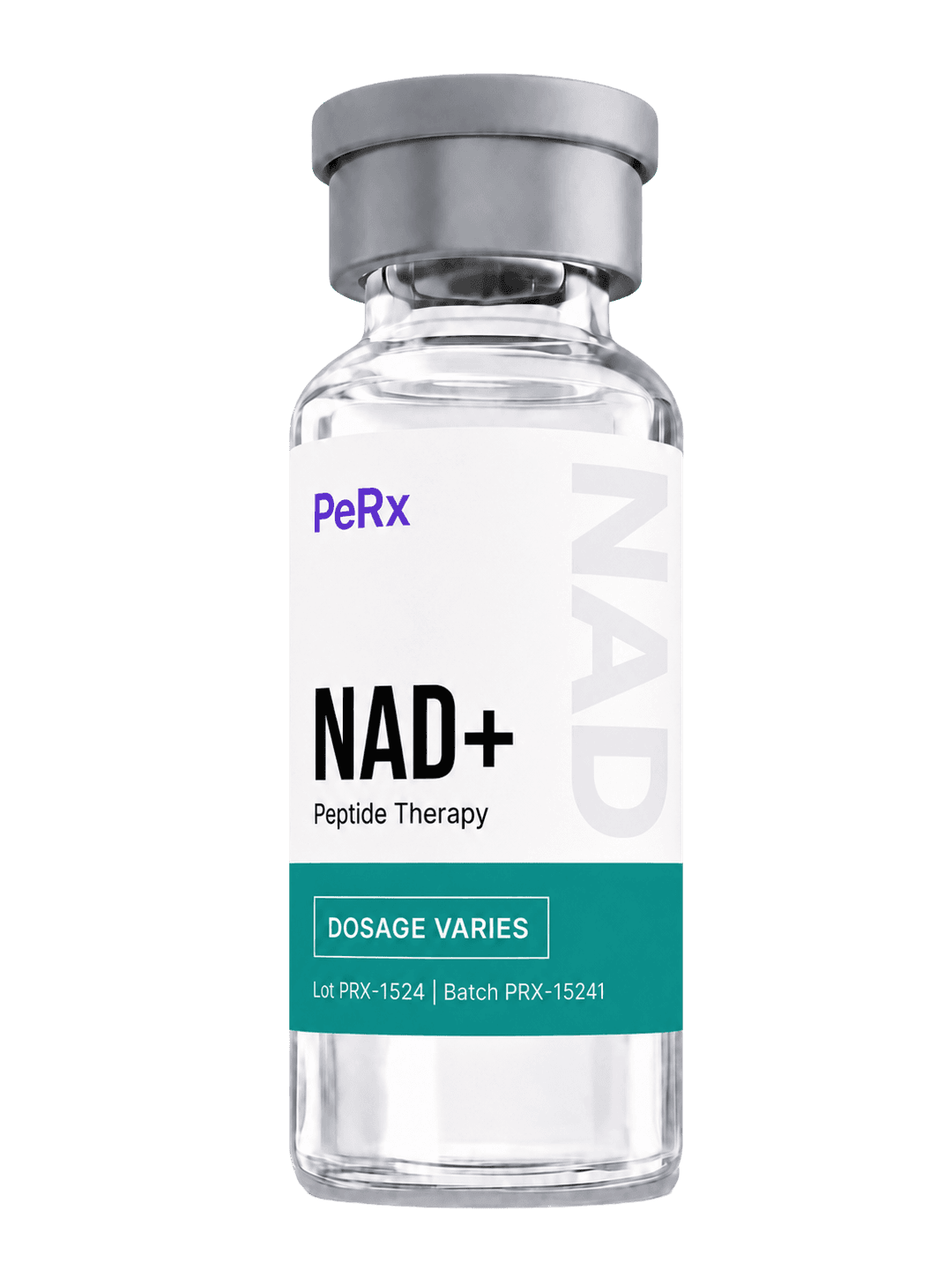
Dosing conventions differ by route. IV clinics typically infuse a few hundred milligrams up to around a gram in a single session, spaced weeks apart. Subcutaneous protocols use much smaller amounts far more often. The PeRx protocol is representative of the at-home approach: NAD+ comes as a 100 mg/mL solution in a 10 mL vial, and the standard dose is 20 units on an insulin syringe, which is 0.2 mL, injected under the skin once daily, Monday through Friday, with weekends off.
Typical PeRx NAD+ Protocol
Strength
100 mg/mL solution
Vial Size
10 mL
Dose
20 units (0.2 mL) on an insulin syringe
Frequency
Once daily, Monday through Friday
Route
Subcutaneous injection
Cycling
None required; may be used continuously as prescribed
Storage
Refrigerated at 36-46°F, never frozen
A few practical notes. Drink plenty of water on injection days; hydration noticeably reduces the chance of nausea or cramping. If either shows up anyway, take half the dose at your next injection. Unlike some peptides, NAD+ does not require a cycling break, so there is no mandated off period beyond the built-in weekend rest. Your PeRx provider prescribes the optimal protocol for you based on the current evidence, and the vial arrives with syringes, alcohol swabs, and an injection guide, so nothing needs to be measured or mixed. Every vial ships fully reconstituted and ready to use.
What NAD Injections Cost
IV NAD+ pricing varies by city and dose, but sessions are commonly advertised in the $300 to $800 range, with high-dose infusions sometimes running four figures. A once-monthly drip habit lands somewhere between $3,600 and $9,600 a year, and that buys twelve doses. Packages soften the per-session number, but you are still paying clinic overhead, chair time, and a nurse for every dose.
Subcutaneous pricing works differently because you are the one doing the ten-second injection. PeRx prescribes NAD+ at $229 for a one-month supply, covering the physician review, the pharmacy-compounded vial, cold shipping, and injection supplies, and that supports daily Monday-through-Friday dosing rather than one dose a month. Oral precursors like NMN and NR are cheaper still, often $40 to $100 a month, with the tradeoff that you rely on absorption and conversion instead of receiving the finished molecule. Since NAD+ is compounded rather than sold as an FDA-approved drug, the regulatory picture is worth understanding too. We explain it plainly in Is NAD+ FDA approved?
NAD+
PeRx NAD+ is prescribed by a licensed provider after a health screening, compounded at a US-based 503A pharmacy, and shipped cold to your door. It ships fully reconstituted and ready to use, with insulin syringes, alcohol swabs, and a step-by-step injection guide in the box.
The standard protocol is one small subcutaneous injection Monday through Friday. $229 per month, no clinic appointments, no drip chair.
Before and After: Honest Expectations
Searches for NAD injection before and after tend to expect transformation photos, so let us be straight: NAD+ does not produce visible before-and-after results the way a weight-loss medication might, and any page showing dramatic photos attached to NAD+ deserves skepticism. The changes people report are how their days feel, not how they look. Here is a realistic arc for someone who responds, based on typical user reports rather than any guaranteed outcome.
Week 1-2
Building the routine, expecting little
The first weeks are about consistency: a quick injection with your morning routine, five days a week. You may notice brief warmth or light flushing for a few minutes after injecting. Most people feel no meaningful energy change yet, and that is normal. If nausea or cramping appears, halve your next dose and drink more water.
Week 3-4
The window where responders start noticing
This is when subjective reports typically begin: mornings that start a little easier, a softer version of the afternoon slump, slightly cleaner focus during long work blocks. The changes are subtle enough that some people only spot them by comparing against how last month felt.
Month 2-3
Evaluate honestly
By now you have enough data to judge. If your baseline energy, focus, and recovery are noticeably steadier, the therapy is doing what it plausibly can. If you feel no different after two to three months of consistent dosing, that is a real answer too, and a reason to reassess rather than re-up on autopilot.
A fair self-experiment beats a testimonial. Before your first injection, write down three concrete markers: how hard mornings feel, when your afternoon energy dips, how long recovery takes after a hard workout or a short night. Check them monthly. That log will tell you more than any before-and-after gallery. And if longevity is the specific goal, our Epitalon vs NAD+ comparison covers how the two approaches differ.
Frequently Asked Questions
Related Guides
Continue reading about peptides and protocols that pair well with this guide.
NAD+ Injection: The Longevity Molecule, Explained
Hollywood's most talked-about anti-aging treatment used to require a $1,000 IV drip and four hours in a clinic. The same molecule, discovered in 1906, studied by Harvard, and endorsed by half the celebrity A-list, now comes as a simple at-home injection. Here's what NAD+ actually does, why your levels are dropping every year, and whether the hype is justified.
Where to Inject NAD+: Sites, Rotation, Sting
NAD+ is a subcutaneous injection, and it has a reputation for stinging more than most peptides. The good news is that the sting is almost entirely a technique problem. Where you put the needle, how slowly you push, and how you rotate all change the experience more than the molecule does. Here is the practical site-and-technique guide patients ask for after their first NAD+ vial arrives.
How Long Does Sermorelin Take to Work?
Sermorelin does not flip a switch. It works gradually by prompting your own pituitary to release more growth hormone, so the changes arrive in a predictable order rather than all at once. Sleep tends to shift first, then energy and recovery, then the slower body-composition and skin changes over several months. This guide lays out that arc honestly, explains what speeds it up or slows it down, and covers when to check back in with your provider.
Ready to get started?
Pharmaceutical-grade NAD+, delivered to your door with everything you need.
Medical Disclaimer
The information provided on this website, including all articles, guides, and educational content, is for informational and educational purposes only and is not intended as medical advice, diagnosis, or treatment. Nothing on this site should be construed as a substitute for professional medical advice from a qualified healthcare provider.
The majority of peptides discussed on this site are not approved by the U.S. Food and Drug Administration (FDA) for the indications described. They are classified as bulk drug substances and are available only through a licensed prescribing provider and compounding pharmacy. All treatments require a valid prescription and provider oversight.
The majority of published research on peptide therapies has been conducted in preclinical (animal) models. While early human data is encouraging, comprehensive clinical trial data remains limited for most peptide compounds. Individual results may vary significantly based on health status, injury type, and other factors. No specific outcomes are guaranteed.
Certain peptides discussed on this site are classified as prohibited substances by the World Anti-Doping Agency (WADA) and are banned by major sports organizations including the NFL, NCAA, UFC, NBA, MLB, NHL, and PGA. If you are subject to anti-doping testing, consult your governing body before considering any peptide therapy.
Statements on this website have not been evaluated by the Food and Drug Administration. Products and therapies discussed are not intended to diagnose, treat, cure, or prevent any disease.
© 2026 Wellness MD Group PC DBA PeRx. All rights reserved.