Sermorelin Tablets: Do Oral and Sublingual Work?
Tablets, troches and sublingual drops all promise sermorelin without the needle. This page does what the product listings do not: it goes to the published record, reports exactly what is in it, and explains what a 3,358-dalton peptide is up against on each route.
In this article
Key Takeaways
- As of September 2026, a PubMed search for sermorelin alongside oral, sublingual, troche, tablet or capsule returns zero results. The search is in this article so you can run it yourself. Every sermorelin tablet and troche on sale is being sold ahead of its evidence, not behind it.
- Sermorelin is a 29-amino-acid chain weighing 3,358 daltons. That is roughly three times the size of octreotide, the peptide the pharmaceutical industry did successfully move into a capsule, and it took an enteric coating, a permeability enhancer and a Phase III program to get there.
- The molecule is fragile by nature, not just in the gut. The FDA label for Geref, the approved injectable version, put the mean absolute bioavailability of a subcutaneous dose at about 6%, and the half-life at 11 to 12 minutes.
- That 6% figure is the real argument, and not in the direction most people expect. The point is not that it is low. The point is that somebody measured it in 12 volunteers and published it. No equivalent number exists for any troche.
- Route suitability is specific to the molecule, not a rule about peptides. Oral BPC-157 capsules are a legitimate product because that peptide is unusually stable in the stomach and its target is the gut lining itself. Sermorelin has neither property.
- PeRx prescribes sermorelin as a subcutaneous injection only, $229 for a one-month supply. There is no oral, sublingual or nasal sermorelin here, and this page explains the reasoning rather than routing around the question.
Oral Sermorelin at a Glance
Molecule
29 amino acids, 3,358 daltons, formula C149H246N44O42S
Published oral or sublingual studies
None indexed on PubMed as of September 2026
What the FDA label measured
About 6% absolute bioavailability, subcutaneous, in 12 volunteers
Half-life
11 to 12 minutes, the same by vein or under the skin
Route of the approved product
Injection. Both Geref approvals were injections, withdrawn in 2009
What PeRx prescribes
Subcutaneous injection only, 20 units at bedtime, $229 per month
Do Sermorelin Tablets Work?
Nobody knows, and that is the honest answer rather than a dodge. No published human study has measured whether a swallowed sermorelin tablet, a sublingual troche or a dissolvable strip puts any meaningful amount of intact sermorelin into the bloodstream. Products exist, some are dispensed by licensed compounding pharmacies with real prescriptions behind them, and patients report feeling better on them. What does not exist is a measurement.
That gap matters more for this molecule than for most, because sermorelin is unusually fragile even when you inject it. The rest of this page lays out the pharmacology, the exact literature search, and what a buyer can reasonably do with all of it. If you are looking for the injectable protocol instead, the sermorelin dosage chart has it.
Why PeRx Is Answering a Question About a Product It Does Not Sell
We prescribe sermorelin as an injection and nothing else, which gives us an obvious interest in the answer. So rather than assert a conclusion, this page shows the searches, the label figures and the sources, and you can check every one of them.
What the Published Record Contains
Start with the size of the whole field. Searching PubMed for sermorelin in the title or abstract returns 24 records, checked in September 2026. That is the entire indexed literature carrying the drug name prominently, across 35 years. Most of it is analytical chemistry written for anti-doping laboratories: methods for detecting growth hormone releasing hormone analogs in urine and blood. Two are clinical reviews. One is a case report.
Now narrow it to the route. Pair sermorelin with oral, with sublingual, with troche, tablet or capsule, or with bioavailability, and every one of those searches returns nothing at all. Not a small study, not an animal study, not a pharmacokinetic letter.
Run the Search Yourself
sermorelin[Tiab] AND oral[Tiab]
0 results
sermorelin[Tiab] AND sublingual[Tiab]
0 results
sermorelin[Tiab] AND (troche[Tiab] OR tablet[Tiab] OR capsule[Tiab])
0 results
sermorelin[Tiab] AND bioavailability[Tiab]
0 results
sermorelin[Tiab], the whole field
24 results, mostly doping-control assay development
Paste any of those into the PubMed search box. Counts change as papers are indexed, and if that first line ever returns something, this page should be updated. As of writing it does not. A 2026 review in Frontiers in Endocrinology arrives at the same place from a different direction: it sorts the growth hormone axis peptides into evidence tiers running from regulatory-grade randomized trial data down to a complete absence of human studies, and its whole premise is the distance between what the literature supports and what circulates in online self-administration protocols.
Dominikowski A, Rękoś Z, Olejarz M, Szczepanek-Parulska E, Domin R, Ruchała M. "The emerging landscape of performance-enhancing peptides modulating GH-IGF1 axis: bridging the gap between clinical evidence and patient self-administration." Frontiers in Endocrinology. 2026;17:1822475. View study
One more thing worth knowing. The paper most often cited as the reference for adult sermorelin is a two-page piece from 2006 in Clinical Interventions in Aging. It is a commentary rather than a trial, and it closes by offering free sermorelin to practitioners willing to study it. A legitimate opinion piece, and not evidence that a tablet absorbs.
Why Sermorelin Is Hard to Absorb
Two separate problems stack up here, and most pages only mention the first one.
The gut problem. Sermorelin is a chain of 29 amino acids. Your digestive tract runs on enzymes whose specific job is cutting chains of amino acids into pieces small enough to absorb. Swallowing a peptide feeds it to the machinery built to dismantle it. This is the general obstacle across the whole class, described plainly in a 2020 review in Nature Reviews Drug Discovery: peptide therapeutics require injection, oral delivery faces substantial barriers tied to how the gastrointestinal tract is organized, and getting around those barriers takes permeation enhancers, enzyme inhibitors or engineered carrier peptides.
Drucker DJ. "Advances in oral peptide therapeutics." Nature Reviews Drug Discovery. 2020;19(4):277-289. View study
The fragility problem. This one is specific to sermorelin and it is the more interesting half. The molecule is short-lived once it is in you, by any route. Chemists at Serono, the company that made the approved product, published on exactly this: the main drawback of using GRF(1-29) as a drug is a plasma half-life of roughly 10 to 20 minutes in humans, driven by filtration at the kidney and by enzymes chewing the chain from its N-terminal end. Their answer was to attach polyethylene glycol to the peptide to slow that destruction down, and they tested those conjugates by vein and under the skin.
Esposito P, Barbero L, Caccia P, et al. "PEGylation of growth hormone-releasing hormone (GRF) analogues." Advanced Drug Delivery Reviews. 2003;55(10):1279-1291. View study
Read that again with an eye on what is missing. The manufacturer knew its peptide was fragile, invested real chemistry in fixing it, and never went looking for an oral version. The engineering effort went into making an injection last longer.
The 6% Number, and What It Actually Argues
The clinical pharmacology section of the Geref label reports that 2 mg of sermorelin was given subcutaneously to 12 normal volunteers. Peak concentrations arrived in 5 to 20 minutes, and the mean absolute bioavailability of that subcutaneous dose was about 6%. Absolute bioavailability compares a route against an intravenous dose, so roughly 94% of an injection never arrives intact. Clearance ran 2.4 to 2.8 litres per minute.
That is low for an injected peptide, and it is a measurement of the molecule rather than a criticism of the needle. The approved dose was set with the loss already priced in. The reason it belongs on a page about tablets is the comparison it sets up: for the injection, twelve people were dosed and the fraction was published. For a troche, nobody has run the equivalent study, so the honest comparison is not a high number against a low one. It is a measured number against no number.
GEREF (sermorelin acetate for injection) prescribing information, Serono Laboratories. Description and Clinical Pharmacology sections, as archived by RxList. View study
Tablets, Troches, Sprays: Format by Format
The formats are not equivalent to each other. Here is each one on its own terms.
| Format | The idea behind it | What is published for sermorelin |
|---|---|---|
| Swallowed tablet or capsule | Convenience. Absorbed through the intestinal wall like any oral drug | Nothing. The peptide also has no gut-local target to act on along the way |
| Sublingual troche or tablet | Dissolve under the tongue, cross the mucosa, skip the stomach and the liver | Nothing. The route is real pharmacology, but permeability falls steeply with molecular size |
| Nasal spray | Thin, blood-rich nasal tissue. Several peptide hormones are marketed this way | A 1998 review listed GHRH among the intranasal peptides never brought to market |
| Subcutaneous injection | Deposit under the skin, absorb into blood and lymph, bypass digestion entirely | About 6% absolute bioavailability, measured in 12 volunteers for the approved product |
Swallowed tablet or capsule
- The idea behind it
- Convenience. Absorbed through the intestinal wall like any oral drug
- What is published for sermorelin
- Nothing. The peptide also has no gut-local target to act on along the way
Sublingual troche or tablet
- The idea behind it
- Dissolve under the tongue, cross the mucosa, skip the stomach and the liver
- What is published for sermorelin
- Nothing. The route is real pharmacology, but permeability falls steeply with molecular size
Nasal spray
- The idea behind it
- Thin, blood-rich nasal tissue. Several peptide hormones are marketed this way
- What is published for sermorelin
- A 1998 review listed GHRH among the intranasal peptides never brought to market
Subcutaneous injection
- The idea behind it
- Deposit under the skin, absorb into blood and lymph, bypass digestion entirely
- What is published for sermorelin
- About 6% absolute bioavailability, measured in 12 volunteers for the approved product
The sublingual row deserves the most care, because it is the format with the strongest theoretical case and it is where the better sellers have moved. Absorption under the tongue is genuine pharmacology. The tissue is thin and sits over a dense bed of vessels, and anything crossing it enters circulation without passing through the liver. The catch is that permeability drops sharply as molecules get larger, and sermorelin at 3,358 daltons sits far up that curve. Our sublingual peptides guide works through the size rules in detail and reaches the same conclusion about the growth hormone peptides as a group.
There is also a practical problem nobody advertises. Sublingual absorption is a race against your own swallowing reflex, and whatever goes down the throat before it crosses the mucosa becomes an ordinary oral dose, back in front of the digestive enzymes.
On the nasal route, a 1998 review of peptide hormones by nasal delivery is instructive. It names the peptides that made it to market that way, including desmopressin, oxytocin and salmon calcitonin, and then lists the ones that had not, with GHRH on that second list. Nearly thirty years later it is still there. Its opening line is the general rule: peptide hormones cannot be given by mouth, because they are digested and inactivated in the gastrointestinal tract and then hit significant first-pass metabolism in the liver.
Pontiroli AE. "Peptide hormones: Review of current and emerging uses by nasal delivery." Advanced Drug Delivery Reviews. 1998;29(1-2):81-87. View study
What Making a Peptide Oral Actually Takes
The best way to judge a compounded sermorelin troche is to look at what the pharmaceutical industry had to do when it genuinely solved this problem for another peptide. Octreotide is the clearest case. It is eight amino acids weighing about 1,019 daltons, roughly a third the size of sermorelin, and it had the same obstacle: it worked by injection and patients disliked the injections. The oral version that reached the clinic combines an enteric coating, so the capsule survives the stomach and releases in the small intestine, with a transient permeability enhancer that briefly opens the intestinal wall to let the peptide through. Twice-daily oral dosing reaches octreotide levels comparable with 100 micrograms given subcutaneously, and that conclusion rests on Phase III trials followed by durability data out to three years.
McLaren DS, Seejore K, Lynch J, Murray RD. "Oral Octreotide Capsules and Paltusotine in Management of Acromegaly." touchREVIEWS in Endocrinology. 2024;20(1):32-36. View study
Oral semaglutide tells the same story in a different molecule. It is an approved product, and it is approved because it is co-formulated with an absorption enhancer that carries it across the stomach lining, not because somebody discovered semaglutide absorbs on its own.
Set a compounded sermorelin troche next to either of those. It is a larger molecule than octreotide, it typically has no permeability enhancer, no enteric engineering, no pharmacokinetic study, and no clinical program. It is a peptide in a pleasant-tasting base. That is not an accusation of bad faith, and the pharmacies making these preparations are following prescriptions in the ordinary way. It is a statement about what has and has not been demonstrated.
Where Oral Peptides Genuinely Do Work
A page like this can slide into a blanket claim that oral peptides are a scam, and that claim is wrong. Route suitability belongs to the specific molecule and its target, not to the category. PeRx sells an oral peptide product, which would be indefensible if the blanket version were true.
BPC-157 capsules work for two reasons that sermorelin cannot borrow. The peptide was derived from a protein found in human gastric juice, so it is unusually stable in the exact environment that destroys most peptides. And for gut protocols the target tissue is the stomach and intestinal lining itself, which means contact happens before absorption is even the question. A peptide that only needs to touch the gut does not have the same problem as one that has to reach the pituitary. The BPC-157 route comparison covers where that argument holds and where it stops.
Sermorelin has neither property. It is not stable in the stomach, and its target is a gland at the base of the brain that it can only reach through the bloodstream. The general version of this trade-off, across the catalog, is in our oral vs injectable peptides guide.
Ideal for
The injection is the straightforward answer if: you want the route with a published absorption figure behind it; your goal depends on a predictable dose reaching circulation; you are comparing growth hormone peptides on evidence, as in tesamorelin vs sermorelin; or a small bedtime injection is an inconvenience rather than a real barrier.
Consider alternatives if
Think harder if: needle aversion is severe enough that you would not start at all. The honest comparison then is an unproven route against no treatment, and that conversation belongs with a clinician who knows your history. Neither route fits if: you have an active or recent cancer, are pregnant or breastfeeding, or compete in a drug-tested sport.
Questions to Ask Before You Buy
If you are going to buy an oral or sublingual sermorelin product anyway, and people will, these are the questions that separate a real pharmacy preparation from a bottle of something. The answers are also a fast way to tell whether a seller has thought about any of this.
Six Questions Worth Asking
What is the route and the dose, in micrograms?
A listing that names a format without a strength is not describing a medicine. Doses set for one route do not transfer to another.
Is there published human absorption data for this route?
For sermorelin by mouth or under the tongue, the answer in September 2026 is no. A seller who says otherwise should be able to name the study.
What does the testing cover, the raw powder or the finished product?
Identity and potency on an incoming powder says nothing about how much survives in the finished troche. How to read a peptide COA explains the difference.
Is this a patient-specific prescription from a licensed pharmacy?
A compounded preparation is dispensed against a prescription after a provider reviews your history. Anything sold as research material is not that.
What is the beyond-use date, and how is it stored?
Peptides degrade. A compounded preparation should carry a dated label and storage instructions, the same as any other prescription.
Who is accountable if something goes wrong?
The gap between a prescription and an online purchase is mostly a gap in accountability. Research vs prescription peptides covers what that difference is worth.
The Amazon Listing
One of the top ten results for sermorelin tablets is an Amazon listing selling sermorelin as laboratory research material. Sermorelin is a prescription drug substance. A product sold without a prescription, labelled for research, carries no assurance of identity, purity, sterility or dose, and the seller is not claiming it is a medicine. Is it safe to buy peptides online goes through how to tell these apart.
What the Injection Actually Involves
Most people searching for a sermorelin pill are not making a pharmacology argument. They are trying to avoid a needle, often picturing something from a doctor's office decades ago.
The PeRx protocol is 20 units on a U-100 insulin syringe, which is 0.2 mL, or 600 micrograms, into the fat layer of the abdomen or thigh at bedtime, Monday through Friday, at least two hours after eating. The needle is 29 to 31 gauge, thinner than the ones used for blood draws, and the whole business takes about ten seconds. Most people describe it as a pinch or as nothing at all. The vial ships fully reconstituted and ready to use, so there is no mixing and no measuring beyond lining up a mark on a syringe. Our injection site guide maps the rotation, and how to take peptides covers technique across the catalog.
The bedtime timing is not arbitrary either, and it is a detail the oral formats tend to lose. The largest natural growth hormone pulse in adults comes with the first stretch of deep sleep, and the dose is timed to land on top of it.
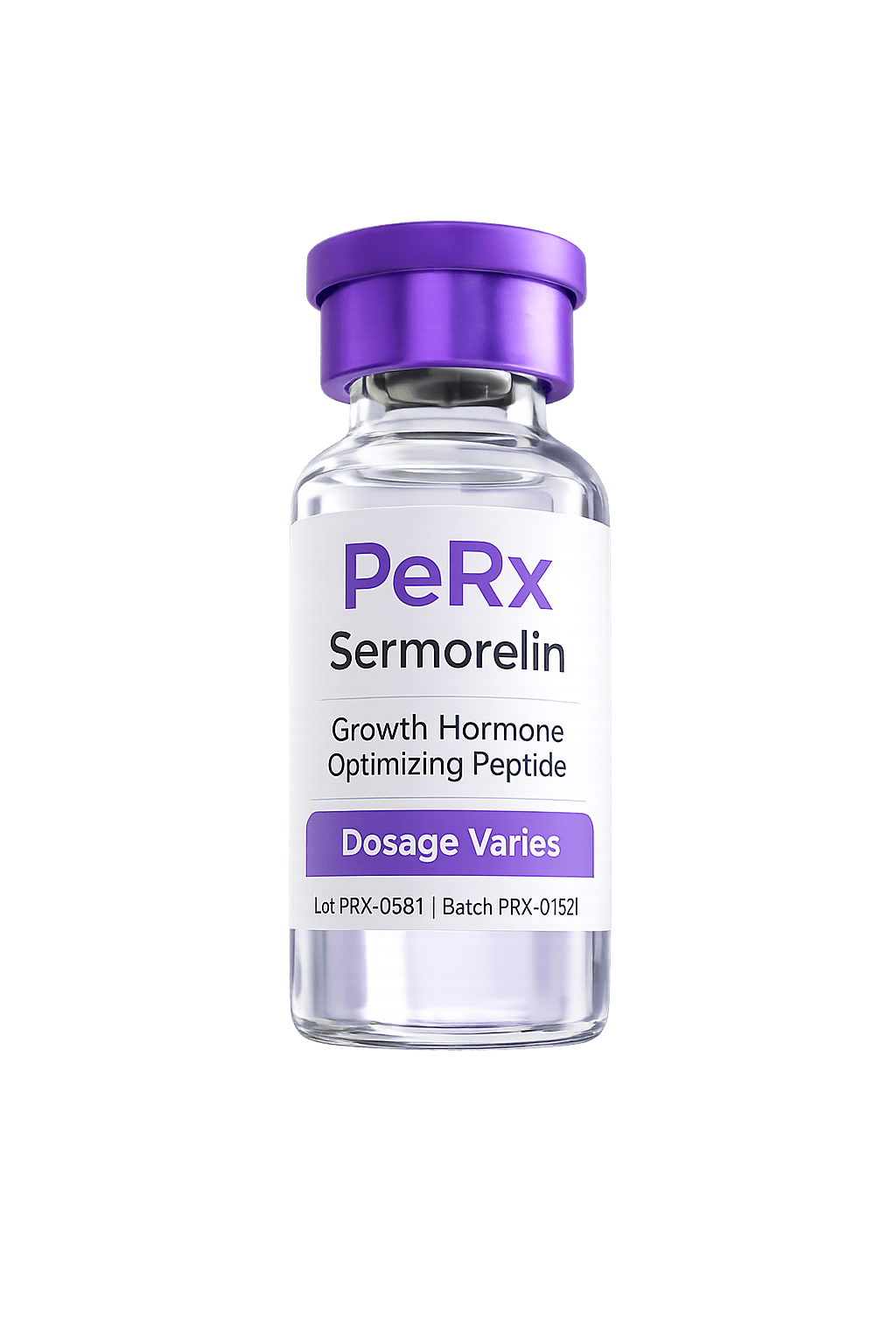
Sermorelin
One vial, 3 mg per mL, 5 mL, compounded by a licensed US 503A pharmacy against a prescription written after a provider reviews your intake. At 20 units a night, five nights a week, a vial is 25 doses. It arrives cold with syringes and alcohol swabs in the box and nothing to prepare.
Compounded sermorelin is not Geref and has not been through FDA review, which is worth stating on a page built around what has and has not been demonstrated. $229 for a one-month supply, charged only if a provider approves the prescription.
Sermorelin Tablets: Common Questions
Related Guides
Continue reading about peptides and protocols that pair well with this guide.
Is Sermorelin FDA Approved? Yes Until 2008
Sermorelin has a unique regulatory history. It was FDA-approved in 1997 as Geref Diagnostic for testing pituitary function, and its therapeutic form (Geref) was used for pediatric growth hormone deficiency. Then the manufacturer discontinued it in 2008. Today Sermorelin is only available as a compounded medication. Here is the full story.
Sermorelin Peptide: Benefits, Dosing & How It Works
Every growth hormone peptide used today traces its lineage back to this molecule. Sermorelin was once FDA-approved, then abandoned for commercial reasons. Now it's having a second act as the safest entry point into growth hormone optimization. The peptide that was too gentle for children turned out to be exactly what adults needed.
Is PT-141 Legal in 2026? Yes, and Here's Why
Yes, PT-141 is legal in the United States in 2026 when prescribed by a licensed provider and dispensed through a 503A or 503B compounding pharmacy. The active molecule (bremelanotide) is the same one the FDA approved as Vyleesi in 2019 for premenopausal women with HSDD, which gives the 503A compounding pathway a documented safety anchor. Compounded PT-141 was not restricted in the 2024-2026 peptide reclassifications. The version to avoid is unregulated "research chemical" PT-141 sold by gray-market suppliers, with no prescription, no testing, and not the same product.
Ready to get started?
Pharmacy-compounded sermorelin, prescribed by a licensed provider after a health review, shipped fully reconstituted and ready to use with everything you need.
Medical Disclaimer
The information provided on this website, including all articles, guides, and educational content, is for informational and educational purposes only and is not intended as medical advice, diagnosis, or treatment. Nothing on this site should be construed as a substitute for professional medical advice from a qualified healthcare provider.
The majority of peptides discussed on this site are not approved by the U.S. Food and Drug Administration (FDA) for the indications described. They are classified as bulk drug substances and are available only through a licensed prescribing provider and compounding pharmacy. All treatments require a valid prescription and provider oversight.
The majority of published research on peptide therapies has been conducted in preclinical (animal) models. While early human data is encouraging, comprehensive clinical trial data remains limited for most peptide compounds. Individual results may vary significantly based on health status, injury type, and other factors. No specific outcomes are guaranteed.
Certain peptides discussed on this site are classified as prohibited substances by the World Anti-Doping Agency (WADA) and are banned by major sports organizations including the NFL, NCAA, UFC, NBA, MLB, NHL, and PGA. If you are subject to anti-doping testing, consult your governing body before considering any peptide therapy.
Statements on this website have not been evaluated by the Food and Drug Administration. Products and therapies discussed are not intended to diagnose, treat, cure, or prevent any disease.
© 2026 Wellness MD Group PC DBA PeRx. All rights reserved.