Semax Peptide: What It Is, Uses, and the Evidence
Semax is a seven-amino-acid peptide designed in Moscow, registered in Russia as nasal drops, and sold in the United States mostly by chemical suppliers. This guide covers what it is, what the studies in rats and in people actually show, what FDA reviewers concluded in 2026, who gets screened out, and why PeRx prescribes it only inside an injected blend with Selank.

In this article
Key Takeaways
- Semax is a synthetic seven-amino-acid peptide (Met-Glu-His-Phe-Pro-Gly-Pro) modeled on a fragment of the hormone ACTH. It keeps none of the hormonal activity of ACTH. It is a registered medicine in Russia, sold there as nasal drops, and it is not FDA-approved.
- In rats, a single dose raised BDNF protein 1.4-fold and activated its receptor, trkB, in the hippocampus, and Semax also shifted serotonin turnover. That is the core of the mechanism story, and the FDA describes the mechanism overall as poorly understood.
- The human evidence is small and almost entirely intranasal. The FDA review dated May 11, 2026 found no human pharmacokinetic study by any route and no published study of Semax given by subcutaneous injection, which is how US clinics, PeRx included, prescribe it.
- FDA staff proposed keeping Semax off the 503A compounding list. On July 24, 2026 the advisory committee voted 8 to 5, with one abstention, to recommend it anyway. The vote is advisory, no rule has followed as of September 2026, and the status remains unsettled.
- PeRx prescribes Semax only inside the subcutaneous Semax/Selank blend ($299 per month), compounded at 1 mg/mL of each peptide. There is no nasal product here and no standalone Semax vial.
- N-acetyl Semax amidate is a chemically modified variant sold by research vendors. A PubMed search in September 2026 returns no studies under that name, the FDA review did not cover it, and PeRx does not sell it.
Semax Quick Facts
Full Name
Semax (Met-Glu-His-Phe-Pro-Gly-Pro)
Type
Synthetic heptapeptide, analog of the ACTH(4-10) fragment, no hormonal activity
Origin
Institute of Molecular Genetics, Russian Academy of Sciences. Registered in Russia as 0.1% and 1% nasal drops
Primary Mechanism
BDNF and trkB signaling plus serotonin turnover in rodent brain; not fully mapped
Studied For
Stroke recovery, attention and memory, optic nerve disease, mostly in Russia
At PeRx
Subcutaneous injection, only inside the Semax/Selank blend
What Is Semax?
Semax is a lab-made peptide seven amino acids long. Its design starts from ACTH, the pituitary hormone that tells your adrenal glands to release cortisol. Researchers noticed decades ago that short pieces of ACTH changed learning and attention in animals without touching the adrenal glands at all. The stretch numbered 4 through 10 carried most of that effect, but it did not survive long in the bloodstream.
Chemists at the Institute of Molecular Genetics in Moscow kept the first four amino acids of that fragment, Met-Glu-His-Phe, and swapped the last three for Pro-Gly-Pro, a tail that slows the enzymes that chew peptides apart. The result is Semax. The FDA describes it as "devoid of the hormonal corticotropic and melanotropic properties" of ACTH, meaning it does not raise cortisol and does not darken skin. In 1997 its designers published a retrospective covering fifteen years of work on the molecule, which dates the project to the early 1980s.
Its regulatory and commercial life has been almost entirely Russian. Semax is a registered drug there, dispensed as 0.1% and 1% nasal drops, and Russian neurologists have used it for stroke, circulation-related cognitive decline, and optic nerve disease. It is not an FDA-approved drug. Search for it in the United States and the first page is journal abstracts and chemical supply catalogs, a fair picture of a molecule well known to a small research community and barely tested anywhere else. Our overview of nootropic peptides for brain health places Semax next to the other cognitive peptides.
One Name, Several Molecules
The FDA flagged a problem most sellers never mention. "Semax" is a common name, not an official nonproprietary one, and the agency found the free base and the acetate salt sold under it interchangeably. Both nominations it reviewed named one form in the title and described another by CAS number. Add vendor variants such as N-acetyl Semax amidate, and a label reading "Semax" can mean at least three different substances.
What Does Semax Do?
Nearly everything known about how Semax works comes from rats and mice. The finding reported most often involves BDNF, brain-derived neurotrophic factor, a protein that supports the strengthening of connections between neurons during learning. In 2006 Dolotov and colleagues gave rats a single intranasal dose of 50 micrograms per kilogram and measured a 1.4-fold rise in BDNF protein in the hippocampus, along with a 1.6-fold rise in activation of trkB, the receptor BDNF acts through. The treated animals also learned an avoidance task faster.
Dolotov OV, Karpenko EA, Inozemtseva LS, et al. "Semax, an analog of ACTH(4-10) with cognitive effects, regulates BDNF and trkB expression in the rat hippocampus." Brain Research, 2006;1117(1):54-60. View study
How Semax Works
Four effects documented in rodents
BDNF and trkB
A single dose raised BDNF protein and activation of its receptor, trkB, in rat hippocampus.
Serotonin Turnover
The serotonin metabolite 5-HIAA rose 25% in striatal tissue two hours after dosing and climbed to 180% of baseline in the fluid between cells.
Amplified Dopamine Response
Semax alone left dopamine unchanged, but given before amphetamine it sharply increased the dopamine release and movement the stimulant caused.
Blood Flow and Clotting
In rat stroke models it reduced tissue damage, and separate rodent work points to anticoagulant and antithrombotic activity.
All four come from animal experiments. None is confirmed as a mechanism in people.
Eremin KO, Kudrin VS, Saransaari P, et al. "Semax, an ACTH(4-10) analogue with nootropic properties, activates dopaminergic and serotoninergic brain systems in rodents." Neurochemical Research, 2005;30(12):1493-1500. View study
Two of those four matter later in this guide. The amphetamine finding is why stimulant prescriptions come up in screening, and the clotting finding is why blood thinners do. As for the big picture, FDA pharmacologists described Semax as acting "through poorly understood mechanisms of action." A plausible BDNF story in rats is a reason to study a molecule, not a description of what happens in your own head.
What Is Semax Peptide Used For, and What Does the Research Show?
The limitation comes first: we found no large randomized trial of Semax for anything, published in a form Western regulators could assess. What exists is a long list of rodent experiments, a Russian clinical literature of mostly small or open-label studies, and brain-imaging pilots in healthy volunteers. The table sorts the common claims by what sits underneath them.
| Use people search for | What exists | Evidence tier |
|---|---|---|
| Stroke recovery | A 1997 study of 30 patients against 80 conventionally treated controls, and a 2018 rehabilitation study of 110 patients where plasma BDNF rose and function scores improved faster | Human, Russian-language, not placebo-controlled |
| Focus, attention, memory | A 1996 study in 19 healthy men and a 2018 fMRI pilot in 24 volunteers that showed a change in a resting brain network, with no cognitive test attached | Human pilot studies, intranasal |
| ADHD | One 2007 hypothesis article proposing it as a candidate. No trial | None |
| Protection after reduced blood flow to the brain | Rat models, including one where damaged areas were about 20% smaller after a week of dosing | Animal |
| Anxiety and low mood | Behavioral tests in rodents | Animal |
| Dementia or cognitive aging | No clinical studies. The Alzheimer's Drug Discovery Foundation review lists none | None |
Stroke recovery
- What exists
- A 1997 study of 30 patients against 80 conventionally treated controls, and a 2018 rehabilitation study of 110 patients where plasma BDNF rose and function scores improved faster
- Evidence tier
- Human, Russian-language, not placebo-controlled
Focus, attention, memory
- What exists
- A 1996 study in 19 healthy men and a 2018 fMRI pilot in 24 volunteers that showed a change in a resting brain network, with no cognitive test attached
- Evidence tier
- Human pilot studies, intranasal
ADHD
- What exists
- One 2007 hypothesis article proposing it as a candidate. No trial
- Evidence tier
- None
Protection after reduced blood flow to the brain
- What exists
- Rat models, including one where damaged areas were about 20% smaller after a week of dosing
- Evidence tier
- Animal
Anxiety and low mood
- What exists
- Behavioral tests in rodents
- Evidence tier
- Animal
Dementia or cognitive aging
- What exists
- No clinical studies. The Alzheimer's Drug Discovery Foundation review lists none
- Evidence tier
- None
Gusev EI, Skvortsova VI, Miasoedov NF, et al. "Effectiveness of semax in acute period of hemispheric ischemic stroke (a clinical and electrophysiological study)." Zhurnal Nevrologii i Psikhiatrii imeni S.S. Korsakova, 1997;97(6):26-34. In Russian. View study
Gusev EI, Martynov MY, Kostenko EV, et al. "The efficacy of semax in the treatment of patients at different stages of ischemic stroke." Zhurnal Nevrologii i Psikhiatrii imeni S.S. Korsakova, 2018;118(3 Vyp 2):61-68. In Russian. View study
Lebedeva IS, Panikratova YR, Sokolov OY, et al. "Effects of Semax on the Default Mode Network of the Brain." Bulletin of Experimental Biology and Medicine, 2018;165(5):653-656. View study
Three things make this record hard to lean on. Most of the clinical papers are in Russian with only an English abstract, so few readers can check the methods. The designs are weak by current standards: Semax added to standard care and compared, unblinded, against patients who did not get it. And one small circle of investigators, centered on the institute that invented the molecule, appears on most of the papers. None of that proves the findings wrong. It means nobody independent has repeated them, and repetition is how medicine tells a real effect from a hopeful one.
ADHD deserves a direct answer because so many people search it. The paper behind most online claims is a short 2007 hypothesis by Tsai, arguing that because Semax raises BDNF and amplifies stimulant-driven dopamine release in rodents, it might be worth testing in ADHD. Nobody ran that test. When the FDA looked at Semax for ADHD in 2026 it set the use aside because "supporting literature for this use was not found."
Tsai SJ. "Semax, an analogue of adrenocorticotropin (4-10), is a potential agent for the treatment of attention-deficit hyperactivity disorder and Rett syndrome." Medical Hypotheses, 2007;68(5):1144-1146. View study
Alzheimer's Drug Discovery Foundation. "Semax." Cognitive Vitality Report for researchers, June 2020. View study
Nasal Research, Injected Prescription: The Route Question
Almost every human dose of Semax in the published record went up the nose, and the rat data explain why. Radiolabeled Semax given intranasally reached the brain within two minutes, in amounts several times higher than after an intravenous injection of the same dose, most likely by traveling along the olfactory nerve. Either way the share was tiny, well under a tenth of one percent of the dose, and the peptide was broken down quickly, leaving the fragment Pro-Gly-Pro as the main remnant.
Shevchenko KV, Nagaev IIu, Alfeeva LIu, et al. "Kinetics of Semax penetration into the brain and blood of rats after its intranasal administration." Bioorganicheskaia Khimiia, 2006;32(1):64-70. In Russian. View study
Here is the uncomfortable part for any clinic that prescribes injected Semax, ours included. The FDA reviewers were "unable to find literature that discussed administration via subcutaneous injection" in people, and found no animal study of how Semax behaves after a subcutaneous dose either. Many rodent experiments did use injections into the abdomen, the amphetamine study among them, so injected Semax plainly does something in a rodent brain. But nobody has measured blood levels, brain delivery, or duration after a subcutaneous injection in a person, and results from one route do not transfer automatically to another.
Why inject it, then? Nothing PeRx sells is intranasal. We prescribe Semax only as part of a Semax/Selank vial that a US 503A pharmacy compounds as a sterile solution at a fixed concentration, so a dose is a volume you can read on a syringe. A nasal product adds a second variable, the pump. The FDA said it "would have strong concerns" about a compounded Semax nasal spray because nothing is known about how a container and pump would be chosen to deliver a consistent dose. The trade is real: injection buys measured dosing and a sterile product, and gives up the nose-to-brain shortcut the original research was built around. Where to inject Selank covers the practical side.
What FDA Reviewers Found in 2026
Ahead of its July 2026 advisory meeting, FDA staff wrote a roughly fifty-page evaluation of Semax, dated May 11, 2026. They searched PubMed, Embase, Cochrane, ClinicalTrials.gov and the FDA adverse event database. Their count of published human exposure they could assess: between 33 and 47 healthy adults, 69 adults with medical conditions, and 451 children in Russian studies of depression and tic disorders, several available only as conference abstracts. One paper reported no adverse events. The rest did not discuss adverse events at all.
They found no human pharmacokinetic study by any route. They found no acute toxicity, repeat-dose toxicity, or reproductive toxicity studies in animals. The adverse event database held a single report through December 3, 2025: a consumer who described eye pain and burning after using 0.1% nasal drops bought online. The Russian clinical papers did not count in the assessment, because FDA rules require a verified English translation of foreign-language material and none was supplied. That is a paperwork gap as much as a scientific one.
Three specific concerns stand out. The amphetamine result in mice raised a question about abuse potential that no study has addressed. The possible antithrombotic activity "raises concern about the risk of bleeding," particularly alongside other drugs that thin the blood. And like any injected peptide, Semax could provoke an immune response or clump into aggregates, a risk tied to impurities and manufacturing quality that nobody has tested for this molecule. On effectiveness, the conclusion was "insufficient evidence" for the three uses evaluated: reduced blood flow to the brain, migraine, and trigeminal nerve pain.
U.S. Food and Drug Administration. "FDA Briefing Document: Semax-Related Bulk Drug Substances (Semax (free base) and Semax acetate)." Pharmacy Compounding Advisory Committee, July 2026. Evaluation dated May 11, 2026. View study
The Regulatory Picture, September 2026
Semax is not an FDA-approved drug and is not a component of one. In April 2026 the FDA took it off the restricted Category 2 list along with eleven other peptides, a step that neither approved it nor added it to the list of substances 503A pharmacies may compound. FDA staff then proposed "not adding semax (free base) or semax acetate to the 503A Bulks List." On July 24, 2026 the Pharmacy Compounding Advisory Committee voted 8 to 5, with one abstention, to recommend adding it regardless. That vote is advisory. A change requires notice-and-comment rulemaking, none has been issued as of this writing, and until one is, the compounding status of Semax is unsettled. Our FDA panel write-up has the full meeting results.
Semax Side Effects and Who Gets Screened Out
With so little measured, any side-effect list for Semax is short and soft, and the only published rates come secondhand. The Alzheimer's Drug Discovery Foundation, citing a 2013 Russian review it could not check against original data, reports discoloration of the nasal lining in roughly 10% of patients using the drops and a rise in blood glucose in about 7.4% of patients with diabetes. The first is a nasal-route effect and does not apply to an injection. The second might, and it is on our intake for that reason. Long-term effects are unknown.
For the injected blend, what patients mention is ordinary: brief redness or soreness where the needle went in, and sometimes feeling wired or sleeping poorly if the dose is taken late in the day, which is why the blend is a morning injection. Those are reports, not measured rates, from a vial that also contains Selank. The screening below follows from the FDA findings and from mechanism: caution standing in for data.
What Screening Looks At Before Semax Is Prescribed
Stimulant medication
Semax amplified the dopamine surge from amphetamine in mice. Adderall, Vyvanse, methylphenidate and similar drugs need to be on your intake.
Blood thinners or a bleeding disorder
Rodent work suggests anticoagulant activity, and the FDA named bleeding risk as a concern.
Diabetes
A Russian review reported higher glucose readings in some diabetic patients.
Antidepressants and other psychiatric medication
Semax changes serotonin turnover in rodents, and no interaction study exists in people.
Pregnancy, trying to conceive, breastfeeding
No reproductive toxicity study of any kind exists. Not prescribed.
Stop and contact a clinician for hives, swelling of the face or throat, or trouble breathing after a dose, for unusual bruising or bleeding, for a racing heart or agitation that does not settle, or for an injection site that gets redder, hotter, or more swollen after a day or two. PeRx prescribes only to adults 21 and older. Our peptide side effects guide covers the reactions common to all injected peptides.
What Is N-Acetyl Semax Amidate?
N-acetyl Semax amidate, often shortened to NA-Semax, is Semax with two chemical caps added: an acetyl group on the front end of the chain and an amide on the back end. Peptide chemists use both modifications to slow the enzymes that attack a chain from its ends, and research vendors sell this version, usually as a nasal spray, with claims that it is stronger or longer lasting than plain Semax.
Nothing published supports those claims. A PubMed search in September 2026 for N-acetyl Semax and its spelling variants returns zero papers, against more than 230 for Semax itself. The capped molecule is a different substance, so the Russian clinical record, thin as it is, does not belong to it, and the FDA evaluation covered Semax free base and Semax acetate only. One naming trap: Semax acetate is a salt form of ordinary Semax, while N-acetyl Semax is a modified molecule. PeRx does not sell N-acetyl Semax amidate in any form.
Why We Pair Semax With Selank
Semax is the activating half of a pair. In animal work it pushes toward alertness and drive, and patients describe it the same way. Selank, a separate Russian peptide built from an immune fragment called tuftsin, has been studied for the opposite problem, anxiety, with a calming effect that does not sedate. If you are trying to work out which of the two you actually need, Semax vs Selank takes that apart. People rarely come to us wanting sharper focus alone. They want to think clearly under pressure, and the pressure is usually the larger half of the problem. Adding drive to an already anxious nervous system is a poor fit for that person, which is why we prescribe the two together and do not offer Semax alone.
The practical reason is simpler: one vial, one morning injection, one set of screening questions. The full case for the combination, including the Selank anxiety trial, is in our Selank and Semax guide, and peptides for anxiety weighs it against conventional options. If sleep and longer-horizon brain health interest you more than daytime focus, the other Selank-containing blend is covered in what is Pinealon and the Pinealon/PE-22-28/Selank guide.
How Semax Is Prescribed at PeRx
Most Semax sold online in the United States comes from research suppliers: vials and nasal sprays labeled not for human use, with no prescription, no screening, and no way to confirm which form of Semax is inside or whether it was tested for endotoxins, the bacterial residue that matters most in anything injected. The FDA noted that none of the seller websites it examined said whether the product was the base, a salt, or something else. Research peptides vs prescription peptides explains how far apart those two supply chains are, and how to read a peptide COA shows what a certificate should cover.
Semax/Selank
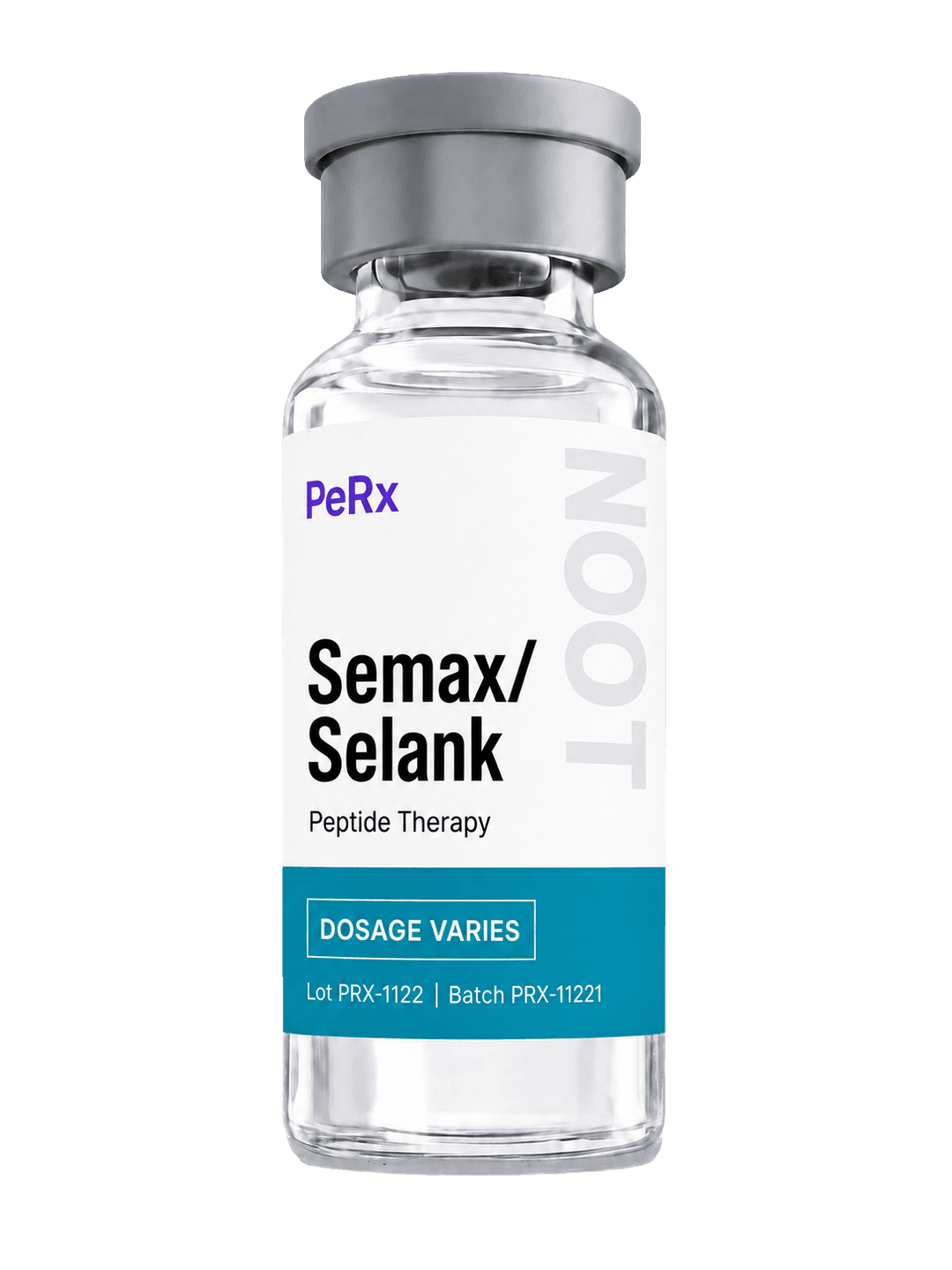
The only form of Semax PeRx prescribes: Semax and Selank together in one 5 mL vial, 1 mg/mL of each, compounded by a US 503A pharmacy. It is a subcutaneous injection taken in the morning. The vial ships fully reconstituted and ready to use, packed cold, with syringes and alcohol swabs in the box.
From $299 for a one-month supply. You complete an online intake, a licensed provider reviews it and prescribes the protocol if it fits, and your card is charged only after that approval. The dose is the one printed on your prescription label.
Semax: Common Questions
Related Guides
Continue reading about peptides and protocols that pair well with this guide.
Selank Peptide: What It Is, What It Does & Benefits
Your immune system already makes a molecule that calms anxiety. Soviet scientists found it in the 1970s, reverse-engineered it, and created two peptides: one that quiets anxiety without sedation, and another that sharpens cognition through BDNF. Both have been prescription medications in Russia since 2009. Combined in a single injectable blend, Selank and Semax cover both sides of the equation: calm and sharp at the same time.
Semax vs Selank: Which One Do You Actually Need?
Every page ranking for this question tells you to pick one: Semax for focus, Selank for calm. The split is useful and softer than the marketing admits. Here is what the single human head-to-head found, where the two run on the same machinery, where the FDA record splits them, and why a prescribing clinic puts both in one vial instead of making you choose.
Traveling With Peptides: TSA, Flying & Cold-Chain
Yes, you can fly with peptides. They are prescription injectable medications, which means they get the same TSA accommodations as insulin or any other refrigerated drug. The trick is packing them so they stay cold and clearing the checkpoint without a fuss. Here is the complete, practical walkthrough.
Ready to get started?
Pharmaceutical-grade Semax/Selank, both peptides in one ready-to-use vial, delivered to your door with everything you need.
Medical Disclaimer
The information provided on this website, including all articles, guides, and educational content, is for informational and educational purposes only and is not intended as medical advice, diagnosis, or treatment. Nothing on this site should be construed as a substitute for professional medical advice from a qualified healthcare provider.
The majority of peptides discussed on this site are not approved by the U.S. Food and Drug Administration (FDA) for the indications described. They are classified as bulk drug substances and are available only through a licensed prescribing provider and compounding pharmacy. All treatments require a valid prescription and provider oversight.
The majority of published research on peptide therapies has been conducted in preclinical (animal) models. While early human data is encouraging, comprehensive clinical trial data remains limited for most peptide compounds. Individual results may vary significantly based on health status, injury type, and other factors. No specific outcomes are guaranteed.
Certain peptides discussed on this site are classified as prohibited substances by the World Anti-Doping Agency (WADA) and are banned by major sports organizations including the NFL, NCAA, UFC, NBA, MLB, NHL, and PGA. If you are subject to anti-doping testing, consult your governing body before considering any peptide therapy.
Statements on this website have not been evaluated by the Food and Drug Administration. Products and therapies discussed are not intended to diagnose, treat, cure, or prevent any disease.
© 2026 Wellness MD Group PC DBA PeRx. All rights reserved.