Semax vs Selank: Which One Do You Actually Need?
Every page ranking for this question tells you to pick one: Semax for focus, Selank for calm. The split is useful and softer than the marketing admits. Here is what the single human head-to-head found, where the two run on the same machinery, where the FDA record splits them, and why a prescribing clinic puts both in one vial instead of making you choose.

In this article
Key Takeaways
- The usual summary is roughly right. Selank has the better human evidence for anxiety, built on a 62-patient Russian trial. Semax was studied mostly for stroke recovery and attention, in weaker designs. Neither has a large randomized trial a Western regulator could lean on.
- Only one published study gave both to people and compared them. In 52 healthy volunteers, brain imaging after an injection of Semax, Selank, or placebo found changes around the right amygdala. The region picked for the focus story is not where the difference showed up.
- They overlap more than the marketing admits. Both are seven amino acids, both were stabilized with the same Pro-Gly-Pro tail at the same Moscow institute, and both block the same enkephalin-degrading enzymes in human serum.
- The FDA record splits them in a way no comparison page mentions. Semax got a roughly fifty-page agency evaluation and an advisory vote in July 2026. Selank got neither, and the FDA wrote it out of scope for that review.
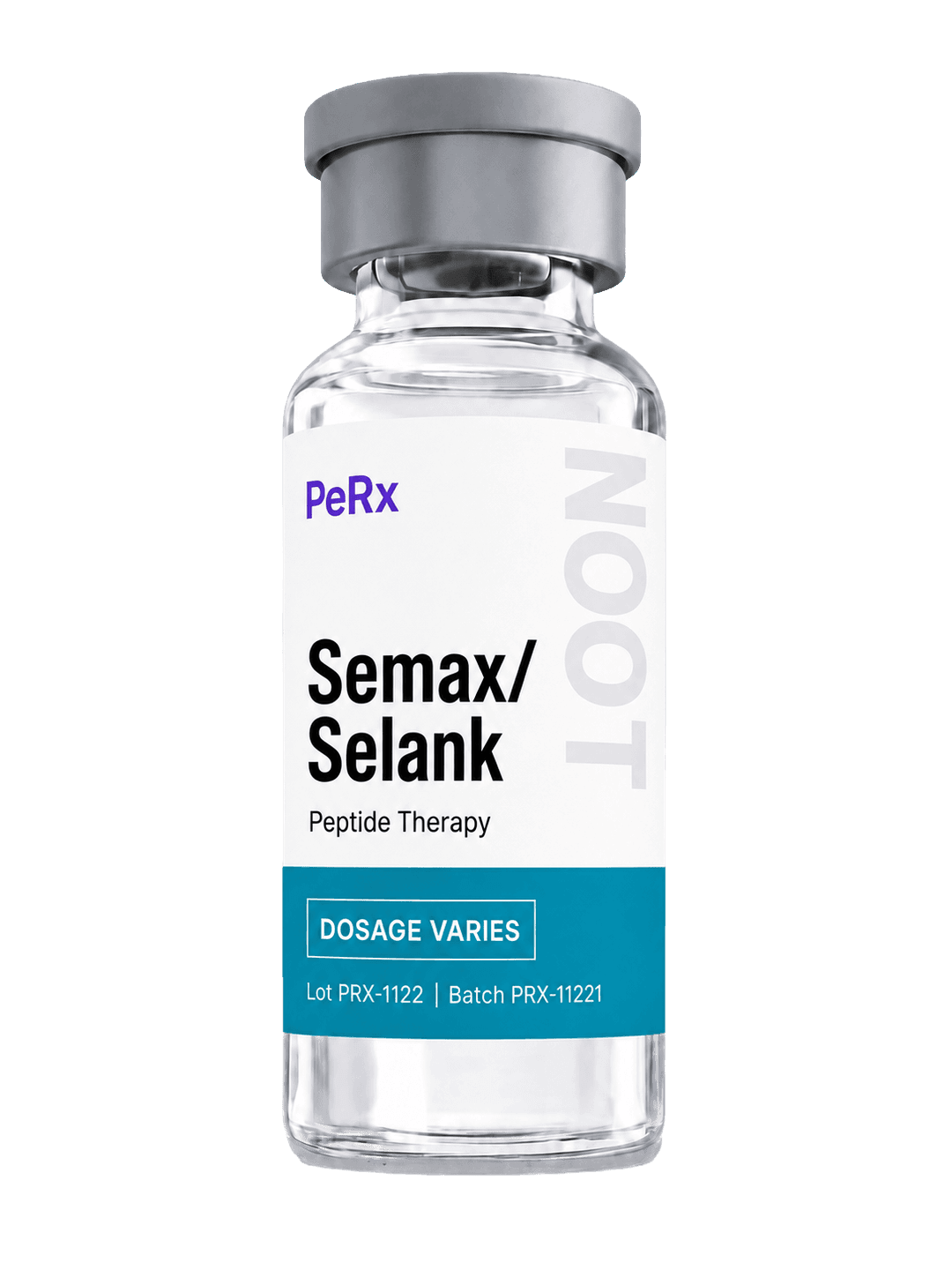
- Most published research on both used nasal dosing, and most of what sells online is a nasal spray. PeRx carries no nasal product. Both peptides reach PeRx patients in one subcutaneous vial at 1 mg/mL each.
- For anyone buying a prescription here, this is not a choice. The blend is $299 a month for both, and the practical case is one injection, one set of screening questions, and two peptides whose effects point in opposite directions.
Semax vs Selank at a Glance
Semax
ACTH(4-10) analog, studied for attention and stroke recovery
Selank
Tuftsin analog, studied for generalized anxiety
Shared Origin
Same Moscow institute, same Pro-Gly-Pro stabilizing tail
Best Human Evidence
Selank: a 62-patient anxiety trial. Semax: stroke add-on studies
Direct Comparisons
One imaging study in 52 healthy volunteers
How PeRx Supplies Them
Both in one subcutaneous vial, 1 mg/mL each, $299
The Short Answer
If you are comparing these two because you are about to buy one from a research vendor, the conventional split will serve you: Selank is the one with a controlled human trial behind its anxiety claim, and Semax is the one Russian neurologists reached for in stroke clinics and attention complaints. If you are comparing them because you are considering a prescription, there is nothing to decide. Both arrive in the same vial.
What almost no comparison page tells you is how thin the ground under that split really is. The two molecules came out of the same laboratory, share a stabilizing tail, and block the same family of enzymes in human blood. One study has ever given both to people and compared what happened, and reading it carefully complicates the tidy accelerator-and-brake story that the ranking pages repeat almost word for word.
What this page does not repeat
Mechanism detail for each peptide alone lives elsewhere and is not re-told here. Our Semax guide covers the BDNF research and what FDA reviewers wrote in 2026. The Selank and Semax guide covers the blend, the GABA story, and how it compares with benzodiazepines and SSRIs. This page stays on the comparison.
Semax vs Selank at a Glance
| Semax | Selank | |
|---|---|---|
| Built from | ACTH(4-10), a pituitary hormone fragment | Tuftsin, an immune peptide from antibody protein |
| Sequence | Met-Glu-His-Phe-Pro-Gly-Pro | Thr-Lys-Pro-Arg-Pro-Gly-Pro |
| Studied mainly for | Stroke recovery, attention, cognitive complaints | Generalized anxiety and asthenia |
| Best human study | Unblinded stroke add-on studies and imaging pilots | A 62-patient trial against a benzodiazepine |
| FDA evaluation | Full review and an advisory vote, July 2026 | Never evaluated. Written out of scope |
| At PeRx | Only inside the Semax/Selank vial | Only inside the Semax/Selank vial |
Built from
- Semax
- ACTH(4-10), a pituitary hormone fragment
- Selank
- Tuftsin, an immune peptide from antibody protein
Sequence
- Semax
- Met-Glu-His-Phe-Pro-Gly-Pro
- Selank
- Thr-Lys-Pro-Arg-Pro-Gly-Pro
Studied mainly for
- Semax
- Stroke recovery, attention, cognitive complaints
- Selank
- Generalized anxiety and asthenia
Best human study
- Semax
- Unblinded stroke add-on studies and imaging pilots
- Selank
- A 62-patient trial against a benzodiazepine
FDA evaluation
- Semax
- Full review and an advisory vote, July 2026
- Selank
- Never evaluated. Written out of scope
At PeRx
- Semax
- Only inside the Semax/Selank vial
- Selank
- Only inside the Semax/Selank vial
Same Lab, Same Trick, Different Start
The two are siblings in a literal sense. Both came out of the Institute of Molecular Genetics in Moscow, and both solved the same engineering problem the same way. A short natural peptide does something interesting in the brain but falls apart in the bloodstream within minutes, so the chemists bolted a Pro-Gly-Pro tail onto the end to slow the enzymes that chew peptides from their ends. Do that to a fragment of ACTH and you get Semax. Do it to tuftsin, a fragment of antibody protein described by an American immunologist in 1970, and you get Selank.
That shared design shows in the sequences. Semax is Met-Glu-His-Phe-Pro-Gly-Pro. Selank is Thr-Lys-Pro-Arg-Pro-Gly-Pro. Seven amino acids each, and the last three are identical. The starting material differs, which is where the accelerator-and-brake framing comes from, but the family resemblance is not cosmetic, and it has a consequence the next section gets to.
Where They Overlap
In 2001 a Moscow group tested both peptides against enkephalin-degrading enzymes from human serum. Enkephalins are the body's own opioid-like signaling peptides, and the enzymes that break them down handle other regulatory peptides too. Both inhibited those enzymes dose-dependently. Semax was the more potent, with a half-maximal concentration around 10 micromolar against roughly 20 for Selank, and both beat the reference inhibitors tested alongside them. The authors proposed this shared activity as one mechanism behind both peptides.
Kost NV, Sokolov OYu, Gabaeva MV, et al. "Semax and selank inhibit the enkephalin-degrading enzymes from human serum." Bioorganicheskaia Khimiia. 2001;27(3):180-183. PMID 11443939. View study
That finding is not obscure: the FDA cited the same paper in its 2026 reference list for Semax. It cuts against the premise of the comparison. Two peptides working partly through the same enzymatic route are not a stimulant and a sedative at opposite ends of a spectrum. They are close relatives with different emphases, a less satisfying answer than the search results offer and a more accurate one.
The enkephalin thread
The 62-patient Selank trial measured enkephalin activity in blood alongside the anxiety scores, reporting that patients with generalized anxiety started with lower enkephalin stability that rose during treatment. The same Moscow researchers appear on that trial and the enzyme paper. Whether the mechanism explains the clinical effect is unsettled, but it is the thread the group has pulled on for two decades.
The One Human Head-to-Head
Search PubMed for papers mentioning both peptides and you get eleven results. Most are rodent work, chemistry, or reviews. Exactly one put both molecules into people and compared them, and it is worth more attention than the entire first page of search results gives it.
In 2020, a group at the Mental Health Research Center in Moscow recruited 52 healthy volunteers and scanned them with resting-state functional MRI three times each: before an injection, five minutes after, and twenty minutes after. Participants received Semax, Selank, or placebo. The regions of interest were chosen in advance, and the choice maps neatly onto the marketing: the amygdala, described as one of the key regions for regulating anxiety, and the dorsolateral prefrontal cortex, called the key region for executive functions including working memory. Amygdala for the calm peptide, prefrontal cortex for the focus peptide.
Panikratova YR, Lebedeva IS, Sokolov OY, et al. "Functional Connectomic Approach to Studying Selank and Semax Effects." Doklady Biological Sciences. 2020;490(1):9-11. PMID 32342318. View study
The differences sat between the right amygdala and a region of the right temporal lobe. Both drugs moved that connection, and a follow-up analysis let the authors describe general and specific effects of each peptide on it, which they noted was the first time anyone had done so. The prefrontal region, picked to capture the cognitive story, does not appear in the reported findings at all.
What this study does not establish
Fifty-two people split three ways is roughly seventeen per arm. The endpoint was a brain-connectivity measurement, not a test of anxiety, attention, or memory, so nobody was asked whether they felt calmer or sharper. A shift in resting-state connectivity twenty minutes after an injection is evidence that an injected dose reaches the brain and does something measurable. It is not evidence that either peptide improves how you think or feel.
One more detail earns its place: participants were injected, where almost every other human study of either peptide used nasal dosing. For a clinic that prescribes these as a subcutaneous vial, it is the rare piece of human data collected by the route we use.
The animal literature that compared them directly tells a similar story with the same caveats. In a 2017 experiment, rats with chemically induced Parkinson-like damage received Semax or Selank. Neither peptide changed motor activity or defensive behavior. Selank reduced anxiety measures; the report describes no equivalent finding for Semax on those endpoints.
Slominsky PA, Shadrina MI, Kolomin TA, et al. "Peptides semax and selank affect the behavior of rats with 6-OHDA induced PD-like parkinsonism." Doklady Biological Sciences. 2017;474(1):106-109. PMID 28702721. View study
What Backs Each One
Strip out the direct comparisons and you are left with two separate evidence bases that are not the same size or the same quality, and not in the direction most people assume. Selank has fewer studies but its best one is a controlled clinical trial. Semax has more clinical volume but in designs that are harder to trust.
| Claim | What exists | Evidence tier |
|---|---|---|
| Selank for anxiety | 62 patients with generalized anxiety or neurasthenia, Selank against medazepam, standard rating scales | Human, controlled, no placebo arm |
| Selank works through GABA | 84 neurotransmission genes measured in rat frontal cortex, 45 changed at one hour | Animal, mechanistic |
| Semax for stroke recovery | Russian studies adding Semax to standard care, compared unblinded against patients who did not receive it | Human, weak design |
| Semax for focus | Rodent behavior work and small brain-imaging pilots in healthy volunteers | Animal plus imaging |
| Either one, long term | Nothing. No long-term safety study of either peptide by any route | None |
Selank for anxiety
- What exists
- 62 patients with generalized anxiety or neurasthenia, Selank against medazepam, standard rating scales
- Evidence tier
- Human, controlled, no placebo arm
Selank works through GABA
- What exists
- 84 neurotransmission genes measured in rat frontal cortex, 45 changed at one hour
- Evidence tier
- Animal, mechanistic
Semax for stroke recovery
- What exists
- Russian studies adding Semax to standard care, compared unblinded against patients who did not receive it
- Evidence tier
- Human, weak design
Semax for focus
- What exists
- Rodent behavior work and small brain-imaging pilots in healthy volunteers
- Evidence tier
- Animal plus imaging
Either one, long term
- What exists
- Nothing. No long-term safety study of either peptide by any route
- Evidence tier
- None
The Selank trial is the strongest single piece of evidence either peptide has, so its shape matters. Sixty-two patients with generalized anxiety disorder or neurasthenia were split between Selank and medazepam, a benzodiazepine. Both produced similar anxiolytic effects, and the authors reported that Selank additionally had antiasthenic and stimulating effects. Note what is missing: no placebo group, so the trial shows Selank performing like an active drug rather than proving it beats doing nothing. It was published in Russian in 2008.
Zozulia AA, Neznamov GG, Siuniakov TS, et al. "Efficacy and possible mechanisms of action of a new peptide anxiolytic selank in the therapy of generalized anxiety disorders and neurasthenia." Zhurnal Nevrologii i Psikhiatrii imeni S.S. Korsakova. 2008;108(4):38-48. PMID 18454096. View study
The GABA claim attached to Selank rests on gene expression rather than a receptor binding study. Researchers gave rats either Selank or GABA itself and measured 84 neurotransmission genes in the frontal cortex. Forty-five changed within an hour, twenty-two were still changed at three hours, and the Selank changes correlated positively with the GABA changes. That correlation is the basis for calling Selank an allosteric modulator of the GABA system: a reasonable inference from rat brain tissue, not a measurement in a person.
Volkova A, Shadrina M, Kolomin T, et al. "Selank Administration Affects the Expression of Some Genes Involved in GABAergic Neurotransmission." Frontiers in Pharmacology. 2016;7:31. PMID 26924987. View study
Nasal Research, Injected Prescription
Roughly three thousand US searches a month look for these two as a nasal spray, and the expectation is well founded. Most of the Russian research used nasal dosing, Semax is registered in Russia as nasal drops, and the products sold online are mostly sprays. Surveying the market in 2026, FDA reviewers found sites selling Semax alone and combined with Selank, including a fifty-fifty version offered both as an injectable and as a nasal spray.
PeRx does not sell a nasal product
Nothing in the PeRx catalog is a nasal spray, nasal drops, or intranasal in any form. Semax and Selank reach PeRx patients as a single sterile solution for subcutaneous injection, compounded at 1 mg/mL of each peptide in a 5 mL vial. Intranasal versions of both peptides are real, they are what most of the published research used, and other sellers offer them. We are not one of those sellers, and results from one route do not transfer automatically to another.
The tradeoff is worth stating plainly. A nasal dose takes a shortcut into the brain that an injection does not, and in rats it delivered several times more peptide to brain tissue than an intravenous dose of the same size. What it gives up is dose control, because the pump and container become variables. An injection gives up the shortcut and buys a fixed concentration and a volume you can read off a syringe. Our Semax guide covers the route question in depth, and where to inject Selank covers the vial.
Where the FDA Record Splits Them
Here the two genuinely part company, and no comparison page we found mentions it. Start with what they share. Both appear on the FDA page listing bulk substances nominated for compounding and later withdrawn, with near-identical language for each, warning that compounded drugs containing them may pose a risk of immunogenicity for certain routes because of potential aggregation and peptide impurities. Neither appears in any of the three categories of the FDA document tracking nominated substances, updated May 14, 2026.
The divergence is what happened next. FDA pharmacologists produced a roughly fifty-page assessment of Semax dated May 11, 2026, and on July 24, 2026 the Pharmacy Compounding Advisory Committee voted 8 to 5, with one abstention, to recommend adding it to the list of substances pharmacies may compound under section 503A, against the FDA staff position. Selank was not on the agenda either day. It has never had an agency evaluation, and the Semax review explicitly set it aside, noting that a submitted paper concerned "a different peptide, selank," which was "out of the scope of this evaluation and is, therefore, not further discussed."
U.S. Food and Drug Administration. "FDA Briefing Document: Semax-Related Bulk Drug Substances (Semax (free base) and Semax acetate)." Pharmacy Compounding Advisory Committee Meeting, July 23-24, 2026. Evaluation dated May 11, 2026. View study
What the vote does and does not mean
An advisory committee recommendation is advice, not a rule. Adding a substance to the 503A list requires rulemaking, and as of September 2026 no rule has followed. Semax having been voted on does not make it approved or settled, and Selank having been skipped does not make it prohibited. Both sit in a regulatory gray zone with the status unsettled. Our write-up of the July 2026 FDA panel covers the votes across all seven peptides.
Anti-doping is thinner than athletes expect, and here the two sit together. Neither peptide is named anywhere in the 2026 World Anti-Doping Agency Prohibited List. The list's S0 class sweeps in any pharmacological substance with no current approval by any governmental health authority for human therapeutic use, which is the provision usually cited for these peptides, though both are registered medicines in Russia. Do not try to resolve that ambiguity alone. Get a written determination from your anti-doping organization before using either, and see peptide therapy for athletes for the wider picture.
Side Effects and Screening
Neither peptide has a measured side-effect rate worth quoting, because nobody has run the studies that would produce one. FDA reviewers noted that adverse events went undiscussed in nearly every Semax study they read, and there is no comparable body of safety reporting for Selank at all. What follows is therefore a description of what is watched for and why, not a table of frequencies.
Two concerns apply to both rather than one. The first is immunogenicity, the possibility that an injected peptide provokes an immune response, which is the specific risk the FDA named for each. The second is bleeding. Russian work comparing anticoagulant effects across several proline-containing peptides examined both, and the FDA flagged possible antithrombotic activity for Semax as a concern for anyone on blood thinners. That question sits open for the pair.
Liapina LA, Pastorova VE, Obergan TIu, et al. "Comparison of anticoagulant effects of regulatory proline-containing oligopeptides. Specificity of glyprolines, semax, and selank and potential of their practical application." Izvestiia Akademii Nauk. Seriia Biologicheskaia. 2006;(2):193-203. PMID 16634437. View study
Ideal for
Adults who want the cognitive and stress-resilience angles covered together, who are comfortable with a daily morning injection, and who can read a small and mostly Russian evidence base for what it is.
Consider alternatives if
Anyone on an anticoagulant or antiplatelet drug, anyone pregnant or breastfeeding, and anyone with a diagnosed anxiety disorder looking for a substitute for therapy or psychiatric medication rather than something alongside them. Tested athletes without a written ruling. If sleep rather than daytime stress is the real problem, best peptides for sleep covers what targets it directly.
What patients on the injected blend actually report is unremarkable: brief redness or soreness at the injection site, and occasionally feeling wired or sleeping badly if the dose lands too late in the day, which is why it is a morning injection. Those are reports rather than measured rates. Stop and contact a clinician for hives, swelling of the face or throat, trouble breathing, or unusual bruising or bleeding after a dose.
Why We Prescribe the Pair
The case for combining them is practical, and its limits are worth stating. No published trial has tested Semax and Selank together against either alone, so the pairing rests on mechanism and clinic experience rather than evidence that the combination beats its halves. What it does buy is concrete: one vial, one morning injection, one set of screening questions, and a pharmacy preparing a fixed concentration of each instead of two products bought separately and dosed by guesswork.
The logic is that anxiety and concentration are not separate problems for most people who come looking. Worry consumes the attention that focus needs, and a heavy cognitive load generates the stress that feeds the worry. Semax is the activating half and Selank the settling half, and they can share a syringe because neither is a sedative. The fuller argument for the blend sits in the Selank and Semax guide, while peptides for anxiety and nootropic peptides for brain health weigh it against the alternatives on each side.
If You Are Buying Them Separately
Most Semax and Selank sold in the United States comes from research suppliers, labeled not for human use, with no prescription and no screening. The quality problem that creates is not hypothetical. In 2017 and 2018, Belgium's national health institute analyzed two seized suspicious pharmaceutical preparations and found they contained Selank and Semax. The researchers noted that neither peptide had completed any clinical trial to their knowledge, that both were freely available online as powder for injection or as nasal sprays, and built a laboratory method so control agencies could identify them in future seizures.
Vanhee C, Francotte A, Janvier S, Deconinck E. "The occurrence of putative cognitive enhancing research peptides in seized pharmaceutical preparations: An incentive for controlling agencies to prepare for future encounters of the kind." Drug Testing and Analysis. 2020;12(3):371-381. PMID 31667971. View study
The FDA made a related observation from the other direction: surveying sites selling Semax, it found that none indicated whether the product contained the free base or a salt, two forms sold interchangeably under one name. The questions worth asking are which form is in the vial, what it was tested for beyond purity, and whether anyone screened you before you injected it. How to read a peptide COA covers what those reports do and do not include, and research peptides vs prescription peptides lays out how differently the two channels are regulated.
Semax/Selank
Both peptides in one 5 mL vial at 1 mg/mL each, compounded by a licensed US 503A pharmacy and shipped fully reconstituted and ready to use. One small subcutaneous injection in the morning covers both.
From $299 for a one-month supply. Checkout saves your card without charging it, and the charge only goes through once a provider has approved the prescription.
Common Questions
Related Guides
Continue reading about peptides and protocols that pair well with this guide.
Selank Peptide: What It Is, What It Does & Benefits
Your immune system already makes a molecule that calms anxiety. Soviet scientists found it in the 1970s, reverse-engineered it, and created two peptides: one that quiets anxiety without sedation, and another that sharpens cognition through BDNF. Both have been prescription medications in Russia since 2009. Combined in a single injectable blend, Selank and Semax cover both sides of the equation: calm and sharp at the same time.
Where to Inject Semax/Selank: Sites, Rotation, Timing
PeRx sells Selank as part of the Semax/Selank blend, a single vial given as a subcutaneous injection. Standalone intranasal Semax is a different product. This guide covers where to place the blend, how to rotate sites, and why morning timing matters, as of July 2026.
Is Glutathione FDA Approved? Antioxidant Status
Glutathione is the most abundant antioxidant in your body. Oral glutathione supplements are sold everywhere. IV and injectable glutathione are used in clinics worldwide. But the FDA approval picture is more nuanced than you might expect. Here is what glutathione actually is, how different forms are regulated, and what the science supports.
Ready to get started?
Pharmaceutical-grade Semax/Selank, delivered to your door with everything you need. Both peptides in one vial, prescribed after a licensed provider reviews your intake.
Medical Disclaimer
The information provided on this website, including all articles, guides, and educational content, is for informational and educational purposes only and is not intended as medical advice, diagnosis, or treatment. Nothing on this site should be construed as a substitute for professional medical advice from a qualified healthcare provider.
The majority of peptides discussed on this site are not approved by the U.S. Food and Drug Administration (FDA) for the indications described. They are classified as bulk drug substances and are available only through a licensed prescribing provider and compounding pharmacy. All treatments require a valid prescription and provider oversight.
The majority of published research on peptide therapies has been conducted in preclinical (animal) models. While early human data is encouraging, comprehensive clinical trial data remains limited for most peptide compounds. Individual results may vary significantly based on health status, injury type, and other factors. No specific outcomes are guaranteed.
Certain peptides discussed on this site are classified as prohibited substances by the World Anti-Doping Agency (WADA) and are banned by major sports organizations including the NFL, NCAA, UFC, NBA, MLB, NHL, and PGA. If you are subject to anti-doping testing, consult your governing body before considering any peptide therapy.
Statements on this website have not been evaluated by the Food and Drug Administration. Products and therapies discussed are not intended to diagnose, treat, cure, or prevent any disease.
© 2026 Wellness MD Group PC DBA PeRx. All rights reserved.