Pinealon Peptide: What It Is, Evidence and Dosing
Pinealon is three amino acids long, comes from one research institute in St. Petersburg, and is sold with a confidence its evidence does not support. Here is what the peptide actually is, why its name points at the wrong gland, what about twenty published studies do and do not show, why the dosing charts online disagree, and why we only prescribe it as one part of a three-peptide blend.
In this article
Key Takeaways
- Pinealon is a synthetic tripeptide, Glu-Asp-Arg (also written EDR), developed by Vladimir Khavinson’s group at the St. Petersburg Institute of Bioregulation and Gerontology. At three amino acids it is one of the smallest compounds sold as a peptide, and it is not FDA-approved.
- Despite the name, it did not come from the pineal gland. The institute’s own review describes it as isolated from Cortexin, a brain cortex preparation, and in the group’s one experiment on pineal tissue it was Epitalon, not Pinealon, that changed how pineal cells behaved.
- The evidence is cell-culture and rodent work from a single research school. PubMed returned 22 records for the word pinealon in September 2026, about twenty of them relevant and twelve in Russian. There is no randomized controlled trial and no study registered on ClinicalTrials.gov.
- The human reports that exist describe capsules taken by mouth or do not state a route. None describes an injection. One 32-person report also recorded pro-oxidant activity and a fall in CD34+ blood stem cell counts alongside its favorable findings.
- Nobody has published a human pharmacokinetic study, and no indexed study measures sleep or melatonin in anyone given Pinealon. The dosing charts online come from vendor and community protocols, not from dose-finding trials.
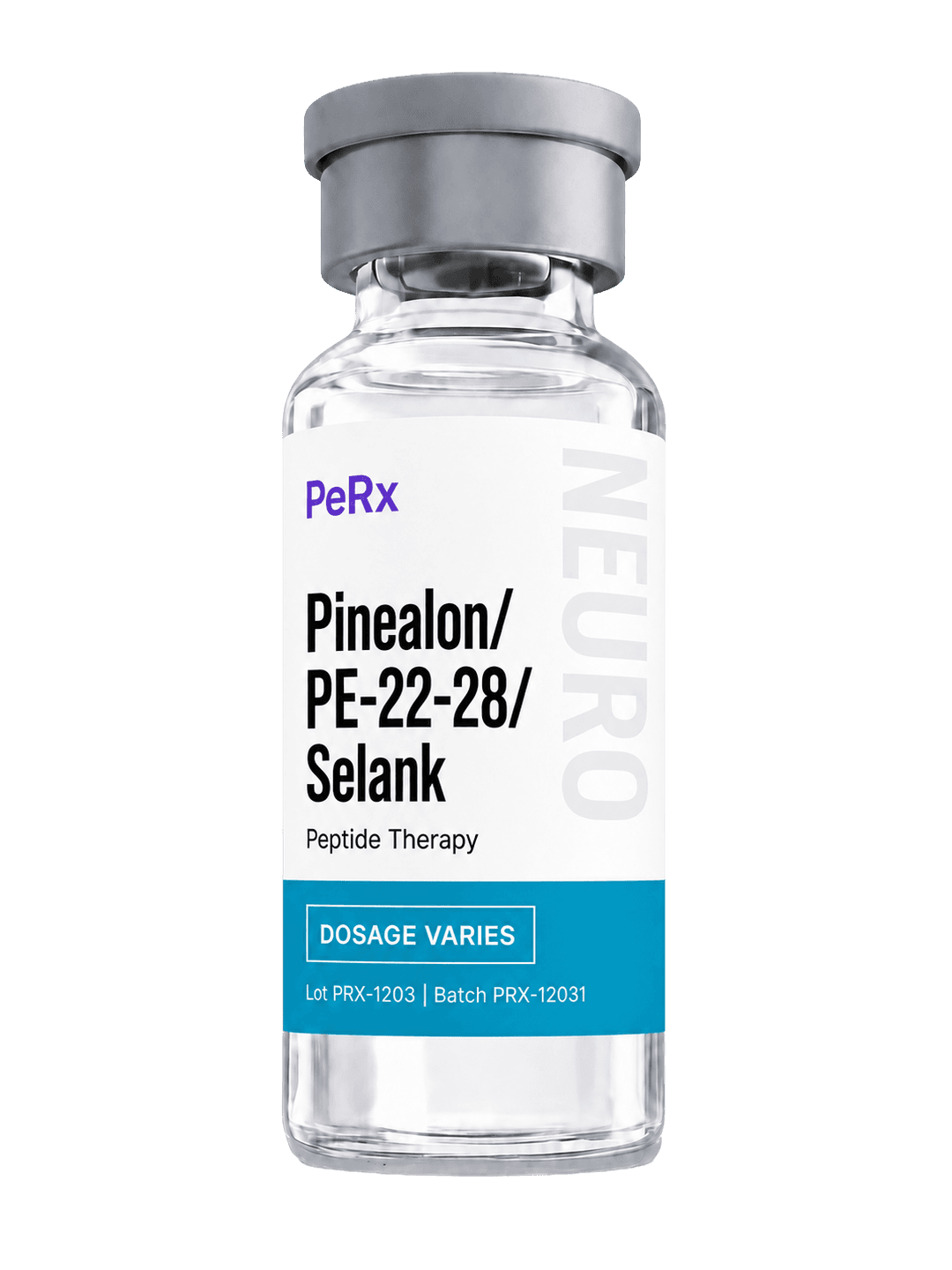
- PeRx prescribes Pinealon only inside the subcutaneous Pinealon/PE-22-28/Selank blend ($299 for a one-month supply). The vial holds 2 mg/mL of each peptide, so every 10 units on an insulin syringe carries 0.2 mg of each. There is no standalone Pinealon vial.
- Pinealon does not appear in any category of the FDA’s list of substances nominated for 503A compounding (updated May 14, 2026), which means the agency has never evaluated it. It is not named on the 2026 WADA Prohibited List, but the S0 catch-all for unapproved substances covers it.
Pinealon at a Glance
Full name
Pinealon, also written EDR peptide (Glu-Asp-Arg)
Type
Synthetic tripeptide, one of the Russian "peptide bioregulators"
Developed by
St. Petersburg Institute of Bioregulation and Gerontology. Earliest PubMed paper: 2008
Human evidence
A few small Russian reports, oral where a route is given. No randomized trial
How PeRx supplies it
Only inside the subcutaneous Pinealon/PE-22-28/Selank blend, 2 mg/mL of each
Last reviewed
September 2026
What Is Pinealon?
Pinealon is a synthetic peptide made of three amino acids: glutamic acid, aspartic acid and arginine, written Glu-Asp-Arg or EDR. It belongs to a family of very short "peptide bioregulators" developed at the St. Petersburg Institute of Bioregulation and Gerontology, and it has been studied mostly in cell cultures and rats for protecting neurons under stress. It is not an FDA-approved drug.
Three amino acids is small even by peptide standards. BPC-157 has 15, Selank has 7, and insulin has 51. The institute’s founder, Vladimir Khavinson, built a research program around the idea that fragments this short, which his group calls cytogens, can slip into cells and switch genes on or off in a tissue-specific way. Pinealon is the program’s brain peptide. Its siblings include Epitalon, four amino acids long and studied for aging and the pineal gland, and Vesugen, another tripeptide.
Most pages that rank for Pinealon are selling vials, and they call it a sleep peptide, a memory peptide and an anti-aging peptide, often in one paragraph. We prescribe it, inside one blend, and would rather you see how thin the file is first. For the comparison with its better-known cousin, see Epitalon vs Pinealon.
Pinealon and the Pineal Gland: The Name Problem
The name suggests a peptide taken from the pineal gland that tunes melatonin and sleep. Vendor pages and forum posts repeat that story, and some state outright that it was isolated from pineal tissue. The institute’s own papers tell a different one. In a 2020 review, Khavinson and colleagues describe EDR as a tripeptide isolated from Cortexin, a polypeptide preparation made from brain cortex and used in Russia as a neuroprotective drug. The source tissue is cortex. The pineal connection lives in the branding.
The group did test Pinealon on pineal tissue once, and the result is worth knowing. In 2011 they grew rat pineal gland in culture and added four short peptides. Epitalon and a second tripeptide raised a marker of cell proliferation. Only Epitalon raised the secretory marker they tracked. Pinealon is not reported to have raised either, none of the peptides changed the cell-death marker, and the authors’ conclusion credits Epitalon alone with a tissue-specific effect on pineal cells.
Khavinson VKh, Linkova NS, Chalisova NI, Dudkov AV, Koncevaya EA. "Effect of short peptides on expression of signaling molecules in organotypic pineal cell culture." Bulletin of Experimental Biology and Medicine. 2011;152(1):138-141. View study
What about sleep itself? We searched PubMed in September 2026 for Pinealon alongside sleep, melatonin or circadian rhythm. The only hit was an orthopaedics review that mentions the peptide once. No indexed study has measured melatonin or sleep quality in anyone given Pinealon. The nearest threads are a cell-culture paper in which EDR increased serotonin, the chemical precursor of melatonin, in aging cortex cells, and a rat carotid-occlusion study that recorded more sleep behavior after dosing.
What People Report vs What Was Measured
People on the blend often describe vivid dreams and deeper sleep in the first couple of weeks. That is anecdote, not measurement, and in a three-peptide vial it cannot be separated from what Selank, the calming component, is doing.
How Pinealon Is Thought to Work
Most peptide drugs work by docking onto a receptor on the cell surface. The bioregulator school proposes something more direct for its short peptides: they enter the cell, reach the nucleus and bind DNA or the histone proteins that package it, nudging particular genes. For Pinealon the supporting pieces look like this.
How Pinealon Works
Four findings behind the proposed mechanism
It reaches the nucleus
Fluorescently labeled Pinealon showed up in the cytoplasm, nucleus and nucleolus of HeLa cells in a 2011 experiment.
It binds DNA in a test tube
Spectroscopy, NMR and simulation work from a St. Petersburg physics group placed EDR partly inside DNA’s major groove, helped along by magnesium ions.
Predicted gene targets
Computer docking fits EDR to promoter sequences of genes including CASP3, SOD2, NES, GAP43 and APOE. These are modeled fits, not binding measured in neurons.
Less oxidative damage in cells
In cultured cerebellar neurons, neutrophils and PC12 cells, Pinealon limited reactive oxygen species and cell death and delayed ERK 1/2 activation.
All four come from cell-free, cell-culture or computer models.
It is a coherent hypothesis, and an unusual one. Three amino acids picking out a specific six-letter DNA sequence among roughly three billion would be remarkable selectivity, and outside this research school the idea has barely been tested. Treat the mechanism as proposed.
Fedoreyeva LI, Kireev II, Khavinson VKh, Vanyushin BF. "Penetration of short fluorescence-labeled peptides into the nucleus in HeLa cells and in vitro specific interaction of the peptides with deoxyribooligonucleotides and DNA." Biochemistry (Moscow). 2011;76(11):1210-1219. View study
What the Pinealon Research Shows
PubMed returned 22 records for the word pinealon in September 2026. Two are unrelated or passing mentions. The other twenty are close to the whole indexed file, twelve of them in Russian, and a few newer papers use only the name EDR. The table sorts the common claims by the strongest evidence behind each.
| Claim | Strongest evidence available | Evidence tier | Independent of the institute? |
|---|---|---|---|
| Protects neurons from oxidative stress | Less reactive oxygen species and cell death in cultured neurons and PC12 cells (2011). Less oxidative DNA damage in neurons made from elderly donors’ skin cells, no effect on mitochondria or p16 (2024) | Cell culture | No |
| Improves learning and memory | Rats learned a water maze better than with Cortexin in one study. Pups of methionine-loaded mothers learned better when the mothers received Pinealon | Animal | No |
| Protects synapses in Alzheimer’s models | Reported to prevent dendritic spine loss in the 5xFAD mouse model. The daily injections described in that paper used a sister peptide, KED | Cell and animal model | No |
| Improves sleep or melatonin | No indexed study measures either. Serotonin rose in aging cortex cell cultures, and one rat study noted more sleep behavior | None direct | Not applicable |
| Helps cognition after brain injury | 72 patients given oral Pinealon on top of standard therapy, described second-hand in the institute’s reviews. Design not available in English | Human report, design unclear | No |
| Slows biological aging | 32 adults aged 41 to 83. Biological-age indices improved, less than with Vesugen. Pro-oxidant activity and a fall in CD34+ blood stem cell counts were also recorded | Human, small, no control group described | Partly. A Ural medical group using the institute’s preparations |
| Safe for long-term use | No published toxicology program, no human pharmacokinetics, no registered trial | None | Not applicable |
Protects neurons from oxidative stress
- Strongest evidence available
- Less reactive oxygen species and cell death in cultured neurons and PC12 cells (2011). Less oxidative DNA damage in neurons made from elderly donors’ skin cells, no effect on mitochondria or p16 (2024)
- Evidence tier
- Cell culture
- Independent of the institute?
- No
Improves learning and memory
- Strongest evidence available
- Rats learned a water maze better than with Cortexin in one study. Pups of methionine-loaded mothers learned better when the mothers received Pinealon
- Evidence tier
- Animal
- Independent of the institute?
- No
Protects synapses in Alzheimer’s models
- Strongest evidence available
- Reported to prevent dendritic spine loss in the 5xFAD mouse model. The daily injections described in that paper used a sister peptide, KED
- Evidence tier
- Cell and animal model
- Independent of the institute?
- No
Improves sleep or melatonin
- Strongest evidence available
- No indexed study measures either. Serotonin rose in aging cortex cell cultures, and one rat study noted more sleep behavior
- Evidence tier
- None direct
- Independent of the institute?
- Not applicable
Helps cognition after brain injury
- Strongest evidence available
- 72 patients given oral Pinealon on top of standard therapy, described second-hand in the institute’s reviews. Design not available in English
- Evidence tier
- Human report, design unclear
- Independent of the institute?
- No
Slows biological aging
- Strongest evidence available
- 32 adults aged 41 to 83. Biological-age indices improved, less than with Vesugen. Pro-oxidant activity and a fall in CD34+ blood stem cell counts were also recorded
- Evidence tier
- Human, small, no control group described
- Independent of the institute?
- Partly. A Ural medical group using the institute’s preparations
Safe for long-term use
- Strongest evidence available
- No published toxicology program, no human pharmacokinetics, no registered trial
- Evidence tier
- None
- Independent of the institute?
- Not applicable
The cell work
The founding English-language paper, from 2011, exposed three cell types to oxidative stress and found that Pinealon held down reactive oxygen species and necrotic cell death in a dose-dependent way. A 2024 paper used a more modern model, neurons reprogrammed from the skin cells of elderly donors. EDR encouraged dendrite growth and reduced oxidative DNA damage. It did nothing for mitochondrial or lysosomal activity or for p16, a marker of cellular aging.
Khavinson V, Ribakova Y, Kulebiakin K, Vladychenskaya E, Kozina L, Arutjunyan A, Boldyrev A. "Pinealon increases cell viability by suppression of free radical levels and activating proliferative processes." Rejuvenation Research. 2011;14(5):535-541. View study
Kraskovskaya N, Linkova N, Sakhenberg E, et al. "Short Peptides Protect Fibroblast-Derived Induced Neurons from Age-Related Changes." International Journal of Molecular Sciences. 2024;25(21):11363. View study
The animal work
In rats, the cleanest study gave Pinealon to pregnant animals fed excess methionine, a diet that raises homocysteine and harms the developing brain. Their offspring showed better spatial learning, and neurons from the pups’ cerebellum resisted oxidative stress better. Other rat work, mostly from a collaborating group in Rostov, covers hypoxia, hypothermia and carotid artery occlusion in old animals. The Alzheimer’s-model paper vendors cite most reports that EDR and KED prevented dendritic spine loss. A correction to it was published in 2025.
Arutjunyan A, Kozina L, Stvolinskiy S, Bulygina Y, Mashkina A, Khavinson V. "Pinealon protects the rat offspring from prenatal hyperhomocysteinemia." International Journal of Clinical and Experimental Medicine. 2012;5(2):179-185. View study
Khavinson V, Ilina A, Kraskovskaya N, et al. "Neuroprotective Effects of Tripeptides-Epigenetic Regulators in Mouse Model of Alzheimer’s Disease." Pharmaceuticals (Basel). 2021;14(6):515. View study
The human reports
The figure quoted most often is 72 patients with lingering effects of traumatic brain injury, given oral Pinealon alongside standard therapy, with better memory, milder headaches and steadier mood reported afterward. We could only find it second-hand, in the institute’s 2020 English review, which cites a 2013 Russian-language review. Whether there was a control group or blinding is not something an English-speaking reader can check. Several pages attach those patients to the 2011 cell-culture paper, whose abstract describes cell experiments only.
The other human material is occupational and geriatric: truck drivers, locomotive crews and older adults given Pinealon, usually with Vesugen, as what the authors call preventive nutrition. The most informative is a 32-person study from a medical group in the Urals. It reported improved biological-age indices, with Vesugen looking better than Pinealon. It also reported pro-oxidant activity on chemiluminescence testing and a drop in circulating CD34+ cells, which the authors read as suppressed blood cell formation. Findings like that rarely reach a sales page.
Khavinson V, Linkova N, Kozhevnikova E, Trofimova S. "EDR Peptide: Possible Mechanism of Gene Expression and Protein Synthesis Regulation Involved in the Pathogenesis of Alzheimer’s Disease." Molecules. 2020;26(1):159. View study
Meshchaninov VN, Tkachenko EL, Zharkov SV, Gavrilov IV, Katyreva IuE. "Effect of synthetic peptides on aging of patients with chronic polymorbidity and organic brain syndrome of the central nervous system in remission." Advances in Gerontology. 2015;28(1):62-67. Article in Russian. View study
Why Single-Lab Evidence Gets a Discount
Most of the papers above carry an author from the St. Petersburg institute, and the rest come from Russian groups working with its preparations. We could not find a study of Pinealon itself from a laboratory outside Russia. That describes where the file stands. It is not an accusation, and science discounts unreplicated findings for ordinary reasons: inventors tend to find what they hope to find, and positive results get written up more often than negative ones. None of this work was registered in advance. ClinicalTrials.gov lists no study of Pinealon at all.
The school’s own head-to-head results are more mixed than the marketing suggests. In aged rats under hypoxia and cold stress, Cortexin, the parent extract, affected free-radical processes and caspase-3 more than Pinealon did. In the carotid-occlusion study, caspase-3 activity rose moderately with Pinealon, against the protective story. In the 32-person report the sister peptide looked better. Mixed results are normal in pharmacology. A literature that almost nobody else has tried to repeat is not.
Mendzheritsky AM, Karantysh GV, Ryzhak GA, Prokofiev VN. "Pinealon and Cortexin influence on behavior and neurochemical processes in 18-month aged rats within hypoxia and hypothermia." Advances in Gerontology. 2015;28(3):532-539. Article in Russian. View study
What Nobody Has Measured
There is no published human pharmacokinetic study of Pinealon: no half-life, no blood levels after an injection, no figure for how much reaches the brain. A PubMed search pairing the name with pharmacokinetics, half-life or bioavailability returns nothing. That gap matters for a tripeptide, because enzymes in blood and tissue cut short unmodified peptides apart quickly, often within minutes. Whether three linked amino acids last long enough, and travel far enough, to do what is claimed is a question the literature does not address.
The route is a second gap. The human reports we could trace describe capsules taken by mouth or do not state a route. None describes an injection, which is how most US sellers and clinics, ours included, supply it. Long-term safety has not been studied by any route, a gap our long-term safety guide treats in general terms. And no study has tested Pinealon together with PE-22-28 and Selank.
Pinealon Dosing: Why the Charts Disagree
Search for a Pinealon dosage chart and you will find confident numbers: commonly 1 to 2 mg a day by injection for 10 to 20 days, sometimes capsules, sometimes a nasal product from sellers who make one. One widely copied protocol site is candid that its figures come from the institute’s publications and community habit, and are not a dosing recommendation. No dose-finding study exists. Nobody has compared 1 mg with 2 mg, daily with weekly, or ten days with thirty, so every chart is an educated guess laid out as a table.
PeRx does not prescribe Pinealon by itself, so there is no PeRx Pinealon dose to chart. What we can give you is the arithmetic of the blend it comes in.
What the Blend Delivers
Vial
5 mL, with Pinealon, PE-22-28 and Selank at 2 mg/mL each
Per 10 units (0.1 mL)
0.2 mg of each peptide
Per 20 units (0.2 mL)
0.4 mg of each peptide
Your dose
The units printed on your prescription label
Route
Subcutaneous injection, usually in the evening
Format
One pre-mixed vial that ships fully reconstituted and ready to use
Because all three peptides share one vial at one concentration, the Pinealon dose cannot rise without the other two rising with it. That suits people who want the combination and not anyone chasing a Pinealon number from a forum. Timing and cycle length are covered in the Pinealon/PE-22-28/Selank guide, and technique in how to inject peptides.
Why We Only Prescribe It Inside a Blend
A standalone Pinealon vial would ask you to pay for, and inject, a compound whose entire human record is a handful of oral reports. We were not comfortable building a product on that. Inside the blend, Pinealon is the most speculative third of a vial whose other two components are better characterized.
| Pinealon | PE-22-28 | Selank | |
|---|---|---|---|
| What it is | Tripeptide, Glu-Asp-Arg | Seven-amino-acid analog of spadin that blocks the TREK-1 potassium channel | Seven-amino-acid analog of the immune peptide tuftsin |
| Strongest evidence | Cell and rodent studies, plus small oral human reports | Mouse and cell studies from one French group (2017). The only PubMed record under its name | A 62-patient Russian trial against the benzodiazepine medazepam (2008), plus animal work |
| On the FDA’s lists? | Appears on neither FDA table | Appears on neither FDA table | Selank acetate is listed among substances formerly in Category 2 whose nominations were withdrawn, with an immunogenicity note |
What it is
- Pinealon
- Tripeptide, Glu-Asp-Arg
- PE-22-28
- Seven-amino-acid analog of spadin that blocks the TREK-1 potassium channel
- Selank
- Seven-amino-acid analog of the immune peptide tuftsin
Strongest evidence
- Pinealon
- Cell and rodent studies, plus small oral human reports
- PE-22-28
- Mouse and cell studies from one French group (2017). The only PubMed record under its name
- Selank
- A 62-patient Russian trial against the benzodiazepine medazepam (2008), plus animal work
On the FDA’s lists?
- Pinealon
- Appears on neither FDA table
- PE-22-28
- Appears on neither FDA table
- Selank
- Selank acetate is listed among substances formerly in Category 2 whose nominations were withdrawn, with an immunogenicity note
Read that table plainly and the blend’s case rests mostly on Selank for how you feel in the first weeks, with PE-22-28 and Pinealon as mechanistically interesting additions that nobody has tested in people by injection. Both papers named in the table are cited in full in the blend guide. If that is not a trade you want to make, there are cleaner choices.
Ideal for
People who want one evening injection aimed at calm, sleep and cognition together, who understand that two of the three components are early-stage, and who have no psychiatric medication or seizure history that would complicate Selank or PE-22-28.
Consider alternatives if
For sleep alone, DSIP at $229 is the single-purpose option, compared in best peptides for sleep. For calm focus without the speculative components, see our Selank guide and Semax guide. For the pineal gland and aging, Epitalon is the peptide that research was about. Tested athletes, and anyone pregnant or breastfeeding, should skip the blend.
Pinealon/PE-22-28/Selank
Three peptides in one 5 mL vial at 2 mg/mL each, compounded by a US 503A pharmacy and sent cold with insulin syringes and alcohol swabs. It ships fully reconstituted and ready to use, so nothing gets mixed at your kitchen counter.
$299 for a one-month supply. You complete an online intake, a licensed provider reviews it, and checkout holds your card without charging it until a prescription is approved.
FDA and Anti-Doping Status
Where Pinealon Stands With the FDA
Pinealon is not FDA-approved for any use, and we could not find a record of any national regulator approving it as a medicine. It does not appear in the FDA’s list of bulk substances nominated for compounding under section 503A, updated May 14, 2026, in any of the three categories. It is also absent from the agency’s page of nominated substances flagged for possible safety risks, which does list Selank, Semax, Epitalon and fourteen others. It was not among the twelve peptides the FDA moved out of Category 2 in April 2026, and it is on neither the July 2026 advisory committee agenda nor the list for the follow-up meeting due before the end of February 2027.
Put plainly, the FDA has never evaluated Pinealon for compounding, favorably or unfavorably. That leaves it in a regulatory gray zone with its status unsettled, a different position from peptides such as BPC-157 that the agency has at least reviewed. We will update this section if that changes. Our FDA panel write-up covers the peptides that were voted on.
Anti-doping is a separate question. Pinealon is not named anywhere on the 2026 World Anti-Doping Agency Prohibited List. The list’s S0 class, though, prohibits at all times any pharmacological substance with no current approval by a governmental health authority for human therapeutic use, and Pinealon fits that description. Tested athletes should treat it as prohibited. Peptide therapy for athletes goes through the wider picture.
Pinealon: Common Questions
Related Guides
Continue reading about peptides and protocols that pair well with this guide.
Pinealon, PE-22-28 & Selank Guide (2026)
Three peptides, three layers of brain support. Pinealon is studied for neuroprotection in cell and animal models, and its name promises more than any study has measured. PE-22-28 drives neurogenesis by blocking the TREK-1 potassium channel. Selank calms anxiety through GABA modulation without sedation or dependence. Together they rebuild, grow, and protect neural tissue from three independent angles.
Best Peptides in LA: 2026 Aesthetic & Recovery Guide
A plain guide to peptide therapy in Los Angeles, where looking camera-ready drives most of the demand. What it costs across clinics, med spas, and telehealth, and how pharmaceutical-grade peptides reach any LA address without a clinic visit.
Peptides for Pilots and Crew: Jet-Lag Protocol
How DSIP, NAD+, Semax, and the Pinealon/PE-22-28/Selank blend slot into the actual rhythm of flight legs: pre-flight, in-flight, layover, recovery. Built around the asymmetry between eastbound and westbound, and the reality that no sleep aid is FAA-approved for flight duty.
Ready to get started?
Pharmaceutical-grade Pinealon/PE-22-28/Selank, delivered to your door with everything you need.
Medical Disclaimer
The information provided on this website, including all articles, guides, and educational content, is for informational and educational purposes only and is not intended as medical advice, diagnosis, or treatment. Nothing on this site should be construed as a substitute for professional medical advice from a qualified healthcare provider.
The majority of peptides discussed on this site are not approved by the U.S. Food and Drug Administration (FDA) for the indications described. They are classified as bulk drug substances and are available only through a licensed prescribing provider and compounding pharmacy. All treatments require a valid prescription and provider oversight.
The majority of published research on peptide therapies has been conducted in preclinical (animal) models. While early human data is encouraging, comprehensive clinical trial data remains limited for most peptide compounds. Individual results may vary significantly based on health status, injury type, and other factors. No specific outcomes are guaranteed.
Certain peptides discussed on this site are classified as prohibited substances by the World Anti-Doping Agency (WADA) and are banned by major sports organizations including the NFL, NCAA, UFC, NBA, MLB, NHL, and PGA. If you are subject to anti-doping testing, consult your governing body before considering any peptide therapy.
Statements on this website have not been evaluated by the Food and Drug Administration. Products and therapies discussed are not intended to diagnose, treat, cure, or prevent any disease.
© 2026 Wellness MD Group PC DBA PeRx. All rights reserved.