Sermorelin Benefits: What the Research Supports
Search for sermorelin benefits and you will find the same list on every clinic website: sleep, muscle, fat loss, skin, energy. What almost none of those pages tell you is how strong the evidence behind each claim actually is. This guide grades every major benefit against the published human research, names the honest size of each effect, and is just as specific about what sermorelin will not do.

In this article
Key Takeaways
- The best-proven sermorelin benefit is the least glamorous one: restoring growth hormone and IGF-1 output. In human studies, GHRH(1-29) returned GH and IGF-1 levels in men in their 60s and 70s to young-adult ranges within two weeks.
- The other benefits are not all equal. Skin thickness and GH restoration have direct human trial data. Sleep has strong experimental data for the GHRH class with one honest caveat. Body composition data is real but modest. Recovery is mostly mechanistic extrapolation.
- Sermorelin acetate is not a different product. Acetate is the salt form the pharmaceutical and compounded versions have always used, so "sermorelin acetate benefits" and "sermorelin benefits" are the same list.
- Honest negatives: sermorelin is not HGH, cannot make an adult taller, does not raise testosterone, and cannot push GH output past what your own pituitary can produce.
- The people who benefit most are adults dealing with age-related GH decline who already train, eat, and sleep with some consistency. Young adults with normal GH levels tend to notice the least.
- All findings and figures below reflect the published literature as of September 2026.
Quick Facts
What It Is
GHRH(1-29) analog that raises your own GH output
Best-Proven Benefit
GH and IGF-1 restoration in older adults (human trials)
Also Supported
Skin thickness, sleep (GHRH class), modest lean mass in men
Weakest Evidence
Recovery and energy claims (mechanistic extrapolation)
Sermorelin Acetate
Same molecule; acetate is just the salt form
What It Is Not
Not HGH, not a testosterone booster, no adult height gain
This page does one job. It takes every benefit commonly attributed to sermorelin, checks it against the published research, and tells you which claims stand on human trials, which stand on physiology, and which are marketing momentum. If you want the mechanism, the Geref approval history, and the full picture of how sermorelin works, start with our complete sermorelin guide. For injection timing and dose specifics, the sermorelin dosage chart covers that ground. Here, the only question is: what does sermorelin actually do for you, and how sure are we?
How We Graded the Evidence
Sermorelin occupies an unusual spot in the peptide world. Unlike most peptides sold today, it went through the full FDA approval process in the 1990s, which means real human trial data exists. But that approval was for children with growth hormone deficiency. The adult benefits people care about now rest on a smaller set of studies, most of them from the same era, most of them short, and some of them using close GHRH(1-29) analogs rather than sermorelin by name. Since those analogs share the identical 29-amino-acid active core, endocrinologists treat their findings as directly relevant. We do too, and we flag it when a cited study used an analog.
Each benefit below opens with one of four grades. Human trial means a controlled study of sermorelin or GHRH(1-29) in people measured the outcome directly. Small human study means human data exists but the trial was tiny, short, or uncontrolled. Human physiology means the claim rests on well-established GH research in humans rather than a sermorelin-specific trial. Mechanistic extrapolation means the logic is sound but nobody has run the study. None of these grades converts into a promised outcome for any individual. They tell you how much weight the claim can bear, nothing more.
The Benefits, Graded
Restoring GH and IGF-1 output: the anchor benefit
Evidence grade: human trial, replicated. Everything else on this page flows from this finding, and it is the one sermorelin claim with genuinely strong human support. In a 1992 National Institute on Aging study, healthy men in their 60s and 70s injected GHRH(1-29) twice daily for two weeks. At the higher dose, their 24-hour GH profiles and IGF-1 levels rose until they were statistically indistinguishable from men in their 20s. Not improved. Restored to young-adult range, in 14 days, with no changes in glucose, blood pressure, or lab safety markers.
Corpas E, Harman SM, Pineyro MA, Roberson R, Blackman MR. "Growth hormone (GH)-releasing hormone-(1-29) twice daily reverses the decreased GH and insulin-like growth factor-I levels in old men." Journal of Clinical Endocrinology and Metabolism, 1992. View study
Why does raising a lab number matter? Because the age-related decline it reverses is large and well documented. GH secretion falls steadily through adult life, with both age and body fat independently suppressing pulse frequency and amplitude. A 55-year-old is not producing what a 25-year-old produces, and that gap shows up in body composition, skin, and recovery capacity. Sermorelin's core value proposition, argued formally in Richard Walker's 2006 review, is that reopening your own GH production, with the pituitary's feedback loops intact, is a more physiological way to close that gap than injecting synthetic growth hormone over the top of it.
Iranmanesh A, Lizarralde G, Veldhuis JD. "Age and relative adiposity are specific negative determinants of the frequency and amplitude of growth hormone (GH) secretory bursts and the half-life of endogenous GH in healthy men." Journal of Clinical Endocrinology and Metabolism, 1991. View study
Walker RF. "Sermorelin: a better approach to management of adult-onset growth hormone insufficiency?" Clinical Interventions in Aging, 2006. View study
Sleep: strong signal, one honest caveat
Evidence grade: human trial for the GHRH class, with a wrinkle. The sleep story has real experimental teeth. GHRH and deep sleep are physiologically intertwined: the largest GH pulse of the day fires during the first slow-wave sleep episode of the night, and the two systems reinforce each other. In a 1993 Brussels study, researchers injected GHRH into healthy young men at different points in the night. Given late in the night, when deep sleep is normally scarce, GHRH cut time awake and increased slow-wave sleep almost 10-fold. That is a dramatic, directly measured human effect, and it is the reason evening dosing is standard.
Kerkhofs M, Van Cauter E, Van Onderbergen A, Caufriez A, Thorner MO, Copinschi G. "Sleep-promoting effects of growth hormone-releasing hormone in normal men." American Journal of Physiology, 1993. View study
Van Cauter E, Plat L. "Physiology of growth hormone secretion during sleep." Journal of Pediatrics, 1996. View study
Now the wrinkle, because this page promised honesty. The longest GHRH(1-29) analog trial in older adults, 16 weeks of nightly injections, tracked sleep quality by questionnaire and found no significant change. Objective sleep architecture and subjective sleep ratings are different instruments measuring different things, and the questionnaire in that study was a secondary endpoint. But it means the fair summary is this: GHRH demonstrably shifts sleep architecture toward deep sleep in lab conditions, evening-dosed sermorelin is positioned to exploit that pathway, and many patients report noticeably better sleep within weeks, yet the one long-term trial that asked people directly did not confirm it on paper. Deep-sleep improvement is a well-grounded expectation, not a certainty.
Body composition: real, modest, and slower than you want
Evidence grade: small human trials, modest effects. Two studies define what we actually know. The first is the 16-week trial mentioned above: 19 adults aged 55 to 71 self-injected a GHRH(1-29) analog nightly in a placebo-controlled design. Men gained a statistically significant amount of lean body mass, on the order of a kilogram and change, and showed improved insulin sensitivity. Women did not show either change. Neither sex lost measurable fat mass, and body weight did not move. The second study gave healthy men aged 64 to 76 nightly GHRH(1-29) for six weeks: nocturnal GH rose, two of six strength measures improved, but DEXA scans found no body composition change at all in that short window.
Khorram O, Laughlin GA, Yen SS. "Endocrine and metabolic effects of long-term administration of [Nle27]growth hormone-releasing hormone-(1-29)-NH2 in age-advanced men and women." Journal of Clinical Endocrinology and Metabolism, 1997. View study
Vittone J, Blackman MR, Busby-Whitehead J, et al. "Effects of single nightly injections of growth hormone-releasing hormone (GHRH 1-29) in healthy elderly men." Metabolism, 1997. View study
Read together, those trials say three useful things. Lean mass gains are real but arrive in months, not weeks. Six weeks is simply too short for measurable change, which matches what we lay out in how long sermorelin takes to work. And the response depends heavily on context: the subjects in these trials were not lifting weights or managing protein intake, so a training adult has more room to convert a restored GH pulse into visible change than the raw trial numbers suggest. What the numbers rule out is the transformation narrative. Anyone promising rapid fat loss from sermorelin alone is selling past the data.
Skin thickness: the quiet human-trial winner
Evidence grade: human trial, secondary endpoint. This one surprises people. In the 16-week Khorram trial, skin thickness measured by calipers at four sites increased significantly in both men and women. It was one of only two outcomes that improved in both sexes, the other being the hormone levels themselves. The mechanism is unglamorous and plausible: GH drives collagen synthesis, and restoring GH output gives dermal fibroblasts a stronger signal to build. The visible payoff is gradual, the kind of change you notice in 3-to-6-month comparison photos rather than the mirror, and the sermorelin before and after guide shows what realistic expectations look like on that front.
Recovery, energy, and well-being: where the evidence thins out
Evidence grade: mixed, mostly mechanistic extrapolation. Here is where honest grading matters most, because recovery and energy are the benefits patients talk about and the benefits with the least direct data. The mechanistic case is coherent: GH and IGF-1 support tissue repair, and more slow-wave sleep is itself a recovery upgrade, since deep sleep is when most physical restoration happens. The six-week trial in elderly men adds a small direct data point, with improvements in two strength measures and a muscle endurance test. And the 16-week trial found significantly improved general well-being and libido, though only in men. What does not exist is a sermorelin trial measuring workout recovery, soreness, or daytime energy as primary endpoints in active adults. Patients report these benefits consistently, they are downstream-plausible, and they remain clinically observed rather than trial-proven. That is the grade.
Sermorelin Acetate Benefits: Same Molecule, Same Evidence
A lot of people search for "sermorelin acetate benefits" as if acetate were a distinct or upgraded version. It is not. Acetate is a salt form, the pharmaceutical chemistry used to make a peptide stable and soluble in its finished formulation, the same way metformin is dispensed as metformin hydrochloride without anyone calling it a different drug. Geref, the FDA-approved product from the 1990s, was sermorelin acetate. The sermorelin that compounding pharmacies prepare today is sermorelin acetate. Once the injection is absorbed, the acetate dissociates and what circulates in your body is sermorelin itself, the 29-amino-acid GHRH fragment.
The practical upshot: every study cited on this page, including the pediatric trial program behind the original approval, is evidence about the same substance regardless of whether the label says sermorelin or sermorelin acetate. There is no separate benefit list, no potency difference, and no version worth seeking out over another. If a website markets acetate as a distinct product with distinct advantages, that tells you something about the website, not the molecule.
Prakash A, Goa KL. "Sermorelin: a review of its use in the diagnosis and treatment of children with idiopathic growth hormone deficiency." BioDrugs, 1999. View study
What Sermorelin Does Not Do
A benefits page that never says no is an ad. These are the claims that circulate anyway and do not survive contact with the evidence.
It is not HGH, and it cannot exceed your pituitary
Sermorelin asks your pituitary to release more of its own growth hormone. Synthetic HGH bypasses the pituitary entirely. That difference is sermorelin's main safety advantage, because somatostatin feedback still caps every pulse, but it is also a hard ceiling on the effect size. You cannot signal your way past what your own gland can produce. If your pituitary is damaged or your expectations are set by HGH results, sermorelin will underdeliver, and the sermorelin vs HGH comparison walks through exactly where the two diverge.
It is worth knowing what even direct HGH achieves in healthy older adults, because that number is the ceiling on this whole category. A 2007 systematic review in the Annals of Internal Medicine pooled the trials: roughly two kilograms of lean mass gained, similar fat lost, no consistent improvement in strength or function, and meaningfully higher rates of joint pain, soft tissue swelling, and glucose problems. Sermorelin trades some of that potency for a cleaner side-effect profile. It does not secretly outperform the hormone it stimulates.
Liu H, Bravata DM, Olkin I, et al. "Systematic review: the safety and efficacy of growth hormone in the healthy elderly." Annals of Internal Medicine, 2007. View study
It will not make an adult taller
Sermorelin raised growth velocity in children because their growth plates were still open. In adults, those plates fused at the end of puberty, and no amount of growth hormone signaling reopens them. Adult GH optimization affects tissue composition, not skeletal length. Any adult-height claim attached to sermorelin, or any GH product, is false.
It is not a testosterone booster
The GH axis and the gonadal axis are separate systems. GHRH acts on pituitary somatotrophs, not on the cells that drive testosterone production, and no GHRH trial has shown a testosterone increase. The confusion persists partly because the 16-week trial recorded improved libido in men, but that tracked with GH restoration and well-being, not with any change in sex hormones. Men with low testosterone symptoms need that axis evaluated on its own; sermorelin does not address it.
It is not a weight-loss drug
No sermorelin or GHRH(1-29) trial has shown significant fat mass or body weight reduction. GH does promote fat breakdown, and body composition can shift favorably over months, but a shift in the lean-to-fat ratio is a different outcome from weight loss. If losing a meaningful amount of weight is the primary goal, that is a different conversation involving different tools, which is exactly the territory the sermorelin vs semaglutide guide covers. The 16-week trial also found no change in bone mineral density, so treat near-term bone claims as unproven too.
Who Tends to Benefit, and Who Does Not
The trial data sketches a clear profile. The subjects who responded were older adults with age-suppressed GH output, because sermorelin can only restore what has declined. That maps onto clinical experience: the strongest responses tend to come from people in their late 30s and beyond whose sleep, recovery, and body composition have drifted in ways that track GH decline, and who bring consistent training, protein intake, and sleep habits for the restored signal to act on. The weakest responses come from young adults with normal GH levels, where there is little missing signal to restore, and from anyone treating sermorelin as a substitute for the fundamentals rather than an amplifier of them.
Ideal for
Adults 35+ noticing the cluster that tracks GH decline: lighter sleep, slower recovery, stubborn body-composition drift despite consistent habits. People who want the gentlest entry point into growth hormone optimization, with feedback loops intact and decades of human safety data behind the molecule. Consistent trainers who can convert a restored GH pulse into lean mass over a 3 to 6 month cycle. Anyone prioritizing the sleep and skin benefits, which carry some of the strongest human data on this page.
Consider alternatives if
Adults under 30 with normal GH output, who have the least room to improve and usually notice the least. Anyone expecting HGH-scale changes or rapid fat loss; the trial data does not support either, and stronger options like CJC-1295/Ipamorelin exist for those chasing a bigger GH pulse. People with active or hormone-sensitive cancer, since raising IGF-1 is inappropriate there. Anyone unwilling to run a multi-month cycle, because the meaningful benefits are cumulative.
If that profile sounds like you, two resources fill in the practical layer this page deliberately skips: the sermorelin dosage chart for how prescribers structure dosing around the nightly GH pulse, and how long sermorelin takes to work for the week-by-week arc of when each graded benefit tends to show up.
Sermorelin
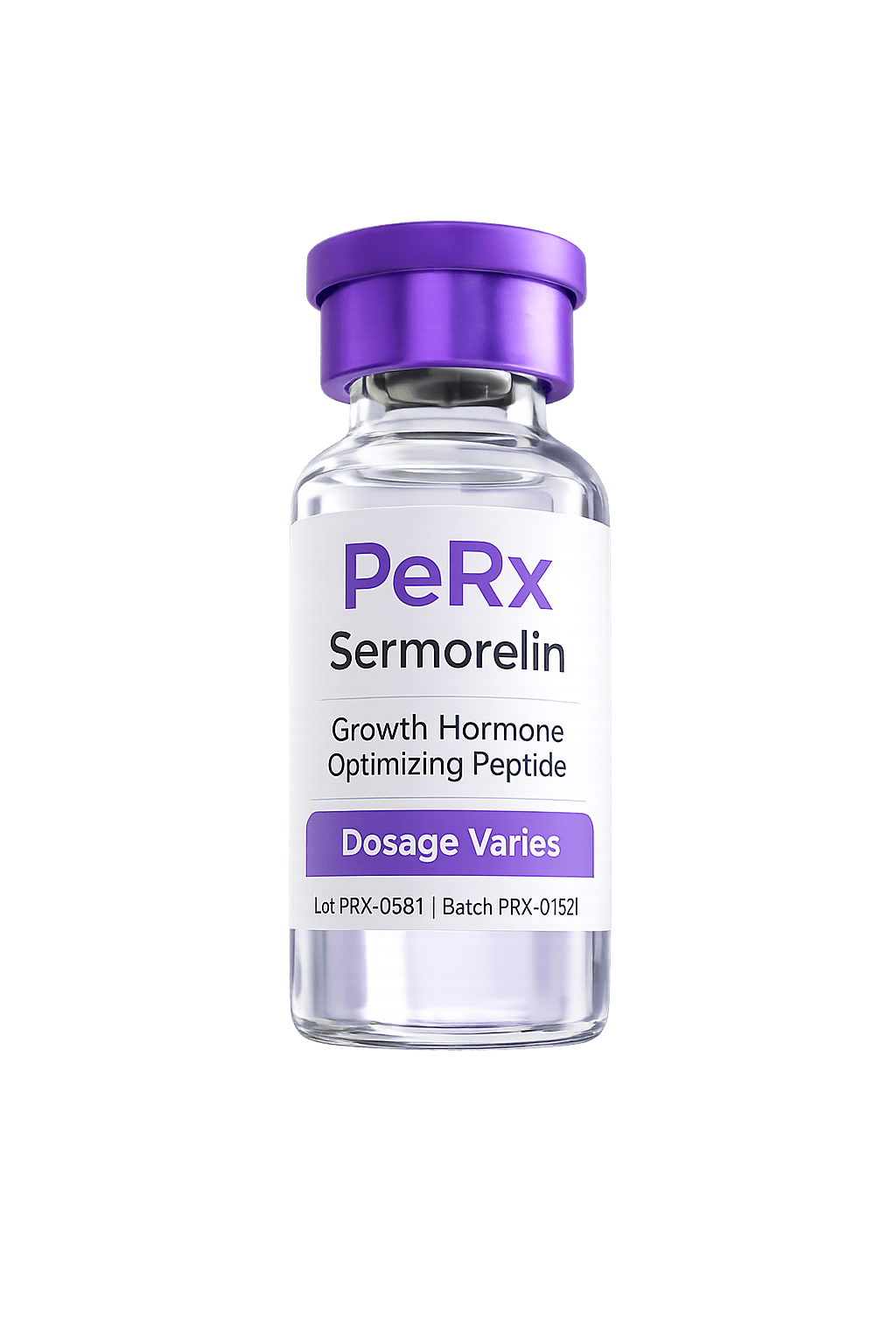
PeRx offers sermorelin as a physician-prescribed subcutaneous injection at $229 per month. Complete a health assessment, and a licensed provider reviews your history and determines whether sermorelin fits your situation. If prescribed, it is compounded by a US-based, FDA-regulated 503A pharmacy and shipped cold to your door in ready-to-use vials, no mixing required.
It is the same 29-amino-acid GHRH fragment, as the acetate salt, that every study on this page examined. Most patients dose it before bed to line up with the natural overnight GH pulse.
Sermorelin Benefits: Common Questions
Related Guides
Continue reading about peptides and protocols that pair well with this guide.
Sermorelin Peptide: Benefits, Dosing & How It Works
Every growth hormone peptide used today traces its lineage back to this molecule. Sermorelin was once FDA-approved, then abandoned for commercial reasons. Now it's having a second act as the safest entry point into growth hormone optimization. The peptide that was too gentle for children turned out to be exactly what adults needed.
Is Sermorelin FDA Approved? Yes Until 2008
Sermorelin has a unique regulatory history. It was FDA-approved in 1997 as Geref Diagnostic for testing pituitary function, and its therapeutic form (Geref) was used for pediatric growth hormone deficiency. Then the manufacturer discontinued it in 2008. Today Sermorelin is only available as a compounded medication. Here is the full story.
BPC-157 Peptide: Benefits, Dosage & Complete Guide
A peptide discovered in a Croatian lab in the early '90s is now one of the most studied healing compounds in regenerative medicine. Here's what the science actually says, where it came from, and what you should know before starting.
Ready to get started?
Pharmaceutical-grade sermorelin, prescribed by a licensed provider after an online health review and shipped cold in ready-to-use vials. The same molecule behind every study on this page, at the gentlest entry point to growth hormone optimization.
Medical Disclaimer
The information provided on this website, including all articles, guides, and educational content, is for informational and educational purposes only and is not intended as medical advice, diagnosis, or treatment. Nothing on this site should be construed as a substitute for professional medical advice from a qualified healthcare provider.
The majority of peptides discussed on this site are not approved by the U.S. Food and Drug Administration (FDA) for the indications described. They are classified as bulk drug substances and are available only through a licensed prescribing provider and compounding pharmacy. All treatments require a valid prescription and provider oversight.
The majority of published research on peptide therapies has been conducted in preclinical (animal) models. While early human data is encouraging, comprehensive clinical trial data remains limited for most peptide compounds. Individual results may vary significantly based on health status, injury type, and other factors. No specific outcomes are guaranteed.
Certain peptides discussed on this site are classified as prohibited substances by the World Anti-Doping Agency (WADA) and are banned by major sports organizations including the NFL, NCAA, UFC, NBA, MLB, NHL, and PGA. If you are subject to anti-doping testing, consult your governing body before considering any peptide therapy.
Statements on this website have not been evaluated by the Food and Drug Administration. Products and therapies discussed are not intended to diagnose, treat, cure, or prevent any disease.
© 2026 Wellness MD Group PC DBA PeRx. All rights reserved.