Sermorelin Side Effects: What the FDA Label Shows
Sermorelin is the rare compounded peptide that once carried an FDA label, so its side effects do not have to be guessed at. Here is what that label counted, which patients the numbers came from, what three small adult studies added, an honest read on IGF-1 and cancer, and the symptoms that mean stop and call someone.

In this article
Key Takeaways
- The most common sermorelin side effect is a reaction where the needle went in: pain, swelling or redness. The FDA label for Geref, the approved brand, put it at about 1 patient in 6. Of 350 patients in the clinical trials, three stopped treatment because of it.
- Every other treatment-related event on that label ran under 1%: headache, flushing, trouble swallowing, dizziness, hyperactivity, sleepiness and hives. No generalized allergic reaction was reported in the trials.
- Those figures come from trials run for a pediatric indication: children with growth hormone deficiency, dosed by body weight every night. Adult evidence is three small studies covering 40 older adults in total, the longest lasting 16 weeks. The only adverse effect any of them reported was a temporary rise in blood lipids that resolved before the study ended.
- Fasting glucose did not change in any of the three adult studies. Swelling, joint ache and tingling hands are documented effects of injected growth hormone, not measured effects of sermorelin, but they sit on the same hormonal axis and are worth knowing.
- No study links sermorelin to cancer, and none was large or long enough to rule it out. The label states that long-term carcinogenicity studies were never performed. Higher IGF-1 tracks with modestly higher risk of some cancers in population data, which is why an active or recent malignancy screens you out.
- Geref left the market in 2008, and in 2013 the FDA determined it had not been withdrawn for reasons of safety or effectiveness. Compounded sermorelin is a different product that has not been through FDA review.
Sermorelin Side Effects at a Glance
Most common
Injection-site pain, swelling or redness: about 1 patient in 6 on the FDA label
Under 1% each on the label
Headache, flushing, trouble swallowing, dizziness, hyperactivity, sleepiness, hives
Where those numbers come from
350 patients in the Geref trials, run to support a pediatric indication
Adult data
Three small studies, 40 older adults, 2 to 16 weeks
Fasting glucose in adult studies
Unchanged in all three
Cancer link
None shown, none ruled out. Carcinogenicity studies were never run
FDA history
Approved 1990 and 1997, discontinued 2008, not withdrawn for safety
Sermorelin Side Effects: The Short Answer
The most common side effect of sermorelin is a local reaction at the injection site: pain, swelling or redness, which the FDA-approved label put at roughly one patient in six. Headache, facial flushing, dizziness, sleepiness, trouble swallowing and hives were each reported in fewer than 1% of trial patients. Serious reactions are rare, and an allergic reaction is the one that needs emergency care.
Most peptides cannot offer even that paragraph, because their side-effect lists are built from animal work and forum posts. Sermorelin spent years as a licensed drug called Geref, which means somebody counted. The catch is who they counted. The trials supported a pediatric indication, growth hormone deficiency, not adults using it for sleep or body composition. So each figure below is tagged with its source, and clinic experience or anecdote is labelled as such.
| Effect | How often | Source and population |
|---|---|---|
| Injection-site pain, swelling, redness | About 1 in 6 | Geref label, 350 trial patients |
| Headache, flushing, dizziness, sleepiness, hyperactivity | Under 1% each | Geref label |
| Trouble swallowing, hives | Under 1% each | Geref label. Treat either as a possible allergy |
| Temporary rise in blood lipids | Seen in one study | 19 adults aged 55 to 71, 16 weeks. Resolved on its own |
| Puffy hands or ankles, joint ache | Not counted for sermorelin | Documented with injected HGH. Clinic reports only for sermorelin |
| Vivid dreams, restless first nights | Unknown | Anecdote. The one trial that asked found sleep quality unchanged |
Injection-site pain, swelling, redness
- How often
- About 1 in 6
- Source and population
- Geref label, 350 trial patients
Headache, flushing, dizziness, sleepiness, hyperactivity
- How often
- Under 1% each
- Source and population
- Geref label
Trouble swallowing, hives
- How often
- Under 1% each
- Source and population
- Geref label. Treat either as a possible allergy
Temporary rise in blood lipids
- How often
- Seen in one study
- Source and population
- 19 adults aged 55 to 71, 16 weeks. Resolved on its own
Puffy hands or ankles, joint ache
- How often
- Not counted for sermorelin
- Source and population
- Documented with injected HGH. Clinic reports only for sermorelin
Vivid dreams, restless first nights
- How often
- Unknown
- Source and population
- Anecdote. The one trial that asked found sleep quality unchanged
What the FDA Label Counted
Two sermorelin products were approved in the United States, both under the Geref name. A diagnostic injection was approved on December 28, 1990, and a treatment version for children with idiopathic growth hormone deficiency and growth failure followed on September 26, 1997. The manufacturer, EMD Serono, told the FDA in 2008 that it was discontinuing both. Approval of the two applications was formally withdrawn effective June 18, 2009.
Whether a drug left the market because something went wrong is a question the FDA answers on the record. It did so on March 4, 2013, after reviewing its files and the postmarketing adverse event data: both Geref products "were not withdrawn from sale for reasons of safety or effectiveness." Our sermorelin FDA status guide has the rest of that history.
Food and Drug Administration. "Determination That GEREF (Sermorelin Acetate) Injection, 0.5 Milligrams Base/Vial and 1.0 Milligrams Base/Vial, and GEREF (Sermorelin Acetate) Injection, 0.05 Milligrams Base/Amp, Were Not Withdrawn From Sale for Reasons of Safety or Effectiveness." Federal Register. 2013;78(42):14095. FR Doc 2013-04827. View study
The adverse reactions section of the Geref label is short. Local injection reactions were the most common treatment-related event, in about 1 patient in 6. Of the 350 patients exposed to sermorelin in clinical trials, three stopped because of those reactions. Every other treatment-related event had an individual rate under 1%: headache, flushing, dysphagia (difficulty swallowing), dizziness, hyperactivity, somnolence and urticaria (hives). No generalized allergic reactions had been reported, though the label warns that allergic reactions can occur with any peptide and need prompt medical attention.
The diagnostic product went into a vein, and it had its own list: facial flushing, injection-site reactions, nausea, headache, vomiting, an odd taste in the mouth, pallor and tightness in the chest. Nausea and chest tightness, two items people worry about online, come from that intravenous list and were not among the events counted with subcutaneous dosing.
Antibodies: the Finding Most Pages Skip
The label reports that a large proportion of patients developed anti-GRF antibodies at least once during treatment. It also says what happened next: a positive test at one growth assessment often turned negative by the following one, and the antibodies did not appear to affect growth or to line up with any particular adverse reaction. That is reassuring for an approved product in children. Nobody has repeated the measurement in adults on compounded sermorelin, and impurities make any peptide more likely to provoke an immune response, which is one reason vial quality matters.
Three precautions round out the label. Hypothyroidism appeared in 6.5% of patients during the clinical studies, and the label says untreated hypothyroidism can jeopardize the response to sermorelin. Glucocorticoids taken at the same time may blunt the response. And children whose deficiency came from an intracranial lesion were never studied, so the label advised against treating them. It is a pediatric label, written for a nightly dose of 30 mcg per kg, and it transfers to adults only partway.
GEREF (sermorelin acetate for injection) prescribing information, Serono Laboratories. Adverse Reactions, Precautions and Clinical Pharmacology sections, as archived by RxList. View study
Thorner M, Rochiccioli P, Colle M, et al. "Once daily subcutaneous growth hormone-releasing hormone therapy accelerates growth in growth hormone-deficient children during the first year of therapy." Journal of Clinical Endocrinology and Metabolism. 1996;81(3):1189-1196. View study
What the Adult Studies Found
Adults are who take sermorelin now, and the adult file is thin. Three studies from the 1990s gave GHRH(1-29) to older volunteers and recorded safety measures along the way. Between them they enrolled 40 people. None ran past 16 weeks, and the largest used a close analog with one amino acid swapped, not sermorelin itself.
| Study | Who and how long | Dose | Safety findings |
|---|---|---|---|
| Corpas 1992 | 10 men around age 68, 14 days per dose level | 0.5 mg and 1 mg, twice daily | No effect on fasting glucose, blood pressure, chemistry or blood counts. Phosphate rose |
| Vittone 1997 | 11 men aged 64 to 76, 6 weeks | 2 mg nightly | No change in weight, glucose, insulin or lipids. "No significant adverse effects were observed" |
| Khorram 1997 | 10 women and 9 men aged 55 to 71, 16 weeks | 10 mcg per kg nightly (an analog) | Blood pressure, weight, fasting glucose and insulin unchanged. Transient hyperlipidemia was the only adverse effect |
Corpas 1992
- Who and how long
- 10 men around age 68, 14 days per dose level
- Dose
- 0.5 mg and 1 mg, twice daily
- Safety findings
- No effect on fasting glucose, blood pressure, chemistry or blood counts. Phosphate rose
Vittone 1997
- Who and how long
- 11 men aged 64 to 76, 6 weeks
- Dose
- 2 mg nightly
- Safety findings
- No change in weight, glucose, insulin or lipids. "No significant adverse effects were observed"
Khorram 1997
- Who and how long
- 10 women and 9 men aged 55 to 71, 16 weeks
- Dose
- 10 mcg per kg nightly (an analog)
- Safety findings
- Blood pressure, weight, fasting glucose and insulin unchanged. Transient hyperlipidemia was the only adverse effect
Two of the three studies used doses well above what is prescribed today. Corpas gave up to 2 mg a day and Vittone gave 2 mg every night, against a 600 mcg bedtime dose on the PeRx label. Clean safety readings at three times the dose are mildly reassuring. They also come from 21 men over a few weeks, which cannot detect anything uncommon or slow.
A 1999 review of the drug in BioDrugs reached the same place from the pediatric side: repeated once-daily subcutaneous doses were well tolerated, with transient facial flushing and injection-site pain the most commonly reported adverse events. In the largest pediatric trial, 110 children treated for up to a year, fasting glucose did not change.
Corpas E, Harman SM, Pineyro MA, Roberson R, Blackman MR. "Growth hormone (GH)-releasing hormone-(1-29) twice daily reverses the decreased GH and insulin-like growth factor-I levels in old men." Journal of Clinical Endocrinology and Metabolism. 1992;75(2):530-535. View study
Vittone J, Blackman MR, Busby-Whitehead J, et al. "Effects of single nightly injections of growth hormone-releasing hormone (GHRH 1-29) in healthy elderly men." Metabolism. 1997;46(1):89-96. View study
Khorram O, Laughlin GA, Yen SS. "Endocrine and metabolic effects of long-term administration of [Nle27]growth hormone-releasing hormone-(1-29)-NH2 in age-advanced men and women." Journal of Clinical Endocrinology and Metabolism. 1997;82(5):1472-1479. View study
Prakash A, Goa KL. "Sermorelin: a review of its use in the diagnosis and treatment of children with idiopathic growth hormone deficiency." BioDrugs. 1999;12(2):139-157. View study
Growth Hormone Effects vs Sermorelin Effects
Clinic pages often put fluid retention, joint pain, carpal tunnel symptoms and insulin resistance on the sermorelin list. None of those appears on the Geref label or in the adult studies above. They come from trials of growth hormone itself.
A 2007 systematic review in the Annals of Internal Medicine pooled randomized trials of injected HGH in healthy older adults. People on growth hormone were significantly more likely to develop soft tissue swelling, joint pain, carpal tunnel syndrome and gynecomastia, and somewhat more likely to develop impaired fasting glucose or diabetes.
Liu H, Bravata DM, Olkin I, et al. "Systematic review: the safety and efficacy of growth hormone in the healthy elderly." Annals of Internal Medicine. 2007;146(2):104-115. View study
Sermorelin works upstream of all that. It asks the pituitary for a pulse of its own growth hormone, the pulse clears, and the usual feedback loop stays in place, which is the argument our sermorelin vs HGH comparison makes at length. That argument is physiological and has never been tested head to head. The fair statement: these effects have been measured with HGH, they have not been measured with sermorelin at prescribed doses, and a puffy ring finger or achy knuckles in the first weeks is a recognized clinic report that usually settles. Persistent tingling or numbness in the hands is worth reporting.
The heart question sits in the same bucket. USADA ties hypertension and cardiac enlargement to chronic growth hormone excess, the state seen in acromegaly. Blood pressure was tracked in two of the adult sermorelin studies and did not move. Nothing connects prescribed doses to heart problems, and no study ran long enough to look.
Sermorelin, IGF-1 and Cancer
Online, this question gets answered with far more confidence than the evidence allows. Start with what exists. No published study reports sermorelin causing or accelerating cancer in people. The Geref label says long-term animal studies for carcinogenicity were not performed, and that there was no evidence of genetic toxicity in the studies that were done. The human trials were too small and too short to detect a change in cancer rates in either direction.
Now the reason anyone asks. Sermorelin raises growth hormone, growth hormone raises IGF-1, and IGF-1 tells cells to grow and divide. A 2004 meta-analysis in The Lancet pooled 21 studies with 3,609 cancer cases and 7,137 controls. People in the top quarter of IGF-1 levels had higher odds of prostate cancer (odds ratio 1.49) and premenopausal breast cancer (1.65) than people in the bottom quarter. The authors described the associations as modest and variable between cancer sites. Those are observations about natural IGF-1 levels across populations. They do not show that nudging IGF-1 upward within the normal range causes cancer, or that it is harmless.
Renehan AG, Zwahlen M, Minder C, et al. "Insulin-like growth factor (IGF)-I, IGF binding protein-3, and cancer risk: systematic review and meta-regression analysis." The Lancet. 2004;363(9418):1346-1353. View study
Why Cancer History Is an Intake Question
An active malignancy, or one treated recently, screens you out of any growth hormone peptide. The reasoning is caution under uncertainty, not a documented harm: a signal that promotes cell growth is a poor thing to add while a tumor may be present, and nobody has data showing it is safe to do so. With a cancer history, the decision belongs with your oncologist. It is also why an IGF-1 level is worth knowing before and during use. A result above the reference range for your age is not a goal.
Side Effects in Men and in Women
People search for sermorelin side effects in men and in women separately. The data shows little difference. The label notes that clearance of the drug is similar in adult men and women. The only adult study that enrolled both sexes found that the benefits skewed toward men, who gained lean mass and insulin sensitivity while women did not, but it reported one adverse effect, the temporary lipid rise, without attributing it to either sex.
Gynecomastia shows up in the HGH trials and has not been reported with sermorelin. For women, the documented cautions are pregnancy and breastfeeding. Geref was Pregnancy Category C: minor fetal variations appeared in rats and rabbits at several times the human dose, there are no adequate studies in pregnant women, and whether the drug reaches breast milk is unknown. Both are screening exclusions here.
What the First Month Looks Like
The PeRx label reads 20 units (0.2 mL, 600 mcg) under the skin at bedtime, Monday through Friday, at least two hours after eating, for three months followed by a month off. The sermorelin dosage chart explains each line. The Geref data was never broken down by week, so the timing below is clinic experience and patient report, not trial data.
Nights 1-5
The injection site
A small pink patch, a sting or mild itching that fades within hours to a day is the expected range, and it is the 1 in 6 effect from the label. Rotate sites and let the alcohol dry first. Our where to inject sermorelin guide maps the rotation.
Weeks 1-2
Flushing, headache, odd sleep
A warm face for a few minutes after the dose, a mild headache or a lightheaded moment are the label effects people most often describe early. Vivid dreams get reported too. Bedtime dosing means you sleep through most of it.
Weeks 3-4
Water and joints
If a puffy feeling in the hands or ankles or a dull joint ache is going to appear, this is usually when. Most people never notice it, and it should ease, not progress.
Month 2 onward
Quiet, for most people
New side effects this late are unusual. Anything that starts now, or a site reaction that lingers for days, deserves a message to the care team.
What Not to Take With Sermorelin
The label names one drug interaction and one condition that interferes. The rest of this list is mechanism, flagged as such. Put every medication and supplement on your intake form.
Interactions Worth Knowing
Glucocorticoids (prednisone and similar)
On the label: taken alongside sermorelin, they may inhibit the response. A short course is a reason to mention it, not a danger.
Untreated hypothyroidism
On the label: it can jeopardize the response. Treated, stable thyroid disease is a different situation.
Insulin and diabetes medication
Mechanism only. Growth hormone pushes against insulin, though the adult studies saw no change in fasting glucose. Poorly controlled diabetes is a reason to wait.
HGH or other GH secretagogues
Stacking moves you toward the side-effect profile of the HGH trials. Take only what was prescribed together.
Who Gets Screened Out
A licensed provider reviews your health intake before anything is compounded. For sermorelin, the deciding questions map onto the label and the uncertainties above. What providers review before prescribing walks through the process.
Common Reasons an Intake Is Declined or Paused
Active or recent cancer
The IGF-1 uncertainty described above. Oncologist involvement comes first.
Pregnancy or breastfeeding
No adequate human data, and animal findings at higher doses.
Known sensitivity to sermorelin or a vial ingredient
The single contraindication on the Geref label.
Untreated thyroid disease
Interferes with the response. Sort the thyroid first.
Pituitary or intracranial tumor or lesion
Never studied, and the label advised against treatment.
Poorly controlled diabetes
A growth hormone signal is the wrong addition until glucose is stable.
Tested athletes
Sermorelin is named in section S2.2.4 of the 2026 WADA Prohibited List and is banned at all times.
Long-Term Use
How long can you stay on sermorelin? The longest documented exposure is pediatric: the 1999 review describes growth effects sustained over 12 months, with data in a few children out to 36 months. In adults the longest published study ran 16 weeks. Geref was sold for years without a safety withdrawal, and the FDA reviewed postmarketing reports before saying so in 2013. That is more of a record than most compounded peptides have. It is still not a long-term adult safety study, because none has been done.
The three months on, one month off cycle on the PeRx label is a precaution built around that gap. It caps continuous exposure and gives a natural point to recheck IGF-1 with your own doctor. One finding from the 16-week study is relevant here: IGF-1 rose within two weeks, stayed up through week 12, and drifted back toward baseline by week 16 while dosing continued. The body appears to adjust. Our long-term peptide safety guide sets this against the rest of the catalog.
When to Stop and Get Help
Most of what this page describes needs only a note. A short list needs action, and it follows the instructions that ship with the prescription.
Stop the Injections and Act
Call emergency services for swelling of the face, lips, tongue or throat, trouble breathing or swallowing, widespread hives, a severe headache that will not ease, or a racing heartbeat. These can signal a serious allergic reaction, and trouble swallowing and hives are both on the label.
Contact the care team or your own clinician for a rash or hives near the injection site, a site reaction that has not settled within a few days or is getting larger, warmer or more painful, swelling in the hands or feet that keeps building, numbness or tingling in the fingers that persists, unusual thirst or frequent urination, or any new symptom you cannot explain. Do not take the next dose while you wait for an answer.
Sermorelin
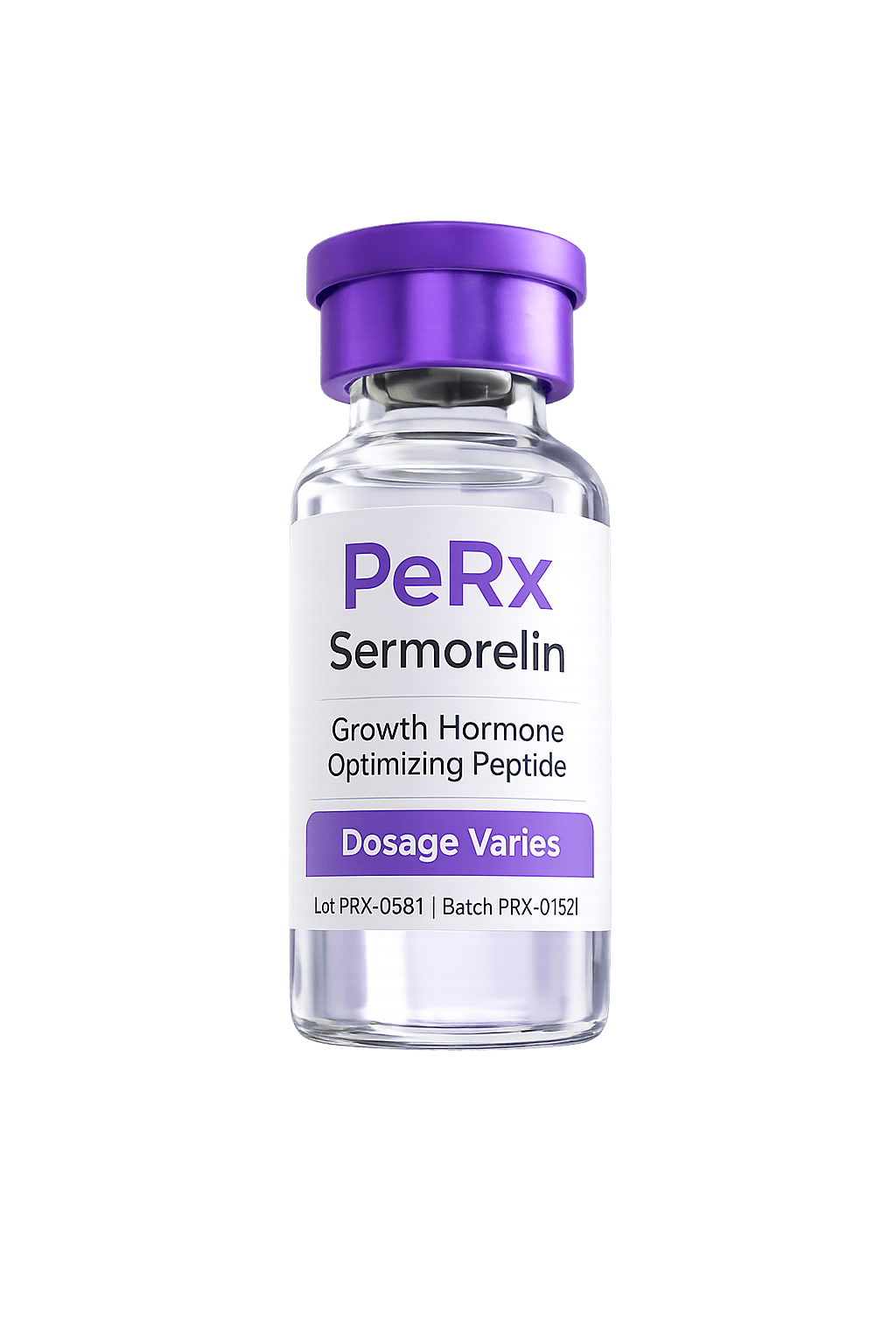
Some of the risk with any injectable sits in the vial, not the molecule: wrong concentration, contamination, or a powder mixed at home with guessed arithmetic. PeRx sermorelin is prescribed by a licensed provider after a health intake and compounded by a US 503A pharmacy at a fixed 3 mg per mL. It ships fully reconstituted and ready to use, so the dose on the label is a line on the syringe and nothing has to be mixed.
Compounded sermorelin is not Geref and has not been reviewed by the FDA, which is worth saying plainly on a page about safety. $229 for a one-month supply, with syringes and alcohol swabs in the box.
Sermorelin Side Effects: Common Questions
Related Guides
Continue reading about peptides and protocols that pair well with this guide.
Is Sermorelin FDA Approved? Yes Until 2008
Sermorelin has a unique regulatory history. It was FDA-approved in 1997 as Geref Diagnostic for testing pituitary function, and its therapeutic form (Geref) was used for pediatric growth hormone deficiency. Then the manufacturer discontinued it in 2008. Today Sermorelin is only available as a compounded medication. Here is the full story.
Sermorelin vs Semaglutide: Different Jobs
These two get compared constantly, usually by people trying to sell one of them. They are not competitors. A GLP-1 receptor agonist changes how hungry you are. Sermorelin nudges your pituitary to release more of your own growth hormone. Only one of them is a weight loss medication, and it is not sermorelin.
MOTS-c vs. Metformin: Peptide or the Pill?
Both MOTS-c and metformin flip the same cellular switch: AMPK, the master sensor that turns on during exercise and fasting. That shared mechanism is why they keep getting compared in longevity circles. But one is a decades-old, oral, FDA-approved diabetes drug used off-label, and the other is a mitochondrial peptide given as a subcutaneous injection. This guide breaks down how each works, where the human evidence actually stands, and why the honest answer is not either-or.
Ready to get started?
Pharmacy-compounded sermorelin, prescribed by a licensed provider who reviews your health history first. Ships fully reconstituted and ready to use.
Medical Disclaimer
The information provided on this website, including all articles, guides, and educational content, is for informational and educational purposes only and is not intended as medical advice, diagnosis, or treatment. Nothing on this site should be construed as a substitute for professional medical advice from a qualified healthcare provider.
The majority of peptides discussed on this site are not approved by the U.S. Food and Drug Administration (FDA) for the indications described. They are classified as bulk drug substances and are available only through a licensed prescribing provider and compounding pharmacy. All treatments require a valid prescription and provider oversight.
The majority of published research on peptide therapies has been conducted in preclinical (animal) models. While early human data is encouraging, comprehensive clinical trial data remains limited for most peptide compounds. Individual results may vary significantly based on health status, injury type, and other factors. No specific outcomes are guaranteed.
Certain peptides discussed on this site are classified as prohibited substances by the World Anti-Doping Agency (WADA) and are banned by major sports organizations including the NFL, NCAA, UFC, NBA, MLB, NHL, and PGA. If you are subject to anti-doping testing, consult your governing body before considering any peptide therapy.
Statements on this website have not been evaluated by the Food and Drug Administration. Products and therapies discussed are not intended to diagnose, treat, cure, or prevent any disease.
© 2026 Wellness MD Group PC DBA PeRx. All rights reserved.