Tesamorelin Results: What the Trials Actually Showed
Search for results on almost any peptide and you get mouse studies and marketing. Tesamorelin is the exception. The molecule went through two Phase 3 randomized trials with more than 800 patients, and the endpoint was not a survey or a scale. It was visceral fat measured by CT scan. This article walks through those numbers, the population they came from, what a realistic timeline looks like, and why the honest version of "tesamorelin before and after" involves a tape measure instead of a mirror.

In this article
Key Takeaways
- Tesamorelin is the rare peptide whose results question has a real answer: two Phase 3 randomized trials, 816 patients total, run for the FDA approval of Egrifta in HIV-associated lipodystrophy.
- In the pivotal NEJM trial, CT-measured visceral fat fell 15.2 percent over 26 weeks on tesamorelin while it rose 5 percent on placebo. Triglycerides dropped about 50 mg/dL. Subcutaneous fat, the layer you can pinch, was essentially unchanged.
- Those numbers belong to the approved Egrifta program and its studied population. Compounded tesamorelin prescribed off-label for body composition is a different product and a different context, and the trial figures are evidence, not a promise.
- Body weight was not the endpoint and moved little. Tesamorelin redistributes where fat is stored rather than shrinking the whole body, which is why the trials used CT imaging instead of a scale.
- The extension data is blunt about stopping: patients switched to placebo at week 26 saw visceral fat return toward baseline, while those who continued held or extended their reductions to roughly 18 percent at 12 months.
- Self-reported results on reddit run noisier than trial data for predictable reasons: unverified vials, no imaging, timelines cut short, and the scale measuring the wrong thing.
Quick Facts
Full Name
Tesamorelin (trans-3-hexenoic acid-GHRH(1-44)-NH2)
Type
Synthetic growth hormone-releasing hormone (GHRH) analog
Evidence Base
Two Phase 3 randomized trials, 816 patients, CT-measured endpoints
Headline Result
15.2% visceral fat reduction over 26 weeks vs. placebo (NEJM, 2007)
Studied Population
HIV-associated lipodystrophy, the FDA-approved Egrifta indication
Administration
Subcutaneous injection, ready-to-use vial
What Does Tesamorelin Do?
Tesamorelin is a synthetic analog of growth hormone-releasing hormone, the signal your hypothalamus sends to your pituitary gland. Injected subcutaneously once a day, it binds GHRH receptors on the pituitary and prompts it to release your own growth hormone in the same pulsatile rhythm your body already uses. It is not growth hormone. It is the upstream instruction, which is why the feedback loops that normally regulate GH stay intact and why IGF-1 rises within days of starting.
Downstream, elevated growth hormone signaling increases lipolysis, and it does so preferentially in visceral adipose tissue, the fat packed around the organs inside the abdominal wall. That selectivity is the entire story of tesamorelin. It does not suppress appetite, it does not block fat absorption, and it does not melt the pinchable layer under the skin. It mobilizes the specific fat depot most strongly tied to metabolic risk, the one a tape measure only hints at and a scale barely registers.
So the one-sentence answer to "what does tesamorelin do" is this: it raises your own growth hormone output, and over months that shrinks visceral fat while leaving most other tissue alone. The receptor-level detail, the molecule’s Montreal origin story, and the full safety picture live in the complete tesamorelin guide. This article stays on the question people actually type, which is what happened when it was tested and what you can reasonably expect to notice.
The Trial Results: Real Numbers From 816 Patients
First, the attribution, because it matters. The numbers below come from the clinical program that earned tesamorelin its FDA approval as Egrifta in 2010. Those trials enrolled HIV-positive patients with lipodystrophy, a condition in which antiretroviral therapy drives abnormal visceral fat accumulation. That is the approved indication and the studied population. Compounded tesamorelin prescribed for body composition in people without HIV is off-label use of a different, non-FDA-approved preparation. The trial data is the best evidence anywhere in the GH peptide category, but it describes what happened in that program, not what will happen to you.
With that stated plainly, the numbers are worth taking seriously. The pivotal trial, published by Falutz and colleagues in the New England Journal of Medicine in 2007, randomized 412 patients to 2 mg of tesamorelin or placebo daily for 26 weeks. Visceral adipose tissue measured by CT scan fell 15.2 percent in the tesamorelin group while it rose 5.0 percent on placebo. Triglycerides dropped 50 mg/dL against a 9 mg/dL rise on placebo. The total cholesterol to HDL ratio improved. IGF-1 climbed 81 percent, confirming the pituitary was responding. Glycemic measures showed no significant difference between groups.
Falutz J, Allas S, Blot K, et al. Metabolic effects of a growth hormone-releasing factor in patients with HIV. N Engl J Med. 2007;357(23):2359-2370. View study
A second Phase 3 trial of 404 patients, published in 2010, reproduced the finding: visceral fat down 10.9 percent at 26 weeks against 0.6 percent on placebo, with waist circumference and trunk fat improving while limb fat and abdominal subcutaneous fat did not change. Patients who stayed on tesamorelin through the 12-month extension reached a visceral fat reduction of roughly 18 percent. Between the two trials, 816 patients were randomized, which makes this the largest controlled evidence base of any peptide in the PeRx catalog by a wide margin.
Falutz J, Potvin D, Mamputu JC, et al. Effects of tesamorelin, a growth hormone-releasing factor, in HIV-infected patients with abdominal fat accumulation: a randomized placebo-controlled trial with a safety extension. J Acquir Immune Defic Syndr. 2010;53(3):311-322. View study
Later work extended the picture to the liver. A randomized trial at Massachusetts General Hospital, published in JAMA in 2014, found tesamorelin reduced visceral fat by a net 42 square centimeters versus placebo over six months and modestly reduced liver fat as well, again in HIV-positive patients. Fasting glucose ticked up at two weeks but the difference was no longer significant by six months.
Stanley TL, Feldpausch MN, Oh J, et al. Effect of tesamorelin on visceral fat and liver fat in HIV-infected patients with abdominal fat accumulation: a randomized clinical trial. JAMA. 2014;312(4):380-389. View study
| What changed in the trials | How much | How it was measured |
|---|---|---|
| Visceral fat (pivotal trial) | Down 15.2% over 26 weeks vs. up 5.0% on placebo | Abdominal CT scan |
| Visceral fat (second Phase 3) | Down 10.9% at 26 weeks; ~18% at 12 months with continued use | Abdominal CT scan |
| Triglycerides | Down 50 mg/dL vs. up 9 mg/dL on placebo | Fasting blood draw |
| IGF-1 | Up 81% vs. down 5% on placebo | Blood draw |
| Waist circumference | Statistically significant but modest improvement | Tape measure |
| Subcutaneous (pinchable) fat | Essentially unchanged | Abdominal CT scan |
| Liver fat (2014 MGH trial) | Net -2.9% lipid-to-water fraction vs. placebo | MR spectroscopy |
| Body weight | Not a primary endpoint; changed little | Scale |
Visceral fat (pivotal trial)
- How much
- Down 15.2% over 26 weeks vs. up 5.0% on placebo
- How it was measured
- Abdominal CT scan
Visceral fat (second Phase 3)
- How much
- Down 10.9% at 26 weeks; ~18% at 12 months with continued use
- How it was measured
- Abdominal CT scan
Triglycerides
- How much
- Down 50 mg/dL vs. up 9 mg/dL on placebo
- How it was measured
- Fasting blood draw
IGF-1
- How much
- Up 81% vs. down 5% on placebo
- How it was measured
- Blood draw
Waist circumference
- How much
- Statistically significant but modest improvement
- How it was measured
- Tape measure
Subcutaneous (pinchable) fat
- How much
- Essentially unchanged
- How it was measured
- Abdominal CT scan
Liver fat (2014 MGH trial)
- How much
- Net -2.9% lipid-to-water fraction vs. placebo
- How it was measured
- MR spectroscopy
Body weight
- How much
- Not a primary endpoint; changed little
- How it was measured
- Scale
Why there are no before-and-after photos here
The honest version of "tesamorelin before and after" is a pair of CT cross-sections, because the compartment that changes sits behind the abdominal wall where a camera cannot see it. Photo-based before-and-afters of tesamorelin are either showing you something else (diet, training, a GLP-1) or showing you nothing measurable. The trials used imaging precisely because the mirror is a poor instrument for visceral fat.
A Realistic Timeline
The single most common mistake with tesamorelin is running it on a BPC-157 clock. Injury-repair peptides get judged in weeks. Tesamorelin was designed, dosed, and measured on a six-month horizon, and nothing about the biology speeds that up. Fat mobilization from a specific depot is slow arithmetic: a small daily shift in lipolysis compounding over months. Here is how the sequence typically runs, with the trial-anchored points marked as such.
Days 1-14
Biochemistry moves, nothing visible
IGF-1 rises within the first days as the pituitary responds, which is how the trials confirmed the drug was working long before any fat changed. Nothing shows in the mirror. The adverse effects reported in the trial program cluster here too: injection site redness, mild fluid retention, joint aches, and tingling in the hands for some patients, most of it settling as the body adjusts.
Weeks 2-8
Subjective changes, unverified by trials
People using GHRH analogs commonly report deeper sleep and faster recovery from training in this window. Take those reports for what they are: anecdotal, not trial endpoints, and impossible to separate from expectation. Visceral fat change is not measurable this early by any tool you own. Quitting here, a very common move, means quitting before the mechanism has had time to show anything.
Months 2-3
The tape measure may start to register
Waist circumference improved significantly in the Phase 3 program, but it is a noisy proxy that moves later and less dramatically than the CT numbers. A morning measurement under identical conditions, tracked weekly and read as a trend rather than a daily verdict, is the realistic instrument at this stage. Triglycerides, if you are running labs, tend to move earlier than the waistline.
Month 6
The trial endpoint
This is where the numbers you have read about were measured. The 15.2 percent visceral fat reduction in the NEJM trial and the 10.9 percent reduction in the second Phase 3 are 26-week figures from daily 2 mg dosing in the studied population. Twenty-six weeks of consistent daily injections is the commitment the evidence describes. There is no published shortcut.
Month 12
Continuation extends the result
In the 12-month extension, patients who stayed on tesamorelin reached roughly an 18 percent visceral fat reduction. Patients switched to placebo at week 26 lost their gains, which is the subject of its own section below. The trajectory is slow, real, and dependent on continued use.
Why the Scale Barely Moves
Here is the part that disappoints people who skipped the fine print. In trials where visceral fat fell by double-digit percentages, body weight changed little. That is not a contradiction. Visceral fat is a minority share of total body mass, and tesamorelin leaves the biggest depots alone: subcutaneous fat was essentially unchanged across the program, and growth hormone signaling supports lean tissue rather than stripping it. Move a few hundred grams out of one internal compartment while everything else holds and the bathroom scale has nothing to report.
This is why judging tesamorelin by weight is measuring the wrong variable, in both directions. The scale can sit still through a genuine result, and early on it can even drift up slightly with fluid retention while the mechanism is working. The trial designers understood this, which is why the primary endpoint was CT-measured visceral adipose tissue and not a single trial in the program was powered around body weight. If weight loss is the actual goal, tesamorelin is the wrong molecule, and the comparison worth reading is tesamorelin after a GLP-1, which draws that boundary carefully.
What did track with the visceral change was blood work. Triglycerides fell by about 50 mg/dL in the pivotal trial and the cholesterol-to-HDL ratio improved, which makes a fasting lipid panel a better progress marker than a scale for this particular molecule. Waist circumference improved too, modestly. A shrinking waist at a stable weight is close to a signature pattern for visceral fat loss, and it is exactly the pattern the scale is structurally unable to show you.
What Happens When You Stop
The second Phase 3 trial answered this question directly, and the answer is uncomfortable enough that most articles about tesamorelin results leave it out. At week 26, patients on tesamorelin were re-randomized: some continued, some were switched to placebo without knowing it. The switchers’ visceral fat returned toward baseline over the following months. In the published authors’ own words, the initial improvements were rapidly lost. The continuers held their reductions and extended them.
Mechanistically this is unsurprising. Tesamorelin augments a signal, and when the signal stops, the underlying metabolic conditions that built the visceral depot are still there. The result is maintained by ongoing use, not banked. Anyone weighing a tesamorelin protocol should price that in from the start: the trial-demonstrated result lives inside a window of consistent use, and a plan that ends at month six without any follow-on strategy for diet, training, or continued therapy is a plan to rent the result rather than keep it. This is a conversation to have with the licensed provider who reviews your intake, not a detail to discover at month seven.
The Reddit Version of Results
A large share of the people searching for tesamorelin results end up reading peptide forum threads, because they want something trials do not offer: unfiltered reports from regular people. That instinct is reasonable. It is still worth knowing exactly why forum results and trial results diverge, because the gap is not random.
Start with what the threads get right, because they get real things right. The cost complaints are accurate: tesamorelin is one of the more expensive peptides in any catalog, and a six-month horizon multiplies that. The adherence complaints are accurate: a daily subcutaneous injection for half a year tests anyone’s consistency. The recurring observation that the scale did not move matches the trial data exactly, even when the poster reads it as failure. And the posters who report their midsection refilling after stopping are describing, without knowing it, the same reaccumulation the Phase 3 extension documented.
Now the systematic problems. Nobody posting has serial CT scans, so every reported result is mirror, tape, or scale, the three instruments least suited to the compartment tesamorelin targets. A large fraction of forum tesamorelin is gray-market powder from unverified sources, so a disappointed report may be a report on a vial that contained the wrong dose or nothing at all, a problem a prescribed product from a licensed pharmacy exists to eliminate. Timelines run short: threads are full of verdicts rendered at week six on a molecule measured at week 26. And self-reports select for extremes in both directions, with the quietly satisfied and the quietly indifferent mostly not posting. None of that makes forum readers wrong to look. It means the threads are best read as a record of logistics, side effects, and expectations, and read last, after the trial data, not instead of it.
A report is only as good as the vial
Before weighting any anonymous tesamorelin report, ask what was actually in the syringe. Unverified powder purchased online carries no assurance of identity, dose, or sterility, and results attributed to it, good or bad, are uninterpretable. Prescribed tesamorelin dispensed by a licensed US compounding pharmacy is the version of this molecule where the question has an answer.
How to Measure Your Own Results
If you run a tesamorelin protocol, decide before the first injection how you will judge it, because the default instruments will mislead you. A workable measurement stack, roughly in order of usefulness, looks like this.
Waist circumference, done properly. Same time of morning, same landmark at the navel, tape level and snug but not compressing, recorded weekly. Individual readings bounce; the eight-week trend is the signal. This is the cheapest meaningful proxy for the compartment you are targeting. A DEXA scan where available. Many imaging centers offer DEXA body composition scans without a referral for a modest cash price, and newer scanners estimate visceral adipose tissue specifically. One scan at baseline and one near the six-month mark brackets the protocol with actual data. Labs through your physician. A fasting lipid panel tracks the triglyceride effect that moved early in the trials, and IGF-1 confirms the pituitary response the way the trials did. Because tesamorelin raises growth hormone signaling, fasting glucose and HbA1c belong in the panel too, as a safety check as much as a progress marker. Discuss the schedule with your prescribing physician rather than improvising it.
What not to use: daily scale weight, for every reason covered above, and progress photos, which capture the one fat layer tesamorelin does not change. Alongside measurement, the execution details carry weight of their own: consistent daily timing, correct technique from the injection site guide, and the dosing structure laid out in the tesamorelin dosage chart. If you are still deciding whether this is the right molecule at all, the comparison pages against AOD-9604 and the other GH peptides map the alternatives.
Tesamorelin
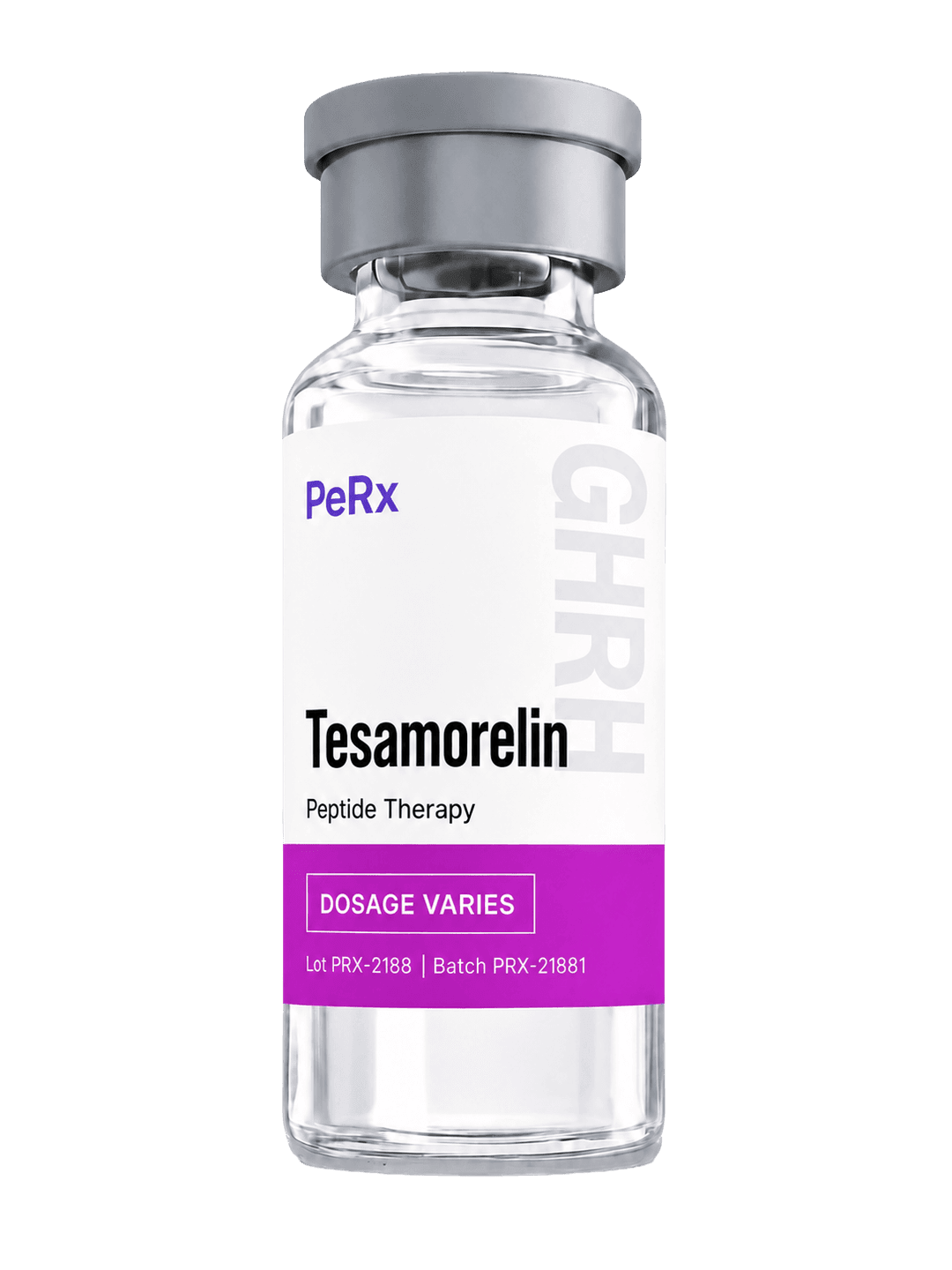
Pharmaceutical-grade tesamorelin, prescribed by a licensed provider after an online intake review and dispensed by a licensed US compounding pharmacy. Each vial ships overnight in refrigerated packaging, fully reconstituted and ready to use, with syringes and alcohol swabs included.
The evidence behind the molecule is the strongest in the GH peptide category: two Phase 3 randomized trials with CT-measured visceral fat endpoints and an FDA approval heritage under the brand name Egrifta. $229 per one-month supply.
Common Questions
Related Guides
Continue reading about peptides and protocols that pair well with this guide.
Tesamorelin Peptide: Benefits, Dosage & Visceral Fat
Most peptides in the compounding space have animal studies and early clinical signals. Tesamorelin has two Phase 3 randomized controlled trials, 816 patients, CT-measured visceral fat data, and an FDA approval. It is a synthetic analog of growth hormone-releasing hormone that triggers your pituitary to produce its own GH in a natural, pulsatile pattern. The result: targeted visceral fat loss without the side effects of injecting growth hormone directly.
Where to Inject Tesamorelin: Sites and Rotation
Tesamorelin is the rare peptide with FDA-approved labeling that tells you exactly where it goes: a subcutaneous injection into the abdomen, rotated. As of July 2026, that approved route is the anchor for how patients use it. Here is the practical site map, the rotation habit that keeps absorption consistent, and the technique details patients ask about after their first vial arrives.
BPC-157 Peptide: Benefits, Dosage & Complete Guide
A peptide discovered in a Croatian lab in the early '90s is now one of the most studied healing compounds in regenerative medicine. Here's what the science actually says, where it came from, and what you should know before starting.
Ready to get started?
Pharmaceutical-grade Tesamorelin, prescribed through a licensed provider and shipped overnight, fully reconstituted and ready to use. The evidence horizon is six months; the intake takes about ten minutes.
Medical Disclaimer
The information provided on this website, including all articles, guides, and educational content, is for informational and educational purposes only and is not intended as medical advice, diagnosis, or treatment. Nothing on this site should be construed as a substitute for professional medical advice from a qualified healthcare provider.
The majority of peptides discussed on this site are not approved by the U.S. Food and Drug Administration (FDA) for the indications described. They are classified as bulk drug substances and are available only through a licensed prescribing provider and compounding pharmacy. All treatments require a valid prescription and provider oversight.
The majority of published research on peptide therapies has been conducted in preclinical (animal) models. While early human data is encouraging, comprehensive clinical trial data remains limited for most peptide compounds. Individual results may vary significantly based on health status, injury type, and other factors. No specific outcomes are guaranteed.
Certain peptides discussed on this site are classified as prohibited substances by the World Anti-Doping Agency (WADA) and are banned by major sports organizations including the NFL, NCAA, UFC, NBA, MLB, NHL, and PGA. If you are subject to anti-doping testing, consult your governing body before considering any peptide therapy.
Statements on this website have not been evaluated by the Food and Drug Administration. Products and therapies discussed are not intended to diagnose, treat, cure, or prevent any disease.
© 2026 Wellness MD Group PC DBA PeRx. All rights reserved.