BPC-157 Dosage Chart: mL, Units, and Cost
A BPC-157 dosage chart is only as good as the concentration it assumes, and most of the ones online assume a vial you mixed yourself. PeRx BPC-157 ships ready to use at a fixed 3 mg/mL, so this chart works every time: micrograms to insulin-syringe units to mL in one table, plus the mcg-vs-mg trap, capsule dosing, course length, and what a month costs, as of August 31, 2026.
In this article
Key Takeaways
- PeRx BPC-157 comes in a 5 mL vial at 3 mg/mL (15 mg total), ready to use. On a U-100 insulin syringe one unit holds 30 mcg, so units equals mcg divided by 30 and mL equals mcg divided by 3,000.
- The range providers most often prescribe is 250 to 500 mcg per day, which is 8 to 17 units, always less than 0.2 mL. Your prescription label is the number that governs, not this page.
- BPC-157 doses are written in micrograms, not milligrams. Reading 250 mcg as 250 mg is a thousand-fold error, and it is the single most common mistake people make with this peptide.
- The controlled dosing literature is animal work, mostly rodents at about 10 mcg per kilogram. Human daily doses are clinic convention informed by that research, not the output of human trials, and honest dosing pages say so.
- BPC-157 runs in courses tied to a goal: roughly 4 to 8 weeks for soft-tissue work, 8 to 12 weeks for gut protocols, then stop. It is $229 per vial at PeRx, one vial per prescription month.
BPC-157 Dosing at a Glance
Vial
5 mL at 3 mg/mL (15 mg total), ships ready to use
Typical prescribed range
250 to 500 mcg daily (8 to 17 units on a U-100 insulin syringe)
Route
Subcutaneous injection, insulin syringes included
Course
About 4 to 8 weeks for injuries, 8 to 12 weeks for gut protocols
Oral option
BPC Capsules, one capsule daily, $200 per 30
Cost
$229 per vial at PeRx, one vial per prescription month
The BPC-157 Dosage Chart
Every number in this table depends on one fact: the PeRx vial is compounded at 3 mg per mL and arrives at that concentration, every order, with nothing to mix. A dosage chart for a different vial at a different concentration would have different unit counts on every row, which is why charts copied between forums so often disagree with each other. At 3 mg/mL, here is the full conversion for the doses people actually search for. For a vial at any other concentration, the peptide dosage calculator runs the same mcg to units conversion with your own numbers.
| Dose (mcg) | Units on a U-100 syringe | Volume (mL) | Doses per 5 mL vial |
|---|---|---|---|
| 200 mcg | 6.7 units (draw to 7) | 0.067 mL | 75 |
| 250 mcg | 8.3 units (draw to 8) | 0.083 mL | 60 |
| 300 mcg | 10 units | 0.1 mL | 50 |
| 400 mcg | 13.3 units (draw to 13) | 0.133 mL | ~37 |
| 500 mcg | 16.7 units (draw to 17) | 0.167 mL | 30 |
| 750 mcg | 25 units | 0.25 mL | 20 |
200 mcg
- Units on a U-100 syringe
- 6.7 units (draw to 7)
- Volume (mL)
- 0.067 mL
- Doses per 5 mL vial
- 75
250 mcg
- Units on a U-100 syringe
- 8.3 units (draw to 8)
- Volume (mL)
- 0.083 mL
- Doses per 5 mL vial
- 60
300 mcg
- Units on a U-100 syringe
- 10 units
- Volume (mL)
- 0.1 mL
- Doses per 5 mL vial
- 50
400 mcg
- Units on a U-100 syringe
- 13.3 units (draw to 13)
- Volume (mL)
- 0.133 mL
- Doses per 5 mL vial
- ~37
500 mcg
- Units on a U-100 syringe
- 16.7 units (draw to 17)
- Volume (mL)
- 0.167 mL
- Doses per 5 mL vial
- 30
750 mcg
- Units on a U-100 syringe
- 25 units
- Volume (mL)
- 0.25 mL
- Doses per 5 mL vial
- 20
How to use this chart
The chart exists to translate. If a protocol you read somewhere quotes 250 mcg twice a day, you can now see that means two draws to 8 units. It does not exist to help you choose a dose. The dose you inject is the one printed on your prescription label, and if your provider wrote something not on this table, the label wins.
BPC-157
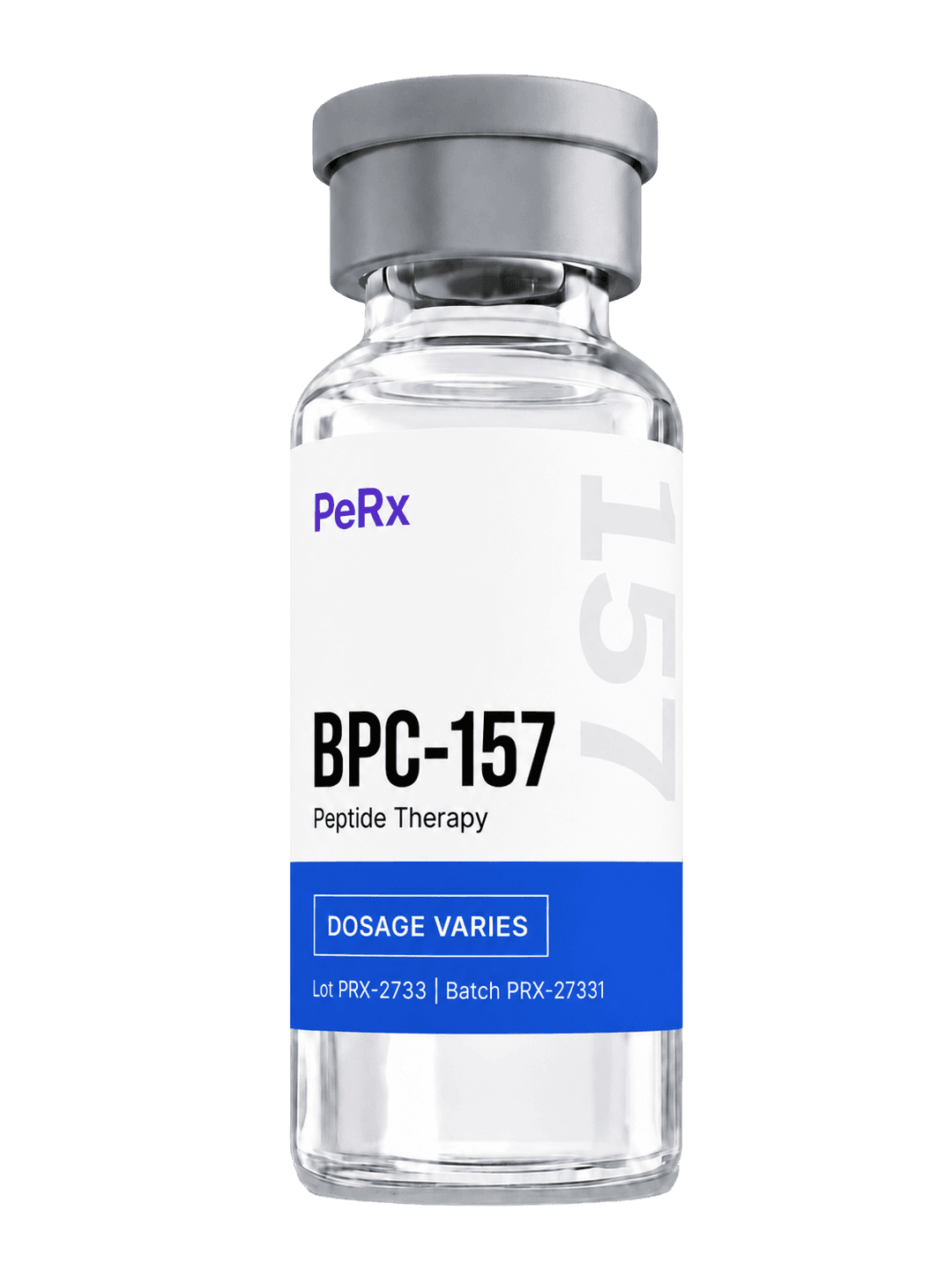
The numbers on this page are simple because the PeRx vial is standardized: 3 mg/mL, 5 mL, 15 mg of BPC-157 per vial, shipped fully reconstituted and ready to use with insulin syringes in the box.
It is prescribed by a licensed provider after a health screening and compounded at a US-based 503A pharmacy with third-party testing. One vial covers a month of therapy at $229, and your prescription label carries your exact draw.
BPC-157 Dosage in mL and Units
The conversion is one line of arithmetic, worth understanding rather than memorizing. A U-100 insulin syringe holds 100 units per mL, so each unit is 0.01 mL. Multiply by the concentration: at 3 mg per mL, one mL carries 3,000 mcg, so one unit carries 30 mcg. From there, units equals micrograms divided by 30, and mL equals micrograms divided by 3,000. A 300 mcg dose is 10 units and 0.1 mL. A 500 mcg dose is 0.167 mL, drawn to the 17-unit mark.
Notice how small those volumes are. Nothing on the chart above reaches a quarter of a mL, which is why BPC-157 is drawn with an insulin syringe rather than anything larger; PeRx includes them in the box. Small volumes also mean the syringe markings matter more than they would with a bigger draw, so read the barrel at eye level rather than estimating. Where that small draw should go, and whether injecting near the injury matters, is a separate question covered in where to inject BPC-157. If subcutaneous injections are entirely new to you, how to inject peptides walks through the technique from the first alcohol swab.
This math holds at 3 mg/mL only
Vials from other sources are often sold as a powder the buyer dissolves at home, which means the final concentration is whatever that person made it. Their 10 units and your 10 units can be very different doses. Never carry unit counts from one vial to another without checking the concentration first. PeRx BPC-157 ships fully reconstituted and ready to use at 3 mg/mL, so at PeRx the conversion never changes.
Micrograms vs Milligrams in BPC-157 Dosing
BPC-157 doses are written in micrograms. Vial totals are written in milligrams. One milligram is 1,000 micrograms, and mixing the two up is the most consequential reading error in peptide dosing. A 250 mcg dose is a quarter of a milligram; someone who reads it as 250 mg is looking at a thousand times the intended amount, more than sixteen entire vials in one sitting. The confusion usually enters through sloppy forum posts that write "take 250" with no unit at all. When a BPC-157 number has no unit attached, it is almost certainly micrograms, and the 15 mg printed on the vial is the total contents, not a dose.
The units also explain where daily doses came from, and this is worth stating plainly: the controlled BPC-157 dosing literature is animal research. A 2019 review of the musculoskeletal soft-tissue studies found the rodent work clustered around 10 mcg per kilogram of body weight, delivered by injection near the injured tissue. Individual studies, like the 2011 tendon-cell work that mapped how BPC-157 promotes tendon outgrowth and cell survival, used concentrations chosen for the lab, not for a person. No human dose-finding trial has been published. The 250 to 500 mcg daily range you see in clinics is a convention that grew out of scaling those animal doses to adult bodyweights and then rounding to numbers that draw cleanly on a syringe. It is informed by the research without being proven by it, which is exactly why the prescription model matters: a provider weighs that uncertainty against your history instead of a forum doing it for you.
Gwyer D, Wragg NM, Wilson SL. "Gastric pentadecapeptide body protection compound BPC 157 and its role in accelerating musculoskeletal soft tissue healing." Cell and Tissue Research. 2019;377(2):153-159. View study
Chang CH, Tsai WC, Lin MS, Hsu YH, Pang JH. "The promoting effect of pentadecapeptide BPC 157 on tendon healing involves tendon outgrowth, cell survival, and cell migration." Journal of Applied Physiology. 2011;110(3):774-780. View study
How Much BPC-157 to Take
The honest answer is that your provider decides, and the useful answer is what the decision usually looks like. Most protocols land between 250 and 500 mcg per day. Providers tend to reason in two frames at once. The first is per day: a smaller daily dose for gut-focused or maintenance goals, a larger one when there is a named injury to support. The second is per injury phase: the dose stays flat, but the course starts when the injury does and ends when healing is satisfactory, rather than running on the calendar indefinitely. Some prescriptions split the daily amount into a morning and evening injection; twice 250 mcg and once 500 mcg both appear in practice, and neither has trial evidence over the other.
What the published human record actually contains is thin and worth characterizing accurately. The most cited human report is a 2021 case series in which physicians injected BPC-157 directly into the knee joints of chronic knee pain patients. That is a clinician performing an intra-articular procedure, which is not the same thing as a home subcutaneous protocol, and it reported outcomes rather than comparing doses. It tells you people have been given BPC-157 by doctors and tolerated it; it does not hand you a number. For what BPC-157 is, how it works, and what the wider evidence base looks like, the full BPC-157 guide is the deep dive. This page stays on arithmetic and conventions.
Lee E, Padgett B. "Intra-Articular Injection of BPC 157 for Multiple Types of Knee Pain." Alternative Therapies in Health and Medicine. 2021;27(4):8-13. View study
The BPC-157 Dosage Calculator Question
People search for a BPC-157 dosage calculator because most vials on the market need one: when the buyer dissolves a powder themselves, the concentration depends on how much liquid went in, and the units-per-dose math changes with every batch. A calculator is a patch for a variable that should not be variable. At a fixed 3 mg/mL there is nothing left to calculate. Units equals mcg divided by 30. Volume in mL equals mcg divided by 3,000. The chart at the top of this page is those two formulas evaluated at every common dose, and it will still be correct next month, because the concentration will still be 3 mg/mL.
BPC-157 Capsule Dosing
BPC-157 also comes as an oral capsule, and the dosing story there is deliberately simpler: BPC Capsules are taken as one capsule daily with water, on the schedule your provider sets. No syringe, no unit math, no refrigeration, thirty capsules per bottle at $200. Each capsule is 500 mcg of BPC-157, and as with the injection, the bottle label is the instruction that governs.
Capsules and injections are not interchangeable at equal doses, and the difference is the route, not the label. Swallowed BPC-157 meets stomach acid and digestive enzymes, so only a fraction reaches the bloodstream intact; what makes the oral route interesting is that the peptide contacts the gut lining directly on the way through, which is the point of gut-focused protocols. Injection skips digestion and delivers the systemic dose that tendon and ligament protocols are built around. The full breakdown of when providers choose each route is in BPC-157 oral vs injectable. The practical summary: gut goals often go oral, musculoskeletal goals go injectable, and some patients run both under provider direction.
BPC-157 Cycle Length
BPC-157 is a course peptide, not a forever peptide. The course is tied to a goal: commonly about 4 to 8 weeks for a soft-tissue injury, with 4 weeks often enough for an acute strain and 8 more typical for something chronic, and roughly 8 to 12 weeks for gut-focused protocols. When the goal is met, the course ends. If symptoms return later, providers generally prefer a fresh course over continuous indefinite use. This goal-based logic is different from the receptor-based cycling that growth hormone peptides need, and the distinction is mapped across the whole catalog in the peptide cycling guide.
Two related pages fill in what this one leaves out. When results tend to show up inside a course, from the first week to the four-month mark, is the subject of how long BPC-157 takes to work; nothing about injecting more moves that timeline up. And if your protocol pairs BPC-157 with TB-500, the combined product has its own arithmetic and its own table in the BPC-157 and TB-500 dosage chart.
What a Month of BPC-157 Costs
BPC-157 at PeRx is $229 per vial, one vial per prescription month, with the provider review, compounding at a US 503A pharmacy, overnight refrigerated shipping, and syringes all inside that number. Nothing is charged until a licensed provider approves the prescription. The per-day math follows straight from the chart: a 15 mg vial holds exactly 30 doses at 500 mcg, so a month at the top of the typical range works out to about $7.63 a day. At 250 mcg the same vial holds 60 doses, and your provider structures the course accordingly. The oral route prices similarly: $200 for 30 capsules is about $6.67 a day. An 8-week injectable course is two vials, $458 before any discount.
Storage protects that spend. Keep the vial refrigerated at 36 to 46 degrees Fahrenheit, never frozen, upright and out of light, and check that the solution is clear before each draw. Side effects at these doses are usually limited to minor injection-site reactions; what is common versus what deserves a call is covered in the peptide side effects guide, and anything systemic or persistent goes to your provider, not to a dose adjustment you make yourself.
If You Miss a BPC-157 Dose
Skip it and take the next dose at its normal time. Do not inject twice to catch up. BPC-157 protocols work through consistent daily exposure across a multi-week course, so one missed day is background noise; two injections stacked into one day just doubles the dose your provider chose without adding a day of coverage. If travel or a rough week costs you several days in a row, mention it at your check-in so the course end date can shift, rather than quietly extending it on your own. And if you find whole weeks slipping, that is a signal the capsule might fit your life better than the syringe, which is a conversation your provider can have with you mid-course.
Common Questions
Related Guides
Continue reading about peptides and protocols that pair well with this guide.
BPC-157 Capsules vs Injection: Which Route Wins
BPC-157 is the rare peptide with a real oral story, but that does not mean capsule and injection are interchangeable. A physician-reviewed breakdown of gut-local vs systemic delivery, what survives digestion, and how providers choose the route.
BPC-157 vs a Cortisone Shot for Injury Recovery
A cortisone shot can quiet an angry joint or tendon in days. BPC-157 works the other way around: a slower, regenerative approach taken as a daily injection over weeks. They are not competing versions of the same idea. They are different tools for different jobs, and the honest answer to which one you need depends on what you are actually trying to fix.
Franklin Peptide Therapy: 2026 Cost Guide
A plain guide to peptide therapy in Franklin and Williamson County: what it costs across local clinics, concierge services, and telehealth, and who tends to use it here. Plus how pharmaceutical-grade peptides reach any Tennessee address without a clinic visit.
Ready to get started?
Pharmaceutical-grade BPC-157, prescribed by a licensed provider, compounded at a US 503A pharmacy, and shipped to your door ready to use with insulin syringes included.
Medical Disclaimer
The information provided on this website, including all articles, guides, and educational content, is for informational and educational purposes only and is not intended as medical advice, diagnosis, or treatment. Nothing on this site should be construed as a substitute for professional medical advice from a qualified healthcare provider.
The majority of peptides discussed on this site are not approved by the U.S. Food and Drug Administration (FDA) for the indications described. They are classified as bulk drug substances and are available only through a licensed prescribing provider and compounding pharmacy. All treatments require a valid prescription and provider oversight.
The majority of published research on peptide therapies has been conducted in preclinical (animal) models. While early human data is encouraging, comprehensive clinical trial data remains limited for most peptide compounds. Individual results may vary significantly based on health status, injury type, and other factors. No specific outcomes are guaranteed.
Certain peptides discussed on this site are classified as prohibited substances by the World Anti-Doping Agency (WADA) and are banned by major sports organizations including the NFL, NCAA, UFC, NBA, MLB, NHL, and PGA. If you are subject to anti-doping testing, consult your governing body before considering any peptide therapy.
Statements on this website have not been evaluated by the Food and Drug Administration. Products and therapies discussed are not intended to diagnose, treat, cure, or prevent any disease.
© 2026 Wellness MD Group PC DBA PeRx. All rights reserved.