BPC-157/TB-500 Dosage Chart: Units, mg, Cycle
The prescribed BPC-157/TB-500 blend has one concentration and one dose, and every number on this page follows from those two facts. Draw 20 units and you get 0.6 mg of each peptide. Here is the full arithmetic: the dosage chart, units on an insulin syringe, per-day and per-week totals, how the capsules dose differently, and what a month actually costs.
In this article
Key Takeaways
- The prescribed BPC-157/TB-500 dosage at PeRx is 20 units (0.2 mL) injected under the skin once daily, Monday through Friday, for 6 weeks, then 6 weeks off.
- The vial is compounded at 3 mg BPC-157 and 3 mg TB-500 per mL, so each 20-unit dose delivers 0.6 mg of each peptide, 1.2 mg combined. That is 6 mg per week and 36 mg over a full 6-week course.
- The 5 mL vial ships fully reconstituted and ready to use, so there is no mixing step and no concentration math. It holds 25 doses; a 6-week course needs 30, so plan on a second vial.
- The capsules dose differently: 500 mcg of each peptide per capsule, one capsule every morning, seven days a week. Oral milligrams and injected milligrams are not interchangeable, especially for TB-500.
- Your provider prescribes your protocol and the prescription label governs. These are the numbers as written at PeRx, not trial-derived doses; TB-500 in particular has no published human dosing data.
BPC-157/TB-500 Dosage Quick Facts
Dose
20 units (0.2 mL) subcutaneously
Frequency
Once daily, Monday through Friday
Per injection
0.6 mg BPC-157 + 0.6 mg TB-500 (1.2 mg total)
Vial
5 mL at 3 mg/3 mg per mL, ready to use, 25 doses
Cycle
6 weeks on, 6 weeks off before restarting
Capsules
500 mcg of each peptide, 1 capsule every morning
Last reviewed
August 31, 2026
Your Label Governs
Everything below describes the protocol as prescribed through PeRx. A licensed provider writes your prescription after reviewing your intake, and the directions on your prescription label take precedence over any chart, this one included. If your label and this page disagree, follow the label and message your provider.
What Concentration Is the Blend Vial?
A dosage chart is only as good as the concentration it assumes, and this is where most BPC-157/TB-500 numbers on the internet fall apart. The blend is not one standardized product. Gray-market vendors sell it as a powder in whatever ratio they choose, often 10 mg of each peptide, and the buyer sets the final concentration by deciding how much diluent to add. Two people following the same forum chart can be injecting very different amounts.
The prescribed version dispensed through PeRx removes that variable. The compounding pharmacy supplies a 5 mL vial at 3 mg BPC-157 and 3 mg TB-500 per mL, a fixed 1:1 ratio, 15 mg of each peptide and 30 mg of total peptide in the vial. It ships fully reconstituted and ready to use, refrigerated, with insulin syringes in the box. You never touch a concentration decision. The pharmacy made it, the label states it, and the only number you handle is the line you draw to. If you want the reasoning behind the pairing and the week-by-week expectations, the main BPC-157 and TB-500 guide covers all of that. This page stays on the math.
BPC-157/TB-500 Dosage Chart
Every row in the chart comes from two inputs: 20 units on a U-100 insulin syringe equals 0.2 mL, and each mL carries 3 mg of each peptide. Multiply through and the daily, weekly, and full-course totals fall out.
| Measure | BPC-157 | TB-500 | Combined |
|---|---|---|---|
| Concentration (per mL) | 3 mg | 3 mg | 6 mg |
| Per dose (20 units, 0.2 mL) | 0.6 mg | 0.6 mg | 1.2 mg |
| Per week (5 doses, Mon-Fri) | 3 mg | 3 mg | 6 mg |
| Per 6-week course (30 doses) | 18 mg | 18 mg | 36 mg |
| Per 5 mL vial | 15 mg | 15 mg | 30 mg |
| Doses per vial | 25 | 25 | 25 doses |
| Vials per 6-week course | 1.2 | 1.2 | Runs into a 2nd vial |
Concentration (per mL)
- BPC-157
- 3 mg
- TB-500
- 3 mg
- Combined
- 6 mg
Per dose (20 units, 0.2 mL)
- BPC-157
- 0.6 mg
- TB-500
- 0.6 mg
- Combined
- 1.2 mg
Per week (5 doses, Mon-Fri)
- BPC-157
- 3 mg
- TB-500
- 3 mg
- Combined
- 6 mg
Per 6-week course (30 doses)
- BPC-157
- 18 mg
- TB-500
- 18 mg
- Combined
- 36 mg
Per 5 mL vial
- BPC-157
- 15 mg
- TB-500
- 15 mg
- Combined
- 30 mg
Doses per vial
- BPC-157
- 25
- TB-500
- 25
- Combined
- 25 doses
Vials per 6-week course
- BPC-157
- 1.2
- TB-500
- 1.2
- Combined
- Runs into a 2nd vial
Two patterns in the table are worth noticing because they make the mental math easy. Five doses of 0.2 mL is exactly 1 mL, so one week of injections uses one mL of the vial, and your weekly intake always equals the per-mL numbers on the label: 3 mg of each peptide. And because the vial holds 5 mL, it covers 5 dosing weeks. A 6-week course needs 30 doses, so it runs one week into a second vial. Order accordingly rather than discovering the shortfall in week five.
BPC/TB-500
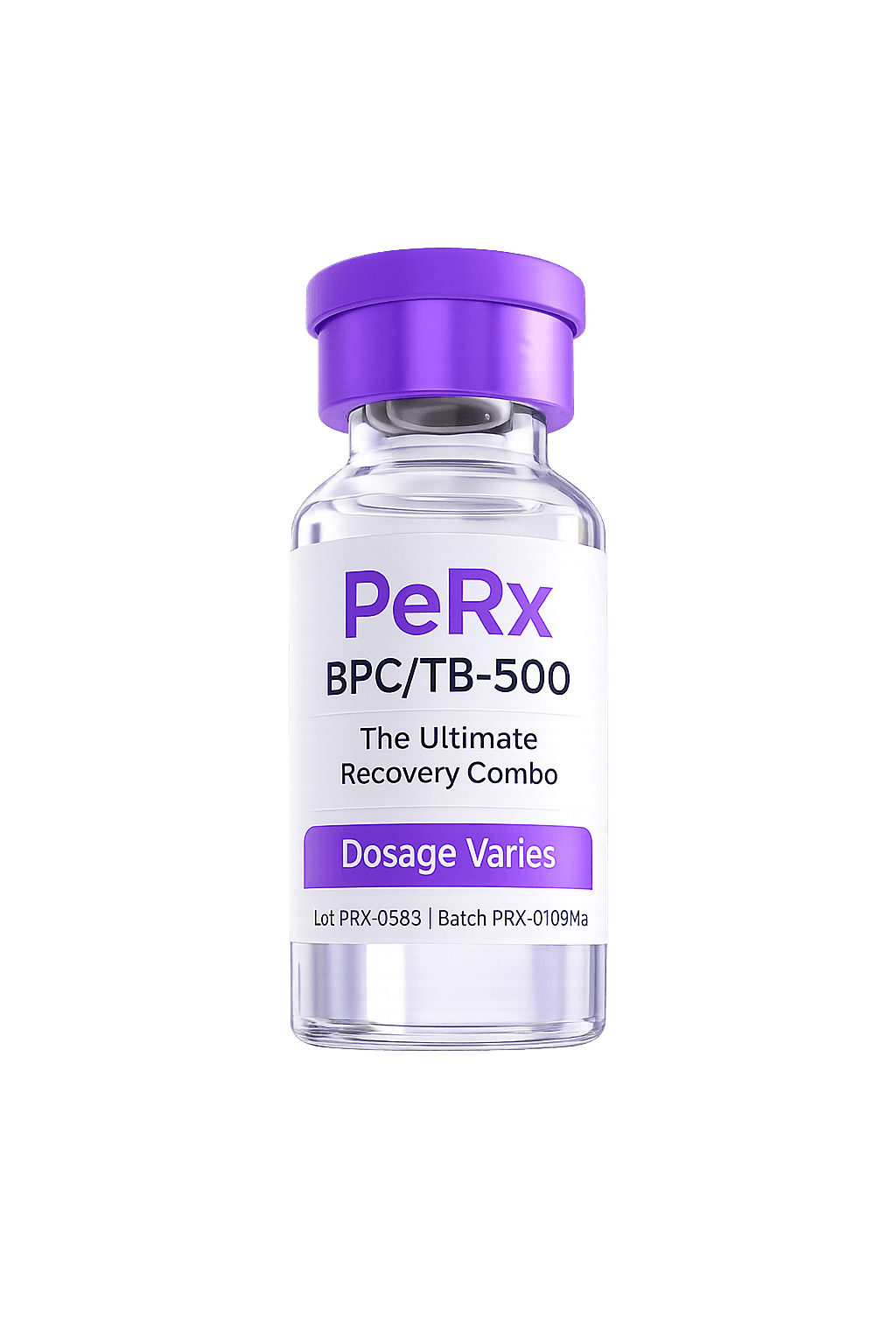
PeRx ships the blend this chart describes as a single vial: 3 mg/mL of each peptide, 5 mL total, prescribed by a licensed provider and compounded at a US-based 503A pharmacy. It arrives fully reconstituted and ready to use, with insulin syringes included.
Because both peptides sit in one solution at matched concentrations, one draw delivers the pair in a fixed ratio, with no second vial and no separate math. $299 for the monthly vial, and the oral capsules are available at $225 if injections are not for you.
How Many Units on an Insulin Syringe?
The prescription is written in units because insulin syringes are marked in units. On a U-100 syringe, 100 units equals 1 mL, so each unit is 0.01 mL. The prescribed pull is 20 units, which is 0.2 mL no matter which syringe size you were sent: one-fifth of a 1 mL barrel, two-fifths of a 0.5 mL barrel, two-thirds of a 0.3 mL barrel. Read the printed unit markings, not the fill height by eye. Twenty units is a short draw, and eyeballing it is how people end up at 12 or 15 without noticing.
| Units (U-100) | Volume | BPC-157 | TB-500 | Combined |
|---|---|---|---|---|
| 10 units | 0.1 mL | 0.3 mg | 0.3 mg | 0.6 mg |
| 20 units (prescribed) | 0.2 mL | 0.6 mg | 0.6 mg | 1.2 mg |
| 30 units | 0.3 mL | 0.9 mg | 0.9 mg | 1.8 mg |
| 40 units | 0.4 mL | 1.2 mg | 1.2 mg | 2.4 mg |
| 50 units | 0.5 mL | 1.5 mg | 1.5 mg | 3.0 mg |
10 units
- Volume
- 0.1 mL
- BPC-157
- 0.3 mg
- TB-500
- 0.3 mg
- Combined
- 0.6 mg
20 units (prescribed)
- Volume
- 0.2 mL
- BPC-157
- 0.6 mg
- TB-500
- 0.6 mg
- Combined
- 1.2 mg
30 units
- Volume
- 0.3 mL
- BPC-157
- 0.9 mg
- TB-500
- 0.9 mg
- Combined
- 1.8 mg
40 units
- Volume
- 0.4 mL
- BPC-157
- 1.2 mg
- TB-500
- 1.2 mg
- Combined
- 2.4 mg
50 units
- Volume
- 0.5 mL
- BPC-157
- 1.5 mg
- TB-500
- 1.5 mg
- Combined
- 3.0 mg
The rows above 20 units exist so you can translate charts written for other concentrations, not as an invitation to draw more. At this concentration the prescribed dose is 20 units, and nothing on your label changes with the day of the week. Injection goes under the skin, as close to the injury as you can comfortably reach, rotating spots. Site selection has its own logic, and where to inject BPC-157 maps it out region by region. If you have never drawn from a vial at all, How to Take Peptides walks the full sequence from swab to sharps container.
Dosage Per Day vs Per Week
Searches for BPC-157/TB-500 blend dosage per day usually come from people comparing the blend to separate-vial stacking protocols, and the comparison only works at the weekly level. On dosing days you take 1.2 mg of combined peptide: 0.6 mg of each. Saturday and Sunday you take nothing. Across a week that is 3 mg of BPC-157 and 3 mg of TB-500.
Separate-vial protocols look different on paper because the two peptides are traditionally scheduled differently when each has its own vial. Forum protocols tend to run BPC-157 as a small daily injection while giving TB-500 as a larger shot once or twice a week, because a standalone TB-500 vial makes that split possible. The blend cannot do that and does not try. Both peptides ride in the same solution at a fixed 1:1 ratio, so both arrive on the same Monday-through-Friday schedule, in smaller and more frequent amounts. Same weekly logic, different delivery rhythm. The reasoning behind combining them into one vial in the first place is covered in why we pair BPC-157 and TB-500.
One implication worth stating plainly: a per-day number from a chart built for separate vials does not transfer to the blend, and a blend number does not transfer back. If a chart tells you to inject 2.5 mg of TB-500, it is describing a standalone TB-500 protocol at some other concentration. Trying to hit that number with the blend would mean drawing over 80 units and taking 2.5 mg of BPC-157 along for the ride. The unit count on your prescription label is the only per-day number that applies to this vial.
Capsules: How Oral Dosing Differs
The blend also comes as an oral capsule, and the dosing is structured differently in three ways: the per-dose amount, the schedule, and what the milligrams mean once they are inside you.
| Injectable blend | Capsules | |
|---|---|---|
| Per dose | 0.6 mg of each peptide (20 units) | 500 mcg (0.5 mg) of each peptide per capsule |
| Schedule | Once daily, Monday through Friday | One capsule every morning, 7 days a week |
| Timing rules | Any consistent time of day | Empty stomach, water only, wait 30 minutes before food or coffee |
| Nominal weekly intake | 3 mg of each peptide | 3.5 mg of each peptide |
| Route | Subcutaneous, near the injury when possible | Oral, absorbed through the GI tract |
| Storage | Refrigerated, 36 to 46 degrees F | Room temperature, cool and dry |
| Cycle | 6 weeks on, 6 weeks off | 6 weeks on, 6 weeks off |
Per dose
- Injectable blend
- 0.6 mg of each peptide (20 units)
- Capsules
- 500 mcg (0.5 mg) of each peptide per capsule
Schedule
- Injectable blend
- Once daily, Monday through Friday
- Capsules
- One capsule every morning, 7 days a week
Timing rules
- Injectable blend
- Any consistent time of day
- Capsules
- Empty stomach, water only, wait 30 minutes before food or coffee
Nominal weekly intake
- Injectable blend
- 3 mg of each peptide
- Capsules
- 3.5 mg of each peptide
Route
- Injectable blend
- Subcutaneous, near the injury when possible
- Capsules
- Oral, absorbed through the GI tract
Storage
- Injectable blend
- Refrigerated, 36 to 46 degrees F
- Capsules
- Room temperature, cool and dry
Cycle
- Injectable blend
- 6 weeks on, 6 weeks off
- Capsules
- 6 weeks on, 6 weeks off
The nominal weekly numbers land close together, 3 mg injected versus 3.5 mg swallowed, but they are not equivalent doses. An injected milligram bypasses digestion entirely. An oral milligram has to survive the GI tract first, and the two peptides fare very differently there. BPC-157 was isolated from gastric juice and is unusually stable in stomach acid, which is why an oral format exists for it at all; the oral versus injectable BPC-157 breakdown goes through the absorption evidence. TB-500 is a larger molecule with poor oral survivability, so the capsule is best understood as a gut-directed BPC-157 product with a partial TB-500 contribution rather than an equal-strength swap for the injection. The general trade-offs between the two routes are laid out in oral versus injectable peptides.
Cycle Length
The prescription as written runs 6 weeks on, then 6 weeks off, and says in plain words not to use it continuously. Six weeks at five doses per week is 30 injections and 36 mg of combined peptide. If there is still a reason to continue after the off period, a new cycle goes back through provider review rather than rolling over automatically. Providers can and do write different cycle lengths for different situations, which is exactly why the label outranks this page.
The off period earns its place in the math. BPC-157 has a large preclinical literature, nearly all of it rodent work, and essentially no controlled human trials behind the doses used in practice. TB-500 is thinner still: the human data that exists belongs to full thymosin beta-4, which reached early-phase wound-healing trials, and the TB-500 fragment itself has no published human dosing data at all. A bounded cycle keeps cumulative exposure capped at 26 dosing weeks per year while that evidence gap stands. The same 20-unit, weekdays-only, 6-on-6-off structure carries over to the four-peptide version of this vial, charted in the KLOW dosage guide.
Seiwerth S, Rucman R, Turkovic B, et al. "BPC 157 and Standard Angiogenic Growth Factors. Gastrointestinal Tract Healing, Lessons from Tendon, Ligament, Muscle and Bone Healing." Current Pharmaceutical Design. 2018;24(18):1972-1989. View study
Treadwell T, Kleinman HK, Crockford D, et al. "The regenerative peptide thymosin β4 accelerates the rate of dermal healing in preclinical animal models and in patients." Annals of the New York Academy of Sciences. 2012;1270:37-44. View study
Two Rules That Ride With the Prescription
No NSAIDs during the cycle: no ibuprofen, naproxen, or aspirin, including the versions tucked inside combination cold and headache products. And brief lightheadedness after an injection is possible; sit down for your first several doses and stay seated a few minutes. If lightheadedness lasts past 15 to 20 minutes, if you faint, or if you have swelling of the face or throat, trouble breathing, or a racing heartbeat, treat it as an emergency.
What a Month Costs
The injectable blend is $299 for a one-month supply, which is the 5 mL vial. At 25 doses per vial that works out to just under $12 per injection, and at five doses per week one vial covers five dosing weeks. A full 6-week course spans two vials, with most of the second vial left over; an unopened continuation into a later cycle is a question for your provider, since the vial carries a pharmacy beyond-use date.
The capsules are $225 for a bottle of 30, which is $7.50 per day at one capsule daily. Because capsules run seven days a week, a bottle lasts 30 days flat, and a 6-week course uses 42 capsules and therefore reaches into a second bottle. Per milligram the capsules look cheaper than they are; the oral route gives up a large share of the TB-500 in transit, so cost per absorbed milligram tilts back toward the injectable. Which format fits is a goals question, gut-focused versus injury-focused, more than a budget question.
If You Miss a Dose
For the injectable: if you remember on the same day, take the dose when you remember. If the day has passed, skip it and inject on the next scheduled day. Never draw double to catch up. One missed dose out of a 30-dose course is a rounding error; a doubled dose is an unforced one. Weekends are not missed doses. Saturday and Sunday off is the schedule working as written.
For the capsules the same logic applies on a 7-day clock. A forgotten morning capsule can be taken later that day, though you lose the empty-stomach timing; if the whole day slips by, resume with one capsule the next morning rather than taking two. If you find yourself missing doses often enough that the course stretches out, mention it to your provider instead of improvising a compressed schedule at the end.
BPC-157/TB-500 Dosage: Common Questions
Related Guides
Continue reading about peptides and protocols that pair well with this guide.
Wolverine Stack Dosage Chart: Daily and Weekly Doses
The Wolverine stack is the forum nickname for BPC-157 plus TB-500, and most dosage charts for it assume two gray-market vials and a loading phase. The prescribed version is simpler: one blend vial, 20 units, Monday through Friday. This page puts the circulating protocols and the prescribed numbers side by side, answers the per-day and per-week questions in plain milligrams, and shows why you do not need a calculator for any of it.
Where to Inject TB-500: Sites and Rotation
TB-500 is a subcutaneous injection. One detail catches most people off guard: PeRx does not dispense TB-500 on its own. It comes pre-mixed with BPC-157 in a single ready-to-use vial, so "where to inject TB-500" is really "where to inject the BPC-157/TB-500 combo." The four standard subQ sites all work, and because this is a tissue-repair combination, there is a practical case for injecting near the injury when it makes sense. Here is the guide patients ask for after their first vial arrives.
Ipamorelin Peptide: What It Does, Doses, Evidence
Ipamorelin is a five-amino-acid peptide that tells the pituitary to release a pulse of growth hormone. Its reputation rests on one word, selective, and that word traces back to a 1998 experiment in pigs. The human record is narrower than most pages admit: one dosing study by IV infusion and a surgical program that failed. This guide covers what ipamorelin does, where the dose numbers online come from, what FDA reviewers concluded in 2024, and why we only prescribe it paired.
Ready to get started?
Pharmaceutical-grade BPC-157 and TB-500 in one ready-to-use vial, prescribed by a licensed provider and delivered to your door with syringes and supplies included.
Medical Disclaimer
The information provided on this website, including all articles, guides, and educational content, is for informational and educational purposes only and is not intended as medical advice, diagnosis, or treatment. Nothing on this site should be construed as a substitute for professional medical advice from a qualified healthcare provider.
The majority of peptides discussed on this site are not approved by the U.S. Food and Drug Administration (FDA) for the indications described. They are classified as bulk drug substances and are available only through a licensed prescribing provider and compounding pharmacy. All treatments require a valid prescription and provider oversight.
The majority of published research on peptide therapies has been conducted in preclinical (animal) models. While early human data is encouraging, comprehensive clinical trial data remains limited for most peptide compounds. Individual results may vary significantly based on health status, injury type, and other factors. No specific outcomes are guaranteed.
Certain peptides discussed on this site are classified as prohibited substances by the World Anti-Doping Agency (WADA) and are banned by major sports organizations including the NFL, NCAA, UFC, NBA, MLB, NHL, and PGA. If you are subject to anti-doping testing, consult your governing body before considering any peptide therapy.
Statements on this website have not been evaluated by the Food and Drug Administration. Products and therapies discussed are not intended to diagnose, treat, cure, or prevent any disease.
© 2026 Wellness MD Group PC DBA PeRx. All rights reserved.