Free tool · No sign-up · Nothing you enter is stored
Peptide Dosage Calculator: Units, mg and mL Explained (and Why PeRx Vials Need No Math)
Enter the vial strength, the liquid volume and your dose, and this peptide calculator returns the syringe units, the volume and the concentration.
The tool only does arithmetic. Your prescribing provider sets your dose, and the pharmacy label is the final word on your vial.

Medically reviewed by Cory Mellon, MD
Medical Advisor · Last reviewed October 16, 2026
Peptide Calculator
Pick the mode that matches your vial. A powder vial needs the amount on the label and the liquid you added. A vial that is already in solution, which is how a prescribed vial arrives, needs only the concentration printed on the label. Then enter the dose your provider gave you and the syringe you have.
Use this when the vial holds a powder and you add liquid to it.
Enter the numbers from your vial and your prescribed dose. The result updates as you type.
This tool converts numbers you enter. It does not recommend a peptide or an amount, and your prescribing provider sets your dose. Follow your pharmacy label.
Tired of reconstituting your own peptides?
Every PeRx peptide ships fully reconstituted and ready to use, with your dose set by a licensed provider. The label states the concentration and the prescribed dose arrives on paper with the vial, so there is nothing to work out.
Check eligibilityHow the Peptide Calculator Works
Three formulas, the same ones every U-100 insulin-syringe peptide dose calculator uses. Written out so you can check the tool by hand.
1. Concentration
vial mg ÷ liquid mL = mg/mL
5 mg in 2 mL is 2.5 mg/mL. Each unit of a U-100 syringe is 0.01 mL, so one unit holds 0.025 mg, or 25 mcg.
2. Units per dose
dose mg ÷ (mg/mL ÷ 100) = units
A 250 mcg dose is 0.25 mg. Divide by 0.025 mg per unit and the draw is 10 units, which is 0.1 mL.
3. Doses per vial
vial mg × 1,000 ÷ dose mcg
5 mg is 5,000 mcg. At 250 mcg a dose, the vial holds 20 doses. The tool rounds down, because a partial dose is not a dose.
Notice what the liquid does. More liquid in the same powder lowers the concentration, so the same dose takes more units, but the dose itself does not change. Adding 4 mL instead of 2 mL to that 5 mg vial makes 250 mcg a 20-unit draw rather than 10. All of this rests on the U-100 standard: 100 units equals 1 mL, so one unit is 0.01 mL.
Peptide Dosage Calculator Examples
Four rows with clean numbers so you can see the pattern. Example math only. These rows are not doses or protocols, and no peptide is named on purpose.
| Vial | Liquid | Dose | Concentration | Volume | Draw |
|---|---|---|---|---|---|
| 5 mg | 2 mL | 250 mcg | 2.5 mg/mL | 0.1 mL | 10 units |
| 10 mg | 2 mL | 2.5 mg | 5 mg/mL | 0.5 mL | 50 units |
| 5 mg | 1 mL | 500 mcg | 5 mg/mL | 0.1 mL | 10 units |
| 2 mg | 1 mL | 100 mcg | 2 mg/mL | 0.05 mL | 5 units |
Read the first and third rows together: half the liquid and twice the dose still land on 10 units. The peptide calculator makes those relationships visible; it does not decide any of the numbers.
Insulin Syringe for Peptides: U-100 Units Explained
A U-100 insulin syringe is marked in units, where 100 units fill 1 mL. The 0.3 mL, 0.5 mL and 1 mL sizes all use that same scale. They differ only in capacity, 30, 50 or 100 units, and in how far apart the marks sit. A smaller barrel spreads the same units over the same length, so a 0.3 mL syringe is easiest to read for a small draw, and a 1 mL syringe is the one that fits a large draw at all.
| Volume | U-100 units |
|---|---|
| 0.05 mL | 5 units |
| 0.1 mL | 10 units |
| 0.2 mL | 20 units |
| 0.5 mL | 50 units |
| 1 mL | 100 units |
Choose the syringe after the math. Under about 10 units, the 0.3 mL barrel gives the most room between marks; over 50 units, only the 1 mL size holds it. Technique is covered in our guide on how to inject peptides and the illustrated injection guide.
Common Mistakes and What to Do
Mixing up mg and mcg.
A dose of 250 typed as mg instead of mcg is a thousand times too large. The calculator flags a result larger than the vial, larger than any syringe, or too small to draw. Check the unit on the label first.
Entering the wrong liquid volume.
If you added 2 mL but typed 1, every draw comes out half size. Measure the liquid with the syringe and type the total you actually added.
A result over the syringe capacity.
The tool names the next size up. If even 1 mL will not hold it, use less liquid in a powder vial, or ask the pharmacy before splitting a prescribed dose.
A result under 2 units.
Too small to measure reliably. Add more liquid to a powder vial, or ask the pharmacy about a prescribed vial. Do not estimate a fraction of a mark.
Reading the wrong scale.
Some syringes carry mL and units side by side. This peptide calculator reports U-100 units; if your syringe is marked only in mL, use the mL figure instead.
The other half of the title
Why PeRx Vials Need No Math
A licensed provider writes the prescription, a state-licensed 503A pharmacy fills it, and the vial ships fully reconstituted and ready to use. The label states the concentration in mg/mL, and the prescribed dose arrives on paper with the vial. The powder-vial half of this page, and the peptide dosage calculator with it, exists for people holding a vial from somewhere else.
That removes the mix-up the calculator warns about most, mg against mcg and mL, because nobody adds liquid or converts a dose at home. The concentration is a pharmacy figure, checked at the pharmacy, which is the subject of how PeRx tests its peptides. For the vocabulary, read what pharmaceutical-grade peptides means, and for the process, read how to get peptides prescribed online. Plan-level pricing is on the pricing page.
Most-Calculated Peptides
The calculator above works for any peptide. These four are the ones people most often arrive here holding. None of these lines is a dose recommendation.
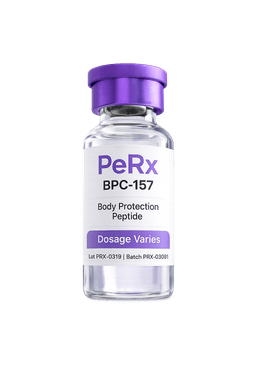
BPC-157
Searching for a BPC 157 dosage calculator? The tool above does the math, your prescribing provider sets the dose, and the BPC-157 dosage chart gives the published context.
Find out more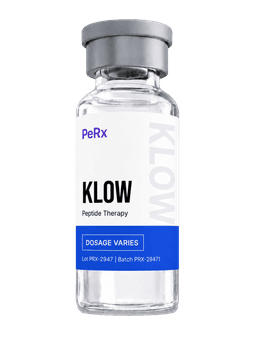
KLOW
Four repair peptides in one ready-to-use vial. The KLOW dosage guide explains how a blended vial is labeled.
Find out more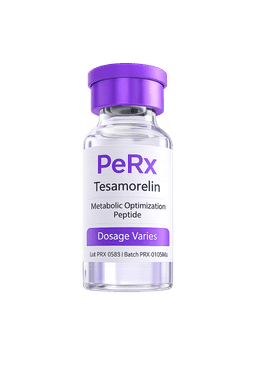
Tesamorelin
A growth hormone-releasing hormone analog in a ready-to-use vial. See the tesamorelin dosage chart for the published ranges.
Find out more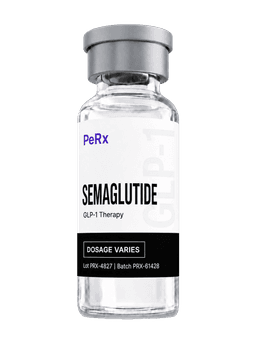
Semaglutide
Compounded semaglutide, a once-weekly GLP-1 injection prescribed by a licensed provider. It is not the FDA-approved brand, and it ships ready to use.
Find out more
Browse all peptides to see what a licensed provider can prescribe through PeRx.
Storage and Safety Basics
- Write the date on the vial the day you first draw from it.
- Keep it cold and away from light unless the pharmacy label says otherwise.
- Never reuse a needle, and never share a syringe or a vial.
- Discard anything cloudy, discolored or with particles in it.
- Double-check the math once, then follow the pharmacy label, which overrides any calculator.
No shelf-life number is given here; it depends on the product and the pharmacy. Our guide on how to store peptides goes further.
Your Dose Is Set by Your Provider
A peptide dosage calculator turns a dose you already have into syringe units. It cannot tell you whether a peptide is right for you or how much to take; that is a prescribing decision, which is why peptides require a prescription. For the published ranges a provider weighs, the dosage chart is the parent page.
Peptide Calculator FAQs
How do I convert a peptide dose into syringe units?
- Divide the vial amount by the liquid volume to get mg/mL, divide that by 100 to get mg per unit, then divide your dose in mg by the mg per unit. For 5 mg in 2 mL, that is 2.5 mg/mL and 0.025 mg per unit, so 250 mcg is 10 units. People also search for a BPC 157 dosage calculator, but the arithmetic is the same for every peptide; only the dose, which comes from your prescribing provider, changes.
Does syringe size change the number of units?
- No. The 0.3, 0.5 and 1 mL insulin syringes all use the U-100 scale, where 100 units equals 1 mL, so 10 units is 0.1 mL on every one of them. Size only changes how much the barrel holds and how far apart the marks sit, which is why a small draw is easier to read on a 0.3 mL syringe.
What if my dose is less than 2 units?
- Under 2 units is hard to measure accurately. With a powder vial, adding more liquid lowers the concentration so the same dose takes more units, which is easier to see. With a vial that is already in solution, ask the pharmacy or your prescribing provider rather than guessing at a fraction of a mark.
Does the type of liquid change the math?
- No. The calculator only needs the volume, because concentration is mg divided by mL whatever the liquid is. Which diluent to use, and how much, is on the pharmacy label or comes from the pharmacist. Follow that label rather than a forum post.
Do PeRx vials need mixing before use?
- No. Every PeRx vial ships fully reconstituted and ready to use. The label states the concentration in mg/mL and the prescribed dose arrives on paper with the vial, so the only number you handle is the units your provider wrote. If anything on the label and the paper disagree, contact support before injecting.
Can this calculator tell me my dose?
- No. It converts a dose you already have into syringe units and mL. Whether a peptide is appropriate for you, and how much, is a prescribing decision made by a licensed provider after reviewing your health history. If you do not have a prescribed dose yet, the eligibility check is the place to start.
References
- ISO 8537:2016, Sterile single-use syringes, with or without needle, for insulin. The U-100 scale (100 units per mL) used by every insulin syringe sold in the United States; recognized by the FDA as a consensus standard.
- Centers for Disease Control and Prevention. Injection Safety. cdc.gov/injection-safety. One needle, one syringe, only one time.
- U.S. Food and Drug Administration. Compounding and the FDA: Questions and Answers. fda.gov. Compounded drugs are not FDA approved.
Content current as of October 2026. This page and the calculator on it are educational. They do not diagnose, treat or recommend any peptide or any amount of one, and they do not replace the instructions of your prescribing provider or your pharmacy label. Compounded medications, including those PeRx dispenses, are not FDA approved. If you have an urgent medical concern, contact your clinician or call 911.