MOTS-c Before and After: What Changes, and When
Every MOTS-c before-and-after page online agrees on a tidy schedule: energy in week one, visceral fat by week six, a new body by week twelve. No study of injected MOTS-c in people has ever reported a result, so that schedule was written by nobody. This guide separates what patients typically report from what has actually been measured, week by week, and shows you how to run a before-and-after on yourself that would survive a skeptic.

In this article
Key Takeaways
- No completed trial of injected MOTS-c in humans has reported results, so every week-by-week MOTS-c timeline online is assembled from user reports, a four-week study of a modified analog, and mouse data. Treat the schedules as hypotheses, not findings.
- The one human number worth knowing: in the CB4211 analog trial, 11 adults with obesity and fatty liver dosed daily for four weeks showed a 6% drop in glucose and lower liver enzymes against placebo, with only a trend toward lower weight. That is the ceiling of what has been measured.
- What people typically report arrives in an order: injection-site reactions and a subjective lift in energy in the first two weeks, stamina and recovery changes in a training log by weeks three to six, and small waist or lab shifts, if any, by the end of an 8 to 12 week cycle.
- The measurable "after" is metabolic, not visual. Fasting glucose, an HbA1c drawn at baseline and three months later, a waist measurement, and a fixed benchmark workout will tell you more than any photo.
- MOTS-c did not reduce food intake in mice and is not a weight-loss therapy. Dramatic MOTS-c transformation photos almost always include a GLP-1 medication, a diet phase, or a training block that did the work.
- Everything here describes typically reported patterns and small studies as of September 2026. MOTS-c is not FDA approved, individual response varies widely, and a fair trial is a full cycle with a baseline written down first.
MOTS-c Before and After Quick Facts
Weeks 1 to 2
Injection-site reactions and a subjective energy lift; nothing verifiable yet
Weeks 3 to 6
Stamina and recovery show up in a training log; glucose is the first number that can move
Weeks 8 to 12
End of a typical cycle; the window for a waist measurement and a repeat HbA1c
Human evidence
One four-week trial of an analog (CB4211) in 20 people; no trial of MOTS-c itself has reported
Photos
No human study has produced one; body-composition change is modest at best
What to track
Fasting glucose, HbA1c at baseline and 3 months, waist, a benchmark workout, sleep
MOTS-c Before and After: The Honest Version
Search this phrase and the results agree with each other to a suspicious degree. Energy in the first two weeks. Visceral fat and insulin sensitivity moving by week six. Visible body-composition change by week twelve. The reason the pages agree is not that they cite the same trial. It is that there is no trial to cite. As of September 2026, no completed study of injected MOTS-c in humans has reported a result, and the FDA evaluation prepared for its July 2026 advisory meeting found no clinical studies and no human exposure data for the peptide by any route. The timelines were written from user reports, one four-week study of a modified analog, and mice.
That does not make a MOTS-c before-and-after meaningless. It means the honest version has to be built from three piles: what patients typically report, what has actually been measured in people, and what you can measure in yourself. One fact shapes all three. MOTS-c is a signal the body sends itself after hard work; in a small group of healthy young men, a single workout raised it roughly twelve-fold in muscle and 1.6-fold in blood. Signals like that produce gradual, metabolic change, which is why the domains that move first are the ones you feel in a workout and read on a lab slip, and why a camera is the last instrument to notice anything. Mechanism and the dosage chart live in the MOTS-c guide, the graded evidence in MOTS-c benefits, and the risks in MOTS-c side effects. This page owns one question: what changes, in what order, and how you would know.
| Domain | What people report | When | How to measure it | Measured in people? |
|---|---|---|---|---|
| Energy and stamina | Sessions feel easier; less afternoon fade | Reported from week 1; hard to trust before week 3 | A fixed benchmark workout every 2 weeks | No; treadmill gains are mouse data |
| Recovery | Less lingering soreness; easier back-to-back days | Weeks 3 to 6 | Training log: volume, loads, soreness notes | No |
| Blood sugar | Nothing felt, unless already on glucose-lowering medication | Weeks 4 to 12 | Fasting glucose; HbA1c at baseline and 3 months | Analog trial: glucose down 6% vs placebo at 4 weeks |
| Waist and body composition | Clothes fit differently; small waist change | Weeks 8 to 12, if at all | Tape at fixed landmarks monthly; DEXA if serious | Analog trial: weight trend only, not significant |
Energy and stamina
- What people report
- Sessions feel easier; less afternoon fade
- When
- Reported from week 1; hard to trust before week 3
- How to measure it
- A fixed benchmark workout every 2 weeks
- Measured in people?
- No; treadmill gains are mouse data
Recovery
- What people report
- Less lingering soreness; easier back-to-back days
- When
- Weeks 3 to 6
- How to measure it
- Training log: volume, loads, soreness notes
- Measured in people?
- No
Blood sugar
- What people report
- Nothing felt, unless already on glucose-lowering medication
- When
- Weeks 4 to 12
- How to measure it
- Fasting glucose; HbA1c at baseline and 3 months
- Measured in people?
- Analog trial: glucose down 6% vs placebo at 4 weeks
Waist and body composition
- What people report
- Clothes fit differently; small waist change
- When
- Weeks 8 to 12, if at all
- How to measure it
- Tape at fixed landmarks monthly; DEXA if serious
- Measured in people?
- Analog trial: weight trend only, not significant
The Week-by-Week Timeline, Sourced
Here is the timeline most pages publish, with one change: each stage is labeled by where the claim comes from. A typical clinic cycle runs 8 to 12 weeks with two to five subcutaneous injections a week; your prescription and the concentration on your vial set the dose, and the dosage chart does the syringe math.
Days 1 to 14
The injection site, and the placebo window
Source: user reports and the CB4211 trial. The only effect a MOTS-c-type injection has reliably produced in people is local: redness, mild soreness, occasionally a firm bump that lingers. First-week energy reports are common and unverifiable.
Weeks 3 to 6
Stamina in the log, glucose on the slip
Source: user reports, mouse treadmill data, and the analog trial. People who train say sessions feel easier and recovery days become optional. The only human number sits here: a 6% drop in glucose against placebo at four weeks.
Weeks 7 to 12
Waist, HbA1c, and the end of the cycle
Source: mouse body-composition data and the design of the ongoing Phase 2a trial. Expect a small waist change at most; a repeat HbA1c at three months is the first lab that can reflect a full cycle, which is why the human trial reads its endpoint at week 12. Then compare everything against the baseline you wrote down before day one.
Weeks 1 to 2: The Placebo Window
Two things happen in the first fortnight, and only one is verifiable. The verifiable one is at the injection site: brief redness, a little soreness or a small bruise, usually gone within a day. The CB4211 program paused dosing in 2018 over bumps it called mild but unexpectedly persistent, so a firm lump that lingers deserves a photo and a message to your prescriber. Rotate sites from the first dose; the injection-site guide covers how. The other thing is the feeling. People commonly report more energy within days, and it would be dishonest to pretend they do not. It would be equally dishonest to count it: starting a new injectable you paid for and read about is one of the most reliable ways to feel better for two weeks, and no study has separated that from the peptide. Write it down as a 1 to 10 rating each morning and draw no conclusions until the numbers below have had a chance to agree or disagree.
Weeks 3 to 6: Stamina and the First Numbers
If MOTS-c has a signature domain, it is the one the discovery research pointed at: physical capacity. In the 2021 Nature Communications study, mice given MOTS-c improved their treadmill running, and late-life treatment improved physical capacity in old animals. Mice are not people, but it is why the first thing worth watching is a training log rather than a mirror. What people typically report in weeks three to six is that a hard session no longer wrecks the next one. The trick is to make that testable: add a soreness note to the log, and pick one benchmark you can repeat identically every two weeks, a timed distance, a fixed circuit, a set at a fixed load to failure. If that number improves across a cycle while training and sleep stayed the same, that is a before-and-after.
The other number that can move in this window is glucose, the one place a human measurement exists. In the four-week Phase 1b stage of the CB4211 trial, 20 adults with obesity and fatty liver disease received 25 mg of the analog under the skin daily or placebo. Against placebo, glucose fell 6%, and the liver enzymes ALT and AST fell 21% and 28%. Two cautions: CB4211 was engineered to behave better as a drug than the natural peptide, so its result is a hint about MOTS-c rather than a finding about it, and 11 treated people over four weeks is a very small window. A fasting glucose at baseline and around week four is how you find out whether the hint applies to you.
If you take anything that lowers blood sugar
MOTS-c activates AMPK, the switch metformin works through, and the analog trial moved glucose in four weeks. Layered on insulin or a sulfonylurea, that is a combination nobody has studied. Shakiness, sweating, confusion or a pounding heart after a dose is a low-blood-sugar symptom, not a result to log: treat the low, then tell your prescriber. More in the MOTS-c vs metformin comparison.
Weeks 8 to 12: Waist, HbA1c, and the End of the Cycle
This is the stage every MOTS-c page describes most confidently and supports least. The body-composition story comes from mice: in the 2015 discovery paper, MOTS-c prevented diet-induced obesity and insulin resistance in animals on a high-fat diet without reducing how much they ate. The only human weight data, from the analog trial, was a trend toward lower weight that did not reach significance in four weeks. So the honest expectation at the end of a cycle is a small change in waist circumference at most, with training and nutrition doing the visible work. The lab that fits this window is HbA1c. It reflects roughly three months of average blood sugar, so a draw at baseline and again at the end of a 12-week cycle is the first single number that can summarize a full cycle, which is why the Phase 2a trial reads its endpoints at week 12. The point is to replace "I think it worked" with two numbers on a page that your physician interprets.
Then the cycle ends, and that matters more for this peptide than for most. There is no long-term human safety data on MOTS-c, and the FDA’s 2026 review flagged immunogenicity as never assessed, which is part of why clinics run 8 to 12 weeks and then break; the peptide cycling guide covers the logic. The data you collected, brought to your provider, decides whether a second cycle makes sense.
What the Human Data Actually Shows
Because this page leans on a handful of studies, here they are with what each can support. Two papers carry the mechanism and the mouse results, and neither injected MOTS-c into a human.
Lee C, Zeng J, Drew BG, et al. "The mitochondrial-derived peptide MOTS-c promotes metabolic homeostasis and reduces obesity and insulin resistance." Cell Metabolism, 2015. (Mouse and cell study; the discovery paper. Prevented diet-induced obesity and insulin resistance in mice without reducing food intake.) View study
Reynolds JC, Lai RW, Woodhead JST, et al. "MOTS-c is an exercise-induced mitochondrial-encoded regulator of age-dependent physical decline and muscle homeostasis." Nature Communications, 2021. (Human exercise measurements in a small group of young men plus mouse treatment studies; the human part measured the body’s own MOTS-c, not an injection.) View study
The human injection data is the CB4211 program: a Phase 1a stage in healthy volunteers and the four-week Phase 1b stage above, 11 on 25 mg daily and 9 on placebo. The company reported the glucose and liver-enzyme reductions, a trend toward lower weight, no serious adverse events, and injection-site reactions as the only adverse event in more than 10% of treated subjects. The results came by press release in 2021 and were never published in a journal. One observational study explains why a MOTS-c blood test is not a useful before-and-after: plasma levels sat near 0.5 ng/mL in lean and obese adults alike, and nobody has established what an injected dose does to that number.
CohBar, Inc. "A Phase 1a/1b Study of CB4211 in Healthy Non-obese Subjects and Subjects With Nonalcoholic Fatty Liver Disease." ClinicalTrials.gov identifier NCT03998514. Completed April 2021; topline results by company press release only, no results posted to the registry. View study
Cataldo LR, Fernández-Verdejo R, Santos JL, Galgani JE. "Plasma MOTS-c levels are associated with insulin sensitivity in lean but not in obese individuals." Journal of Investigative Medicine, 2018. (Observational; 10 lean and 10 obese adults; plasma MOTS-c about 0.5 ng/mL in both groups.) View study
Two more things belong in the record. A 2015 Aging Cell paper proposed that a MOTS-c gene variant common in Northeast Asian populations might be one factor behind Japanese longevity; it is a hypothesis paper by its own description, not evidence that injected MOTS-c extends life. And the first placebo-controlled trial of MOTS-c itself, MOTS-MET, began recruiting in February 2026: about 120 adults with prediabetes, a daily subcutaneous dose or placebo for 12 weeks, insulin sensitivity as the primary endpoint, primary completion estimated for February 2027. Until it reports, every human before-and-after for MOTS-c is a self-experiment, including yours.
Fuku N, Pareja-Galeano H, Zempo H, et al. "The mitochondrial-derived peptide MOTS-c: a player in exceptional longevity?" Aging Cell, 2015. (Hypothesis paper on a mitochondrial DNA variant; no treatment data.) View study
"MOTS-c for Improving Insulin Sensitivity in Adults With Prediabetes and Overweight/Obesity" (MOTS-MET). ClinicalTrials.gov identifier NCT07505745. Randomized, placebo-controlled Phase 2a; recruiting as of September 2026; estimated primary completion February 2027. View study
MOTS-c
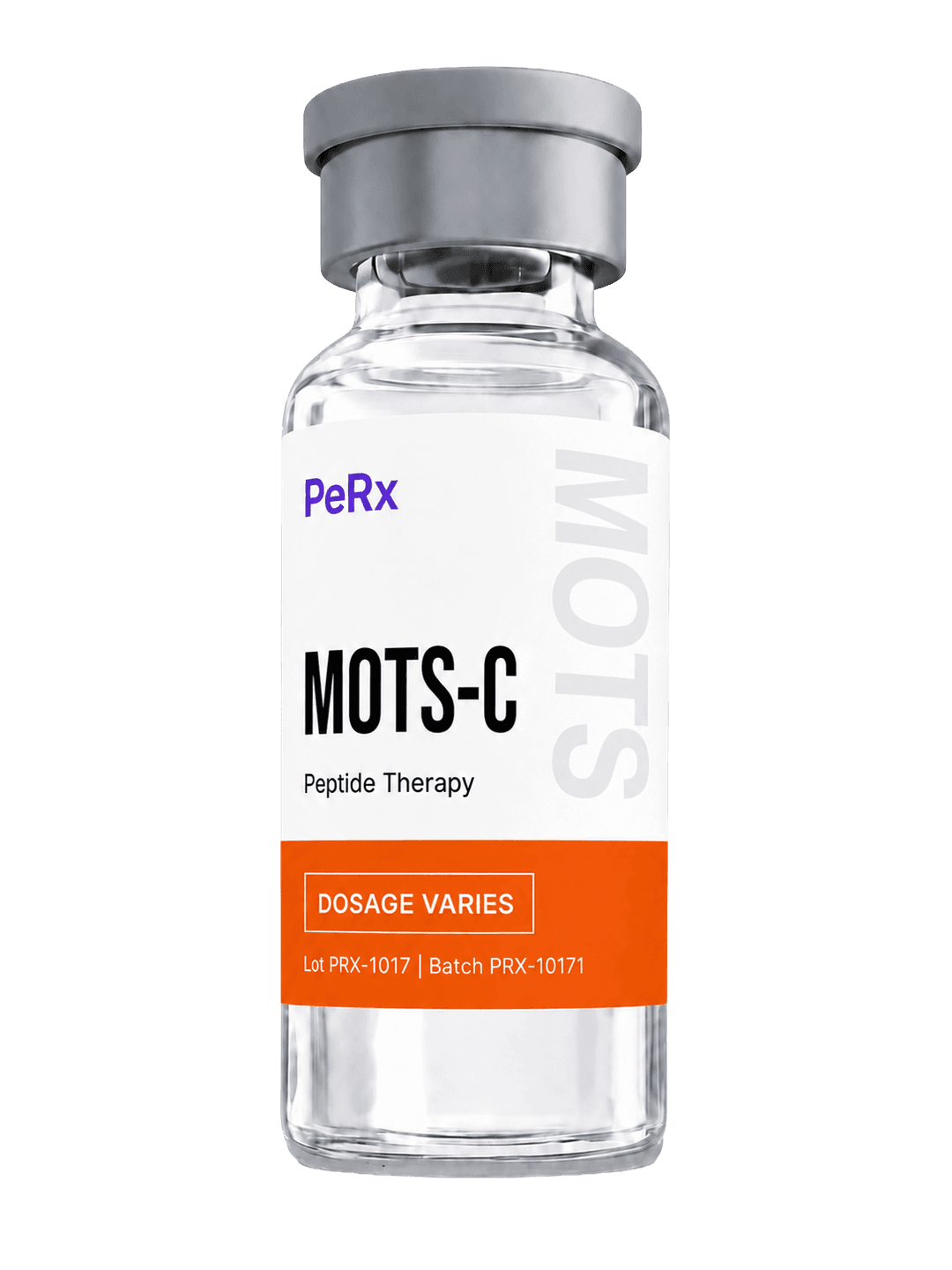
PeRx MOTS-c is prescribed by a licensed provider after a health screening and compounded at a US-based 503A pharmacy at 2 mg/mL in a 5 mL vial, tested for potency and sterility. It ships fully reconstituted and ready to use, with no powder to mix and no concentration to work out.
$229 for a one-month supply. It suits people who train, track, and want a metabolic experiment with a written baseline rather than a visible transformation.
How to Run Your Own Before and After
You cannot audit a forum post, but you can run a clean experiment on yourself, and MOTS-c suits one because its plausible effects are the measurable kind. The setup takes one baseline week before the first dose and ten minutes a week after that.
Labs, through your regular physician. A fasting glucose and an HbA1c before you start; the fasting glucose again around week four and the HbA1c at the end of the cycle. Do not order a plasma MOTS-c level; it is not a validated marker of anything an injection does.
One benchmark workout, every two weeks. Something you can do identically: a timed 5K, a fixed circuit, a set at a fixed load to failure. Same time of day, same warm-up, similar sleep the night before. This single line is the closest a normal person gets to the treadmill test in the mouse studies, and it is far more sensitive than how you feel.
Tape monthly, and a morning rating daily. Waist at the navel, same time of morning, monthly rather than weekly, because body measurements are noisy; a baseline DEXA repeated at the end of the cycle is the gold standard if you want one. Photos only in identical conditions, monthly at most. Then energy from 1 to 10 at the same time each day. Capture at least one baseline week, because once you feel better you will genuinely forget how you felt before.
The rule that makes it honest
Change nothing else on purpose. Start MOTS-c the same week as a new training block, a diet phase, or another peptide and you get a before-and-after with three authors and no way to tell which one wrote it. If you cannot hold everything steady, write down what changed and when.
Then wait the full cycle. Judging a 12-week metabolic experiment at week three is the most common way people talk themselves into or out of a peptide; the onset timeline guide explains why each class runs on its own clock. Athletes have one more line to read first: MOTS-c is prohibited at all times under WADA section S4.4.1 as an AMPK activator, and USADA considers a therapeutic use exemption highly unlikely. A drug-tested athlete cannot run this experiment.
Can You Lose Weight With MOTS-c?
This is the question behind most searches for MOTS-c results, so it deserves a plain answer: not the way the photos suggest. Treated mice on a high-fat diet gained less fat while eating the same amount, a fuel-use shift rather than an appetite effect, and the analog trial produced only a non-significant weight trend in four weeks. MOTS-c does not suppress appetite and is not a weight-loss therapy; the fat-loss peptide guide maps what does have human outcome data. Which brings up the photos. A large share of dramatic MOTS-c images online come from people stacking it with a GLP-1 medication, often named in the same post, and the weight change belongs to the GLP-1. Compounded semaglutide and tirzepatide are a different class, and they are not the FDA-approved brands whose trial results get quoted alongside them; what compounded semaglutide is explains that distinction, and the MOTS-c and semaglutide guide covers what each contributes when both are prescribed.
When You Feel Nothing
Suppose you tracked honestly, the cycle ended, and neither the benchmark workout nor the labs moved. That is real information with a short list of explanations. Start with the trial itself: missed injections, no training stimulus for the peptide to act on, or wrecked sleep all blunt whatever effect exists; in a sedentary week there is nothing for the signal to amplify. Next, the dose question the benefits guide raises: nobody has established how an injected dose compares with what your mitochondria release, so a null result at one dose is not a verdict on the molecule. Then the honest possibility: MOTS-c may not do much for you. Bring your data to your provider; sometimes the answer is a different protocol, sometimes a peptide with more human evidence, sometimes the conclusion that this pathway is not your bottleneck. The what to do when a peptide does not seem to work guide walks through those steps. The answer is never quietly raising your own dose.
Red Flags in MOTS-c Results Content
A confident week-by-week schedule with no study behind it. "Measurable drops in visceral fat by week six" is a sentence no MOTS-c trial has ever produced. A page stating it as fact either invented it or copied it from a page that did. The honest form of every timeline claim for this peptide includes the word "report."
Mouse results quoted as human results. Improved running capacity, less fat gain on a high-fat diet, reversed age-related decline: all real findings, all in mice. A page that drops the species is dropping the most important word in the sentence, and "exercise in a vial" is the same move; exercise produces hundreds of adaptations no single molecule reproduces.
No prescriber in sight. MOTS-c is a prescription peptide, and the FDA’s 2026 review worried about the vial as much as the molecule. A site posting results imagery without a licensed provider and a pharmacy behind it is selling unregulated product; the regulatory picture is in is MOTS-c FDA approved.
Why PeRx shows no patient photos
PeRx publishes no patient before-and-after photos and no patient stories. Our patients are under the care of licensed providers, and their outcomes are private medical information. For a peptide whose human evidence is one four-week analog study, any persuasive photo set would overstate what MOTS-c did or borrow the result from something else.
Ready to get started?
Pharmaceutical-grade MOTS-c, prescribed by a licensed provider and shipped to your door in ready-to-use vials. Set your baseline, run a full cycle, and get a before-and-after you can actually trust.
MOTS-c Before and After: Common Questions
Related Guides
Continue reading about peptides and protocols that pair well with this guide.
MOTS-c Benefits: What the Evidence Supports
Almost every benefit attributed to MOTS-c traces back to a mouse, a cell culture, or a blood test measuring the peptide your own mitochondria already make. This page grades each claim by what was measured, what it was measured in, and whether anyone has given injected MOTS-c to a person and looked.
Is MOTS-c FDA Approved? Mitochondrial Peptide Status
No. MOTS-C was only discovered in 2015. It is the newest peptide in clinical use and the first peptide ever found to be encoded by mitochondrial DNA rather than nuclear DNA. That discovery, from Changhan David Lee's lab at USC, upended decades of assumptions about where bioactive peptides come from. Here is what we know so far.
Can You Use HSA or FSA for Peptide Therapy?
Insurance almost never covers peptide therapy, which makes tax-advantaged health dollars the next question. Prescription peptides often qualify as a medical expense, but the deciding vote belongs to your plan administrator, not to any clinic. Here is how eligibility actually works under IRS rules, when a letter of medical necessity comes into play, and exactly what paying with an HSA or FSA card looks like at PeRx.
Medical Disclaimer
The information provided on this website, including all articles, guides, and educational content, is for informational and educational purposes only and is not intended as medical advice, diagnosis, or treatment. Nothing on this site should be construed as a substitute for professional medical advice from a qualified healthcare provider.
The majority of peptides discussed on this site are not approved by the U.S. Food and Drug Administration (FDA) for the indications described. They are classified as bulk drug substances and are available only through a licensed prescribing provider and compounding pharmacy. All treatments require a valid prescription and provider oversight.
The majority of published research on peptide therapies has been conducted in preclinical (animal) models. While early human data is encouraging, comprehensive clinical trial data remains limited for most peptide compounds. Individual results may vary significantly based on health status, injury type, and other factors. No specific outcomes are guaranteed.
Certain peptides discussed on this site are classified as prohibited substances by the World Anti-Doping Agency (WADA) and are banned by major sports organizations including the NFL, NCAA, UFC, NBA, MLB, NHL, and PGA. If you are subject to anti-doping testing, consult your governing body before considering any peptide therapy.
Statements on this website have not been evaluated by the Food and Drug Administration. Products and therapies discussed are not intended to diagnose, treat, cure, or prevent any disease.
© 2026 Wellness MD Group PC DBA PeRx. All rights reserved.