Semax Side Effects: What Is Reported vs Theoretical
Semax has a reputation for being gentle, and almost no measured data behind it. The Russian labels name a handful of effects, a few small studies add others, and the FDA found no human safety data at all for the injected form. This page sorts every claim into reported, theoretical or unknown, lists who should not use it, and says what to do if something goes wrong.

In this article
Key Takeaways
- The two Russian nasal-drop labels name only a few effects: mild nasal irritation with prolonged use on the 1% label, and restlessness and insomnia on the 0.1% label. Both list acute psychotic states, anxiety-dominant disorders, pregnancy and breastfeeding as contraindications, and the 1% label adds a history of seizures.
- The FDA's May 2026 evaluation found no human pharmacokinetic study by any route, no safety data for injected Semax, and a published human record of roughly 33 to 47 healthy adults, 69 adults with medical conditions and 451 children, most of it in papers that did not discuss side effects at all.
- Bleeding, immune reactions, seizure-like brain-wave activity, abuse potential and cancer risk are theoretical or based on animal work. None has been measured in people, and that is the reason they sit on the avoid list rather than the reason to dismiss them.
- Semax is stimulating rather than calming. People with an anxiety disorder, a psychotic illness or a seizure history are told not to use it by the labels themselves, and nothing on this page is a claim that Semax treats anxiety, depression or ADHD.
- Selank has even less safety data in English. Two Russian trials compared it with benzodiazepines and described it as tolerated, without itemized side-effect rates, and the FDA says it lacks important information about its safety in humans.
- PeRx prescribes Semax only inside a subcutaneous Semax/Selank blend that ships fully reconstituted and ready to use. A licensed provider reviews every prescription, no lab draw is required, and the blend is not an FDA-approved drug.
Semax Side Effects at a Glance
What the labels list
Mild nasal irritation with prolonged use (1% drops); restlessness and insomnia (0.1% drops)
What users report
Headache, dizziness, fatigue, sleep trouble, nausea. No controlled study has measured how often
Theoretical risks
Bleeding, immune reactions, seizure-like EEG activity, abuse potential, unknown long-term and cancer effects
Human safety record
About 33 to 47 healthy adults, 69 adults with conditions, 451 children, nearly all without side-effect reporting (FDA, May 2026)
Injected Semax
No published human safety or pharmacokinetic study by that route, per the FDA
Label contraindications
Acute psychotic states, anxiety-dominant disorders, seizure history, pregnancy, breastfeeding, young children
FDA status
Not FDA approved. Advisory committee voted 8 to 5 (one abstention) in July 2026; FDA staff recommended against listing. Checked November 4, 2026
At PeRx
Only as the subcutaneous Semax/Selank blend, ready to use, provider-prescribed, adults 21 and older
Semax Side Effects: Reported vs Theoretical
Here is the short version. The licensed Russian nasal-drop labels list almost nothing: mild irritation of the nasal lining with prolonged use on one label, restlessness and insomnia on the other. Small studies and user reports add headache, dizziness, fatigue and trouble sleeping. Everything else you will read about, bleeding, immune reactions, abnormal brain-wave activity, dependence, cancer, is a hypothesis drawn from animal work or from how peptides behave in general. The evidence behind all of it is thin and mostly Russian, and the FDA's 2026 evaluation could not find a single human safety study of Semax given by injection, which is the only way it is prescribed in the United States.
Semax is not an FDA-approved drug and is not an approved treatment for anxiety, depression, ADHD or any other mental-health condition. That sentence matters for a safety page because much of what gets sold online as Semax is marketed on exactly those promises. The table grades each effect or risk by where it comes from. "Label" means a Russian product label. "Study" means a published trial or series, almost always small and open-label. "Anecdotal" means user reports and secondary sources with no measurement behind them. "Theoretical" means nobody has looked in people.
| Effect or risk | What is reported or hypothesized | Source type | Evidence grade |
|---|---|---|---|
| Nasal irritation, dryness, burning | The 1% label names mild irritation of the nasal lining with prolonged use. It is the only side effect that label lists. | Russian label (1% drops) | Label-listed |
| Restlessness, feeling wired, insomnia | The 0.1% label lists excitation and insomnia as side effects. User reports say the same, usually with late-day dosing. | Russian label (0.1% drops), user reports | Label-listed |
| Runny nose, sneezing, congestion | Reported by people using the drops. A nasal-route effect; no study measured how often it happens. | User reports | Anecdotal |
| Headache, dizziness, fatigue, nausea | Reported by users and repeated across secondary sources. No controlled study has measured frequency or confirmed cause. | User reports, secondary sources | Anecdotal |
| Higher blood glucose in diabetic patients | A 2013 Russian review, cited secondhand by a US research foundation, reports a rise in blood glucose in about 7.4% of diabetic patients. | Russian review, cited secondhand | Reported, not verified at source |
| Nasal cavity discoloration | The same review reports discoloration of the nasal lining in roughly 10% of patients using the drops. A nasal-route effect. | Russian review, cited secondhand | Reported, not verified at source |
| Eye pain and burning | One consumer report to the FDA: eye pain and burning after 0.1% nasal drops bought online in 2024, with a hospital visit, unresolved a year later. | FDA Adverse Event Reporting System | Single case |
| Bleeding | Semax raised anticoagulant and clot-dissolving activity in rats. The FDA flagged bleeding risk for people with bleeding disorders or on blood thinners. | Rat studies, FDA 2026 review | Theoretical (animal) |
| Immune reactions, aggregation, impurities | No study has checked whether Semax provokes antibodies or clumps in a vial. The FDA names both as concerns for any injected or sprayed peptide. | FDA 2026 review | Theoretical |
| Seizure-like brain-wave activity | A 1999 series in brain-injured patients saw paroxysmal EEG episodes in some after Semax. Both labels treat a seizure history as a reason not to use it. | Small Russian study, Russian labels | Limited human |
| Abuse potential, stimulant interaction | Semax amplified the dopamine surge from amphetamine in rodents. No human study has tested dependence or an interaction with stimulant medicines. | Rodent study, FDA 2026 review | Theoretical (animal) |
| Cancer and long-term effects | The only long-term animal study used a tumor-prone mouse strain and was not built to test cancer risk. No long-term human data exist in either direction. | Mouse study, FDA 2026 review | Unknown |
Nasal irritation, dryness, burning
- What is reported or hypothesized
- The 1% label names mild irritation of the nasal lining with prolonged use. It is the only side effect that label lists.
- Source type
- Russian label (1% drops)
- Evidence grade
- Label-listed
Restlessness, feeling wired, insomnia
- What is reported or hypothesized
- The 0.1% label lists excitation and insomnia as side effects. User reports say the same, usually with late-day dosing.
- Source type
- Russian label (0.1% drops), user reports
- Evidence grade
- Label-listed
Runny nose, sneezing, congestion
- What is reported or hypothesized
- Reported by people using the drops. A nasal-route effect; no study measured how often it happens.
- Source type
- User reports
- Evidence grade
- Anecdotal
Headache, dizziness, fatigue, nausea
- What is reported or hypothesized
- Reported by users and repeated across secondary sources. No controlled study has measured frequency or confirmed cause.
- Source type
- User reports, secondary sources
- Evidence grade
- Anecdotal
Higher blood glucose in diabetic patients
- What is reported or hypothesized
- A 2013 Russian review, cited secondhand by a US research foundation, reports a rise in blood glucose in about 7.4% of diabetic patients.
- Source type
- Russian review, cited secondhand
- Evidence grade
- Reported, not verified at source
Nasal cavity discoloration
- What is reported or hypothesized
- The same review reports discoloration of the nasal lining in roughly 10% of patients using the drops. A nasal-route effect.
- Source type
- Russian review, cited secondhand
- Evidence grade
- Reported, not verified at source
Eye pain and burning
- What is reported or hypothesized
- One consumer report to the FDA: eye pain and burning after 0.1% nasal drops bought online in 2024, with a hospital visit, unresolved a year later.
- Source type
- FDA Adverse Event Reporting System
- Evidence grade
- Single case
Bleeding
- What is reported or hypothesized
- Semax raised anticoagulant and clot-dissolving activity in rats. The FDA flagged bleeding risk for people with bleeding disorders or on blood thinners.
- Source type
- Rat studies, FDA 2026 review
- Evidence grade
- Theoretical (animal)
Immune reactions, aggregation, impurities
- What is reported or hypothesized
- No study has checked whether Semax provokes antibodies or clumps in a vial. The FDA names both as concerns for any injected or sprayed peptide.
- Source type
- FDA 2026 review
- Evidence grade
- Theoretical
Seizure-like brain-wave activity
- What is reported or hypothesized
- A 1999 series in brain-injured patients saw paroxysmal EEG episodes in some after Semax. Both labels treat a seizure history as a reason not to use it.
- Source type
- Small Russian study, Russian labels
- Evidence grade
- Limited human
Abuse potential, stimulant interaction
- What is reported or hypothesized
- Semax amplified the dopamine surge from amphetamine in rodents. No human study has tested dependence or an interaction with stimulant medicines.
- Source type
- Rodent study, FDA 2026 review
- Evidence grade
- Theoretical (animal)
Cancer and long-term effects
- What is reported or hypothesized
- The only long-term animal study used a tumor-prone mouse strain and was not built to test cancer risk. No long-term human data exist in either direction.
- Source type
- Mouse study, FDA 2026 review
- Evidence grade
- Unknown
A few things turn up in forums that are not in the table: a metallic taste, flushing, a tight feeling in the chest. They are anecdotal, with no timing or frequency attached, and they are listed here only so you know they have been described. If one of them happens to you, it belongs in a message to the prescriber, not in a mental note to push through.
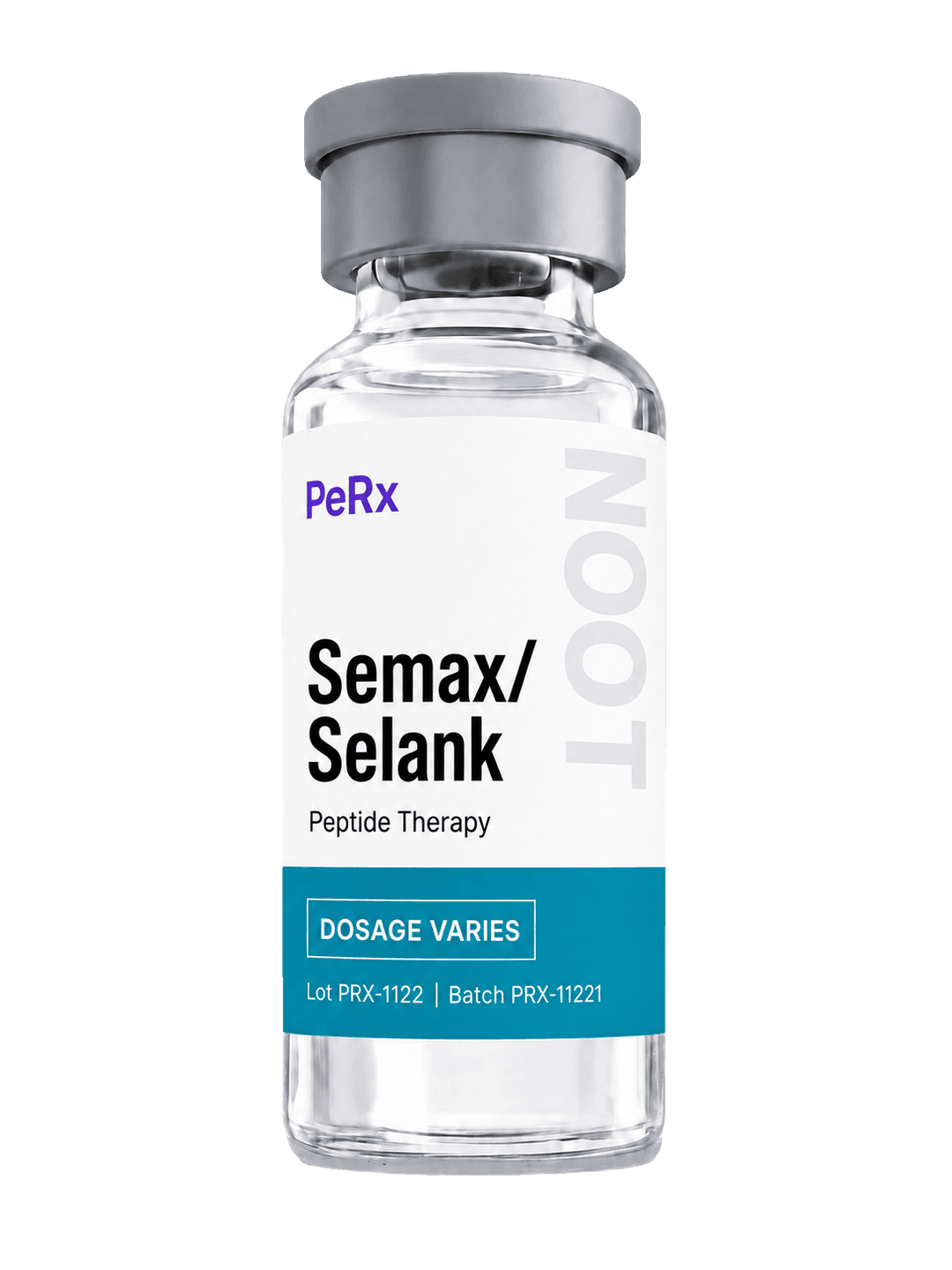
Semax/Selank
The only form of Semax PeRx prescribes: Semax and Selank together in one 5 mL vial, 1 mg/mL of each, compounded by a state-licensed 503A pharmacy and injected under the skin. The vial ships fully reconstituted and ready to use.
A licensed provider reviews every prescription against the screening questions on this page before the pharmacy fills it, and dose steps are decided at each renewal check-in. From $299 for a one-month supply. The blend is not an FDA-approved drug.
What Semax Is, and Why the Route Matters for Safety
Semax is a synthetic seven-amino-acid peptide built from a fragment of ACTH, the pituitary stress hormone, with the hormonal activity engineered out and the effects on attention and memory kept in. It was developed in Moscow and is licensed in Russia as nasal drops, in 0.1% and 1% strengths, for uses that include stroke recovery, cognitive impairment after brain injury and optic nerve disease. It is not approved by the FDA or by any European regulator. Our complete Semax guide covers the history and the research; this page stays on safety.
The route matters because the safety record, such as it is, belongs to the nasal drops. Every human study the FDA could find used the intranasal route. The product prescribed in the United States, including by PeRx, is a subcutaneous injection, and the FDA wrote plainly that it found no safety data for Semax given that way. So the injected form borrows the nasal record for reassurance and adds the unknowns of a different route, a different absorption profile and a compounded vial. Keep that in mind each time this page says "reported": reported for the drops, in Russia, in small numbers.
Semax Side Effects in Studies and on the Label
What the Russian labels list
The two labels do not say the same thing, which is itself worth knowing. The 1% label, from the manufacturer Peptogen and dated June 2011, lists one side effect: slight irritation of the nasal lining with prolonged use. Its contraindications are hypersensitivity, acute psychotic states, disorders accompanied by anxiety, pregnancy, breastfeeding and a history of convulsions. The older 0.1% label, from a 2003 instruction, lists excitation and insomnia as side effects, and its contraindications add endocrine disease and children under five. Both warn against using nasal decongestant sprays alongside the drops.
Statements on those labels that Semax is "practically non-toxic" rest on animal testing and on the manufacturer, not on large human safety trials. A label that lists one side effect is not evidence that there is one side effect. It is evidence that the registration studies were small, open-label and not designed to count adverse events, which is what the FDA concluded when it went looking.
Peptogen (ZAO INPC Peptogen). Semax 1% nasal drops, instructions for medical use, dated June 1, 2011. Reproduced at medi.ru. Contraindications: hypersensitivity, acute psychotic states, anxiety-accompanied disorders, pregnancy, lactation, history of convulsions. Side effect: slight nasal mucosa irritation with prolonged use. View study
Semax 0.1% nasal solution, instructions for medical use approved July 31, 2003. Reproduced in the RLS drug register (entry updated November 21, 2018). Contraindications include hypersensitivity, acute psychotic states, anxiety disorders, endocrine disease, pregnancy, breastfeeding and age under 5. Side effects: excitation, insomnia. View study
What human studies reported
Ahead of its July 2026 advisory meeting, FDA staff tallied every published human exposure they could assess: between 33 and 47 healthy adults, 69 adults with medical conditions (chronic ischemic brain disease, migraine and trigeminal nerve pain, peptic ulcer), and 451 children with depression or tic disorders. Three of the eight references were meeting abstracts with no full paper. One reference, a 1996 study of 37 adults with facial pain, reported that no adverse events were seen. The other seven did not discuss adverse events at all. In several, Semax was given alongside other drugs or therapies, so nothing could be attributed to it even if it had been recorded.
That is the entire measured human safety record in the English-language literature, and the FDA described it as insufficient to characterize a safety profile. Small, short, mostly open-label studies that do not count side effects are not a reassuring safety signal. They are an absence of a signal. The one human finding that does bear on safety, seizure-like EEG activity in a 1999 series, sits in the theoretical section below because it was a small observation in brain-injured patients, not a measured rate.
U.S. Food and Drug Administration. FDA Briefing Document: Semax-Related Bulk Drug Substances (Semax (free base) and Semax acetate). Pharmacy Compounding Advisory Committee meeting, July 23-24, 2026. Evaluation dated May 11, 2026, safety section. View study
Effects people report
Across user forums and vendor pages the same list repeats: nasal irritation, burning, congestion or a runny nose after the drops; headache; trouble falling asleep or staying asleep; restlessness or a wired, anxious edge; nausea; dizziness. Every one of those is a report, not a rate. No controlled study has measured how often any of them happens, and none of the secondary sources that list them cite a study that did. We do not offer tips for managing them here, because a side effect you are managing on your own is a side effect your prescriber has not heard about.
Blood sugar and nasal discoloration
Two figures circulate as if they were measured rates. A 2013 Russian review, as summarized by the Alzheimer's Drug Discovery Foundation in its 2020 researcher report, gives discoloration of the nasal cavity in about 10% of patients using the drops and a rise in blood glucose in about 7.4% of patients with diabetes. The foundation could not check the review against original data, and neither could we; the review is not indexed in PubMed. The nasal finding is a nasal-route effect and does not transfer to an injection. The glucose finding might, which is why diabetes is on the screening list. Both numbers are given here as reported, and neither was measured by PeRx.
Alzheimer's Drug Discovery Foundation. Semax. Cognitive Vitality Report for Researchers, June 2020. Safety section: "Little human evidence exists for potential side effects"; nasal cavity discoloration (~10%) and increased blood glucose in diabetics (~7.4%) cited to Kolomin et al. 2013; long-term side effects unknown. View study
For the reactions common to every injected peptide, redness or a small lump at the injection site, bruising, the rare infection from poor technique, our peptide side effects guide covers what is normal and what is not.
Theoretical Risks and Unknowns
None of the five risks in this section has been observed as a side effect in people. Each is here because an animal study, a mechanism or a gap in the record makes it worth screening for. That is the right way to read them: reasons for caution in specific groups, not findings.
Bleeding
In rats, Semax given intranasally for several days increased the anticoagulant and clot-dissolving activity of the blood, and treated animals formed smaller clots when a vein was clamped. A second rat study found anticoagulant and antiplatelet effects under stress. No human study has measured any of it. The FDA wrote that these findings raise concern about the risk of bleeding, particularly in people already at risk or taking medicines that increase bleeding, and that a compounded product carries no label to warn them. Treat it as preclinical, and as a hard stop for anyone on a blood thinner until a clinician says otherwise.
Cherkasova KA, Lyapina LA, Ashmarin IP. Comparative study of modulatory effects of Semax and primary proline-containing peptides on hemostatic reactions. Bull Exp Biol Med. 2001;132(1):625-628. PMID: 11687836 View study
Grigorjeva ME, Lyapina LA. Anticoagulation and antiplatelet effects of semax under conditions of acute and chronic immobilization stress. Bull Exp Biol Med. 2010;149(1):44-46. PMID: 21113455 View study
Immune reactions and impurities
Any peptide can prompt the body to make antibodies against it, and peptides that clump into aggregates, or that carry manufacturing impurities, do so more readily. The FDA raised both concerns for Semax in injectable and nasal-spray form and noted that neither nomination supplied impurity, aggregate or endotoxin testing data. No study has checked immunogenicity for Semax by any route. This is the risk most tied to who made the vial, which is why the sourcing section below exists.
EEG changes and seizures
A 1999 Russian series followed 73 patients with brain damage after oxygen deprivation, 14 of them in a persistent vegetative state. The authors reported that in some cases the EEG showed episodes of paroxysmal, seizure-like activity after Semax, and advised that the first dose be given with brain-wave monitoring. It says nothing about how often this happens, nothing about healthy people, and the abstract does not specify the route. It is the reason both Russian labels list a history of convulsions as a contraindication, and the reason a seizure history is a firm no on the PeRx screening.
Alekseeva GV, Bottaev NA, Goroshkova VV. [Use of semax at a follow-up of patients with posthypoxic encephalopathy]. Anesteziol Reanimatol. 1999;(1):40-43. Russian. PMID: 10199046 View study
Abuse potential and stimulant medicines
In rats, Semax given before D-amphetamine produced a larger surge of dopamine in the striatum than amphetamine alone, and in mice it increased amphetamine-driven movement. The striatal dopamine surge is the response that drugs of abuse such as cocaine produce, which is why the FDA flagged abuse potential as an open question and noted that no study has addressed it. There is no human evidence that Semax is habit-forming, and no human study of how it interacts with prescribed stimulants such as Adderall, Vyvanse or methylphenidate. Both facts cut the same way: nobody knows, so the combination is screened for.
Eremin KO, Saransaari P, Oja S, Raevskii KS. [Semax potentiates effects of D-amphetamine on the level of extracellular dopamine in the Sprague-Dawley rat striatum and on the locomotor activity of C57BL/6 mice]. Eksp Klin Farmakol. 2004;67(2):8-11. Russian. PMID: 15188751 View study
Cancer and long-term safety
The only long-term animal study gave Semax to female SHK mice, a strain bred to develop mammary tumors early and die young. Treated mice ended life with smaller tumors and lived longer, and the authors suggested an anti-cancer effect. The FDA was unmoved: one fixed dose, females only, treatment short relative to lifespan, and a strain that cannot answer the question a carcinogenicity study asks. No standard long-term cancer study exists. The FDA also found no acute toxicity, repeat-dose toxicity or reproductive toxicity studies of any kind. Long-term human safety is unknown, which is a different statement from safe.
Meshavkin VK, Kost NV, Sokolov OY, et al. The influence of oligopeptides on spontaneous carcinogenesis in mice. Dokl Biol Sci. 2013;449:68-70. PMID: 23652432 View study
Our page on peptides and long-term safety explains why "no data" and "no risk" get confused so often, and what a prescriber can and cannot do about the gap.
Anxiety, Sleep and Overstimulation
Semax is usually described as activating, not calming, and the labels agree. The 0.1% label lists excitation and insomnia as its side effects, and both labels list acute psychotic states and disorders accompanied by anxiety as contraindications. In plain terms, the Russian regulator tells people with an anxiety disorder not to use it. In rodents Semax activates dopamine and serotonin systems, which fits the stimulating reputation and is the basis for caution with psychiatric medicines that act on the same systems.
Sleep trouble, irritability and restlessness are reported effects, not measured ones. Timing is the usual explanation offered online, and timing is a decision for the prescriber, not for this page. What this page will say is that Semax is not an approved treatment for anxiety, depression or ADHD anywhere outside its Russian indications, and that nobody with a diagnosed anxiety or mood disorder should treat it as one. Our comparison of Semax vs Selank explains why the two peptides are paired at PeRx, with Selank studied for the calmer side of the pairing.
Eremin KO, Kudrin VS, Saransaari P, et al. Semax, an ACTH(4-10) analogue with nootropic properties, activates dopaminergic and serotoninergic brain systems in rodents. Neurochem Res. 2005;30(12):1493-1500. PMID: 16362768 View study
Selank Side Effects
Selank is a synthetic seven-amino-acid peptide based on the immune peptide tuftsin, developed by the same Moscow institute as Semax and studied in Russia for anxiety-related effects, most often as a nasal preparation. Its English-language safety record is thinner than Semax's. Two Russian trials are the core: a 2008 study of 62 patients with generalized anxiety disorder or neurasthenia that compared Selank with the benzodiazepine medazepam, and a 2014 study of 60 patients with anxiety and somatoform disorders that compared it with phenazepam and rated tolerability on a standard scale. Both describe Selank as tolerated. Neither abstract itemizes side effects or gives a rate for any of them.
The FDA's position is shorter still. Selank acetate was nominated for the compounding bulks list and the nomination was withdrawn; the FDA's safety-risk page, current as of April 22, 2026, keeps it in the withdrawn table with the note that compounded Selank may carry immunogenicity risk by some routes because of aggregation and peptide impurities, and that the agency lacks important information regarding any safety issues raised by Selank acetate administered to humans. What users report overlaps with Semax: fatigue or drowsiness rather than restlessness, occasional headache, nasal irritation with the drops. Those are reports. The honest evidence grade for every Selank side effect is anecdotal or unknown, and the honest grade for its long-term safety is unknown. Our Selank guide and where to inject Selank cover the rest.
Zozulia AA, Neznamov GG, Siuniakov TS, et al. [Efficacy and possible mechanisms of action of a new peptide anxiolytic selank in the therapy of generalized anxiety disorders and neurasthenia]. Zh Nevrol Psikhiatr Im S S Korsakova. 2008;108(4):38-48. Russian. PMID: 18454096 View study
Medvedev VE, Tereshchenko ON, Israelian AIu, et al. [A comparison of the anxiolytic effect and tolerability of selank and phenazepam in the treatment of anxiety disorders]. Zh Nevrol Psikhiatr Im S S Korsakova. 2014;114(7):17-22. Russian. PMID: 25176261 View study
U.S. Food and Drug Administration. Certain Bulk Drug Substances for Use in Compounding That May Present Significant Safety Risks. Withdrawn-nominations table entries for Semax (heptapeptide) and Selank acetate (TP-7). Content current as of April 22, 2026. View study
Semax and Selank Side Effects Together
No published study describes the safety of Semax and Selank taken together. The rationale for pairing them is mechanistic, one activating and one calming, and it comes from prescribing practice rather than from a trial of the combination. The only responsible assumption is that the effects and cautions of each apply to the pair, and that an effect you cannot assign to one peptide still counts. The PeRx product contains both in one vial, 1 mg/mL of each, as listed on the product page. A licensed provider reviews the prescription against the screening below, and our Semax vs Selank comparison explains how the two differ.
Who Should Avoid Semax
This list combines the Russian label contraindications with the gaps the FDA identified. It is not exhaustive, and it is the list a prescriber works through, not a self-screen that replaces one. Each entry gives the reason, so you can see which are label rules and which are caution standing in for data.
Who Should Avoid Semax, and Why
Acute psychiatric conditions or anxiety-dominant disorders
Both Russian labels list these as contraindications. Semax is stimulating, and it is not a treatment for anxiety or any psychiatric diagnosis.
A history of seizures
Listed on the 1% label, and backed by the 1999 series that saw seizure-like EEG activity in some brain-injured patients.
Pregnancy, breastfeeding, trying to conceive
Both labels list pregnancy and breastfeeding. No reproductive or developmental toxicity study exists. Not prescribed.
Children and adolescents
The Russian labels set age limits by product. PeRx prescribes only to adults 21 and older.
Allergy to any ingredient
Hypersensitivity heads both labels. The immune-reaction concern the FDA raised applies most to people with a history of reactions to injected products.
Bleeding disorders, blood thinners, antiplatelet drugs
Theoretical, from rat anticoagulant and antiplatelet findings. The FDA named bleeding risk as a concern; a clinician decides, not a default.
Stimulant medicines
Adderall, Vyvanse, methylphenidate and similar drugs. Semax amplified amphetamine effects in rodents, and no human interaction study exists.
Antidepressants and other psychiatric medicines
Semax acts on dopamine and serotonin systems in rodents. No human interaction study exists, so these go on the intake, not in the dark.
Diabetes
A rise in blood glucose in some diabetic patients is reported secondhand from a Russian review. Unverified, and enough to screen for.
Endocrine, neurological, cardiovascular, liver, kidney or autoimmune conditions
The 0.1% label lists endocrine disease. The rest need clinician review because nothing has been studied in those groups.
Decongestant nasal sprays
Both labels advise against them. The warning was written for the nasal drops; it is listed for completeness and for anyone using a nasal product elsewhere.
Drug-tested athletes have a separate question. Semax is not on the WADA prohibited list by name, but the list reaches beyond names, and our injury recovery page carries the full disclosure for tested competitors, with the detail in do peptides show up on a drug test. If you are unsure whether something on this list applies to you, our page on what providers review before prescribing peptides shows how the screening works.
Product Quality and Sourcing Risks
Most Semax sold online is not the licensed Russian drop. It is a "research use only" powder or spray from a seller that is not a pharmacy, with no approval for human use and no outside check on concentration, purity or sterility. The one adverse event in the FDA's database, eye pain and burning that sent a consumer to hospital, followed 0.1% drops bought online from a research-chemical seller. The FDA also pointed out that the two compounding nominations it reviewed could not even agree on which chemical form of Semax they meant, free base or acetate salt, and that neither supplied impurity or endotoxin testing. For a peptide whose main theoretical risk is an immune reaction to impurities, the identity of the manufacturer is a safety variable.
A prescription filled by a state-licensed pharmacy with potency, sterility and endotoxin testing on each lot addresses the sourcing problem. It does not create human safety data for Semax, and it would be dishonest to imply that it does. Our quality testing page lists what is tested and why, and is it safe to buy peptides online walks through how to tell a pharmacy from a vendor.
FDA Status: Where Semax Stands
FDA status checked November 4, 2026
Semax is not an FDA-approved drug and is not a component of one. In April 2026 the FDA removed it from its restricted Category 2 list along with eleven other peptides, a step that neither approved it nor cleared it for compounding. FDA staff then evaluated it, in a document dated May 11, 2026, and recommended against adding either form to the list of substances 503A pharmacies may use, citing the absence of human safety data for the injected route, the bleeding and immune-reaction concerns, and the lack of characterization data. On July 24, 2026 the Pharmacy Compounding Advisory Committee voted 8 to 5, with one abstention, to recommend adding it anyway, a tally taken from the public webcast; the FDA had posted no minutes as of the check date. The vote is advisory. No rule has been proposed, the compounding status of Semax remains unsettled, and compounded Semax is not FDA approved whatever the committee recommended. Our write-up of the July 2026 FDA peptide review has the meeting results, and will the FDA ban peptides explains what each step means.
U.S. Food and Drug Administration. July 23-24, 2026: Meeting of the Pharmacy Compounding Advisory Committee. Event page with briefing documents, final agenda and FDA presentations. Content current as of August 6, 2026. View study
When to Get Medical Help
Stop and contact a clinician for any of these
Hives, swelling of the face, lips or throat, chest tightness or trouble breathing after a dose: this is an emergency, call 911. A seizure or an episode that looked like one. Bleeding or a nosebleed that does not stop, or unusual bruising. Severe or persistent eye pain or burning, the one reaction in the FDA's database. Severe agitation, a sudden mood change or thoughts of self-harm. An injection site that gets redder, hotter or more swollen after a day or two. For anything on this list, stop the product and contact the prescriber the same day. Adverse events from a compounded product can also be reported to the FDA through MedWatch, and the agency has said it rarely hears about them otherwise.
Mild redness at the injection site, a brief headache or a restless first night are the kind of thing to mention at the next check-in rather than an emergency. Our guide to peptide safety monitoring explains what to track between check-ins and what a prescriber wants to hear about.
Questions to Ask Your Provider
Four questions cover most of it. Does anything on the avoid list apply to me, including a seizure, a psychiatric diagnosis or a bleeding problem I might not have thought to mention? Could Semax interact with a stimulant, a blood thinner, an antidepressant or anything else I take? Which symptoms mean I should stop and call, and which can wait for the check-in? And is there an approved option with better safety data that fits what I am trying to fix? That last one is a fair question to ask any prescriber of any peptide, and our page on whether peptide therapy is safe is built around it.
Getting Semax/Selank Through a Prescription
The path at PeRx is short. You complete an online eligibility check that asks the screening questions on this page. A licensed provider reviews it and, if the blend fits, writes the prescription; your card is charged only after that approval. A state-licensed 503A pharmacy fills it and ships the vial ready to use, with syringes and swabs. Dose steps are decided at each renewal check-in, and PeRx does not order labs, so any blood work you want is a conversation with your own doctor. The blend is a compounded product and is not FDA approved. Our guide to how to get peptides prescribed online covers the mechanics, and the nootropic peptides page lists everything in the category.
Pinealon/PE-22-28/Selank
A different pairing for the calmer side
Ready to get started?
New to PeRx? Check eligibility in about a minute. Already a patient with a question about a reaction? Message your care team.
Semax and Selank Safety: Common Questions
Related Guides
Continue reading about peptides and protocols that pair well with this guide.
Selank Peptide: What It Is, What It Does & Benefits
Your immune system already makes a molecule that calms anxiety. Soviet scientists found it in the 1970s, reverse-engineered it, and created two peptides: one that quiets anxiety without sedation, and another that sharpens cognition through BDNF. Both have been prescription medications in Russia since 2009. Combined in a single injectable blend, Selank and Semax cover both sides of the equation: calm and sharp at the same time.
Semax vs Selank: Which One Do You Actually Need?
Every page ranking for this question tells you to pick one: Semax for focus, Selank for calm. The split is useful and softer than the marketing admits. Here is what the single human head-to-head found, where the two run on the same machinery, where the FDA record splits them, and why a prescribing clinic puts both in one vial instead of making you choose.
PT-141 Dosage Chart: Units, Limits, Men vs Women
Every other dosage chart on this site describes a daily or nightly routine. PT-141 is the exception: you dose it per event, not per day, and the two numbers that matter most are ceilings, not schedules. This page converts milligrams to insulin-syringe units at the PeRx concentration, anchors everything to the one FDA-approved reference dose, and answers the men-versus-women question with the data that actually exists, as of September 8, 2026.
Medical Disclaimer
The information provided on this website, including all articles, guides, and educational content, is for informational and educational purposes only and is not intended as medical advice, diagnosis, or treatment. Nothing on this site should be construed as a substitute for professional medical advice from a qualified healthcare provider.
The majority of peptides discussed on this site are not approved by the U.S. Food and Drug Administration (FDA) for the indications described. They are classified as bulk drug substances and are available only through a licensed prescribing provider and compounding pharmacy. All treatments require a valid prescription and provider oversight.
The majority of published research on peptide therapies has been conducted in preclinical (animal) models. While early human data is encouraging, comprehensive clinical trial data remains limited for most peptide compounds. Individual results may vary significantly based on health status, injury type, and other factors. No specific outcomes are guaranteed.
Certain peptides discussed on this site are classified as prohibited substances by the World Anti-Doping Agency (WADA) and are banned by major sports organizations including the NFL, NCAA, UFC, NBA, MLB, NHL, and PGA. If you are subject to anti-doping testing, consult your governing body before considering any peptide therapy.
Statements on this website have not been evaluated by the Food and Drug Administration. Products and therapies discussed are not intended to diagnose, treat, cure, or prevent any disease.
© 2026 Wellness MD Group PC DBA PeRx. All rights reserved.