CJC-1295 Side Effects: Trials, FDA Record, No-DAC
Most CJC-1295 side-effect lists quietly borrow from trials of a molecule you will not be prescribed. This page keeps the two forms apart: what the DAC-form studies recorded in healthy adults, what the FDA has said between 2023 and 2026, what the no-DAC blend label tells patients to expect in the first days, and the symptoms that mean stop and get help.

In this article
Key Takeaways
- The CJC-1295 PeRx prescribes is the no-DAC form, only inside the CJC-1295/Ipamorelin blend, and no human safety trial of that form has been published. FDA reviewers in December 2024 found no peer-reviewed clinical or nonclinical data for it at all.
- The human side-effect record belongs to the DAC form. In the 2006 trials, injection-site reactions occurred in about 70% of subjects after a single dose and in every treated subject with repeat dosing, along with headache, flushing, nausea, diarrhea, transient dizziness with low blood pressure, and a faster heart rate after one dose. None was classed as serious. A Phase 2 trial of the DAC form was stopped after a participant died of a heart attack following an eleventh weekly dose, and its data were never published.
- The label for the blend tells patients to expect increased hunger, vivid dreams and mild water retention in the first days, and that these typically settle. The hunger is an expected ghrelin-receptor effect of ipamorelin: a related agonist raised food intake by about 36% in healthy men, and ipamorelin itself has never been tested for appetite in people.
- Beyond the first weeks, the effects to watch are the growth hormone class effects measured with injected GH: soft tissue swelling, joint pain, carpal tunnel symptoms and higher fasting glucose. None has been measured with CJC-1295 at prescribed doses. Severe joint pain or swelling and numbness or tingling that does not resolve are emergency items on the label.
- Neither form of CJC-1295 is FDA-approved. The FDA placed it in Category 2 in September 2023, the nominators withdrew, an advisory committee voted against all five forms on December 4, 2024, and the May 14, 2026 category document lists it in no category. Its compounding status is unsettled in either direction.
- On cancer, the human evidence is absent rather than reassuring: no study in either direction, no carcinogenicity study, a laboratory DNA-damage signal for the DAC form, and population data linking higher IGF-1 to modestly higher odds of some cancers. Active or recent cancer screens you out.
CJC-1295 Side Effects at a Glance
Form you receive
No-DAC CJC-1295 (Modified GRF 1-29), only in the CJC-1295/Ipamorelin blend
Human safety trial of that form
None. FDA reviewers found no peer-reviewed data in December 2024
Recorded in the DAC trials
Injection-site reactions in most subjects; headache, flushing, nausea, diarrhea, transient dizziness and low blood pressure, faster heart rate
Expected early on the blend
Hunger, vivid dreams, mild water retention, per the label. Typically settles
FDA status
Not approved in either form. Advisory committee voted against all five forms, December 4, 2024
CJC-1295 Side Effects: The Short Answer
Which CJC-1295 you mean decides the answer, and the version with human data is not the version you will be prescribed. Every published trial used CJC-1295 with DAC, the once-weekly molecule: injection-site reactions first, then headache, flushing, nausea, diarrhea, brief dizziness with low blood pressure, and a faster heart rate, none classed as serious. The no-DAC form, Modified GRF 1-29, goes into CJC-1295/Ipamorelin blends, ours included, and has never had a human safety trial. The complete CJC-1295/Ipamorelin guide covers what the blend is for; this page covers only what can go wrong.
What the DAC-Form Human Studies Recorded
Two papers from 2006 hold the entire published human safety record. Teichman and colleagues ran two randomized, double-blind, placebo-controlled studies in healthy adults aged 21 to 61: single ascending doses in one, two or three weekly or biweekly doses in the other, over 28 and 49 days. The abstract reports no serious adverse reactions and calls the drug relatively well tolerated.
The adverse event detail never reached the abstract. FDA staff read it out for the December 2024 advisory committee: in the single-dose study 94 percent of subjects reported an adverse event, injection-site reactions occurred in about 70 percent of those given the drug and rarely on placebo, reactions were more severe or prolonged at higher doses, and headache, diarrhea and systemic vasodilatory reactions were also observed. In the repeat-dose study every subject on active drug had an injection-site reaction, plus flushing, headache, nausea, abdominal pain, transient involuntary leg muscle contractions with some loss of coordination, and transient dizziness with low blood pressure.
Teichman SL, Neale A, Lawrence B, et al. "Prolonged stimulation of growth hormone (GH) and insulin-like growth factor I secretion by CJC-1295, a long-acting analog of GH-releasing hormone, in healthy adults." Journal of Clinical Endocrinology and Metabolism. 2006;91(3):799-805. PMID 16352683. DAC form. View study
Ionescu and Frohman sampled blood every 20 minutes overnight in healthy men aged 20 to 40, before and one week after a single DAC injection. Pulse frequency and size were unchanged; the trough between pulses rose 7.5-fold, mean GH 46 percent and IGF-1 45 percent. DAC raises the floor rather than flattening the pattern. The FDA summary adds increased heart rate and transient redness and tenderness at the site.
Ionescu M, Frohman LA. "Pulsatile secretion of growth hormone (GH) persists during continuous stimulation by CJC-1295, a long-acting GH-releasing hormone analog." Journal of Clinical Endocrinology and Metabolism. 2006;91(12):4792-4797. PMID 17018654. DAC form, single dose. View study
ConjuChem took the DAC form into a Phase 2 trial in people with HIV-associated lipodystrophy, weekly injections over twelve weeks. By the FDA account, assembled from anecdotal reports, one participant developed chest discomfort two hours after an eleventh weekly dose, an ECG confirmed an acute myocardial infarction, and the participant died about an hour later. The attending physician judged symptom-free coronary artery disease with a ruptured plaque the most likely cause. The trial was terminated, the data were never published, and ConjuChem withdrew the DAC form from trials that year. Whether the drug contributed is unknown (CJC-1295 guide).
US Food and Drug Administration, Pharmacy Compounding Advisory Committee. Meeting transcript, Topic 1: CJC-1295-related bulk drug substances. December 4, 2024. Source for the adverse event summary and the Phase 2 account. View study
CJC-1295 DAC Side Effects vs No-DAC
If you searched for CJC-1295 DAC side effects, the list above is the direct answer, and it is what stands behind the FDA statement that it has identified serious adverse events with CJC-1295, including increased heart rate and systemic vasodilatory reaction. We do not prescribe that form. The no-DAC form has no list because nobody has studied it; what follows is pharmacology plus prescribing experience.
| CJC-1295 with DAC | No-DAC blend (PeRx) | |
|---|---|---|
| Signal after one dose | Half-life 5.8 to 8.1 days | Not measured; clearance within hours expected |
| Injection-site reactions | About 70% after one dose; all subjects on repeat dosing | One small nightly dose; brief redness or a small bump is the usual report |
| Water retention | Trough GH up 7.5-fold, IGF-1 raised 9 to 11 days | One pulse, then baseline; mild water retention named on the label |
| Flushing, headache, heart rate | All recorded | Brief warmth or light-headedness in some patients; heart rate not measured |
| If a side effect appears | Wait; the drug stays for days | Skip the next night |
Signal after one dose
- CJC-1295 with DAC
- Half-life 5.8 to 8.1 days
- No-DAC blend (PeRx)
- Not measured; clearance within hours expected
Injection-site reactions
- CJC-1295 with DAC
- About 70% after one dose; all subjects on repeat dosing
- No-DAC blend (PeRx)
- One small nightly dose; brief redness or a small bump is the usual report
Water retention
- CJC-1295 with DAC
- Trough GH up 7.5-fold, IGF-1 raised 9 to 11 days
- No-DAC blend (PeRx)
- One pulse, then baseline; mild water retention named on the label
Flushing, headache, heart rate
- CJC-1295 with DAC
- All recorded
- No-DAC blend (PeRx)
- Brief warmth or light-headedness in some patients; heart rate not measured
If a side effect appears
- CJC-1295 with DAC
- Wait; the drug stays for days
- No-DAC blend (PeRx)
- Skip the next night
Lower exposure and a short tail are why we expect fewer fluid and injection-site problems, and why a bad night can be followed by a night off. The same logic cuts the other way: a form with no trial has a thinner margin for anything unmeasured, and the FDA flags immune reactions for both (why we pair CJC-1295 with ipamorelin).
CJC-1295/Ipamorelin
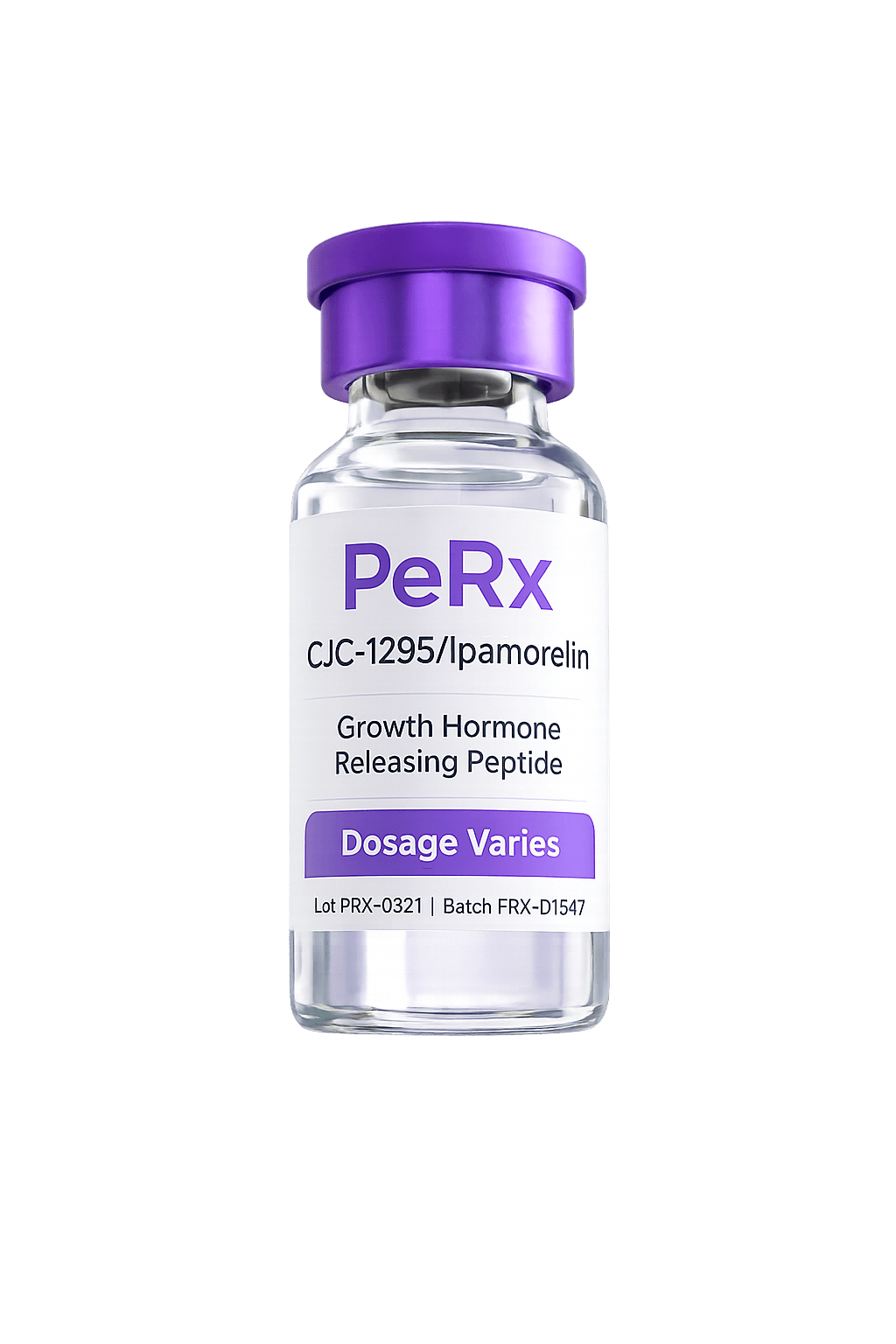
The vial carries part of the risk: an unknown form, a guessed concentration, impurities that provoke immune reactions. PeRx CJC-1295/Ipamorelin is the no-DAC form, labeled as such, compounded by a state-licensed 503A pharmacy at a fixed concentration, and it ships fully reconstituted and ready to use.
$299 for a one-month supply, syringes and swabs included, prescribed only after a licensed provider reviews your history.
What the FDA Has Said, by Date
Neither form of CJC-1295 is an FDA-approved drug, for any use. The record below is stated as of November 2026 and may move again.
2006
DAC form leaves development
ConjuChem withdrew CJC-1295 with DAC from clinical trials after the Phase 2 termination. No trial of either form has followed.
2024
Nominators withdraw
The nominators withdrew, taking CJC-1295 off Category 2. The FDA reviewed it anyway, noting the nominations named no-DAC forms while every clinical reference was DAC.
Dec 4, 2024
CJC-1295 vote
Against all five forms: 0 to 13 on CJC-1295 free base and the three DAC forms, 1 to 12 on CJC-1295 acetate.
July 23-24, 2026
Not on the agenda
The advisory committee reviewed seven other peptides (BPC-157, TB-500, KPV, MOTS-c, DSIP, Epitalon, Semax). CJC-1295 and ipamorelin were not reconsidered.
Sept 29, 2023
Category 2
Placed in Category 2 of the interim 503A list for immunogenicity, impurity and characterization concerns, and reports of increased heart rate and systemic vasodilatory reactions.
Oct 29, 2024
Ipamorelin vote
The Pharmacy Compounding Advisory Committee voted 0 in favor, 12 against, 1 abstaining on each ipamorelin form.
May 14, 2026
No category
The category document lists CJC-1295 in no 503A category; the FDA safety-risks page (April 22, 2026) keeps its risks on record among withdrawn nominations.
The votes are advisory, the agency has finalized nothing in either direction, and the vial a patient receives is a compounded drug from a state-licensed 503A pharmacy on an individual prescription, with no FDA review of its safety, effectiveness or quality. More in is CJC-1295/Ipamorelin FDA approved, FDA-approved peptides and the July 2026 FDA review.
US Food and Drug Administration. "Final Summary Minutes of the Pharmacy Compounding Advisory Committee Meeting, December 4, 2024." Votes on the five CJC-1295-related substances. View study
US Food and Drug Administration. "Final Summary Minutes of the Pharmacy Compounding Advisory Committee Meeting, October 29, 2024." Votes on ipamorelin (free base) and ipamorelin acetate. View study
US Food and Drug Administration. "Certain Bulk Drug Substances for Use in Compounding that May Present Significant Safety Risks." Current as of April 22, 2026. CJC-1295 entry among withdrawn nominations. View study
US Food and Drug Administration. "Bulk Drug Substances Nominated for Use in Compounding Under Section 503A of the Federal Food, Drug, and Cosmetic Act." Updated May 14, 2026. View study
The First Two Weeks on the Blend: Hunger, Dreams, Water
The PeRx prescription is one vial of the no-DAC form blended with ipamorelin; the concentration is printed on the label and the prescribed dose arrives on paper with it. The instructions say to inject at bedtime, Monday through Friday, on an empty stomach at least two hours after the last meal, not to eat afterward, and to stop for one month after three months of use. They also say what to expect: "You may notice increased hunger, vivid dreams, or mild water retention in the first few days; this is normal and typically settles." The arithmetic behind the dose lives on the dosage chart. The three expected effects are patient reports, not trial counts. Ipamorelin brings its own list, covered in the ipamorelin guide.
Hunger. Ipamorelin is a ghrelin-receptor agonist, and ghrelin is the hunger hormone. Whether ipamorelin itself raises appetite in people has never been measured; the closest evidence is a related agonist, GHRP-2, which increased buffet-meal intake by about 36 percent in seven lean, healthy men. The pig study clinics cite for its selectivity did not measure appetite. Expect some hunger in the first week, and do not eat after the dose: food blunts the pulse it exists to create.
Laferrère B, Abraham C, Russell CD, Bowers CY. "Growth hormone releasing peptide-2 (GHRP-2), like ghrelin, increases food intake in healthy men." Journal of Clinical Endocrinology and Metabolism. 2005;90(2):611-614. PMID 15699539. GHRP-2, not ipamorelin. View study
Raun K, Hansen BS, Johansen NL, et al. "Ipamorelin, the first selective growth hormone secretagogue." European Journal of Endocrinology. 1998;139(5):552-561. PMID 9849822. Animal study; appetite not measured. View study
Vivid dreams and heavier sleep. GHRH itself promotes sleep: in healthy young men, an intravenous dose increased REM sleep when given early in the night and sharply increased slow-wave sleep when given late. That was natural GHRH by vein, but it is the likeliest root of the vivid dreams and heavy first nights patients describe. Dream vividness has not been measured with either form; it usually fades within two weeks.
Kerkhofs M, Van Cauter E, Van Onderbergen A, et al. "Sleep-promoting effects of growth hormone-releasing hormone in normal men." American Journal of Physiology. 1993;264(4 Pt 1):E594-E598. PMID 8476038. Natural GHRH, intravenous. View study
Water retention. Growth hormone shifts fluid balance, so a pound or two on the scale, puffy fingers or a tighter ring in the first week is the usual shape of it. With one pulse a night it tends to stay mild and settle by week three or four. The injection site itself should show no more than a small pink patch or a sting that fades within hours; rotate sites from the first night (where to inject CJC-1295/Ipamorelin).
Joints, Hands and Fluid: The Growth Hormone Effects to Watch
Fluid retention, joint pain, carpal tunnel symptoms and gynecomastia appear on nearly every CJC-1295 side-effect list, and none was reported in the CJC-1295 trials. A 2007 systematic review in the Annals of Internal Medicine pooled randomized trials of injected growth hormone in healthy older adults, 220 people treated for an average of 27 weeks: significantly more soft tissue swelling, joint pain, carpal tunnel syndrome and gynecomastia, somewhat more diabetes and impaired fasting glucose, and no change in weight.
Liu H, Bravata DM, Olkin I, et al. "Systematic review: the safety and efficacy of growth hormone in the healthy elderly." Annals of Internal Medicine. 2007;146(2):104-115. PMID 17227934. Injected growth hormone, not CJC-1295. View study
A GHRH analog works upstream: the pituitary answers within its own limits, somatostatin still cuts release off, and the no-DAC request lasts one pulse. That is reasoning, not measurement, and FDA reviewers made the opposite point just as fairly: nothing shows the risks printed on approved growth hormone labels are absent with CJC-1295. Watch for swelling that keeps building, joint pain beyond a dull ache, and numbness or tingling in the hands.
What the Label Says to Do
Severe joint pain or swelling, and numbness or tingling that does not resolve, sit on the emergency list of the prescribing instructions. They are the recognized signs of growth hormone excess, and the short-acting form gives you a clean test of the cause: stop, and see whether it clears.
Blood Sugar and Insulin
Growth hormone counters insulin. It raises free fatty acids and pushes liver and muscle toward insulin resistance; people with growth hormone deficiency become temporarily more insulin resistant when treatment starts. A 2009 review in Endocrine Reviews lays out the human data.
Møller N, Jørgensen JO. "Effects of growth hormone on glucose, lipid, and protein metabolism in human subjects." Endocrine Reviews. 2009;30(2):152-177. PMID 19240267. View study
The CJC-1295 trials reported no blood sugar changes, and as short hormone studies in healthy adults they were not built to find one. The injected growth hormone trials did. A bedtime pulse lands during the overnight fast, so the plausible effect is a nudge toward higher fasting glucose, not a crash. Diabetes and prediabetes go on the intake form and weigh against prescribing until glucose is stable; glucose-lowering drugs go on the same form, since no interaction study exists; PeRx does not order labs; the check-in before each renewal asks about symptoms. If you have your own doctor, a fasting glucose, HbA1c and IGF-1 before you start and a few months in are worth asking for (lab work before starting peptides, peptide safety monitoring). Unusual thirst, frequent urination or blurred vision are symptoms to report.
IGF-1 and Cancer: What Is Known
The cancer question gets answered online with more confidence than the evidence allows. No study has reported CJC-1295 causing or accelerating cancer in people, and none could have: the published human exposure is small groups of healthy adults for at most 49 days, and no carcinogenicity study exists for any form. Two findings keep the question open. The first is population data: a 2004 Lancet meta-analysis of 21 studies, 3,609 cancer cases and 7,137 controls, found higher odds of prostate cancer (odds ratio 1.49, 75th versus 25th percentile of IGF-1) and premenopausal breast cancer (1.65) with high circulating IGF-1, associations the authors called modest and variable by site. Those are natural IGF-1 levels, not IGF-1 raised by a peptide.
Renehan AG, Zwahlen M, Minder C, et al. "Insulin-like growth factor (IGF)-I, IGF binding protein-3, and cancer risk: systematic review and meta-regression analysis." The Lancet. 2004;363(9418):1346-1353. PMID 15110491. View study
The second is laboratory. FDA pharmacologists reported DNA damage in pituitary cells from the DAC form in test-tube and animal experiments, found no two-year carcinogenicity studies of any form, and concluded that pituitary overgrowth and tumors from long-term overstimulation "cannot be ruled out." That is a flag over a gap, not a finding in people. The human evidence on growth hormone secretagogues and cancer is absent rather than reassuring.
Why Cancer History Is a Screening Question
Growth hormone and IGF-1 tell cells to grow and divide. Adding that signal while a tumor may be present is a poor bet with no data behind it, so an active or recently treated malignancy screens you out; with an older cancer history the decision belongs with your oncologist. An IGF-1 above your age range is a reason to reassess, not a goal.
Long-Term Side Effects: The Honest Unknown
Searches for CJC-1295 long-term side effects deserve a plain answer: nobody knows, because nobody has looked. The longest published exposure to any form is 49 days, and FDA reviewers wrote that the substances were nominated for a chronic condition "but their long-term safety profile in humans is unknown." The no-DAC form has been sold since around 2010 without a registry, a follow-up study or, in the FDA search of its adverse event database, a usable report: a record of not counting, not a record of safety.
Two long-run questions stand out: the pituitary question above, and antibodies, which can form over months, blunt a peptide’s effect, and at worst cross-react with the body’s own GHRH. Teichman found none of significance after one to three doses, the FDA noted the assay was never described, and nobody has measured it since. The three months on, one month off instruction on the PeRx label is a precaution built around that gap, not a schedule derived from evidence: it caps exposure, gives a natural point to ask your own doctor to recheck IGF-1 and glucose, and shows which effects resolve when the peptide stops (long-term peptide safety).
Who Gets Screened Out
A licensed provider reviews your health history before anything is compounded (what providers review before prescribing peptides). For this blend the deciding questions follow the uncertainties above.
Why an Intake Gets Declined or Sent Back
Active or recent cancer
The IGF-1 and pituitary uncertainties above. Oncologist involvement comes first.
Pregnancy or breastfeeding
The FDA identified no studies of a full reproductive cycle or of development after birth for any form.
Diabetes that is not well controlled
Growth hormone opposes insulin. Stable glucose comes first.
Known pituitary tumor or lesion
A GHRH analog stimulates the pituitary directly; the FDA raised overstimulation of its growth hormone cells as an unassessed risk.
Coronary artery disease or an uncontrolled rhythm problem
A faster heart rate, vasodilatory reactions and an unexplained death sit in the DAC record; the no-DAC form is unstudied.
Tested athletes
Prohibited at all times under section S2 of the WADA Prohibited List, which names both peptides (peptide therapy for athletes).
When to Stop and Contact a Clinician
The prescribing instructions draw the line in two places.
Stop the Injections and Act
Seek emergency help for severe joint pain or swelling, numbness or tingling that does not resolve, swelling of your face, throat or tongue, difficulty breathing, or dizziness. Chest pain or a pounding heartbeat that does not settle are not on the label, because the heart findings belong to the DAC form, but they mean same-day care with any injectable.
Contact the care team for a mild rash, localized hives, or injection-site irritation that does not resolve within a few days, and for swelling that keeps building, a headache after every dose, unusual thirst or frequent urination, or any new symptom you cannot explain. Do not take the next dose while you wait (peptide side effects guide).
CJC-1295 Side Effects: Common Questions
Related Guides
Continue reading about peptides and protocols that pair well with this guide.
Is CJC-1295/Ipamorelin FDA Approved? (2026 Answer)
The short answer is no. CJC-1295 and Ipamorelin are not FDA-approved drugs. They are compounded medications, prescribed by licensed providers and prepared by regulated pharmacies. Here is what that actually means for you, how it compares to FDA-approved peptides, and why the distinction matters less than most people think.
Where to Inject CJC-1295/Ipamorelin: Sites, Timing
CJC-1295/Ipamorelin is a single subcutaneous injection, and for this stack the two decisions that matter most are where you put it and when. The four standard sites all work, but bedtime timing and an empty stomach change the result more than site choice does. Here is the practical guide patients ask for after their first vial arrives.
Nashville Peptide Therapy: 2026 Music City Guide
A plain guide to peptide therapy in Nashville: what it costs across local clinics, med spas, and telehealth, who tends to use it in a city built on late hours, and how pharmaceutical-grade peptides reach any Tennessee address without a clinic visit.
Beck DE, Sweeney WB, McCarter MD; Ipamorelin 201 Study Group. "Prospective, randomized, controlled, proof-of-concept study of the Ghrelin mimetic ipamorelin for the management of postoperative ileus in bowel resection patients." International Journal of Colorectal Disease. 2014;29(12):1527-1534. PMID 25331030. Intravenous, surgical patients. View study
Ready to get started?
Pharmacy-compounded CJC-1295/Ipamorelin, the no-DAC form in one ready-to-use vial, prescribed by a licensed provider who reviews your health history first.
Medical Disclaimer
The information provided on this website, including all articles, guides, and educational content, is for informational and educational purposes only and is not intended as medical advice, diagnosis, or treatment. Nothing on this site should be construed as a substitute for professional medical advice from a qualified healthcare provider.
The majority of peptides discussed on this site are not approved by the U.S. Food and Drug Administration (FDA) for the indications described. They are classified as bulk drug substances and are available only through a licensed prescribing provider and compounding pharmacy. All treatments require a valid prescription and provider oversight.
The majority of published research on peptide therapies has been conducted in preclinical (animal) models. While early human data is encouraging, comprehensive clinical trial data remains limited for most peptide compounds. Individual results may vary significantly based on health status, injury type, and other factors. No specific outcomes are guaranteed.
Certain peptides discussed on this site are classified as prohibited substances by the World Anti-Doping Agency (WADA) and are banned by major sports organizations including the NFL, NCAA, UFC, NBA, MLB, NHL, and PGA. If you are subject to anti-doping testing, consult your governing body before considering any peptide therapy.
Statements on this website have not been evaluated by the Food and Drug Administration. Products and therapies discussed are not intended to diagnose, treat, cure, or prevent any disease.
© 2026 Wellness MD Group PC DBA PeRx. All rights reserved.